


Choosing where to stay on the Costa Brava is not a theoretical question. It decides whether you spend your days slipping into rocky coves before breakfast, wandering a medieval old town after dinner, or rinsing salt off your dive gear beside a marina. After spending meaningful time based in Cadaqués, Begur, Calella de Palafrugell and Llafranc, Tossa de Mar and L’Estartit on different trips, I have come to think of them less as interchangeable “beach towns” and more as very different answers to the same question: what kind of Costa Brava do you want?
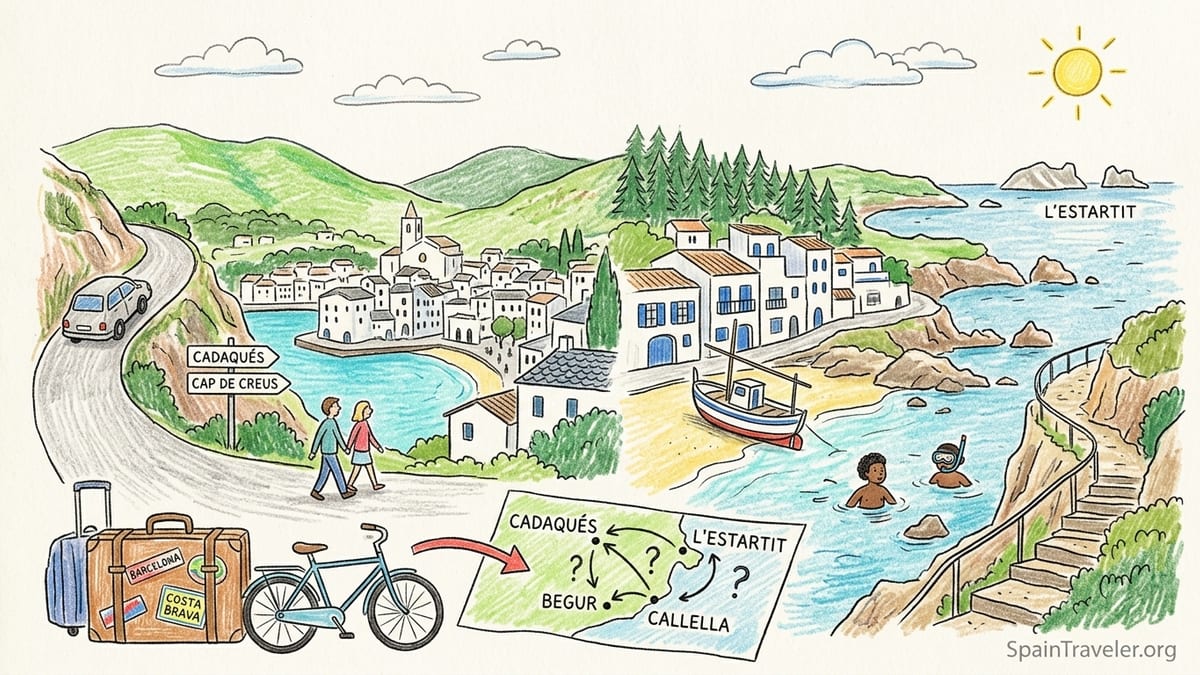
How I Tested These Costa Brava Bases
Across several trips over the last few years, I have stayed in or immediately around Cadaqués, Begur, Calella de Palafrugell and neighboring Llafranc, Tossa de Mar and L’Estartit, using each as a base for at least a couple of nights. I rented small apartments up steep lanes, mid-range hotel rooms with sea views and simple pensions above restaurants. I arrived once by bus, several times with a rental car, and in one case by taxi from Girona. That mix matters, because your experience on the Costa Brava changes completely depending on whether you have your own wheels, how much you like to walk and what you want your evenings to feel like.
To compare them fairly, I paid attention to the same details in each place: how hard it was to park in late afternoon, whether I could walk to dinner without tackling serious hills, how long it took to reach good swimming coves, what the town felt like after 10 p.m., and how quickly I could reach Cap de Creus, the Begur coves, the Calella to Llafranc coastal path, Tossa’s old town and the Medes Islands. I also checked local tourism office maps and municipal parking information in each destination to cross-check my impressions with current realities, especially for parking and access rules.
Prices shift year to year, but on my most recent trips standard double hotel rooms in mid-range properties in these towns usually ran from about 110 to 220 euros per night in June, higher in late July and August. Apartments booked directly or through major platforms sometimes came in cheaper per night for longer stays but rarely undercut basic hotels for a single weekend. Restaurant mains in all these towns generally hovered in the 15 to 25 euro range, with tasting menus and waterfront terraces running higher.
What follows is not about which town is “best.” Instead, I will explain what it actually feels like to base yourself in each place, what works and what does not, and where I would personally stay for a first Costa Brava visit, a dedicated beach holiday, a couples escape and an activity-focused trip.
Cadaqués: Whitewashed Village at the Edge of Cap de Creus
Cadaqués is the Costa Brava town that feels most like the end of the road, partly because it is. After you leave the highway near Roses you climb a long, twisting mountain road before descending to a bay ringed with white houses and slate roofs. That isolation shapes everything. Even in high season it still feels like a self-contained world rather than a resort strip, and once the day trippers drive back over the pass in the evening, it softens into something close to a village again.
As a base for Cap de Creus, Cadaqués is outstanding. The official tourism information signs in town note that Port Lligat, where the Dalí House Museum sits, is about 1.5 kilometers from the village, and the Cap de Creus lighthouse roughly 8 kilometers further along the same narrow road. The first time I stayed, we drove to the lighthouse one late afternoon in May and found scattered roadside parking above rocky inlets, then walked short paths down to natural rock platforms where people were sunning with towels and small coolers. On a later summer visit, access to the far end of the peninsula was subject to vehicle limits and, at times, shuttle requirements, so I learned to check current rules with the tourism office before heading out.
Inside Cadaqués itself, the experience hinges on where you sleep. My favorite stay was in a small hotel one block back from the seafront, up a sloping stone lane. We could walk down to the main promenade in two minutes, but we did not hear late-night bar noise. The town has a mix of municipal and private parking areas. The local information board lists larger car parks on the road into town and free options on the edges of the village, such as near Platja del Ros or the Sa Conca area outside festival days. In practice, in June I could usually find a paid space in the main lot by late afternoon for around 20 euros for 24 hours, then leave the car there and forget it. Once parked, I walked everywhere.
Evenings in Cadaqués are about strolling and lingering rather than “going out” in a big nightlife sense. The seafront is lined with restaurants ranging from simple spots with grilled sardines and pa amb tomàquet to more contemporary places with tasting menus and serious local wine lists. One night we ate at a new bistro-style restaurant that locals had recommended for inventive Catalan plates, paying roughly 40 euros per person including a shared bottle of Empordà white. Another night we sat on low chairs in a tiny square behind the church drinking vermut with olives while children played around the tables. After 11 p.m. in shoulder season, the village was quiet enough that we could hear waves from our open window.
For beach time, Cadaqués itself has small pebbly coves rather than long sandy strands. I found the best swimming either by walking around the bay toward Platja de Sa Conca and little inlets beyond, or by driving to nearby Cap de Creus coves in the morning before parking filled. Without a car, you could still have a magical few days just dipping into the bay, hiking the paths around town and visiting Port Lligat, but reaching the more remote coves and the lighthouse is much easier with your own vehicle or, in high season, by combining local taxis and hiking.
Begur: Hilltop Town With a Necklace of Coves
If Cadaqués is about being at the end of the road, Begur is about having choices. The medieval town itself sits inland on a hill with a ruined castle above it, while below, a string of coves and beaches form one of the best swimming and snorkeling areas on the Costa Brava. Names like Sa Tuna, Aiguablava, Sa Riera, Platja Fonda and Illa Roja all fall under the Begur umbrella. When I based myself here, I split time between a small hotel just below the castle in town and an apartment near Sa Riera beach, and those felt like two different trips.
Up in town, the evening atmosphere is arguably the most appealing of any base in this comparison. The main square and surrounding streets fill with restaurant terraces and people strolling between gelato stands and wine bars. Over a few nights I ate excellent grilled octopus and local rice dishes at mid-range restaurants where mains ran around 18 to 24 euros, and I rarely needed reservations in June on weekdays. Park once and you can eat somewhere different every night without getting in the car. The town has established parking areas such as the Sot d’en Ferrer lot on the edge of the center, marked on local municipal maps, and in June finding a space in the early evening was not difficult, though in July and August it becomes much more competitive and sometimes paid.
The trade-off is that from town to beach you either drive or use local transport. The descent to Sa Tuna or Aiguablava involves narrow, winding roads and relatively limited parking near the coves. On one September trip we arrived at Sa Tuna around 10:30 a.m. and just managed to get a spot close to the water; by 11:30 the roadside spaces were full and late arrivals were turning back. Recent reports from local visitors describe summer parking at Begur beaches as “very difficult,” with the municipality operating a beach bus in peak season that runs from the historic center to Sa Riera, Sa Tuna and Aiguablava. That shuttle system can make it feasible to base in town without using your car every day in high season, but you must be ready to work around bus timetables.
Staying closer to the sea solves the access problem but changes the evening feel. When I rented an apartment above Sa Riera, beach life was effortlessly easy. We could step out by 9 a.m., walk a hundred meters to the sand, swim before breakfast and then follow the coastal camí de ronda path over low cliffs toward Illa Roja. Lunch options lined the back of the beach, with paella and seafood menus around 25 to 30 euros per person. The downside was that after dark the cove went to sleep early and restaurant choice was limited. For dinner variety and any sense of nightlife, we had to drive back up to Begur town, navigating the hairpins again and securing a parking place in one of the larger lots on the outskirts.
For me, Begur with a car is the quintessential “cove-hopping” base. You wake up, check the wind and swell, then choose between sheltered Sa Tuna, shallow Aiguablava or longer Sa Riera. Without a car, you could enjoy a couple of nearby coves and the town’s restaurants, especially if you time your visit with the beach bus, but you would not get the full benefit of all those different swimming spots that sit a few kilometers apart along the cliffs.
Calella de Palafrugell & Llafranc: Walkable Seaside Living
Calella de Palafrugell and its neighbor Llafranc share one of the most satisfying “on foot” setups on the Costa Brava. Calella is a string of sandy coves broken up by low promontories and whitewashed fisherman houses, while Llafranc offers a more open curve of sand with a straight promenade and backdrop of pine-covered hills. You can easily walk between them in about 25 to 30 minutes along a scenic stretch of the camí de ronda, with short flights of stairs and viewpoints over the rocks.
On my last visit, I based in Calella itself, up a short slope from Platja del Canadell. From the apartment, I could be on the sand in two minutes in flip-flops, yet it was quiet enough that early morning deliveries did not wake me. In June, the core of Calella is pedestrianized enough that driving into the center feels like a mistake. The smarter move is to park in one of the municipal parking areas on the edges of Calella and Llafranc and forget the car. Llafranc’s town website, for instance, highlights the Carrer Xarembeco public parking area uphill from the port, a practical choice if your accommodation lacks its own spaces. When I arrived late on a Sunday afternoon in shoulder season, I managed to find a spot there for a daily fee comparable to street parking in a small European city.
Evenings here are low-key but varied. In Calella, people drift between the coves, stopping for aperitifs on terraces above the water. One night I walked along Canadell beach at dusk, weaving between kids playing football on the sand and couples sitting on the sea wall with takeaway pizzas, and ended up at a small family-run restaurant on a side street where the fixed-price three-course menu ran just under 30 euros, including dessert and a glass of wine. In Llafranc, dinner often rotates around the seafront promenade. I remember choosing grilled fish at a long-established hotel restaurant facing the water, with the sound of cutlery and conversation rolling down the line of covered terraces.
The great advantage of this area is that you can spend days without touching the car. From Calella you can walk along the coast toward Llafranc in one direction or toward smaller coves like Port Pelegrí, then inland to the Sant Sebastià lighthouse for wide views. Travel writers who know the area often point out that some of the most attractive little coves around Llafranc and Tamariu are only reachable on foot, with the practical “parking” being whichever lot in town you used at the start of your walk. That has been my experience as well: once we left the car in a paid lot, we walked to everything that mattered, from grocery shops to coves to evening drinks.
For families, particularly with strollers or very young children, the combination of compact scale, gentle beaches and a real but relaxed restaurant strip makes Calella and Llafranc an easy sell. For couples, it can feel quietly romantic rather than isolated. The trade-off is that the towns are not as dramatic or wild as Cadaqués or the Begur coves, and in peak season restaurant terraces on the seafront book up quickly, so reserving for weekend dinners in July and August is wise.
Tossa de Mar: History, Beach and a Lived-In Town
Tossa de Mar gives you something none of the other bases can match in quite the same way: a medieval walled old town that quite literally drops into the sea. The Vila Vella, as the historic quarter is known, is the only fully fortified medieval village still standing on the Catalan coast. Official heritage designations date back to 1931, and its ramparts, towers and steep cobbled streets create the shoreline silhouette that appears constantly in tourism brochures.
Staying in Tossa means that history is your backdrop for simple beach days. Platja Gran, the main town beach, sits directly in front of the modern center, with the walled headland forming its southern edge. Local tourism information describes it as one of the most photographed landscapes on the Costa Brava, and when you stand barefoot in the sand looking up at the walls, it is clear why. A short walk around the headland brings you to Platja d’es Codolar, a smaller cove directly under the cliffs, while Platja de la Mar Menuda lies at the northern end of town. During my stay, I could walk between all three in less than 15 minutes, something that is simply not possible in the more spread-out Begur area.
Parking and access in Tossa are manageable if you plan ahead. The municipality publishes maps highlighting several parking zones around the town, including paid lots near Platja Gran and free or cheaper areas a short walk inland. On one June visit, I parked in a surface lot about 10 minutes from the beach for a daily fee similar to other Costa Brava towns. Once we parked, we did not move the car for two days, exploring entirely on foot. Other travelers arriving by bus from Barcelona or Girona described similar experiences, walking everywhere once in town and only using buses or taxis to leave.
Evenings in Tossa blend tourist energy with everyday life. The lower streets behind the beach are fairly commercial, but climb into the Vila Vella after sunset and you find small restaurants tucked inside old stone houses, some with terraces looking back over the bay. One night we ate fresh fish and suquet de peix (a Catalan fish stew) below one of the towers, watching the lights come on along Platja Gran. Prices in these restaurants were slightly higher than in the modern center but still in the same general band: mains mostly in the 18 to 26 euro range, with set menus offering value in shoulder season.
For walkers, one of the bonuses of Tossa is the road south toward Sant Feliu de Guíxols, which seasoned Costa Brava drivers cite as one of the most scenic drives in the region, twisting past viewpoints and small coves. I drove a portion of it one afternoon, stopping at miradors to look back at Tossa’s walls from different angles. It reinforced why this base works well for a first Costa Brava trip: you get a photogenic historic center, multiple beaches in easy reach on foot and good bus connections without absolutely needing a car to enjoy it.
L’Estartit: For Divers and Medes Islands Adventures
L’Estartit is a different proposition from the others. Where Cadaqués offers a tiny bay and whitewashed labyrinth, and Begur and Calella focus on coves and promenades, L’Estartit looks straight out to the Medes Islands, a protected marine reserve that has turned this stretch of coast into a major diving destination. The town’s seafront mixes a long sandy beach with a large marina and a cluster of dive centers, boat operators and water sports shops.
The first time I used L’Estartit as a base, I was there primarily for diving. Several dive schools operate from the harbour, running daily trips to sites around the Medes Islands, often with two-tank morning outings that include gear rental. One of the established centers describes the experience as a short boat ride out, roughly 50 minutes underwater and then a return to the harbour, and that matched what I found on my own days out. Prices in recent seasons for certified divers have tended to hover around 80 to 120 euros for a two-dive day including tanks and weights, more if you need full equipment.
Staying close to the marina is convenient if you are carrying gear or catching early boats. I booked an apartment one block from the seafront and could walk from my front door to the dive center in under five minutes. The trade-off was that evenings were practical rather than atmospheric. The streets immediately behind the port offer a concentration of bars with sports on television, pizzerias, tapas places catering to dive groups and families, and a few more refined options. Waterfront terraces charged a premium for location, but it was still possible to eat a decent plate of grilled calamari and salad for about 18 to 20 euros on the second line back.
The beach itself is broad and sandy, shelving gently into the sea, with views of the Medes Islands offshore. For families or non-divers, that makes L’Estartit a viable base, especially if some members of the party are out on the boat each day while others prefer to stay on the sand. Local information about the harbour emphasizes its facilities as a water sports hub, with moorings, a crane, fuel dock and parking directly adjacent, underlining that this is very much a functional marina as well as a tourist resort. During my stay, I found paid parking relatively easy in streets a few blocks inland outside the peak August weekends.
If you are not diving or taking boat trips, however, L’Estartit is less compelling than the other towns discussed here. The historic core is modest, and to reach more intimate coves or wilder coastal scenery you need to drive or commit to longer coastal walks. That said, for an activity-focused trip built around diving, kayaking, snorkeling or sailing days, it is hard to beat the convenience of waking up within sight of the Medes and being able to walk your gear to the boat.
Which Base for Your Kind of Trip
After rotating through these bases on different visits, I would choose each one for a different kind of Costa Brava trip rather than anoint a single winner. For a first-time visit without clear priorities, I consistently steer friends toward Tossa de Mar. You can arrive by bus from Barcelona or Girona, walk straight to your accommodation, and spend a few days combining beach time on Platja Gran and Mar Menuda with wanders through the Vila Vella and perhaps one coastal hike or scenic drive. You will not see Cap de Creus or the Begur coves from there, but you will understand why people fall in love with this coastline.
For a classic beach holiday where you want to walk from your door to the sand every morning and have a good choice of relaxed restaurants at night, Calella de Palafrugell or Llafranc would be my pick. Calella feels slightly more picturesque and intimate, with multiple small coves, while Llafranc’s wide bay makes it easier to find space on the sand even on busy days. Parking is the main challenge, especially in high summer, so I would either choose accommodation with its own parking or plan to leave the car in one of the municipal lots such as the Carrer Xarembeco area in Llafranc and forget it. Once parked, everything from evening gelato to coastal walks lies within a comfortable stroll.
For a couples trip with some drama and a sense of being somewhere distinct from everyday life, Cadaqués is hard to top. The approach road filters out casual traffic, the light on the bay in early morning and late evening feels almost cinematic, and the combination of small galleries, excellent restaurants, nearby Dalí sites and Cap de Creus hikes gives you plenty to fill three or four days. I would not choose Cadaqués if I absolutely needed long sandy beaches, but for rocky swims from small coves, cliff paths and late dinners on whitewashed terraces, it delivers. I would strongly recommend having a car here, if only to reach Port Lligat comfortably and explore at least part of Cap de Creus, bearing in mind that in the busiest months access rules for the far tip can change.
For an active trip focused on swimming, short hikes and variety of scenery, I lean toward Begur and its coves or L’Estartit. If your idea of active includes diving, then L’Estartit combined with several days of Medes Islands trips is the clear choice. You wake to sea views, walk to the boat and are underwater within an hour. On rest days you can drive to medieval inland villages or nearby beaches. If your focus is more on cliffside paths and discovering different coves from the shore, then Begur with a car lets you string together Sa Tuna, Aiguablava, Sa Riera and Platja Fonda in a way that is simply not possible from a single beach town.
The common thread is that in almost every case, I was glad to have a car on the Costa Brava. Tossa de Mar is the one base where I felt completely comfortable without one, thanks to its compact layout and bus links. Calella and Llafranc also work without a car if you are happy to arrive by taxi or bus and stay put. But for exploring Cap de Creus from Cadaqués, linking multiple Begur coves in one trip or making independent day trips from L’Estartit, a rental car turns a good trip into a great one.
FAQ
Q1. Is Cadaqués a good base for visiting Cap de Creus without a car?
It is possible but limiting. You can walk to Port Lligat and some nearby paths from Cadaqués, and in some seasons there are shuttle options closer to Cap de Creus. In practice, each time I stayed there I was glad to have a car to reach more remote coves and the lighthouse, especially outside peak summer when transport is reduced.
Q2. How difficult is parking in Begur and its coves in summer?
In July and August, parking at Begur’s main coves such as Sa Tuna, Aiguablava and Sa Riera can be very challenging after mid-morning, with roadside spaces filling early. The town promotes central parking areas like Sot d’en Ferrer and operates a beach bus in high season linking the historic center with major beaches, which makes it easier if you base in town and rely on the shuttle instead of driving down yourself every day.
Q3. Can I enjoy Calella de Palafrugell and Llafranc fully without renting a car?
Yes, provided you are comfortable arriving by bus or taxi and then staying mostly local. Once in Calella or Llafranc, you can walk between beaches, follow the coastal path, and reach most restaurants and shops on foot. On my stays there I parked once on the edge of town and did not need the car again for daily activities, though having one made inland day trips easier.
Q4. Is Tossa de Mar suitable for travelers using only public transport?
Very much so. Tossa has regular bus connections to Lloret de Mar, Girona and Barcelona, and its main beaches and historic center are all within easy walking distance of most accommodations. During my car-free visit, I walked everywhere in town, from Platja Gran to Mar Menuda and up through the Vila Vella, without feeling constrained.
Q5. What makes L’Estartit stand out compared to other Costa Brava bases?
L’Estartit stands out for its direct access to the Medes Islands, one of the Mediterranean’s noted diving and snorkeling areas. The marina and dive centers sit right beside the long town beach, so if you are planning several days of boat trips or water sports, it is one of the most convenient places to stay, even if its town center is less atmospheric than places like Cadaqués or Tossa.
Q6. Where would you stay for a romantic couples trip on the Costa Brava?
For a romantic escape, I would personally choose Cadaqués or Calella de Palafrugell. Cadaqués offers drama, light and the sense of being at the edge of Cap de Creus, while Calella provides intimate coves, cozy streets and easy seaside walks to Llafranc. In both cases, evenings feel relaxed and atmospheric rather than rowdy.
Q7. Which town is best for families with young children?
Calella de Palafrugell, Llafranc and Tossa de Mar all work well for families. Llafranc’s broad, gently shelving beach is particularly good for small children, and Tossa combines a big main beach with a compact, walkable center and the visual interest of the castle walls. In all three places, having accommodation within a short walk of the sand makes naps and early nights easier.
Q8. Do I really need a car on the Costa Brava if I just want beaches?
If you are happy choosing a single beach town and staying mostly in place, you can manage without a car in Tossa, Calella, Llafranc or even L’Estartit. However, if you want to combine multiple very different coves, visit Cap de Creus from Cadaqués or link inland medieval villages with coastal stops, my experience has been that a rental car saves significant time and opens up far more options.
Q9. How far in advance should I reserve accommodation and restaurants?
In July and August, I try to reserve accommodation at least two or three months ahead in the most popular towns, especially for sea-view rooms or properties with on-site parking. For restaurants, I usually book waterfront or particularly well-known places a few days ahead for weekend dinners. Outside peak season, I have often been able to secure good tables on the day, particularly in Begur and Cadaqués.
Q10. If I only have three nights, which single base would you choose?
For a first-time three-night stay, I would personally choose Tossa de Mar. It gives you an immediate sense of Costa Brava history, multiple beaches within walking distance, a lived-in town with year-round services and no absolute need for a car. From there, you can always plan a future trip focused more tightly on Cadaqués, the Begur coves or the Medes Islands once you know which side of the Costa Brava appeals most to you.