


I thought getting from Cadaqués to the Cap de Creus lighthouse would be as simple as following the coastal road until the land literally ran out. In 2026, it is anything but simple. After one very hot, very windy day navigating access restrictions, shuttle buses and rocky paths, I came back to town dusty, thirsty and grateful I had not been fined. Here is exactly how my visit worked, what caught me out, and what I would do differently next time.
Understanding the 2026 Access Rules Before You Go
The biggest thing I wish I had understood before leaving Cadaqués was that reaching the Cap de Creus lighthouse in 2026 is mostly about knowing the rules. The road from Cadaqués to the lighthouse is now under strict motor vehicle control on many spring, summer and early autumn dates. When the system is active, cameras read license plates on the road out of town and fines are issued automatically to unauthorized vehicles, so the casual "let's just see how far we get" drive is no longer a safe option.
On regulated days in 2026, private cars and motorbikes are not allowed to use the road to the lighthouse during core daytime hours. The municipality publishes a calendar each year, and the pattern in recent seasons has been long stretches at Easter, many weekends in spring, and an almost continuous block in July, August and early September. During these periods the road is effectively reserved for the park shuttle buses, authorized vehicles, residents and a few exceptions such as guests with confirmed reservations at businesses at the lighthouse. Everyone else has to combine parking, shuttles, or walking.
Before my visit I skimmed some old blog posts that talked about "getting there early" with a private car and finding a spot at the top. That advice is now out of date on most high demand days. While very early morning or late evening windows sometimes remain open, the times and rules shift each year and are enforced with cameras rather than a person in a booth. I was relieved I had checked the town’s current season notice the night before and realized that the road would be closed to private vehicles from mid-morning through the evening.
The short version is this: in 2026, you should plan as if you will not be able to drive your own vehicle from Cadaqués to the lighthouse on any busy date. If you end up finding an unregulated day outside peak season, that is a bonus. But your base plan should be parking at the official lot and letting the shuttle or your own feet do the rest.
Leaving Cadaqués: Parking at Corral d’en Morell
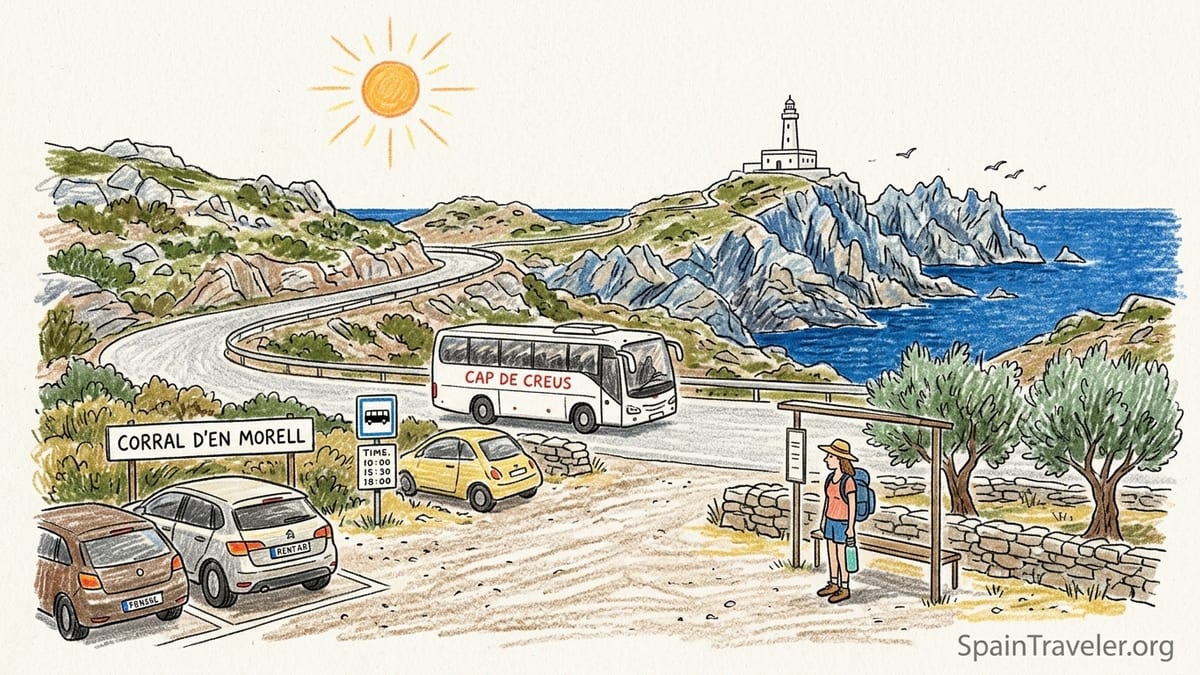
My starting point was the free Corral d’en Morell parking area, on the inland side of Cadaqués, slightly above the town. This has become the main hub for visiting Cap de Creus when access is regulated. Driving up from my rental apartment near the seafront, it took less than ten minutes through the narrow one-way system. By 8:45 in the morning in late August, electronic boards at the town entrances were already flashing warnings that central spaces were full, but Corral d’en Morell still had room.
Corral d’en Morell feels more like a big gravel plateau than a conventional paved car park. The surface is dusty and uneven in places, with loose stones. I was glad I was not dragging a wheeled suitcase, because it would have rattled and snagged. At that hour there were a few campervans that looked as though they had arrived early and plenty of rental cars, many with French and Dutch plates. There is almost no shade, just a few scraggly trees on the edge, so the car interior heats quickly. I cracked the windows slightly and used a windscreen sunshade, and the difference when I came back eight hours later was noticeable but it was still very hot inside.
One detail that surprised me was how long the walk is from the car park down into the historic center. It is not far in absolute distance, roughly 15 to 20 minutes to the seafront at a relaxed pace, but it is significantly downhill into town and then uphill again on the way back in the sun. If you are only changing from car to shuttle you will stay in the upper part of the lot, near the makeshift bus stop, but it is worth thinking about that climb if you plan to explore Cadaqués after a long hike.
There was no barrier or ticket machine at Corral d’en Morell during my visit and the municipal information described it as a free park-and-ride for the Cap de Creus service. I did not see any attendants, just a small blue and white sign with a bus icon and the shuttle timetable taped to a post. The lack of obvious infrastructure makes it feel a little ad hoc, but this really is the correct place to leave your car before heading to Cap de Creus when the road is regulated.
Catching the Shuttle: Timetables, Tickets and Waiting in the Heat
The shuttle buses to Cap de Creus run from a simple stop at the edge of Corral d’en Morell. On the day I went, laminated timetables in Catalan, Spanish, French and English showed services starting in the morning and running roughly every half hour to and from the lighthouse, with intermediate stops at spots like Guillola and the access for the Tudela area. In peak summer the daily operating window extends into the late evening, but in shoulder months the first and last departures can shift earlier.
I arrived to the bus stop around 9:00, hoping to catch the first wave of visitors. There was already a small line, about twenty people, a mix of families with beach bags and hikers with trekking poles. A staff member in a high-visibility vest walked along the line answering questions and confirming that private vehicles were not allowed up that morning. When I asked about tickets, he explained that we could pay the driver directly by card or cash and that the most common option was a simple return ticket between Corral d’en Morell and the lighthouse.
The return fare in 2025 material had been around 7 euros for adults and slightly less for children and seniors, and the pricing posted at the stop for 2026 was similar. I paid the driver contactless with a bank card, received a small printed ticket, and was reminded to keep it for the return journey. There was no need to pre-book online and no assigned seating; if the bus filled up, the next one pulled in a few minutes later.
What I had underestimated completely was the waiting time in the sun. Although the timetable suggested departures every 30 minutes, the actual arrival of the first bus was closer to 9:20 and loading took almost ten minutes. There is no real shelter at the stop, only the side of a small container hut, and by the time I boarded, my water bottle was already half empty. Looking back, I would have worn a wide-brimmed hat and brought at least one and a half liters of water from town instead of starting the day with a single small bottle I had bought at a bakery for just over one euro.
The Ride Out: Wind, Curves and First Views of Cap de Creus
The journey from Corral d’en Morell to the lighthouse takes around 20 to 25 minutes by shuttle bus, but it feels longer because of the winding road and constant views. The road quickly leaves the whitewashed cluster of Cadaqués behind and starts climbing through scrubby hills dotted with olive trees and dry stone walls. Within ten minutes you get your first glimpses of the sea between the folds of rock, and the sense that you are heading for the edge of the peninsula is tangible.
On my visit there was a strong tramontana wind blowing from the north, a dry, gusty wind that the area is famous for. Inside the bus you mostly notice it as sudden shudders when a gust hits the side, and a fine dust that seems to get everywhere each time the doors open. I could see a few cyclists braving the climb on the road shoulder, leaning into the gusts, and I was quietly relieved I was not trying to pedal up that morning.
The shuttle itself was a standard low-floor coach with air conditioning, which helped with the heat but did not eliminate it. By late morning in August, temperatures outside were already above 30 degrees Celsius, and anyone who stepped off the bus at intermediate stops was met by a wall of dry air. On the way up I mapped the curves mentally, trying to remember which bends would make good photo stops on the way back if I decided to hop off and walk a section of the route.
One important detail: the driver reminded us on the loudspeaker that the last shuttle back from the lighthouse that day would leave in the early evening, with the exact final departure time shown at the stop at the top. If you miss it, you are not stranded, because you can still walk back to Cadaqués, but in high summer that can mean two to three hours on exposed tarmac and gravel. It is essential to know that last bus time as soon as you arrive.
At the Lighthouse: Footwear, Food and How Long the Visit Took
The shuttle drops visitors in a designated parking and turning area just below the Cap de Creus lighthouse complex. From there it is a short walk uphill, perhaps three minutes, to the main terrace with its café and panoramic views. The first shock when I stepped off the bus was how different the landscape felt from Cadaqués. The town is all soft curves, tiled roofs and bougainvillea. The headland is a tangle of jagged rocks, low thorny shrubs and raw, exposed slopes scoured by the wind.
I had worn breathable running shoes with relatively soft soles, which were fine for the paved paths and the short walk to the main lookout, but as soon as I stepped onto the dirt tracks leading to viewpoints and coves, I wished I had sturdier hiking shoes. The rock here is fractured and uneven, with sharp edges and loose gravel on top. Several times I slipped slightly while scrambling up to a vantage point, and my toes felt every contour. Closed shoes with good grip and a firm sole are far more useful here than sandals, and I would avoid flip flops entirely unless you intend to stay on the terrace.
Food and water are another area where I misjudged reality. The café at the lighthouse was open, serving coffee, cold drinks, simple sandwiches and plates of fried fish and salads at mid-range coastal prices. A bottled soft drink cost several euros, a sandwich a little more, and main dishes comfortably exceeded typical tapas prices in Cadaqués town. Nothing felt extortionate, but I was conscious that I was paying for the location and that, on a crowded day, there could be a wait for service. Next time I would still plan to buy a drink there to support a business that operates in a challenging spot, but I would also pack a basic picnic of fruit, nuts and a baguette from Cadaqués to give myself flexibility.
In total, I spent just under three hours at the top. The first hour was devoted to walking around the immediate lighthouse area, taking in views across the broken coastline and watching boats weave in and out of the small coves below. The second hour turned into a slow, careful exploration of a rough path towards a lower viewpoint overlooking a natural pool, picking my way between rocks while the tramontana tried to push me sideways. The final hour was a relaxed break at the café terrace, sheltered by glass screens from the worst of the wind, nursing a cold drink and reapplying sunscreen. Including the ride up and back and my time waiting at both ends, the whole outing from leaving my car to returning to it took just over six hours.
Walking Sections: When It Makes Sense to Skip the Shuttle
While the shuttle is the simplest way to reach Cap de Creus when the road is regulated, walking at least one section of the route is extremely rewarding, provided you are prepared. From the Corral d’en Morell area there are marked paths that head towards the headland, including stretches that roughly parallel the road and others that descend towards coves and climb back up. Information I found from hiking enthusiasts suggested that a direct there-and-back walk between Cadaqués and the lighthouse covers roughly 14 kilometers, with plenty of elevation changes and limited shade.
On my visit I compromised by using the shuttle one way and walking a part of the return. I boarded the bus up in the morning when the heat was already building, then in the mid-afternoon I took a shuttle back down only as far as an intermediate stop and walked the final hour back to town. This section still felt challenging in the sun. The path alternated between rocky single track and wider gravel. There were no water fountains and only low shrubs for company, and in several places I needed to step off the road shoulder to let bikes and other walkers pass.
The advantage of this hybrid approach was that I experienced the landscape at human speed without committing to the full out-and-back, and I could still catch a later shuttle if the wind picked up or fatigue set in. The downside was that timing everything around the shuttle departures required attention. The buses were generally on schedule to within ten minutes, but in the middle of the day some services arrived already quite full from earlier stops. On one occasion I watched a bus continue without stopping because all seats were taken, and several of us waited half an hour for the next one. This is where having extra water and a light scarf or hat becomes more than just convenience.
In cooler months outside the regulated high season, walking all the way from Cadaqués to the lighthouse is a realistic full-day hike for fit visitors. In late spring and early autumn when some restrictions still apply, I would treat that as a serious outing starting early in the morning with layers, sun protection and food. In July and August, unless you are extremely accustomed to heat, I would still lean towards using the shuttle at least for the uphill direction.
Common Pitfalls: What Caught Me Out
Several things about my day at Cap de Creus were not at all how I had pictured them when I booked accommodation in Cadaqués. The first was just how quickly parking in and near town fills on summer mornings. Radio reports and local news had warned that Cadaqués was running out of spaces before 11:00 on busy days, but it is another thing to see queues of cars inching uphill and digital signs flashing that car parks are full. Arriving before 9:00 made the difference between driving straight into Corral d’en Morell and having to circle and wait.
The second surprise was the combination of heat and wind. I had expected one or the other: a hot, still Mediterranean day or a cooler, breezy one. Instead, I got searing sunshine with very strong gusts. That combination is deceptive. You do not always feel how much you are sweating because the wind evaporates it immediately, but your body is still working hard. At the lighthouse I saw more than one person in light sandals and a fashion hat struggling on the rocky paths, clearly uncomfortable and carrying no water. I had at least worn trainers and brought sunscreen, but I still ended the day slightly sunburned on the back of my legs and with dry, wind-chapped lips.
The third pitfall was underestimating the "buffer" time around the shuttle. I had naively imagined something close to an urban bus service, where you glance at the timetable and show up five minutes before. In reality you need to think in half-hour blocks at least. On the way up, by the time I arrived, queued, bought a ticket, boarded, completed the ride and walked to the main terrace, more than an hour had elapsed since I had turned off the engine in the car park. On the way back, accounting for missing one bus because it was full and then waiting for the next, the return process took more than ninety minutes door to door.
Lastly, I had not fully appreciated how closely access rules and potential fines are tied to license plates on regulated days. Even using a rental car does not offer any insulation. If your plate is recorded entering at a forbidden time, the notice is issued to the registered holder and passed on to you. I met another traveler in town who had assumed that arriving very early and leaving late in the day would exempt him, only to discover that the day’s restricted hours started earlier than expected. His conclusion, and mine after hearing his story, was that when in doubt, leave the car in Cadaqués and rely on the official shuttle or your feet.
What I Would Do Differently Next Time
If I repeated this visit under the same 2026 system, I would keep the broad outline identical but refine the details. I would still base myself in Cadaqués for at least two nights, to avoid rushing up and back in a single day from somewhere else. I would still aim to reach Corral d’en Morell before 9:00 on a regulated summer day. I would still use the shuttle at least for the uphill portion to conserve energy. However, I would change how I pack, dress and structure the hours more deliberately.
Clothing-wise, I would wear lightweight hiking shoes with grippy soles instead of basic trainers, longer but breathable hiking pants to protect from sun and rough rock, and take a proper sun hat that can be tightened under the chin so the wind does not snatch it away. I would also pack a light windproof layer, even in high summer. Several times at exposed viewpoints the gusts were strong enough that I felt chilly in my sweat-soaked T-shirt, only to feel hot again as soon as I dropped a few meters down.
In terms of supplies, I would bring at least 1.5 to 2 liters of water per person in reusable bottles, plus simple snacks. Buying one cold drink at the café as a treat felt nice. Relying on them for all hydration would have been expensive and inconvenient. A small dry bag or plastic pouch for electronics is also surprisingly useful; some lookout spots have fine grit that the wind whips into every crevice.
Planning-wise, I would check the latest restriction calendar and shuttle timetable directly from official municipal or park information within a day or two of traveling, and I would decide in advance whether I wanted to walk a particular section. That might mean taking the shuttle up, walking down from an intermediate stop in the cooler late afternoon, and timing things so that I reach Cadaqués just as the light turns soft over the bay. Above all, I would keep my expectations flexible. Cap de Creus is wild and changeable, and the system for protecting it is evolving year by year.
The Takeaway
Seeing Cap de Creus from Cadaqués in 2026 is not as simple as hopping in a car and following a road. It is a small logistical project that rewards a bit of homework and respect for the elements. Arriving early in town, parking at Corral d’en Morell, using the regulated shuttle during restricted hours and carrying enough water and sun protection all sound like mundane steps, but together they transform the experience from stressful to memorable.
My day on the headland was shaped as much by the wind and the waiting as by the cliffs and coves. The moments that stay with me are standing above the fractured rocks with the sea flashing deep blue below, watching a lone sailboat cut across the horizon, and feeling that I had reached the literal edge of mainland Spain. The bureaucracy of access fades a little when you are out there in the open air, but if you ignore it, fines and frustration can quickly replace that sense of freedom.
If I could offer one piece of advice to anyone planning the same outing, it would be this: treat the journey to the lighthouse as part of the experience, not just an obstacle. The parking lot, the shuttle ride, the short walks between stops, and even the dusty waits in the heat all belong to the story of visiting this exposed corner of the Costa Brava at a time when crowding and conservation are in delicate balance. Go prepared, give the place at least half a day, and let the wildness of Cap de Creus do the rest.
FAQ
Q1. Can I drive my own car from Cadaqués to the Cap de Creus lighthouse in 2026?
On many spring, summer and early autumn dates in 2026, private motor vehicles are not allowed on the road between Cadaqués and the lighthouse during core daytime hours. Cameras enforce the restriction and unauthorized drivers risk fines. On unregulated days outside these periods, limited access may still be possible, but you should always confirm the specific rules and hours shortly before your visit.
Q2. Where should I park in Cadaqués if the road to Cap de Creus is restricted?
The main place to leave your vehicle on regulated days is the free Corral d’en Morell car park above Cadaqués. From there you can board the official shuttle bus to the lighthouse or start walking. It is a large, mostly open gravel area with little shade, so arrive early and avoid leaving valuables in the car.
Q3. How much does the shuttle to Cap de Creus cost and how do I buy tickets?
Recent seasons have seen adult return fares from Corral d’en Morell to the lighthouse set at a modest amount per person, with reduced prices for children and seniors. You normally buy tickets directly from the driver by card or cash when boarding; there is no need to pre-book online. Exact fares can change from year to year, so check the latest information posted at the stop or through official local channels.
Q4. How long should I plan for a visit from Cadaqués to the lighthouse and back?
If you park at Corral d’en Morell, use the shuttle both ways and spend a couple of hours exploring around the lighthouse, a realistic total is five to six hours door to door. This allows for walking from your car to the bus stop, buying tickets, possible waiting time, the ride itself and a relaxed visit. If you add longer walks or swimming stops, you may easily fill most of a day.
Q5. What kind of footwear is best for Cap de Creus?
Closed shoes with firm soles and good grip are strongly recommended. The terrain around the lighthouse and viewpoints is rocky, uneven and often covered in loose gravel. Lightweight hiking shoes or sturdy trainers are ideal. Flat sandals and flip flops can feel unstable on the rocks and do not protect your feet from sharp edges.
Q6. Is there food and water available at the lighthouse?
There is usually at least one café or restaurant open at the lighthouse complex, serving drinks and simple meals at prices that reflect the remote location. However, offerings can vary by season and time of day, and queues are common in summer. It is sensible to bring enough water and some snacks from Cadaqués, then treat anything you buy at the top as a supplement rather than your only source of food and drink.
Q7. Can I hike from Cadaqués to Cap de Creus without using the shuttle?
Yes, it is possible to hike between Cadaqués and the lighthouse using marked paths and sections of road. A direct out-and-back route can be around 14 kilometers, with significant ups and downs and very little shade. This makes for a satisfying full-day hike in cooler months, but in July and August the combination of heat and exposure can be punishing. Many visitors choose to take the shuttle one way and walk only part of the route.
Q8. What is the weather really like out at Cap de Creus?
The headland is often windier and more exposed than Cadaqués itself. In summer you can expect strong northerly tramontana winds combined with intense sun and high temperatures. In shoulder seasons the wind can make it feel much cooler than town, especially in the shade. Layered clothing, sun protection and lip balm are all helpful, even if the morning feels mild when you leave your accommodation.
Q9. Do I need to reserve anything in advance to avoid fines or problems?
For most visitors the essential step is not a reservation but checking the current access calendar and shuttle schedule shortly before traveling, then leaving private vehicles in Cadaqués when restrictions apply. If you have a booking with a business at the lighthouse or are staying in specific accommodation within the regulated area, those providers may arrange special authorization, but you should never assume this automatically exempts you from rules. When in doubt, ask locally and follow the shuttle system.
Q10. Is Cap de Creus suitable for children and less experienced walkers?
Yes, as long as you adapt your plans. Using the shuttle both ways and staying close to the lighthouse terrace and main viewpoints keeps walking distances short and surfaces mostly manageable. Children should be supervised carefully near edges and rough rocks, and everyone should wear sun protection and closed shoes. Longer hikes down to coves and along narrow tracks are better left to families and groups that are used to uneven terrain and changing weather.