


From the sand of L’Estartit, the Medes Islands look like a row of low, rocky teeth on the horizon. They are close enough that you can trace the white wakes of dive boats heading out, but far enough that what happens in that protected water feels like another world. On my recent guided snorkeling trip, I set out to see what that world was really like, from the booking process and boat ride to the cold shock of the first plunge, the fish I actually saw and how the experience matches up with the Costa Brava tourism brochures.
Booking a Guided Snorkeling Trip From L’Estartit
I based myself in L’Estartit specifically because it is the launch point for the Medes Islands, a small archipelago that forms the heart of the Montgrí, Medes Islands and Lower Ter Natural Park. The town’s seafront promenade is lined with dive centers and activity desks advertising snorkel trips, scuba packages and glass bottom cruises, all promising access to the marine reserve. Rather than walking in cold, I pre-booked a guided snorkeling excursion online a few days in advance, choosing a half-day product clearly labeled as an official Medes Islands snorkeling experience that included boat transfer, snorkel gear and wetsuit.
Several operators in town offer a similar format, often under names like “Medes Islands eco-snorkeling” or “Medes Islands snorkeling cruise.” When I compared options, I concentrated on departures that specifically mentioned the marine reserve, used proper dive boats rather than general sightseeing craft, and capped groups to keep things manageable. The tour I chose followed the structure promoted in Costa Brava experience guides: a short briefing ashore, boat transfer to the islands, around an hour in the water at a protected site and basic equipment included in the advertised price, which, at the time of my visit, started just above 38 euros per person for adults, in line with regional tourism information about official guided snorkeling products.
Booking itself was straightforward. I selected an afternoon departure, paid by card, and received a confirmation email with the operator’s name, the meeting point on Passeig Marítim and a reminder to bring swimwear, a towel and warm clothes for the return. There was also a short note about the marine reserve rules: no touching or feeding marine life, no taking souvenirs, and an expectation that everyone would follow the guide’s instructions to minimize impact on the protected environment.
Because Medes Islands is a regulated marine protected area, only authorized companies can operate there, and spaces in high season can sell out. Even outside peak summer, several departures on the day before my trip were already full. If you are visiting between June and early September, it is sensible to reserve at least a few days ahead, especially for weekend slots and late afternoon trips that appeal to families.
Check-in, Briefing and Getting Kitted Up
On the day of my excursion, I checked in at the operator’s office about 30 minutes before departure, which matched the time stated in the confirmation. The office sat one block behind the seafront, with a wetsuit storage area and gear racks visible from the door. After giving my name, I signed a basic liability and medical form and confirmed that I was snorkeling, not scuba diving. Non-swimmers were not accepted, but several people in the group admitted they were not especially confident in the water; the staff offered them extra-thick wetsuits and optional short flotation vests for reassurance.
The briefing took place in a small room with a wall map of the Medes Islands and the Montgrí coastline. A staff member gave a ten-minute talk in Spanish and English that covered the status of the islands as part of a marine reserve, why anchoring is controlled and why collecting shells or rocks is prohibited. There was a short video explaining local species, from seagrass meadows to grouper and barracuda. The guide was clear that while divers routinely see big groupers and the inside of caves, snorkelers would mostly stay in shallower water above rock platforms and Posidonia beds and that sightings depended on conditions.
Wetsuit sizing came next. The operator issued full-length 5 mm suits, which are standard in this part of the Costa Brava for water temperatures that generally range from the high teens to the low twenties Celsius between late spring and early autumn. In early autumn, my trip coincided with surface temperatures around 21 degrees Celsius near the islands, backed up by local coastal sea temperature reports for that period. Boots were not provided, since entry was from the boat, but we were fitted with adjustable fins, rigid snorkeling masks and simple snorkels with splash guards. Everything was included in the base price, with no additional rental fees for standard sizes.
Once everyone had a suit and gear bag, we walked five minutes down to the port, following the same promenade that looks out toward the islands. This short walk, in wetsuits unzipped to the waist and carrying fins, felt like joining a quiet procession of divers and snorkelers heading out, a reminder that underwater tourism is one of L’Estartit’s key economic pillars.
The Boat Ride: Size, Layout and First Impressions
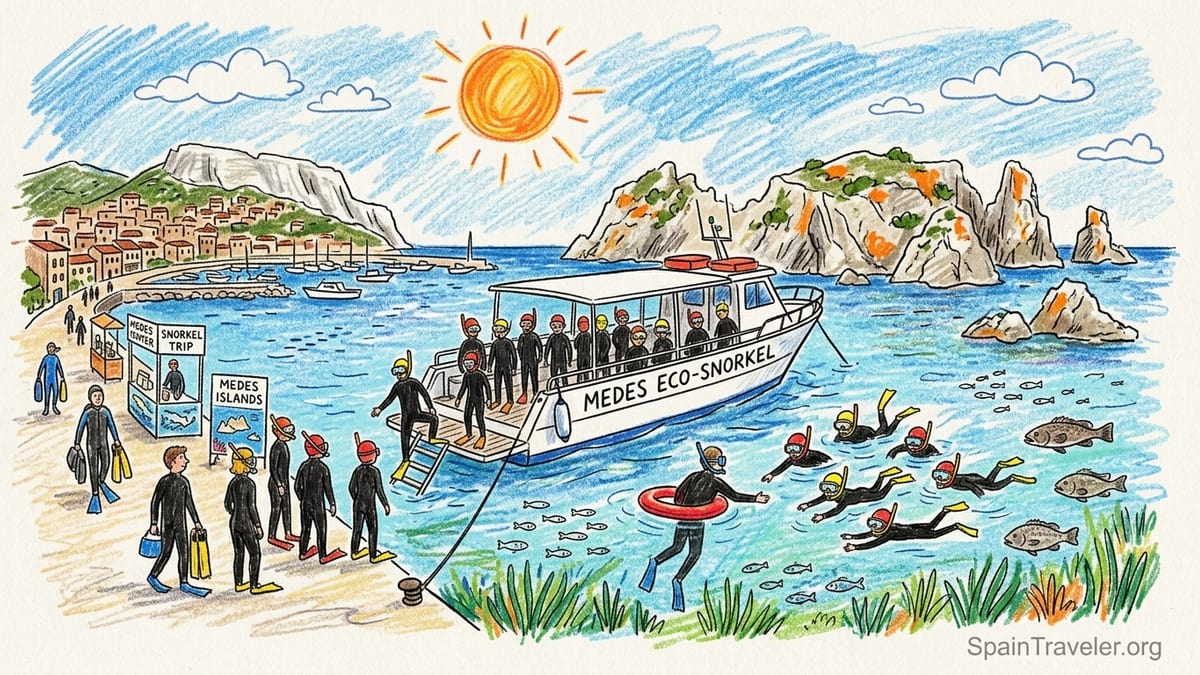
The boat assigned for our trip was a medium-sized dive vessel moored among similar craft in the harbor. It was about 12 to 15 meters long, with a partially covered main deck and a wide stern platform with ladders for water entry and exit. There were fixed benches along both sides, tank racks for the morning’s divers and a storage area at the bow. For our snorkeling departure, around fifteen participants came aboard, along with one main guide for the water and a skipper who remained on board.
The group mix was typical for a Costa Brava snorkeling excursion: a couple of families with teenagers, two small groups of friends, a few couples and two solo travelers including myself. A handful had snorkeling experience, but several had never swum away from a beach before. The guide took this into account when assigning spots and explained that he would keep the group together in a loose cluster, checking repeatedly that everyone felt comfortable and visible.
Leaving the harbor gave the first clear perspective on L’Estartit’s setting. The town slowly slid behind us, backed by the Montgrí Massif’s limestone ridge. Ahead, the Medes Islands resolved from low shapes into sharp, layered rocks with white bird colonies and streaks of orange lichen. The ride itself took just over ten minutes in calm seas, which is typical given the short distance offshore. On choppier days, guides later told me, the crossing can feel rougher for those prone to seasickness, but on my trip there was only a low swell, and everyone stayed on deck, taking photos as the islands drew closer.
Before we arrived at the mooring buoy, the guide ran a second briefing specifically for the water. He showed how to defog masks, adjust snorkels, and use the ladder for entry and exit. There was a strong emphasis on not standing on rocks or seagrass and keeping fins clear of the reef. He explained that the boat would stay on the mooring and that anyone cold or tired could return early at any time. That flexibility, combined with a small enough group that the guide could remember faces and suits, felt reassuring, especially for the less experienced swimmers on board.
In the Water: Temperature, Visibility and Current
We moored on the sheltered side of one of the islands, where several other authorized boats were already tied to park-managed buoys. The guide checked the current from the ladder and announced that there was a gentle surface drift along the rocky shoreline, but nothing strong enough to cancel the session. He suggested we would work with the current, starting slightly up-drift and then letting it carry us back toward the boat.
Sliding into the water in a 5 mm suit brought an immediate rush of cold around the neck and hands, but after a minute of kicking, the temperature felt manageable. At around 21 degrees at the surface, the water was crisp compared with Caribbean or tropical standards, but absolutely reasonable for early autumn Mediterranean snorkeling, especially with a full-length wetsuit. Only one person, a teenager in a thinner shorty he had brought from home, reported feeling chilled early and ended up returning to the boat after about twenty minutes.
Visibility that day was in the range of 10 to 15 meters. Right from the surface, I could see the topography drop away in steps from the rocky shoreline into deeper blue. Sunlight broke through in shafts, lighting up schools of small fish around the mooring line. Compared with unprotected parts of the Mediterranean where visibility can be murkier close to shore, the clarity here felt noticeably better, in line with how the area is often described as one of the richest underwater environments on the Costa Brava.
The current was noticeable but not intimidating. As we followed the guide along the island’s flank, we could feel a gentle push nudging us in one direction. The guide used this to design the route, beginning the swim against the drift for a short stretch so that the return leg back toward the boat felt easy and required very little effort. For anyone unused to swimming in open water, this made a real difference. Two people who were initially nervous relaxed visibly once they realized they were not going to be fighting the sea the whole time.
Marine Life I Actually Saw While Snorkeling
Marketing photos for the Medes Islands often show swirling shoals of fish and large, inquisitive groupers, and while this is a scuba diver’s reality at depth, snorkelers experience a slightly different slice of the ecosystem. From the surface, my world was centered on the sunlit top few meters of water along the island’s rocks. Even so, there was plenty of life to see, more than I have encountered at many other Mediterranean snorkeling spots.
Close to the island, the backdrop was a mix of pale rock and dark green Posidonia oceanica seagrass. Within minutes of starting the swim, I watched small groups of salema and damselfish flash in and out of the seagrass blades. Near boulders, striped bream threaded through gaps and a cloud of tiny fry clustered against the rock face. Wrasse in shades of green and orange patrolled the edges, and I spotted at least one dusky grouper hanging in slightly deeper water, a heavy shape half-lost in the blue beyond the snorkel group’s usual depth.
Over the course of roughly 50 minutes in the water, I also saw a pair of barracuda holding position in the mid-water column, silver bodies catching the light as they shifted slightly to inspect us. They were not part of the giant schools that divers sometimes report deeper in the reserve, but their presence was a reminder that larger predators still work these waters. On the rock wall below me, I could make out streaks of orange and yellow that, at scuba depths, burst into full gorgonian fans. From the surface, they were only hints, but still added color to the scene.
What I did not see were the big octopus or conger eels that diver reports often mention, which are more reliably observed in deeper crevices and cave systems. Nor did I enter any of the famous swim-through tunnels that are a hallmark of Medes diving. Our guide specifically avoided overhead environments, keeping to open water where everyone could float comfortably at the surface. That felt like the right balance for a mixed-experience snorkeling group and aligned with park rules limiting casual snorkelers to less intrusive activities.
Guide Quality, Group Management and Time in the Water
As someone who has taken many snorkel tours that feel rushed or under-supervised, I paid close attention to how our guide handled the session. From the outset, he swam slightly ahead but kept pausing to let slower participants catch up, frequently popping his head up to check that everyone was still comfortable. When one member of the group signaled that their mask was leaking, he calmly adjusted the strap, demonstrated how to reseat the seal and waited until they were happy before moving on.
He also took care to point out features in a way that worked both above and below the surface. Several times, he dove a few meters down, tapped gently near a crevice to highlight a well-camouflaged scorpionfish or nudibranch, then surfaced and verbally described what he had seen for those who preferred not to dive down. This combination of visual signaling and spoken explanation helped bridge the gap between strong swimmers and those who stayed on the surface.
In terms of timing, we spent roughly 50 minutes in the water between the first and last person’s entry and the guide’s call to return to the boat. That figure is worth emphasizing, because it illustrates that the advertised “one hour” in the reserve typically translates to just under an hour of actual snorkeling, once you factor in getting everyone off and on the ladder. Including the boat ride out and back, safety briefings and gear distribution, the full excursion lasted about two hours and fifteen minutes from check-in to stepping off the boat in L’Estartit.
The group size of around fifteen people felt close to ideal for this kind of guided experience. It was small enough for the guide to recognize individuals and large enough that you were never completely alone in the water, which reassured less confident swimmers. I never felt that my view of the reef was blocked by a crowd, and there was space to drift a little off to one side to take in a scene without losing sight of the guide’s bright float, which marked our cluster to other boats and snorkel groups.
Diving at the Medes Islands: How It Compares, From a Snorkeler’s Perspective
I did not scuba dive on this trip, so I cannot speak from firsthand experience about descending along the walls or entering the famous Medes caves. However, both the operator’s briefings and conversations with divers on the boat outlined what sets Medes Islands diving apart, and how that differs from what snorkelers see at the surface.
The Medes archipelago has long been regarded as one of the Mediterranean’s standout diving destinations, in part because fishing restrictions and marine protected status have allowed fish biomass to recover more fully than in many other coastal areas. Divers who return to L’Estartit year after year talk about large groupers that are unafraid of people, schools of barracuda that wrap around the reef like ribbons and rock walls covered in colorful gorgonian corals at depths beyond what snorkelers can comfortably reach. Classic dive sites with names like El Dofí (Dolphin), La Vaca and Les Ferranelles are associated with swim-through tunnels, caverns and intricate topography starting roughly in the 15 to 20 meter range.
Access to these areas is carefully controlled. Only authorized dive centers can operate in the marine reserve, with daily limits on the number of divers and boats. Briefings emphasize strict no-touch and no-take rules, and operators must follow mooring systems rather than dropping anchors onto sensitive seagrass beds or reefs. Beginner scuba divers typically start on milder walls and sheltered sites, sometimes along the Montgrí coastline rather than directly on the islands, before progressing to the more exposed or overhead environments.
From a snorkeler’s standpoint, this means that while you share the same reserve and benefit from the density of life it supports, your view remains anchored to the upper few meters of the water column. You see the same species that divers encounter but in juvenile habitats, seagrass nurseries and shallower rock shelves. On my trip, several certified divers on the boat used the snorkeling excursion as an introduction to the area before booking deeper dives the following day, a pattern that many L’Estartit operators encourage by offering combined snorkeling and diving packages.
If you are considering both activities, it is important to recognize that snorkeling requires basic comfort in open water and fitness to fin steadily, while diving demands certification or participation in a supervised try-dive program that does not typically enter the core island sites. Talking honestly with local dive centers about your experience level remains the best way to choose an appropriate route into the Medes Islands underwater world.
Practical Tips for Choosing an Operator and Timing Your Trip
One of the advantages of basing yourself in L’Estartit is the sheer number of accredited dive and snorkel operators that work under the umbrella of the marine park’s regulations. This gives you real choice, but it also means that quality, group size and style can vary. From my experience and from conversations with other travelers on board, several practical points emerged that can help you choose well.
First, look beyond the brochure headline. Operators whose offers closely match official Costa Brava experience descriptions, including guided snorkeling in the Medes Islands with boat transfer, wetsuit, fins, mask and snorkel bundled into a clearly stated price from just above 38 euros, are typically aligning themselves with the region’s promoted standard. Be cautious of unusually cheap offers where equipment rental or entry to the marine reserve is added later, or where the itinerary does not clearly mention time actually spent in the water at the islands.
Second, check group size caps and the ratio of guides to participants. On my trip, one guide handled about fifteen snorkelers, which worked because conditions were calm and visibility was good. On days with swell or for operators that combine very mixed groups of experienced swimmers and absolute beginners, it can be worth asking whether they add a second in-water guide. Families with younger teenagers in our group expressed relief that the guide kept the pace slow and avoided long surface swims far from the boat.
Season and time of day also shape the experience. Water temperatures in the Medes area typically sit in the high teens in late spring, rise into the low- to mid-twenties by peak summer and slip back toward 18 to 21 degrees by early autumn, which is when I visited. Morning trips in high summer can feel fresher and slightly less busy on the buoys, while late afternoon departures in shoulder season combine softer light with cooler air once you are back on deck. If you feel the cold easily, mentioning this during booking allows the operator to advise whether a thicker suit is available or whether a midday slot might be more comfortable.
The Takeaway
Stepping back onto the quay in L’Estartit, peeling off a damp wetsuit in the late afternoon sun, I felt that my Medes Islands snorkeling trip had delivered what the brochures promised, without glossing over the fact that this is a real, regulated marine environment and not an aquarium. The fish life was undeniably richer than in many other Mediterranean spots I have visited, the water clearer and the setting spectacular, with the islands’ craggy silhouettes set against the Costa Brava coastline.
At the same time, the experience felt measured rather than wild. Our movements were shaped by the marine reserve’s rules, the positions of mooring buoys and the guide’s judgment about current, temperature and the abilities of a diverse group. There were no dramatic encounters with giant pelagics or deep cave penetrations, but there was a calm, sustained immersion in a protected seascape that has been given a chance to recover and flourish.
For travelers who enjoy snorkeling and want a taste of the Mediterranean at its most alive, a guided boat trip from L’Estartit to the Medes Islands is worth fitting into a Costa Brava itinerary. Those who dive will find even more waiting beneath the surface, in sites that drop far below snorkel depth. Yet even from the top few meters, suspended above seagrass and rock while a dusky grouper peers up from the blue, you sense why this small archipelago is considered one of the coast’s key underwater treasures.
FAQ
Q1. How much did the Medes Islands snorkeling trip from L’Estartit cost?
The guided snorkeling excursion I joined, which included boat transfer, wetsuit, fins, mask and snorkel, was priced a little above 38 euros per adult, in line with Costa Brava tourism information that highlights official guided snorkeling products at the Medes Islands starting from about 38.05 euros.
Q2. How long were we actually in the water during the excursion?
From the first entry off the ladder to the guide’s call to return, we spent roughly 50 minutes snorkeling, with the full experience, including check-in, boat ride and briefing, lasting about two hours and fifteen minutes.
Q3. What was the water temperature like at the Medes Islands?
On my early autumn trip, surface water temperature near the Medes Islands was around 21 degrees Celsius, cool but comfortable for close to an hour in the water when wearing a full-length 5 mm wetsuit provided by the operator.
Q4. How good was the visibility for snorkeling?
Visibility on my excursion ranged between roughly 10 and 15 meters, clear enough to see the rocky bottom, seagrass meadows and mid-water fish schools from the surface, and noticeably better than many non-protected coastal areas in the region.
Q5. What kinds of marine life did you actually see while snorkeling?
During the session I observed salema, damselfish, striped bream, various wrasse, juvenile fish sheltering in Posidonia seagrass, at least one dusky grouper in deeper water and a small pair of barracuda, along with glimpses of colorful corals lower on the rock wall.
Q6. How strong was the current during the trip?
There was a gentle surface current running along the sheltered side of the island where we moored, noticeable enough that you could feel a push but mild enough that the guide simply planned the route to start slightly against it and return with the drift.
Q7. What was the group size and did it feel crowded?
My group consisted of about fifteen snorkelers with one in-water guide and a skipper on board, which felt comfortable; there was enough space to move and see the reef without feeling crowded, and the guide was able to keep track of everyone.
Q8. Do you need to be an experienced swimmer to join a Medes Islands snorkeling trip?
You do not need to be an expert swimmer, but you should be confident in deep water and able to fin steadily; non-swimmers were not accepted on my tour, though less experienced participants were offered extra flotation and closer supervision.
Q9. How does snorkeling compare with scuba diving at the Medes Islands?
Snorkeling stays in the top few meters of water above rocks and seagrass, where you see smaller fish, juveniles and the edges of deeper habitats, while scuba diving with authorized centers accesses deeper walls, caves and denser schools of larger fish that are beyond typical snorkel depth.
Q10. When is the best time of year to plan a Medes Islands snorkeling trip?
The main season for comfortable water temperatures and regular departures runs from roughly late spring to early autumn, with the warmest water usually in mid to late summer; outside this window, some operators still run trips, but you should expect cooler conditions and possibly fewer daily departures.