


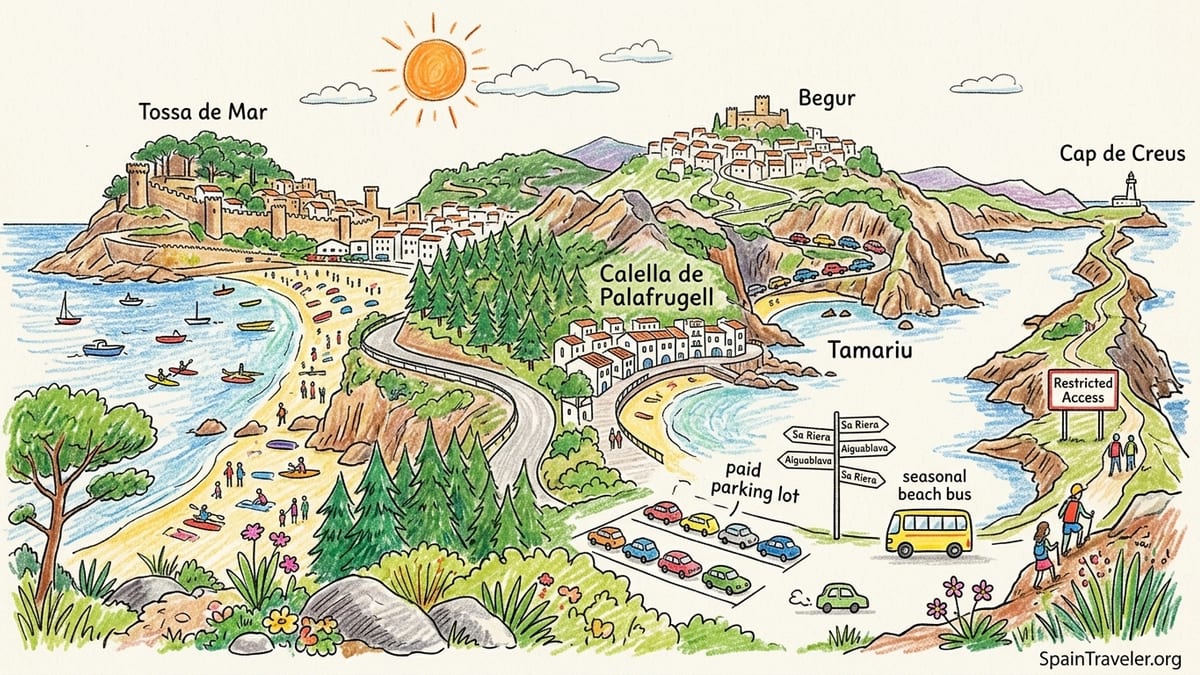
I thought I knew the Costa Brava before I actually drove it. On the map, the stretch from Tossa de Mar to Cadaqués looked like a simple line of beaches and pretty villages. In reality, that line turned into a maze of one-way streets, hidden coves, blue-zone parking, summer-only buses, steep coastal paths and an unexpected shift in mood as resorts gave way to quiet fishing towns and the lunar rock of Cap de Creus. Here is how the coast really felt, and what surprised me most as I made my way north.
Starting in Tossa de Mar: A Castle, Crowds and First Parking Lessons
I began in Tossa de Mar, which feels like a soft landing on the Costa Brava. I based myself just behind Platja Gran, in a small family-run hotel on a back street a short walk from the walled old town, Vila Vella. That location sounded perfect when I booked it, but it meant learning quickly how Tossa manages cars. The streets around the seafront fill early, and many spots are regulated or reserved for residents. I left the car in a paid municipal lot on the edge of the center and walked in. It was my first realization that this coast rewards people who accept that driving and parking are part of the logistics, not the experience.
Tossa’s beach is broad and sandy, and in late June the water was busy with kayaks heading towards the cliffs. The surprise was not the postcard view of the castle over the bay, but how organized the seafront felt compared with the small coves I would see later. Lifeguard towers, rental stands and clear access ramps made it an easy place for families, but it also meant more noise and more people. I mistakenly assumed all Costa Brava towns would have this level of infrastructure and that I could simply roll up to the water, park and swim.
What broke that illusion was my first attempt to park near the old town in the evening for a walk on the ramparts. I circled several times, squeezed through narrow streets behind delivery vans and saw how quickly spots disappeared after 7 p.m. Restaurant terraces were heaving and guided groups snaked through the alleyways. Local authorities have even had to limit guided tours to smaller groups in the historic core to control congestion, which matches exactly how it felt trying to thread my way through Vila Vella. I ended up leaving the car again in an outlying lot and walking ten minutes back down. If I returned, I would choose a hotel that explicitly includes on-site parking and simply leave the car there for the entire Tossa stay.
Despite the crowds, walking Tossa’s coastal path up over the headland towards Cala Pola at sunset gave me a first hint of the wilder Costa Brava. As soon as I left the promenade, the noise dropped. Pines leaned over the path, the castle fell behind and small rocky inlets replaced the organized beach clubs. It was the first time I felt how tight the transition can be between resort and raw coastline here.
Calella de Palafrugell and Llafranc: Blue Zones, Backstreet Hotels and Seaside Promenades
From Tossa I drove north past Platja d’Aro and Palamós to Calella de Palafrugell, where I had booked a modest hotel up the hill behind the village, about a ten-minute walk from the seafront. The idea was to avoid driving every day and to use the car only when hopping along the coast. That turned out to be one of my better decisions. Calella’s old center is beautiful, but in high season parking close to the water is regulated by blue zones and small pay car parks. The municipality has several controlled areas in key spots such as Port Pelegrí and around the promenade, where stays are limited to a few hours and a few euros per hour in summer. I learned that if I tried to chase a space near the front after midday, I would only add stress to what was supposed to be a relaxed beach day.
Instead, I left the car in a larger public car park slightly inland, where prices were lower and time limits more forgiving, then walked down through the village with my beach bag. That short walk became part of the routine. Calella’s tiny coves, white low-rise houses and arcaded waterfront gave it an immediate contrast to Tossa’s big main beach. It felt more like a string of miniature fishing beaches than a single resort. Still, it was busy. By late morning in July, locals and visitors competed for space under the boats pulled up on the sand.
One surprise here was how easy it was to forget about the car completely. A coastal promenade links Calella to neighboring Llafranc in about fifteen to twenty minutes on foot. I took that path several times, starting from the port area of Calella and rising gently up under pines, with glimpses back to tiled roofs and forward to Llafranc’s curved bay. Arriving in Llafranc by foot rather than car meant I only discovered the parking situation when I later tried to drive there for dinner. Much of the seafront parking is also regulated, and residential streets fill quickly in peak evenings. I eventually left the car higher up behind Llafranc and walked down to the promenade, where restaurants put tables almost on the beach and the atmosphere felt calm despite the full terraces.
If I could redo this section, I would stay three nights instead of two and dedicate a full day just to walking from Calella through Llafranc up to the Sant Sebastià lighthouse and back, saving the car for exploring farther coves. The hiking trails in this area are surprisingly well signed, and the coastal “camí de ronda” between the villages combines stone steps, tunnels through rocks and quiet viewpoints that you simply do not see if you stay tied to parking areas.
Tamariu and Begur: Steep Access Roads, Beach Buses and Competition for Sand
From Calella I drove the short distance inland to Palafrugell and then out again to Tamariu. This was my first real encounter with steep, winding access roads to a small cove and what that means for parking. Tamariu sits at the end of a descent through pine forest, with houses clinging to the slope. The waterfront itself is a lovely curve of sand with a modest promenade. The catch is that there is limited flat land for cars. In high season, streets closest to the waterfront fill fast and there are marked areas where parking is forbidden to keep access clear. I arrived mid-morning and managed to find a space up one of the residential streets, then walked five minutes down. By lunchtime, cars were backed up trying to turn around near the seafront.
The village itself felt different from both Tossa and Calella. Fewer day-trippers walked through with shopping bags. Many people seemed to be staying in apartments right above the front. I had a plate of grilled sardines at a simple restaurant facing the water. It was more expensive than similar dishes in Tossa, but the sense of being in a small, self-contained cove was worth it. I also noticed how the tide of people changed through the day. In late afternoon, families with chairs and coolers trickled back to their cars and the cove fell quiet by dusk.
Base for the next nights, though, was Begur. I chose a small hotel on the edge of the medieval hilltop center, which came with one precious thing: an on-site parking space. That turned out to be essential. Begur’s core is a web of narrow one-way streets that climb towards the castle, and during summer evenings the central parking zones fill early with visitors coming for dinner or to stroll. Having a guaranteed spot meant I could take the car out to the beaches during the day, knowing I would not spend half an hour hunting for a place on return.
From Begur, the coast feels like a fan of coves. I drove down to Sa Riera one day, Aiguablava another, and looked longingly at signs for Sa Tuna and Aiguafreda, where road access and parking are even tighter. Municipal regulations and local practice now recognize that parking around these coves is under pressure. In recent summers, designated car parks near the beaches have charged flat daily rates of a few euros and filled up quickly in July and August. Cars that arrive too late are turned away or forced to park further uphill on stretches of road marked with white lines where it is still permitted. To relieve some of this pressure, Begur runs a seasonal beach bus from the town center to Sa Riera, Sa Tuna and Aiguablava, typically from mid-June to mid-September. I took that bus once from Plaça de la Vila down to Aiguablava and immediately wished I had used it more.
Stepping out at Aiguablava, I understood why this area is so heavily regulated. The cove is small, with clear turquoise water and rocky slopes on both sides. It hosts a mix of swimmers, kayaks and small boats. The beach itself gets crowded, but what struck me was how little flat sand there is relative to the number of people trying to enjoy it. Accessible infrastructure, including reserved parking and beach access facilities for people with reduced mobility, has been added here, which is excellent, but it also concentrates use. Walking a few minutes along the rocky path towards neighboring Fornells gave me more breathing space and views back to the main cove. If I returned in high season, I would skip trying to park here entirely and rely on the beach bus from Begur for most days.
L’Estartit: Boats, the Medes Islands and a More Practical Seaside Town
Leaving the Begur headland, the road drops towards L’Estartit, where the mood of the coast changes again. I booked an apartment a few blocks back from the seafront, in a modern building with underground parking. This was a deliberate choice after the parking lessons of the previous days, and it paid off immediately. L’Estartit is oriented around its long sandy beach and busy marina, where boats shuttle visitors to the protected Medes Islands marine reserve. In summer, street parking near the harbor is heavily used, and there are regulated zones and pay-and-display areas around the waterfront. By staying somewhere with dedicated parking, I could forget about the car and explore on foot.
The seafront here is flatter and more open than in the coves around Begur. Families wheeled strollers along a wide promenade, and beach bars spread out evenly along the sand. What surprised me was how clearly marine protection shaped the activities on offer. Almost every second shop seemed to be a dive center or boat tour agency advertising trips to the Medes Islands, where anchoring is controlled and snorkelers are briefed about not touching the seabed or feeding fish. I joined a basic glass-bottom boat trip that left mid-morning. The captain explained, in simple terms, which parts of the islands were no-go zones for private boats and why the number of mooring buoys was limited. Seeing the level of control over activities offshore made me think about the parallel effort to manage vehicle access and foot traffic in other protected parts of the coast.
L’Estartit also gave me my first view of how this coast looks when it opens out into a plain rather than squeezing coves between cliffs. From the far end of the beach, I could see rice fields and wetlands inland and the silhouette of the Montgrí Massif to the south. It felt less like a secret cove and more like a practical seaside town that lives from both tourism and day-to-day life. As someone who had imagined every Costa Brava stop as a tiny fishing village, it was a useful correction. The benefit for travelers is that services here are straightforward. Supermarkets, bakeries and casual restaurants cluster behind the promenade, and public parking areas are clearly marked as you drive in.
If I had known how easy it would be to base myself here without worrying about the car, I might have planned an extra night and used L’Estartit as a springboard to explore the Montgrí and Ter river area on foot or by bike, leaving the more stressful parking battles for shorter side trips only when necessary.
Cadaqués and Cap de Creus: Restricted Roads and a Different World at the End of the Coast
The final arc of the journey, from L’Estartit to Cadaqués, felt very different from the southern section. After skirting Figueres and climbing through olive-covered hills, the road into Cadaqués twists down in tight hairpins. I had booked a small guesthouse on the upper edge of the village, again with private parking. That choice proved essential the moment I saw the knot of cars trying to access the seafront streets. Cadaqués has limited space, with white houses packed around a narrow bay. Much of the central waterfront is pedestrianized or restricted, and public parking is concentrated in larger lots above the village. In summer, those lots fill quickly, and electronic signs at the entrance to town warn drivers as spaces run low.
From the guesthouse I walked down through sloping lanes lined with bougainvillea until the sea appeared between rooftops. The atmosphere here was noticeably quieter than in Tossa, despite the crowds. People lingered on low walls, children played on the pebbly beach, and boats bobbed in the shelter of the bay. It felt like a place that still thinks of itself as a village first, even with the number of visitors. My wrong assumption had been that Cadaqués would be a slightly quieter version of a resort like Tossa. Instead, it felt more like a self-contained community that tolerates visitors but does not expand its built environment just to suit them.
Reaching Cap de Creus from Cadaqués drove home how serious the region has become about protecting its landscapes. The road that once allowed almost unlimited private car access to the lighthouse and headland is now under strict regulation for much of the extended summer season. On many days between late spring and early autumn, private vehicles are either banned from continuing from just outside Cadaqués or strictly limited, and visitors are encouraged or required to park in a designated lot on the outskirts and take a shuttle bus out towards the point. Access is monitored, camera enforcement is used at key stretches, and stopping outside marked areas risks fines.
I left the car in the main parking area above Cadaqués early in the morning and opted to walk to Cap de Creus rather than take the shuttle. The hike took several hours along marked trails, passing through scrubland and wind-shaped rocks. Approaching the lighthouse on foot, with the sea on both sides and the coastline breaking into jagged inlets, the decision to restrict vehicles made complete sense. Parking options out there are extremely limited, and turning the road into a queue of cars would destroy the sense of isolation that gives the headland its character. It also became clear that certain coves and side paths are off-limits to protect sensitive habitats, and signs explain which routes are open and which areas belong to stricter nature reserves.
By the time I took the shuttle back later that afternoon, the vehicle was full but calm. People carried daypacks, not beach club bags, and conversations were more about hiking routes than sunbed rentals. That shift in who comes and how they move around is one of the biggest differences between the southern and northern ends of the Costa Brava. Up here, regulations on where you can drive, park, fish or even drop anchor shape the entire experience.
How the Atmosphere Changes From South to North
Looking back on the journey, the most striking surprise was how dramatically the atmosphere changed over relatively short distances. In Tossa de Mar, life seemed to revolve around the big main beach and the medieval walls. Restaurant hawkers called out along the seafront, souvenir shops sold inflatables and the sound of nightlife drifted inland. Calella de Palafrugell and Llafranc felt immediately smaller in scale, with low white houses hugging stony little beaches and more families who seemed to return year after year. Begur’s coves brought a sharper sense of contrast, where you might spend the morning in a quiet stone alley in the hilltop town and the afternoon squeezed into a small, turquoise cove with limited sand and strict parking rules.
Farther north, in L’Estartit, the coast opened out again. There, the focus shifted from tiny coves to the interplay of a working marina, a broad beach and a heavily protected offshore marine reserve. Conversations on the promenade included divers comparing notes on sea life and boat crews explaining mooring regulations on the Medes Islands. Finally, in Cadaqués and Cap de Creus, the coast narrowed to a point in both geographic and emotional terms. The combination of white cubic houses, pebbly beaches and harsh rock under a hard light felt closer to a remote island than to the kind of resort where you stumble from hotel to bar.
Regulation and management also became more visible the farther north I went. Tossa and Calella certainly have regulated parking and some seasonal restrictions, but they still feel like seaside towns that happen to sit near scenic headlands. In contrast, areas around Begur’s coves, the Medes Islands and especially Cap de Creus have clearly reached a point where authorities actively control how many vehicles arrive, where they can stop, and what people can do in protected zones. Rangers, information boards and clear signs about forbidden activities are now part of the landscape. As a traveler, I found that reassuring rather than restrictive. It signals that the Costa Brava wants to remain wild in parts, rather than letting every beautiful spot become another overflow car park.
My biggest mistake in planning was to underestimate how much time movement and parking would consume in the more constrained areas. I often allowed only twenty or thirty minutes to get from a hilltop town like Begur down to a cove, forgetting that ten of those minutes might be spent crawling behind other cars on a narrow road and another fifteen hunting for a parking place or being redirected by attendants. Next time, I would bundle activities geographically: a full car-free day walking between Calella and Llafranc, another using the Begur beach bus for coves, and separate days where the car stays parked all day in L’Estartit or Cadaqués while I explore on foot.
What I Would Do Differently Next Time
If I repeated this route from Tossa to Cadaqués with the benefit of experience, my itinerary would look different in several key ways. First, I would cut one night from Tossa de Mar and add it to either Calella de Palafrugell or Cadaqués. Tossa is beautiful and worth a full day and night, especially if you enjoy walking the ramparts and swimming off the main beach, but the feel of the Costa Brava that stayed with me came more from the smaller coves and the stark headlands to the north.
Second, I would be much more deliberate about where I insisted on having private parking. In hilltop towns and heavily visited villages such as Begur, L’Estartit and Cadaqués, booking accommodation that includes a guaranteed parking space is, in my experience, worth more than a room upgrade or a sea view. In places where I intended to move mainly on foot, like Calella and Llafranc, I would still be happy staying slightly inland and walking to the sea each day, using public car parks only when needed. That approach cuts down the stress of circling small streets and gives you more predictable mornings.
Third, I would plan specific days with no driving at all. On this trip, I tried to see a new cove almost every day, which meant constantly negotiating access roads, parking rules and time limits. It would have been more restful to, for example, spend a full day based in Calella walking to Llafranc and the lighthouse, followed by a separate day driving to Tamariu and back. Likewise, in Cadaqués, I would dedicate one full day to hiking within Cap de Creus and another to lingering in the village and nearby coves such as Portlligat, without trying to do both on the same day.
Finally, I would adjust my expectations around meals. Some of my best food moments were the simplest: grilled fish on the waterfront in Tamariu, a plate of local anchovies in Begur, and a late lunch of rice in a small restaurant on the backstreets of Cadaqués. In busier seaside spots, prices were noticeably higher for anything directly on the sand. Walking a couple of streets inland often meant quieter terraces, more local clientele and more reasonable bills. Having accurate expectations on budget and ambiance made a big difference to how each stop felt.
FAQ
Q1. Do I need a car to explore the Costa Brava from Tossa de Mar to Cadaqués?
In my experience a car gave me flexibility, especially for reaching coves around Begur and L’Estartit, but it came with parking headaches. If you prefer not to drive, you can link the main towns by bus and then rely on walking, taxis and in some cases seasonal beach shuttles, but you will see fewer of the more remote coves in a short time.
Q2. How difficult is parking in summer in places like Begur, Calella de Palafrugell and Cadaqués?
In July and August, parking near the seafront in these villages is challenging. Blue-zone regulated spaces fill quickly, public car parks reach capacity by late morning and central streets are either residents-only or time-limited. Booking accommodation with on-site parking in hilltop or compact towns such as Begur and Cadaqués made my stay much easier.
Q3. Are there restrictions on driving to Cap de Creus from Cadaqués?
Yes. In extended summer periods, vehicle access on the road from Cadaqués to the Cap de Creus lighthouse is heavily restricted or closed to most private cars. On many days you must leave your car in a designated parking area near Cadaqués and either take a shuttle bus or walk or cycle into the natural park. Signs at the entrance to town explain the current rules and dates.
Q4. Can I rely on public transport to reach the coves around Begur?
Partly. Begur operates a seasonal beach bus in the summer linking the town center with coves such as Sa Riera, Sa Tuna and Aiguablava. I used it to reach Aiguablava and found it far less stressful than driving and searching for parking. Outside the high season, this service may not operate, and reaching the coves without a car becomes more complicated.
Q5. What surprised you most about the beaches along this part of the Costa Brava?
The biggest surprise was how small and enclosed many coves are compared with the wide sandy image I had before visiting. Places like Aiguablava and Tamariu are stunning but have limited sand, so they feel full quickly. I also did not expect the strong presence of marine and landscape protection rules, especially around the Medes Islands and Cap de Creus.
Q6. Is swimming access easy for everyone, including families and people with reduced mobility?
In larger and more developed beaches such as Tossa de Mar, L’Estartit and some coves like Aiguablava, there are ramps, lifeguards and marked zones that help families and people with reduced mobility. In smaller, rockier coves and along sections of the coastal paths, access can be steep or uneven. Checking which beaches have accessible facilities before planning the day is important if mobility is a concern.
Q7. How crowded did the main towns and coves feel in high season?
Tossa de Mar and the central hours on Calella’s small beaches felt very busy in late June and early July, with towels almost edge to edge. Begur’s coves were also crowded on sunny days, although arriving early or using the beach bus helped. Cadaqués had plenty of visitors, but tighter controls on traffic and the layout of the village kept it from feeling as overrun as I had feared.
Q8. What are the main differences between the southern and northern parts of your route?
To the south, around Tossa, the coast felt more like classic resort territory, with larger beaches, more seafront infrastructure and a livelier nightlife. As I moved north through Calella, Begur and L’Estartit, the focus shifted to coves, cliffs and protected marine areas. At the far north, in Cadaqués and Cap de Creus, the landscape turned rugged and remote, and the entire experience felt closer to visiting a national park than a resort.
Q9. Would you recommend staying in one base or moving between several towns?
I stayed in several places and do not regret it, but next time I would choose two or three bases instead of many short stays. For example, using Calella or Llafranc for the central section, Begur for the coves and Cadaqués for the northern headlands would reduce packing and unpacking while still allowing easy day trips.
Q10. What is the single most important tip you would give someone planning this trip?
Plan around parking and movement, not just scenery. Decide where you absolutely need a guaranteed parking spot, consider using seasonal beach buses when they are available, and build in full days where you do not drive at all. That simple shift in planning made each stretch of the Costa Brava feel much more relaxed and allowed me to appreciate the jump from resort sands to wild headlands along the way.