


I picked up a compact rental car in Girona with a simple plan: trace the Costa Brava by road from Tossa de Mar to Cadaqués, hugging the coast whenever the asphalt allowed. What actually happened was a more chaotic, more human version of that fantasy, complete with missed turns, crowded car parks, unexpected detours inland and one very clear realization: on this stretch of Catalonia, a car can be both your greatest freedom and your biggest headache.
Picking Up the Car in Girona and Reaching Tossa de Mar
I started in Girona, where most international visitors either arrive by train from Barcelona or on low-cost flights. I booked a small manual hatchback from a multinational brand at Girona Airport, primarily because the price difference versus a downtown pickup was modest and the airport lots usually have better availability of small cars. At the counter, the agent tried to upsell me to an SUV, but on the Costa Brava, smaller really is better. Narrow village streets, tight hotel parking ramps and old-town access rules all favor a compact vehicle over something high and wide.
From the airport, I followed the signs for the AP-7 and then the C-35 toward the coast, staying on dual carriageway until the last possible moment. Once I turned onto the GI-681 for the final approach to Tossa de Mar, the character of the drive changed immediately. The road narrowed, the curves multiplied and the guardrails suddenly felt much closer. Traffic in late June was moderate, but every slow campervan or delivery truck created a tail of patience-testing cars as overtaking opportunities were limited. It took around 45 minutes from Girona Airport to Tossa itself, and I was glad I had insisted on picking up the car in daylight to get used to the handling before hitting the bends.
Arriving in Tossa de Mar, I aimed first for the large public car park just outside the walled old town, where pricing is by the hour with clear signage at the entrance. Spaces were already filling by 10:00, especially the easier spots close to the pedestrian exit, but I managed to squeeze into a bay that felt tight even for a small hatchback. This first parking experience set the tone for the trip: on the Costa Brava, you often spend more time thinking about where to leave the car than about where to drive it next.
That first evening, traffic inside Tossa itself was one-way and slow, with occasional delivery vans blocking narrow streets while unloading. I quickly learned to leave the car parked and walk. Had I known how intense local congestion gets around sunset, I would have chosen accommodation that included a guaranteed garage spot, even at a higher nightly rate, simply for the peace of mind of not moving the car until departure day.
From Tossa de Mar to Begur: When the Coast Road Is Worth the Stress
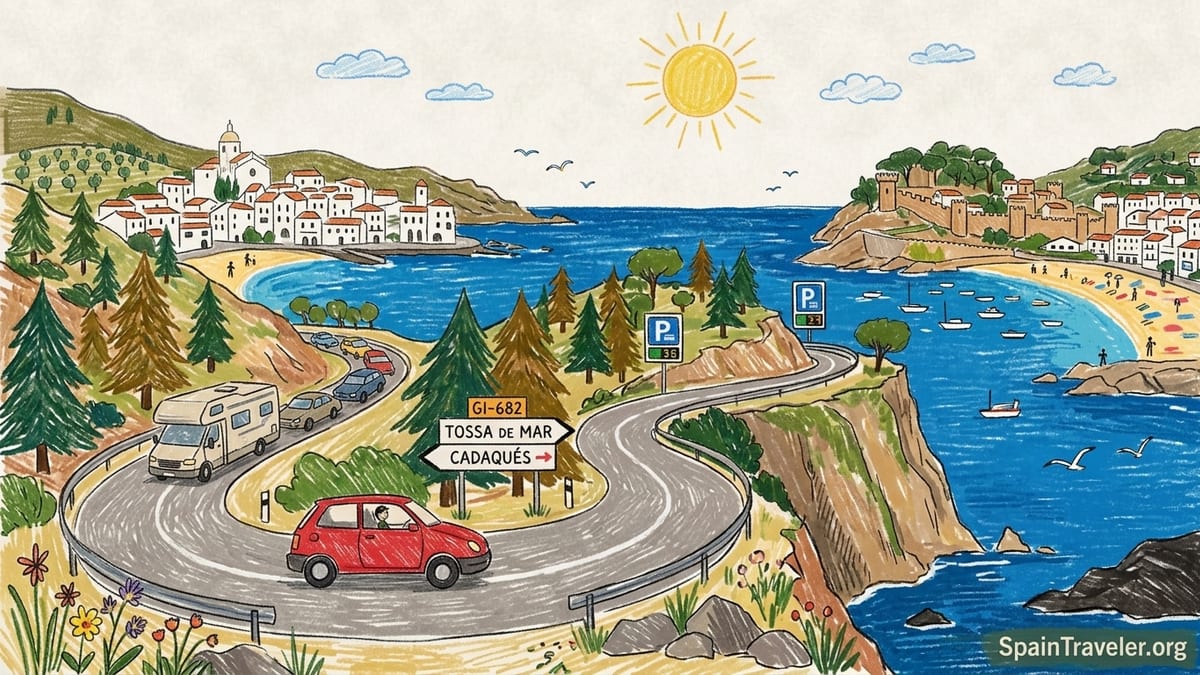
Leaving Tossa toward Begur, I faced the first big decision: follow the coastal GI-682 toward Sant Feliu de Guíxols or head inland sooner to save time. The GI-682 has a near-mythic reputation among drivers and motorcyclists, with more than 300 curves and constant up-and-down gradients between forested hillsides and sudden cliff-edge sea views. On a clear morning, I chose the scenic option and almost immediately understood why many locals warn nervous drivers away from it. The road is technically good, with recent resurfacing in many sections, but there are no long straights and very few forgiving shoulders.
The traffic mix was eclectic: sports cars, local commuters who knew every bend by memory, and rental cars whose drivers clearly did not. I kept my speed conservative, let faster vehicles pass at the occasional wider lay-by, and stopped once at a mirador where a handful of cars were already lined up, each trying not to block the view for others. The sea was spectacular, but from behind the wheel I could enjoy it only in split-second glances between tight corners. It took nearly an hour to cover a distance that would have been much shorter by the faster inland route via the C-65 and C-31.
My first mistake came when I tried to drop down into every promising cove shown on roadside signs. Access to small beaches like Cala Canyet and Cala del Senyor Ramon involved very narrow, steep side roads that quickly filled with parked cars squeezed into informal pull-offs. In one case, I followed a line of vehicles down only to realize that every space was occupied and the only way out was an awkward multi-point turn on a steep gradient. That detour cost me half an hour and a lot of stress for a view I could just as easily have enjoyed from a walking path had I stayed somewhere nearby overnight.
By the time I rejoined the main road and later merged with the C-31 toward Palafrugell and Begur, the drive had become more functional than scenic. Here the car truly paid off: even with my unnecessary stops, I made the trip from Tossa to Begur in under two and a half hours. By public transport, stitching together buses through Lloret or Girona and Palafrugell would have turned this into most of a day. On this first long push, the rental justified its cost in pure time saved, particularly because I was carrying luggage and camera gear that would have been awkward on crowded buses.
Parking and Day-Tripping From Begur: When I Should Have Slept There
Begur sits slightly inland on a hill, and driving into town from the C-31 felt refreshingly straightforward after the coastal roller coaster. The access road is well signed, and the first municipal parking I reached was a pay lot just below the historic center. Spaces were narrow but reasonably organized, and there were digital boards on the approach roads indicating approximate availability. I left the car here to explore the old town on foot and quickly realized that Begur would have made an excellent base for several nights rather than the day trip I had planned.
From the castle at the top, roads radiate out toward a cluster of coves, including Aiguablava, Sa Riera and Sa Tuna. Each is just a 10 to 15 minute drive away in light traffic, but in summer the last kilometer or two can turn into a clogged queue of cars hunting for scarce spaces near the beach. On the day I visited, municipal workers were already positioning temporary signs warning that beach car parks could close once full. I drove down to Sa Riera around midday and immediately regretted not starting earlier. The official car park at the back of the cove had a queue at the entrance, and the attendant was allowing vehicles in only as others left.
When I finally parked, the walk to the sand was short and easy, and here the car again showed its advantage: I could carry a proper beach bag, water and snorkel gear rather than traveling light as I would have on a bus. Still, the price I paid was time. Had I slept in Begur, I could have left the car at my accommodation and taken the seasonal beach shuttle bus that runs between the town center and the main coves in peak months, avoiding at least some of the traffic and the stress of looking for a space at sea level.
My biggest planning error around Begur was trying to combine too much into a single day. After Sa Riera, I aimed for Aiguablava, tempted by its famous turquoise water. The access road narrowed sharply and, nearing the beach, temporary no-parking signs lined both sides of the asphalt. By the time I reached the official lot, a staff member at the entrance was turning cars away, advising drivers to try again later. I pivoted back uphill, burned more fuel in first and second gear, and ended up returning to Begur earlier than expected, wishing I had simply committed to one cove and accepted that driving back and forth twice in the same afternoon was a poor use of energy and petrol.
Calella de Palafrugell and L’Estartit: Easy Distances, Tricky Details
From Begur, the drive to Calella de Palafrugell is short in kilometers but can be slow in summer. I took the local road through Palafrugell itself, following signs first to Llafranc and then to Calella. The asphalt is in good condition and the width is more forgiving than some of the smaller cove access roads, but the final approach into Calella is where things tighten. Here, the car felt like an intruder in a village clearly designed on a pedestrian scale. Narrow, often one-way streets, pedestrians stepping off curbs without looking, and a scattering of delivery vans forced frequent stops and starts.
I chose the main paid car park set slightly back from the seafront. Its advantage was clarity: a barrier at the entrance, tickets issued by machine, and a digital read-out of available spaces. The disadvantage was cost, particularly in August, when the daily maximum rises noticeably. Still, the alternative of circling for an on-street spot in increasingly hot traffic felt worse. In hindsight, Calella is one of those villages where arriving before 9:00 in the morning dramatically changes the driving experience. After mid-morning, drivers circle like aircraft stack over a crowded airport, waiting for any sign of brake lights that might signal someone is leaving a coveted space near the water.
On this part of the trip, driving saved me surprisingly little time compared with what a combination of local buses and walking could have achieved. Distances between Calella, Llafranc and Tamariu are short, and the real pleasure is on the coastal walking path, the Camí de Ronda, rather than in the car. My insistence on using the vehicle between every stop meant repeated parking fees and short, slightly stressful hops that would have been unnecessary had I based myself in a single village for two or three nights and explored mostly on foot.
The next move, from this central stretch to L’Estartit, brought the car back into its own. I headed back to the C-31 and then followed local roads toward Torroella de Montgrí and L’Estartit. Traffic here was lighter, and the landscape opened into flat agricultural land before the Montgrí massif rose up ahead. L’Estartit itself is built around a marina facing the Medes Islands, and the road in is wide and straightforward. I parked near the port in a surface lot used heavily by divers and day-trip boat operators. The presence of trailers and vans made the spaces tighter than they first appeared, but at least circulation was simple and signage clear.
Here, time savings were obvious. Boat tours to the Medes Islands, often lasting 1.5 to 2 hours, have fixed departure times and expect passengers to arrive at the quay at least 20 minutes ahead. With the car, I could adjust my departure from the previous village so that I arrived with a comfortable margin, without having to adapt my whole day to a limited bus schedule. On the downside, I had to return to the car in the heat after the boat trip, walking across a sun-soaked parking area that offered very little shade. Had I been staying in L’Estartit overnight, I could have walked straight back to a nearby hotel rather than negotiating a hot steering wheel and cabin.
The Long Push to Cadaqués: Curves, Fuel and Fatigue
The most challenging drive of the entire trip came on the day I decided to push from L’Estartit all the way to Cadaqués in one go. On paper, the distance does not look intimidating. In reality, the sequence of roads, the need to refuel and the final mountain approach combine to make it a tiring journey, especially in high season. I left L’Estartit by retracing my route to the C-31, then continued north past L’Escala and toward Figueres, where I briefly joined faster roads to gain time before cutting back toward Roses and the Cap de Creus peninsula.
I made a deliberate fuel stop near Figueres at a service station just off the main route. This was a crucial decision. Fuel prices along the Costa Brava can vary, and stations directly in resort towns often charge slightly more. More importantly, there are no petrol stations between Roses and Cadaqués along the mountain road. Filling the tank before entering this section removed one layer of worry and meant I did not need to calculate whether I had enough range left to climb back out from Cadaqués at the end of my stay.
From Roses, the road to Cadaqués begins with a long, steady climb. The asphalt is good and the width sufficient for buses and trucks, but the curves are constant and the drop-offs on the outer edge can feel intimidating, especially for drivers not used to mountain roads. I found myself frequently dropping to second gear on the tightest hairpins, while faster local drivers tucked in behind me, waiting for a rare long view to overtake. Stopping at viewpoints along this stretch is tempting, but formal pull-offs are limited. I chose one signed mirador and ignored several informal dirt patches that would have required a risky reverse maneuver to rejoin the road.
By the time the road snaked down toward the white houses of Cadaqués, fatigue had set in. This was the moment I realized that trying to combine so many hops into a single day was a mistake. Ideally, I would have stopped for the night somewhere between L’Estartit and Roses, perhaps in a quieter inland village, splitting the mountain drive to Cadaqués onto a fresh morning. Instead, I arrived mid-afternoon, tired and exactly at the time when parking pressure in the village was peaking.
Parking in Cadaqués and Seasonal Restrictions Around Cap de Creus
Driving into Cadaqués is a study in controlled congestion. Approaching the village, the main road funnels all traffic toward a series of municipal parking areas on the hillside and closer to the seafront. Electronic signs indicate spaces remaining, but on a busy summer afternoon these can drop to zero quickly. I initially followed the flow of cars toward a lower lot that looked closest to the center, only to find it full and guarded by an attendant turning vehicles around. The resulting U-turn in a crowded space, with pedestrians crossing from all sides, was one of the most stressful maneuvers of the trip.
Eventually, I retreated to a higher, terraced car park above the village. The trade-off was a longer walk down and, more importantly, a steeper walk back up at the end of the evening. Here again, I wished I had booked accommodation that either included on-site parking or was explicitly within a short walk of a municipal lot. Prices in the main car parks reflect the demand, rising notably in peak months, and the absence of reliable free street parking near the center means you should factor daily parking costs into any road trip budget for Cadaqués.
Using the car within Cadaqués itself felt unnecessary. The historic core and waterfront are compact and best explored on foot. For short hops to nearby coves such as Portlligat, where the house of Salvador Dalí stands, I considered driving but quickly saw that the narrow connecting road and very limited parking near the bay made walking or taking a taxi a better idea. The car remained essentially a static object for much of my time in the village, a reminder that in the tightest places along the Costa Brava, a vehicle is primarily useful for arrival and departure, not for daily movement.
The limitations became even clearer when I looked into visiting the Cap de Creus lighthouse and the coves inside the natural park by car. In the high season, access along the road from Cadaqués to the lighthouse is restricted to reduce traffic and protect the landscape. Barriers and control points are set up, and private cars are either banned outright during certain daytime hours or required to park in designated areas before visitors continue by shuttle bus, bicycle or on foot. Similar restrictions apply on the Roses side of the park, where access to some coves is closed to private vehicles in summer, again with controls at set times during the day.
Cap de Creus: When the Car Stops Being the Right Tool
On one hot morning, I tried to drive toward the Cap de Creus lighthouse from Cadaqués, leaving early in the hope of getting ahead of the restrictions. The first kilometers were manageable, with a narrow but paved road twisting through rugged, almost lunar scenery. However, as I approached the park control point, I saw clear signage indicating that, during the main summer window, private cars would not be allowed to continue beyond a certain hour and that parking was limited even before that time. A small queue of vehicles ahead of me turned back after speaking with staff, and I decided to do the same rather than risk being forced to reverse into an awkward space or find the small lots already full.
Had I been staying in Cadaqués for more nights, the better strategy would have been to plan a full day without the car, using the time-limited shuttle service, walking sections of the coastal path or renting a bicycle or scooter that is allowed beyond certain barriers. The driving experience inside the park is not especially enjoyable, since the focus has to remain on the narrow, winding road, and opportunities to park safely and admire the view are limited. When enforcement is active, the car transforms from asset to liability, particularly if you arrive too late in the morning and find yourself stuck in a bottleneck of vehicles all being turned back.
The same logic applies to some of the smaller coves both near Cadaqués and along the Roses side of Cap de Creus. In peak periods, access is regulated for environmental and safety reasons, and only residents, service vehicles or those with prearranged accommodation inside certain zones are allowed through. At one barrier near the Roses sector, staff were checking license plates against a list and directing unauthorized vehicles to turn around, emphasizing that access was possible by foot or bike only. Attempting to “test” the system with a rental car is a poor idea, as fines for violating park rules can be substantial and local authorities are increasingly strict.
In practical terms, this meant accepting that, for Cap de Creus itself, I had brought the wrong mindset. The car was useful to reach Cadaqués and would be essential to leave, but inside the most protected parts of the peninsula, the right pace is walking speed. Visitors who structure their stay around that reality, perhaps with two or three nights in Cadaqués without touching the car, will likely have a calmer experience than those who try to squeeze the lighthouse and multiple coves into a single rushed half-day by road.
The Takeaway
Looking back on my drive from Tossa de Mar to Cadaqués, the pattern is clear. The car gave me enormous flexibility in choosing where to sleep and which small detours to make, and on longer legs between clusters of villages it saved hours compared with public transport. With luggage in the trunk and beach gear in the back seat, I could adapt my plans as the weather and my energy changed, without worrying about timetables or crowded buses.
At the same time, I underestimated how often the car would be more burden than benefit. In Tossa de Mar, Calella de Palafrugell and Cadaqués, parking dictated my schedule as much as any sight I wanted to see. Around Begur, I discovered that the constraint is not the quality of the roads but the capacity of the coves at the end of them, where small car parks fill quickly in summer and temporary restrictions appear with little warning. In Cap de Creus, seasonal access rules made it clear that, beyond a certain point, the car simply does not belong.
If I were to repeat the trip, I would keep the main structure but make three key changes. First, I would choose two or at most three bases and stay longer in each, rather than hop almost every night, which only increased my time spent packing the car and searching for parking. Second, I would avoid using the vehicle for micro-hops between neighboring coves when there are walking paths or local shuttles available, particularly around Begur and Calella. Third, and most importantly, I would treat Cap de Creus as a car-light or car-free interlude, parking once in Cadaqués and planning my park visits around the existing restrictions instead of trying to work around them.
The Costa Brava rewards patience behind the wheel and humility about when to step away from the driver’s seat. The best parts of the journey from Tossa to Cadaqués were not the curves conquered or kilometers logged, but the moments when the road ended and I continued on foot, leaving the rental car cooling quietly under a Mediterranean sun.
FAQ
Q1. Is it necessary to rent a car to travel from Tossa de Mar to Cadaqués?
It is not strictly necessary, but a car makes it much easier to link smaller villages like Begur, Calella de Palafrugell and L’Estartit in a few days, especially if you are carrying luggage. Without a car, you depend on bus connections through larger hubs, which can turn simple hops into multi-hour journeys.
Q2. What kind of car is best for driving the Costa Brava?
A small or compact car is ideal. Narrow hotel garages, tight village streets and limited parking spaces make large SUVs or vans impractical. A modest hatchback with good visibility and light steering is easier to park and less stressful on the twisty coastal and mountain roads.
Q3. How challenging is the coastal road between Tossa de Mar and Sant Feliu de Guíxols?
It is scenic but demanding, with hundreds of curves, frequent elevation changes and few long straights. Confident drivers generally enjoy it, but anyone uncomfortable with tight bends and drops may find it stressful, especially if stuck behind or ahead of slower vehicles with limited chances to overtake.
Q4. Where does driving actually save the most time on this route?
The biggest time savings are on the longer links, such as Tossa de Mar to the Begur area, and from the central Costa Brava up to Roses and Cadaqués. Those legs can often be done in around two to three hours by car, while equivalent journeys by public transport involve multiple connections and can consume most of a day.
Q5. How difficult is parking in popular villages like Begur and Calella de Palafrugell?
In peak season it is challenging. Official car parks can fill by late morning, and on-street spaces near the centers are scarce. Electronic signs and attendants help manage flow, but you should expect to pay for parking and sometimes walk 10 to 15 minutes between your car and the beach or old town.
Q6. Is Cadaqués a good base if I have a rental car?
Each arrival and departure by car involves driving a curvy mountain road and dealing with busy municipal car parks, so Cadaqués works best if you plan to park once and leave the car unused for several days. It is an excellent base for walking and exploring nearby coves on foot or by shuttle, but not ideal for daily driving excursions.
Q7. What should I know about fuel stops on this itinerary?
Fuel is readily available along main roads and in larger towns like Palafrugell, Torroella de Montgrí and Figueres, but there are no petrol stations between Roses and Cadaqués. It is sensible to refuel before tackling the mountain road to Cadaqués so that you do not need to worry about your range during the stay.
Q8. How do seasonal vehicle restrictions work around Cap de Creus?
During the main summer months, authorities restrict private car access to parts of the Cap de Creus Natural Park, including the road to the lighthouse and some coves. Barriers and checkpoints limit or block entry for regular vehicles during set hours, and visitors are directed to use shuttle buses, bicycles or walk instead.
Q9. Are there times of day when driving is noticeably easier?
Early mornings are generally calmer for both traffic and parking. Arriving in villages like Tossa, Calella de Palafrugell or Cadaqués before 9:00 improves your chances of finding a space close to the center and allows you to enjoy the roads before the heaviest daytime flows begin.
Q10. If I am nervous about mountain and coastal roads, should I still drive this route?
You can, but with adjustments. Consider using faster inland roads whenever possible, avoiding the most winding coastal sections at night, and limiting your time on the mountain road to Cadaqués by planning just one arrival and one departure. Renting a smaller car, driving in daylight and taking breaks at signed viewpoints all help reduce stress.