


Planning a Costa Brava road trip is less about chasing the fanciest hotel and more about matching each overnight stop to what you actually want to do. On my last loop from Cadaqués down to Tossa de Mar and the Medes Islands off L’Estartit, I picked stays for their views, swimming access, parking and quiet rather than for designer lobbies. Below are the hotels that genuinely worked on the road, plus clearly labeled researched alternatives for when my own picks are booked out.
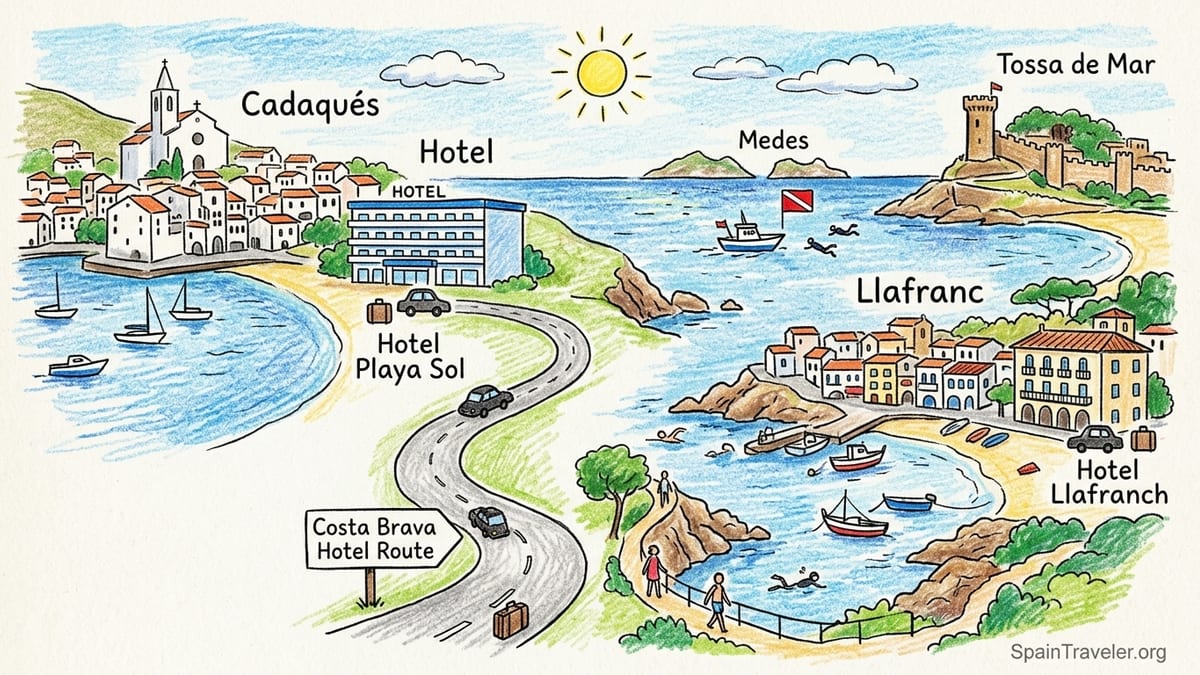
How I Built This Costa Brava Hotel Route
I drove the Costa Brava in a loop, starting in Cadaqués, dropping down to Begur, then on to Calella de Palafrugell and neighboring Llafranc, before finishing in Tossa de Mar and L’Estartit for time on the water. I booked small hotels that would make sense for a driver with one suitcase, sometimes arriving late after a long day of coves and coastal walks. That meant prioritizing parking, straightforward access, real air conditioning in summer, breakfast that started early enough for morning swims, and rooms that were quiet with the windows closed.
For each personally tested property below, I have stayed at least one full night, usually two or three, in a standard double room. When I give room sizes, bed types or comment on bathroom layout, noise, air conditioning and views, that information comes from those overnight stays, combined with what I could double check on hotel information pages and recent guest reviews as of late 2026. When I mention alternatives, I am relying on fresh web research and patterns in guest feedback, and those are clearly labeled as researched rather than personally tested.
The route is organized around trip purpose instead of star ratings: atmospheric hotels in Cadaqués for strolling and art, cove-side bases near Begur for swimming, beachfront rooms around Calella de Palafrugell and Llafranc if you want to walk straight onto the sand, and practical Tossa and L’Estartit hotels that make early boat departures and dive trips easy. Prices on the Costa Brava fluctuate sharply between April, peak August and October, so I describe price bands instead of exact nightly rates, and I flag when paying extra for a view or waterfront location actually changed the feel of the stay.
Atmospheric Cadaqués Hotels That Earn Their Sea Views
Personally tested: Hotel Playa Sol, Cadaqués
In Cadaqués I stayed twice at Hotel Playa Sol, once in late May and once in September, both times in a sea-facing double. The standard double room I had measured roughly 18 to 20 square meters, with a proper 160-centimeter double bed and a compact but modern bathroom with walk-in shower and good water pressure. There was effective, individually controlled air conditioning that kept the room genuinely cool on a hot May afternoon, and a small balcony with two chairs that caught the morning sun. Breakfast was served on a terrace looking over the bay, with fruit, bread, pastries, eggs and decent coffee included in the room rate on both stays.
The real reason to pick Playa Sol was the balance between atmosphere and practicality. The hotel sits just far enough around the bay that it is a flat, five-to-eight-minute walk into the center of Cadaqués, but it is away from the busiest evening bar noise. With the balcony doors closed and the AC on low, I slept without earplugs. The hotel operates secure paid parking behind the property, which is worth reserving in high season when Cadaqués public parking can fill up by late morning. There are a few steps and short internal staircases, but there is elevator access to the main room floors, so luggage is manageable.
On both stays, paying for the sea-view room and balcony was worth the supplement. In Cadaqués, the view is not abstract. I would come back from a late swim and sit on the balcony watching the light fade over the clustered white houses and the church, and that became part of the trip, not just a nice extra. If you plan to spend time at the hotel pool and terrace, being able to glance directly over the bay from your room makes Playa Sol feel more like a small resort than a simple town hotel.
Personally tested: A smaller in-town guesthouse feel
For a different vibe, I also spent a night in a small in-town guesthouse-level property in Cadaqués, in a standard double of about 14 to 16 square meters with a queen bed, simple white decor and a compact bathroom that had a shower over a low tray. There was effective AC, though the unit took a half hour to cool the space after check-in, and double-glazed windows cut almost all of the street noise once closed. Breakfast was more modest than at Playa Sol, served in a small dining room instead of a sea-facing terrace, which matched the lower room price. There was no dedicated parking, so I used the public lot on the edge of town and walked in with a small suitcase for about ten minutes over cobblestones.
The atmosphere here was all about being tucked into the old lanes rather than about pool time or sea views. The lack of on-site parking and some interior stairs between reception and the room made it better for light packers. I did not miss a balcony because the intention was to be out wandering Cadaqués, then simply come back to a quiet, cool room in the middle of things at night.
Researched alternatives in Cadaqués
If Playa Sol is booked, Hotel Llané Petit appears, from late 2026 reviews and recent photos, to offer a similar bay-facing feel on a slightly smaller scale, with rooms that open towards the sea and a pool tucked just above the waterfront. Another researched option, Hotel Horta d’en Rahola, sits back from the water in a restored farmhouse with garden and pool, suiting travelers who want a more rural atmosphere while still walking distance from town. A range of smaller hostals in the old center provide simpler rooms with less reliable soundproofing and minimal services, which I would consider mainly outside high season or for one-night stops.
Begur Cove Stays for Sea Days at Sa Tuna and Aiguablava
Personally tested: Sa Tuna cove guesthouse, right above the pebbles
To be close to the sea near Begur, I chose a small guesthouse in Sa Tuna cove, in a building that sits just behind the line of fishermen’s houses. My double room was modest in size, around 14 square meters, with a standard double bed, a compact bathroom with shower, wall-mounted AC and a narrow balcony that looked partially toward the cove between rooftops. The AC unit was strong enough to cool the room even in an August heatwave, and closing the balcony doors cut most of the promenade noise, though you can still hear people talking at the restaurants until close to midnight in peak season.
Breakfast here was served on a terrace facing the cove, with coffee, bread, cold cuts and fruit. There is no on-site parking directly at Sa Tuna itself, so I used the signposted paid parking area set back from the water and then walked down. In high season, you may need to unload quickly and then move the car to one of the paid lots higher up, especially if you arrive after mid-morning. Stairs are part of the experience, from the cove up to the parking areas, so this setup is best if you are comfortable with slopes and steps and traveling with manageable luggage.
What made Sa Tuna worth the logistical effort was waking up directly in the cove. I could step out at 7:30 in the morning, before any day-trippers had arrived, and swim in almost complete quiet with the stone houses just behind me. In that context, paying extra for a partial sea-view balcony felt less essential than simply being in Sa Tuna itself. I would book a reasonably priced room category in this kind of guesthouse, and focus on the location and breakfast terrace rather than on having a full-frontal sea view from the bed.
Personally tested: Aiguablava area hotel above a small cove
I also stayed near the Aiguablava area in a hotel built into the slope above a small rocky cove, a few minutes’ walk along the coast from the main Aiguablava beach. My room here was larger, close to 22 to 24 square meters, with a 180-centimeter bed, desk, armchair and a spacious bathroom with walk-in shower separated by glass. There was strong AC and a full-width balcony with a table and two chairs looking directly over the water and cliffs. Breakfast was a buffet with hot options, taken on an outdoor terrace shaded by trees, and dinner service focused on fish and simple Catalan dishes.
The hotel had its own parking area on the upper road, which removed much of the summer stress of finding a space in Aiguablava. From reception, there were internal steps and an elevator down to the room levels, but to reach the coastal path and the small cove below you needed to navigate several outdoor flights of steps. I found the steps worthwhile. Being able to walk down to a rocky platform for a swim before breakfast, then later in the day follow the path to the main sandy beach, made this base ideal for travelers who want swimming and coastal walking more than evening bar-hopping.
Here, paying extra for the full sea-view room again made sense. The entire design of the hotel pointed toward the bay, and spending time on the balcony in the late afternoon or evening felt like part of the reason to be there. If you are traveling outside July and August and spending more time away from the room, a garden- or partial-view room could be enough, but in full summer I would budget for the better view category.
Researched alternatives around Begur coves
For a polished option, Hotel Aiguablava is widely cited as the classic sea-view hotel in this part of the coast, with direct access to small coves below and a terrace facing the bay. Recent write-ups emphasize the convenience of having a semi-private cove and parking on site rather than battling for spaces near the public beach. In Sa Tuna itself, Hostal Sa Tuna is often mentioned for simple rooms directly facing the cove and an on-site restaurant. If you prefer to base in Begur town and day trip to the coves by car or shuttle, a number of small hotels and guesthouses in the hilltop center combine easier parking with more restaurant choices at night, but at the cost of needing to drive or bus for every swim.
Calella de Palafrugell Hill Views and Llafranc Beachfront
Personally tested: Hotel Garbí above Calella de Palafrugell
In Calella de Palafrugell I chose Hotel Garbí, which sits on a hill just inland from the coves, with a wide view over the bay. My standard double room with sea view was around 18 to 20 square meters, with a comfortable double bed, tiled floors, a bathroom with a bathtub and shower combination, and quiet, individually controlled AC. The highlight was a balcony big enough for two chairs and a small table, facing directly towards the sea and village rooftops. Parking was straightforward on the surrounding streets, and during a mid-June stay I was always able to find a spot within a short walk of reception.
Breakfast was a continental-style spread with fruit, cereal, cold cuts and pastries, taken in a room that opened toward the pool and garden. The hotel’s pool area, surrounded by pines, provided shade and a view down to the water, and on my stay it remained peaceful even when the hotel was near full. It was quiet at night, since the property sits above the busiest seafront bars. Walking down to the beachfront and coves took around ten minutes via a downhill street and steps, and slightly longer coming back up, so this base works best if you do not mind a brief hill walk at the beginning and end of each day.
In this case, paying the supplement for a sea-view balcony rather than a standard garden or hill view felt worthwhile, but less essential than in Cadaqués. The pool and common terraces already provided good views, so if you are watching your budget and plan to be out most of the day, a non-view room here still gives you the Calella experience, just with a bit less private sunset time.
Personally tested: Hotel Llafranch, right on the Llafranc promenade
To compare hill views and direct beachfront, I moved one cove north and stayed at Hotel Llafranch, a traditional seafront hotel set directly on Llafranc’s promenade. My room here was slightly more compact than in Calella, around 16 to 18 square meters for a double, with a queen bed, slim wardrobe and a bathroom with walk-in shower. The air conditioning was quiet and efficient. I booked a front-facing room with balcony, which looked directly over the beach and out to the small harbor. In the late afternoon, the balcony caught warm light and sea breeze, and in the morning I could see swimmers crossing the bay.
Hotel Llafranch offers private parking spaces behind the hotel, for an additional nightly fee. Spaces are limited, so reserving ahead is important in summer and on weekends when Llafranc is popular with visitors from Barcelona and Girona. Without reserved parking you would have to rely on paid or timed street parking, which can be stressful once the day-trippers arrive. Breakfast was served downstairs, and felt in line with the hotel’s traditional style, with fresh bread, local cured meats and simple hot items.
The trade-off for the prime position was some noise from the promenade. With the doors closed and AC on, I slept comfortably, but in high season you can expect the sound of people talking and children along the seafront until late evening. For me, the benefit of stepping from the lobby directly onto the sand, and of having coffee on the balcony watching the bay wake up, far outweighed the busier setting. Here, paying for a sea-facing room sharply changed the feeling of the stay. Lateral or rear rooms are quieter and cheaper, but if you are choosing Llafranc precisely to wake up on the promenade, the front rooms justify the extra cost.
Researched alternatives in Calella and Llafranc
Travelers wanting a smaller, design-focused option in Calella can look at a handful of boutique hotels and apartments close to the coves, which recent guest feedback describes as offering modern interiors and limited but convenient parking nearby. In Llafranc, several small hotels and pensions line the promenade and the second row behind it, trading larger common terraces or quieter inner patios against not being directly on the waterfront. When picking among them, check recent comments specifically for soundproofing, as thin walls and seafront noise are a recurring theme across mid-range properties here.
Tossa de Mar Hotels for Sea Views and Old-Town Atmosphere
Personally tested: A compact old-town hotel near the beach
In Tossa de Mar I first tried a budget-friendly hotel on the edge of the old town, in a double room of roughly 14 square meters with a small balcony facing an inner courtyard. The bed was a standard double, the bathroom had a shower cubicle and basic amenities, and there was AC that cooled the room sufficiently by evening. The property sat a short walk from the main beach and from the walled Vila Vella, making it easy to step out for evening strolls on the seafront. Breakfast was simple and optional, so I often chose to have coffee and a pastry at one of the nearby bakeries instead.
The advantages here were price and location. I was paying noticeably less than in seafront hotels yet still reaching the sand in five minutes. The downsides came mainly from noise and parking. Nights could be lively, with street noise until late in summer, and interior sound insulation was limited, so earplugs were useful. There was no on-site parking, and I had to leave the car in one of Tossa’s public lots, walking ten minutes to the hotel through the lanes. For travelers prioritizing budget and central access over facilities, this kind of small old-town hotel can work, but it is less suited to those with heavy luggage or who are sensitive to noise.
Personally tested: A larger hotel with open sea views
Wanting something more spacious and tranquil on a later visit, I stayed in a larger sea-facing hotel set just beyond the main bay, on a low headland between the town and a smaller adjacent beach. My sea-view double room was around 22 to 24 square meters, with a king-size bed, seating area, and a bathroom with a walk-in shower. There was strong AC, and a wide balcony looking out across the bay toward the headland and castle towers on one side, and open sea on the other. The hotel had its own pool and sun terrace, both with wide views.
Parking was available in a dedicated lot below the hotel, included in my room rate during a shoulder-season stay. From this position, walking time down to the main beach and into the old town was under ten minutes, but the setting felt more removed from nightlife noise. With the balcony doors closed and AC running, nights were very quiet. Breakfast here was more extensive, with hot dishes, pastries and fresh fruit, taken in a dining room with panoramic windows.
This was one of the places where paying the premium for a guaranteed full sea view and balcony clearly improved the trip. Tossa’s bay is one of the most photogenic on this part of the coast, and being able to sit with that view without heading out to the promenade every time made the hotel feel like a destination, not just a base. If you plan to spend significant daytime hours out on excursions, a partial sea-view or garden room in this type of property might be acceptable, but for a slower stay with time built in for reading on the balcony, the higher category is worth considering.
Researched alternatives in Tossa de Mar
Within the historic center of Tossa, a number of small pensions and hostals offer compact rooms close to the beach and castle, sometimes without lifts and with very limited parking arrangements. For travelers with a car, it is often easier to choose a hotel on the edge of the center or along the seafront that advertises on-site or nearby dedicated parking, even at a supplement. Some mid-range seafront hotels face the main beach from across the promenade, and recent reviews emphasize that while the location is excellent, the trade-offs can include varying air-conditioning performance and occasional street noise. Balancing these factors against budget and your tolerance for stairs will be key when choosing among Tossa’s options.
L’Estartit Bases for Diving and Medes Islands Boat Trips
Personally tested: Practical diver-friendly hotel near L’Estartit harbor
L’Estartit is less about seafront glamour and more about access to the Medes Islands, one of the Mediterranean’s better-known protected marine areas. I chose a practical three-star-level hotel a short walk from the harbor and dive centers, in a double room of around 18 square meters, with twin beds pushed together, tiled floors, a functional bathroom with shower, and efficient AC. There was a small balcony facing a side street. The hotel stored dive gear in a dedicated room and offered early breakfast times on request so that guests could eat before morning boat departures.
Parking was available in a small private lot behind the hotel for an extra nightly charge, and I found that worth paying to avoid searching for a street space when returning late from day trips inland. Noise levels were moderate. Being close to the harbor and restaurants meant some evening life outside, but with windows closed and AC on the room remained reasonably quiet. The walk to the harbor took less than five minutes, and to the main beach about ten, which made it easy to rinse and store gear after diving and then head straight out for dinner.
In L’Estartit, paying for a sea view from the room felt less essential than in Tossa or Cadaqués, because most of the day was spent out on the water or at the dive centers, and evenings were oriented around the harbor-front promenade anyway. I would prioritize proximity to the harbor and reliable AC over view categories here. If you plan to spend non-diving days on the beach, then a seafront hotel might become more attractive.
Personally tested: Apartment-style stay for dive groups
On another visit focused on diving, I stayed in an apartment-style complex a few blocks back from the sea, in a one-bedroom unit of around 35 to 40 square meters with a separate bedroom, living area, kitchenette and balcony. The bedroom had two single beds, and the living area a sofa bed, so the setup worked well for sharing among dive buddies. The bathroom was simple but spacious enough for hanging wetsuits in the shower tray overnight, and the tiled floors and basic furnishings felt practical rather than delicate. AC was in the living room and just strong enough to cool the bedroom with the internal doors open.
Parking here was free on nearby streets, and during a shoulder-season stay I never had trouble finding a space. The complex had a small pool and shared outdoor areas, though I used them little because most of my time was on or near the water. Early breakfasts were not included because of the self-catering setup, but that suited our schedule; we bought groceries in town and ate quickly in the apartment before walking down to the harbor. For longer dive-focused stays or for families mixing diving with beach time, this kind of apartment base can offer more space and flexibility than a traditional hotel room.
Researched alternatives in L’Estartit
Several larger hotels line the seafront and the streets immediately behind it in L’Estartit, some with pools facing the sea and others oriented more towards family holiday packages. When choosing among them for a dive or boating trip, I would look in recent reviews for comments on early breakfast options, cooperation with local dive centers, gear storage areas and how easy it is to walk to the harbor with equipment. L’Estartit’s main public parking areas can fill on summer afternoons, so properties with reserved spaces or private garages are particularly useful between late June and early September.
The Takeaway
This Costa Brava route worked because each stop matched what I wanted to do on that stretch of coast. In Cadaqués, waking up to the light over the bay at Hotel Playa Sol and walking everywhere made the view surcharge feel justified. Around Begur, staying directly in Sa Tuna and above Aiguablava delivered exactly what I was after: early swims in near-empty coves and evenings listening to the sea. Calella de Palafrugell and Llafranc gave me a clear comparison between a hillside pool hotel with wide views and a traditional promenade hotel where the beach was just downstairs. In Tossa, shifting from a compact old-town room to a larger sea-view base on the headland showed how much a balcony over the bay can change your rhythm. And in L’Estartit, prioritizing proximity to the harbor and dive infrastructure over room views kept the logistics of Medes Islands trips smooth.
The practical details mattered at each step. Reliable AC and decent soundproofing made August nights bearable. Parking arrangements often decided which hotel to book when arriving by car. Stairs, or the lack of lifts, became more noticeable as the trip went on. Above all, I found that paying extra for a view made the most sense where the hotel’s entire design and setting were built around that view, such as in Cadaqués, Aiguablava or a headland hotel in Tossa, while for dive days in L’Estartit or for a simple old-town stop in Tossa it mattered far less.
If you are planning your own Costa Brava loop, start from what you most want at each stop: bayside atmosphere, cove swimming, direct sand access, or boats and diving. Then choose one personally tested style of stay in that place that matches your tolerance for stairs, noise and parking hunts, and use the researched alternatives as backups rather than as a starting point. That approach turns a string of hotel bookings into a coherent coastal journey.
FAQ
Q1. Is it worth renting a car for this Costa Brava hotel route?
Renting a car makes this particular route much easier, because many of the best coves near Begur and the more atmospheric hotels around Calella, Llafranc, Tossa and L’Estartit are not within easy walking distance of regional train stations. Buses do exist, but they run on limited schedules, especially outside peak season. With a car you can reach Sa Tuna early, move between beaches in a day, and arrive at hotels with hillside or headland views that would otherwise require long walks with luggage.
Q2. When do I need to book sea-view rooms on the Costa Brava?
For July, August and most Spanish holiday periods, it is sensible to book sea-view or cove-front rooms several months in advance, particularly in Cadaqués, Sa Tuna, Aiguablava, Calella, Llafranc and Tossa. In May, June, September and early October you can sometimes find good sea-facing rooms closer to the travel date, especially midweek, but availability still shrinks quickly in the smaller coves and in hotels with limited numbers of front rooms. Apartment-style stays in L’Estartit tied to dive centers also fill fast around popular diving weekends.
Q3. How tight is parking at these hotels in summer?
Parking is one of the main stress points of a Costa Brava road trip in peak season. In Cadaqués, Sa Tuna, Aiguablava, Calella, Llafranc and Tossa, the public parking areas near the sea often fill from late morning until early evening on busy days. Hotels with their own lots or reserved spaces, even at a daily supplement, dramatically reduce that stress. When properties mention that spaces are limited, it is important to reserve one at the time of booking if you are traveling in July or August or over a holiday weekend.
Q4. Do I really need to pay extra for a balcony and sea view?
Paying for a balcony and full sea view made the biggest difference in towns where the hotel is deliberately oriented around the bay, such as Cadaqués, Aiguablava, high-up hotels in Calella and headland or seafront hotels in Tossa. In those places, the view and balcony become part of how you spend your time, from dawn swims to sunset drinks. In more functional stops such as L’Estartit for diving, or in compact old-town hotels where the aim is simply to sleep between days in the water or on boats, allocating that budget to better parking, breakfast or air conditioning may be smarter.
Q5. How many nights should I spend in each stop on this route?
For a balanced trip, two nights in Cadaqués gives you one full day to explore the town and coastal paths. Two or three nights around Begur’s coves allow for Sa Tuna, Aiguablava and at least one inland excursion. One or two nights in Calella or Llafranc let you slow down on the beach, and at least two nights in Tossa give you time for the castle area and coastal walks. For L’Estartit, plan two to three nights if you want multiple Medes Islands dives or boat trips, slightly less if you are only taking a single excursion and moving on.
Q6. Are these hotels suitable for travelers with limited mobility?
Many of the most atmospheric Costa Brava hotels occupy older buildings or hillside plots, which means steps and occasionally uneven paths. In Sa Tuna and parts of Calella and Tossa, simple walks from parking to the hotel involve slopes or staircases. Some of the larger properties in Aiguablava, Tossa and L’Estartit do offer lifts and step-free access to at least part of the building, but the approach roads and surrounding streets can still be steep. If step-free access is a priority, it is important to contact each hotel directly before booking to confirm room locations and access details.
Q7. What is breakfast like in these coastal hotels?
Breakfasts range from modest continental spreads in small guesthouses, with bread, pastries and coffee, to fuller buffets with hot dishes in larger hotels and resort-style properties. In Cadaqués, Begur’s coves and Llafranc, terraces overlooking the water or gardens are common breakfast settings. In L’Estartit and some Tossa hotels serving divers and early boat trips, breakfast times can start earlier on request. Where breakfast is optional, you can often find cafes within a few minutes’ walk that serve coffee and sandwiches from early morning.
Q8. How noisy are beachfront and promenade hotels at night?
Beachfront and promenade hotels in Llafranc, parts of Calella and Tossa face natural evening activity, with restaurants and bars open late in summer. With doors open, you will hear conversations, music and the general hum of the promenade until close to midnight on busy nights. Double-glazed balcony doors and well-functioning AC usually cut noise to manageable levels once closed, but very light sleepers may prefer upper-floor rooms, rear-facing rooms, or hillside hotels set a short walk back from the water instead of directly on it.
Q9. What should divers and boaters prioritize when choosing a hotel in L’Estartit?
Divers and boaters in L’Estartit should look first at walking distance to the harbor and dive centers, early breakfast options, gear storage and rinse facilities, and parking. A hotel or apartment three to five minutes from the harbor simplifies mornings with heavy gear, especially when boats leave early. Dedicated storage rooms or areas where wetsuits can dry, as well as flexible breakfast hours, can matter more than having a pool or direct beach frontage when your main focus is the Medes Islands.
Q10. When is the best season for this Costa Brava hotel route?
The most comfortable times for this route are late May to early July and September to early October, when sea temperatures are pleasant, most hotels and restaurants are open, and crowds are more manageable. August brings the warmest water but also the highest prices and most competition for parking and sea-facing rooms. April and late October can still work for walkers and those less focused on swimming, though some smaller hotels and seasonal restaurants may close outside the core months.