


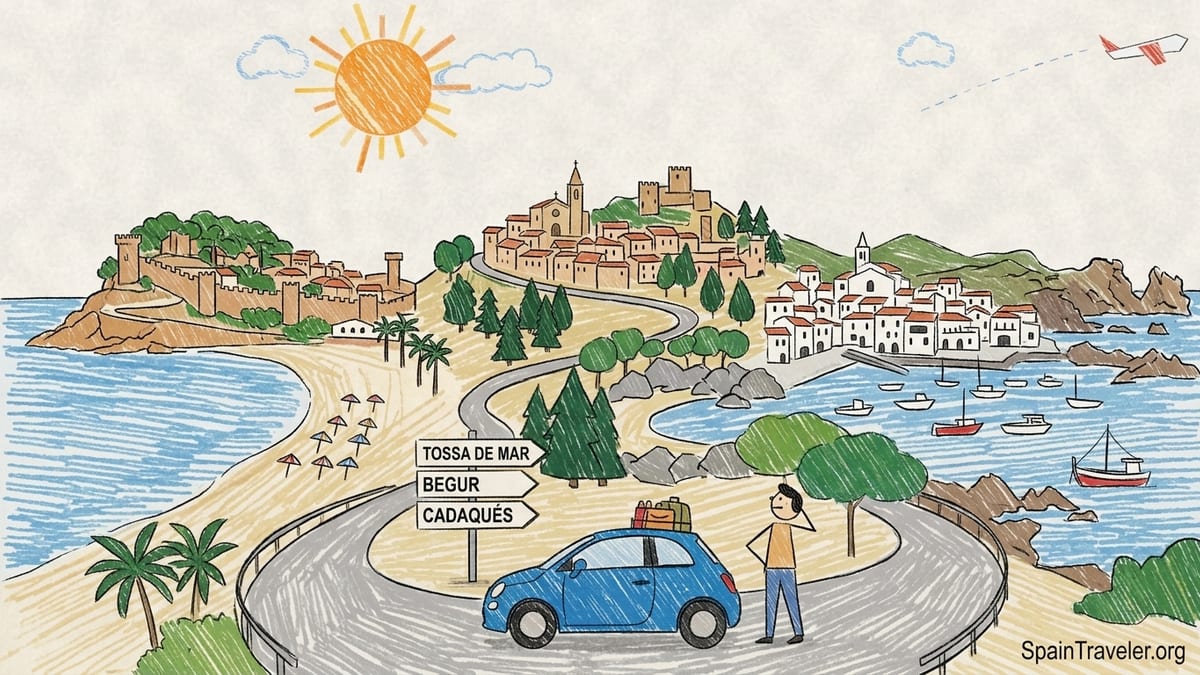
Over three separate trips to the Costa Brava I used Begur, Cadaqués and Tossa de Mar as my main bases, each for at least three nights. I parked in their lots, dragged suitcases up their hills, swum from their beaches and tried to find a late dinner when the day trips were done. This comparison is not theoretical. It is what worked and what frustrated me in each place, and when I would personally choose one over the others.
How I Ended Up Staying in All Three Towns
My first Costa Brava base was Tossa de Mar, a four night stay in early June when I wanted an easy landing after a flight into Barcelona. A few years later I split a September week between Begur and its nearby coves, and most recently I spent three nights in Cadaqués paired with a rental car loop around Cap de Creus. By that point I knew the coastal road curves well enough to compare how each town feels when you are tired, sandy and looking for dinner.
In Tossa I booked a mid range hotel one block behind Platja Gran, the main beach, because I wanted to see whether being close to the sand actually made me swim more. In Begur I deliberately stayed up in the hill town at a small hotel near the church square instead of beside the water, curious whether driving down to the coves each day would feel like a chore. For Cadaqués I chose a simple guesthouse a few minutes from the seafront promenade, mostly because anything directly on the main strip was already reserved months ahead.
Across the three trips I used the same basic setup. I rented a compact car in Barcelona, drove in on a weekday afternoon and tried to arrive before local siesta ended so that reception desks were open. That pattern made parking, check in and dinner easier to compare because I was always coming from the same starting point. What changed was the geography and culture of each town, and how that affected simple daily routines like going out for a morning coffee or deciding on a last swim at sunset.
Parking and Arrival: The First Stress Test
Tossa de Mar was by far the least stressful arrival. Driving up from Barcelona on the AP 7 and then the coastal road, I was able to follow clear signs for the central underground car park behind the main beach. The garage spaces were tight but manageable for a small rental, and the elevator brought me out within a short walk of my hotel. I remember paying what worked out to be a moderate daily rate for secure parking, and I did not need to move the car for two days because the beach and the walled old town were on my doorstep.
Begur took more thought. The town sits inland on a hill, and the roads wrap around it in a series of one way systems that are not intuitive on the first pass. On my September trip I followed signs up to one of the public car parks just below the historic center and abandoned the car there while I checked into my hotel on foot. The walk was only a few minutes but it was uphill, and I was glad I had packed a roller suitcase I could drag over cobblestones. On the plus side, once I understood the layout I could usually find a space in the same lot, which gave the week a reassuring routine.
Cadaqués was the only place where I briefly regretted having a car. The last part of the drive from Figueres crosses a winding mountain road, and on my summer arrival the bends were busy with day trippers. In town I had booked a guesthouse that did not have its own garage, so I looped once or twice on the narrow one way streets before giving up and heading for a paid public lot on the edge of town. It meant a luggage walk along the waterfront. The stroll was pretty, with white houses and boats in the bay, but I kept glancing back at the car park wondering how crowded it would be if I left for a day trip.
Hotel Choices and How the Bases Actually Felt
In Tossa de Mar my hotel behind Platja Gran was not luxurious, but as a base it worked extremely well. I could step out in flip flops, cross a small street and be on the sand in minutes. From my balcony I could see the top of the medieval walls on the headland, which helped me orient myself whenever I came back from a walk. The room insulation was just adequate, and on weekend nights I heard some bar noise from the streets behind, but closing the balcony doors handled most of it. The real luxury was not needing to think about transport. Everything for a classic beach holiday was right there.
Begur felt very different. My small hotel near the central square came with wooden shutters, tiled floors and a terrace that looked over terracotta roofs toward the sea in the distance. It felt more like a village inn than a coastal resort. I quickly learned that staying in hilltop Begur meant accepting the idea of short car rides down to the coves like Sa Tuna and Aiguablava, then returning in the evening to a quieter, more local atmosphere. As a base it suited me when I wanted to read on the terrace in late afternoon and only head down to the water once or twice a day.
In Cadaqués my guesthouse was perhaps the simplest of the three, but the town itself carried much of the experience. The room had whitewashed walls, basic furniture and a small balcony that looked over tiled rooftops to a slice of blue bay. What stood out was the way the sound of the sea and the church bells carried through town. I found myself using the room mainly to sleep and spent the rest of my time walking the promenade or sitting on rocks along the shore. As a base it felt more like staying in a small, lived in fishing town that had gradually taken on an artistic reputation, rather than a beach resort built around hotels.
Beaches, Coves and Coastal Scenery
If you want one large, central beach that you can visit multiple times a day without planning, Tossa de Mar is hard to beat. Platja Gran curves right beneath the fortified Vila Vella, with fine pebbly sand and clear water. On my June trip I took early morning walks along the shoreline before breakfast and evening strolls after dinner just to watch the castle walls light up. The convenience of being able to dip in for a quick swim and return to the hotel to change within minutes shaped the entire stay, and it is the main reason I think of Tossa first for a straightforward beach holiday.
Begur is almost the opposite. The town itself has no beach. Instead it serves as a base for a series of sheltered coves like Sa Tuna, Aiguablava, Sa Riera and Platja Fonda. Each one has its own character. On my Begur trip I drove down to Sa Tuna one morning, parked on the hill above the bay and walked down past stone houses to a tiny pebble beach with fishermen’s huts and turquoise water. Another day I set up on Aiguablava, where the sand is lighter and there are a couple of casual places for a coffee or a drink beside the shore. The scenery felt more intimate and rugged than in Tossa. Rocky headlands, pine trees and small inlets invited exploration. It did, however, require daily decisions about which cove to visit and where to park, which some travelers will enjoy and others might find tiring.
Cadaqués offered a different sort of coastal scene again. The main town beach is small and pebbly, and I rarely saw it as a place to spend an entire day. Instead I used it for a quick dip between walks or meals. The real visual drama came when I drove or walked out toward Cap de Creus. There the coastline turns wilder, with bare rock landscapes, wind brushed vegetation and small coves of clear water backed by strangely sculpted cliffs. I remember sitting on a rock above one of these inlets at sunset, watching boats anchor in the calm water below. It did not feel like a conventional beach resort, more like being on the edge of something elemental.
Restaurants, Walkability and Evening Atmosphere
All three towns are walkable once you are parked and settled, but they each have a distinct evening rhythm. In Tossa de Mar I spent most nights wandering the pedestrian streets behind the beach, choosing between tapas bars, seafood restaurants and gelato stands. Many places had menus in multiple languages and a relaxed, family friendly feel. I remember a dinner of grilled sardines and a simple salad at a terrace just outside the old city walls, with the castle towers lit above and children running on the sand below. It felt social, easygoing and slightly busier than I usually prefer, but never overwhelming in early June.
Begur’s evenings were calmer and more compact. The main square and surrounding lanes hold a mix of wine bars, restaurants and small boutiques, and it was easy to make a slow circuit before choosing where to sit. I had one especially good meal at a restaurant tucked under stone arches near the center, where the dishes leaned a little more toward creative Mediterranean cooking than simple beach fare. After dinner I would often take a short stroll to look at the illuminated castle on the hill. The vibe was closer to a small inland town that happened to have excellent access to the coast, with a noticeable mix of locals and visitors.
Cadaqués after dark struck a balance between the two. The waterfront promenade and the streets just behind it stayed lively, with people moving between small bars, seafood places and ice cream counters. Yet the soundscape was more about conversation and the occasional guitar from a bar than loud music. One evening I sat on a bench near the boats with a takeaway cone, listening to a group of locals argue good naturedly about football. Another night I found a table at a simple restaurant serving grilled fish and local wine, where the staff switched effortlessly between Catalan, Spanish and French. The town is compact enough that you are rarely more than a few minutes from the water, and the reflections of white buildings in the bay give the evenings a calm, almost theatrical backdrop.
Nightlife, Day Trips and How Busy Each Place Felt
I am not a late night club person, so my idea of nightlife is more about atmospheric bars and the ability to find a drink and some music after dinner. Tossa de Mar offered the most obvious options, with several bars and small clubs aimed at visitors staying in the town’s hotels and apartments. On weekend nights the streets behind the beach stayed lively until after midnight, and there was always another place open if I wanted a final glass of wine. In return for that convenience, the resort edge was more visible, especially in high summer when package holiday crowds arrive.
Begur’s nightlife felt lower key. There were bars around the main square where people lingered over gin and tonics, and a couple of places with live music on specific nights, but nothing that felt like a dedicated club strip. I liked that balance. It meant I could enjoy a long dinner and a drink without feeling that the evening should turn into something louder. The trade off was that after a certain hour the streets grew very quiet, and if you prefer to hop between several different venues late into the night, Begur as a hill town will not deliver that sort of scene.
Cadaqués sat somewhere between the two. There were a few bars with a mild bohemian feel, some with photos of visiting artists on the walls and playlists that ranged from jazz to indie. One bar near the waterfront became my go to for a nightcap, with a terrace that looked back toward the lit church. Most nights the town felt lively until around midnight and then gently wound down. The isolation of the town at the end of the road meant there were fewer large tour groups, and the visitors who stayed overnight tended to spread out along the promenade rather than concentrating in a single nightlife zone.
For day trips, Tossa de Mar works well if you want to combine the beach with quick excursions to nearby coastal viewpoints or inland towns. I used one day to drive further north along the coastal road, stopping at viewpoints over the cliffs, and another to visit a nearby village before returning to the main beach in late afternoon. Begur, by contrast, is an excellent hub for exploring multiple coves and sections of the coastal path, as well as making longer drives to other Costa Brava highlights. From Begur I easily reached places like Pals and Peratallada inland, which gave that trip a more varied feel. Cadaqués is more of an end point. From there my main excursion was deeper into the Cap de Creus peninsula and a visit to the house museum of Salvador Dalí in nearby Portlligat. The road back toward Figueres is beautiful but winding, so I planned fewer long day trips from Cadaqués than from Begur.
Which Base I Would Choose for Different Trips
After using all three as bases, I do not think there is a single winner. Instead there are clear situations where I would pick one over the others. If a friend told me they had five summer days on the Costa Brava, wanted to unpack once and spend most of their time on a single beach with a historic backdrop, I would point them toward Tossa de Mar. The combination of a broad central beach, the Vila Vella walls rising above it and a dense cluster of hotels and restaurants within a short walk made that stay feel like the easiest, least complicated holiday I have had on this coast.
If someone said they liked small coves, did not mind driving short distances and cared as much about evening atmosphere as midday swimming, I would suggest Begur. My week there felt like living in a small Catalan hill town that happened to have a string of beautiful beaches five to fifteen minutes away by car. I enjoyed waking up to church bells rather than surf, walking down to the main square for a coffee, then deciding which cove suited my mood and the wind that day. It suited a slightly slower, more exploratory trip, especially outside the peak of summer when parking at the coves was still manageable.
Cadaqués is the base I would choose for a more contemplative or creative trip, or as a final stop on a longer route through Catalonia. Its isolation at the end of the road means you feel you have arrived somewhere distinct. The mix of white houses, rocky shores and the stark landscapes of Cap de Creus gave that stay a mood that lingered after I left. I swam less there than in Tossa or Begur, but I walked more, sat on more rocks just looking at the sea, and felt more inclined to slow down. It is also the place I would return to in the shoulder seasons of May or late September, when the town is busy but not crowded.
If I had to commit to one for a hypothetical repeat trip right now, it would depend entirely on who I was traveling with. With children or friends who mainly care about sandcastles, easy swims and ice cream, I would book a hotel in Tossa behind the main beach without hesitation. With a partner who enjoys small restaurants, scenic drives and variety in swimming spots, I would reserve a room in Begur and rent a small car for the coves. Traveling alone, with a notebook and a camera, I would make the winding drive back to Cadaqués and accept the parking hassle in exchange for that bay and the stony paths of Cap de Creus.
The Takeaway
Using Tossa de Mar, Begur and Cadaqués as bases on different Costa Brava trips taught me that where you sleep shapes much more than your morning view. It determines how often you swim, how far you walk after dinner and whether driving feels like an outing or an obligation. Tossa offered the most straightforward classic beach base, Begur the richest choice of coves and a hill town atmosphere, and Cadaqués the most isolated and distinctive setting tied to wild coastal scenery.
I did not find any of them overrated. Instead I came to think of them as three answers to the same question. Do you want the ease of a main beach under castle walls, the variety of hidden coves spread around a village center, or the feeling of being out at the end of the peninsula with rocks and light that once drew painters. Matching the town to your priorities matters more than chasing an idea of the single best place on the Costa Brava.
If your time is short and your plans are already complex, Tossa will simplify the rest of your trip. If you can give the coast a full week and like the idea of discovering a different cove each day, Begur will reward the extra driving. If you are willing to go a little further for atmosphere and do not mind narrow roads and limited parking, Cadaqués will stay with you long after you leave. Having stayed in all three, I would happily return to any of them, as long as I knew in advance what kind of trip I wanted them to shape.
FAQ
Q1: Which town is best if I do not want to use a car once I arrive
Tossa de Mar worked best for me without a car because the main beach, historic walls and most restaurants are within a few minutes’ walk of central hotels.
Q2: Where did you find parking the most stressful
Cadaqués felt the most stressful for parking due to the narrow streets and limited spaces, especially in peak season, so I relied on paid public lots at the edge of town.
Q3: Which base is better for exploring multiple small coves
Begur was my preferred base for coves because I could drive short distances to places like Sa Tuna, Aiguablava and Sa Riera while returning to a calm hill town in the evening.
Q4: If I want a classic beach under historic walls, where should I stay
Tossa de Mar is the clear choice for that combination, with its main Platja Gran sitting directly beneath the fortified Vila Vella and its towers.
Q5: Which town felt most atmospheric in the evening
Cadaqués felt the most atmospheric to me, with white houses reflecting in the bay, low key bars and the sound of the sea carrying through narrow streets.
Q6: Is Begur inconvenient because it is not directly on the coast
For me Begur was not inconvenient, but it did require short drives or bus rides to reach the coves, which you should factor in if you prefer walking straight to the beach.
Q7: Which place would you pick in high summer for a first Costa Brava trip
For a first summer visit I would pick Tossa de Mar, since it offers a large central beach, clear signage, many accommodation options and a straightforward arrival by car or bus.
Q8: Where did you eat the best food overall
My most memorable meals were in Begur, where small restaurants in the historic center served thoughtful Mediterranean dishes in a more local feeling setting.
Q9: Which town suits a quieter shoulder season stay
In May or late September I would choose Cadaqués, when the roads are less busy, Cap de Creus feels wild but accessible and the town is lively without being crowded.
Q10: If I want both coves and a big beach, can I combine bases
On one trip I would stay several nights in Begur for coves, then move to Tossa de Mar for a few nights of easy big beach access under the castle walls.