


On my first Costa Brava trip I did what everyone tells you to do and rented a car, gliding between hidden coves on a winding coastal road. On my second trip I did the opposite. I landed at Girona Costa Brava Airport with a backpack, no rental booking and a promise to myself that I would rely entirely on public transport. What followed was a mix of pleasant surprises, empty bus bays, awkward luggage hauls and long walks that taught me exactly where the Costa Brava works without a car and where, quite frankly, it still does not.
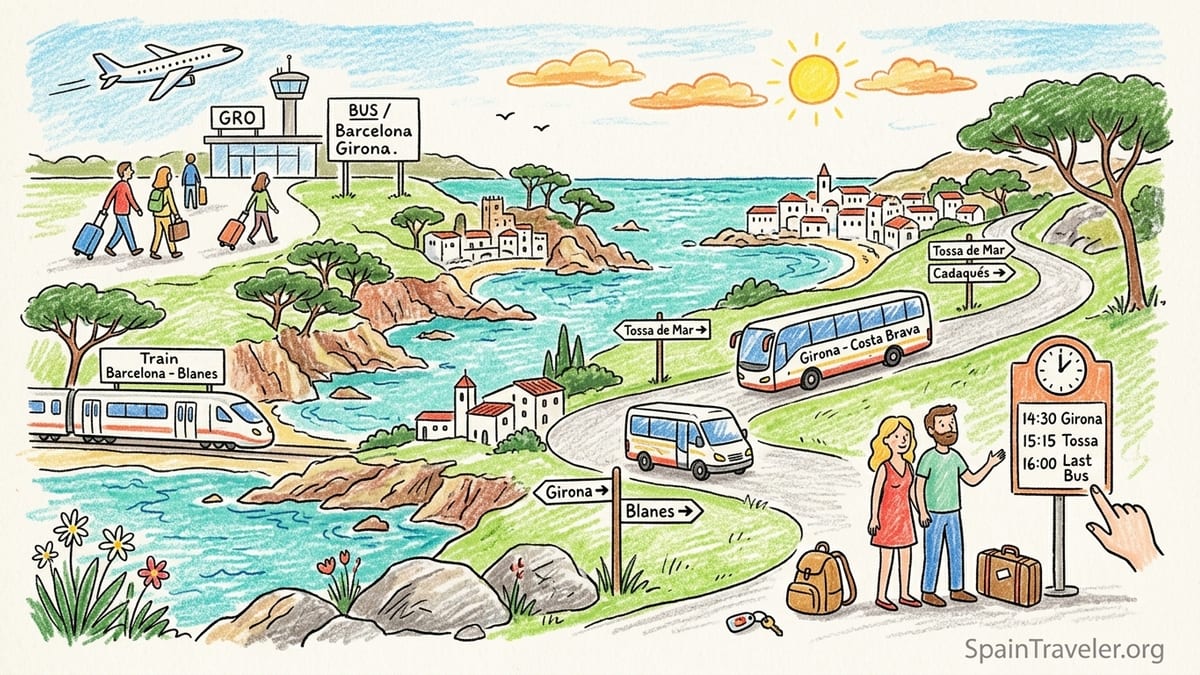
Arriving at Girona Costa Brava Airport With No Car Key
I arrived at Girona Costa Brava Airport (GRO) on a spring afternoon with a low-cost airline crowd, the kind that has clearly been sold the idea of the Costa Brava as a quick escape. Instead of heading to the rental desks, I followed the small stream of people walking past them toward the exit signed for "Bus / Barcelona / Girona." Just outside the terminal doors, slightly to the right, there is a compact bus area where the regional operator runs routes to Girona city, Barcelona and several Costa Brava and Maresme towns. The entire public transport experience starts here, and it immediately feels more improvised than the clean, predictable rental car ritual.
The main airport bus to Girona city uses a simple setup. There is a clearly marked stand with the Girona destination, and a small timetable sheet taped inside a display case. Tickets were sold directly by the driver in cash and card when I visited, with a short queue forming as passengers explained their destination one by one. For Barcelona, a separate, longer-distance coach departed from a neighboring bay, filling mostly with passengers heading straight to the city rather than the coast. The striking thing for me, after two trips through this airport, was how the buses are still scheduled around flight banks. If you land on a mid-morning arrival wave, you see several departures clustered. Land late at night, and your options narrow quickly.
On my car-based trip years earlier, I left the airport car park within 20 minutes of landing and was on the highway toward Tossa de Mar almost immediately. Without a car, my timing depended on the next bus. On my most recent visit, I waited about 40 minutes for the Girona city bus, watching passengers for Lloret de Mar gather with increasing anxiety as they realized their direct airport bus ran only a couple of times that afternoon. Several ended up pooling for a taxi after seeing that missing one bus would push their arrival to well after dark. That is the first lesson of Costa Brava without a car: your trip starts and ends at the timetable, not at the steering wheel.
From an airport logistics perspective, luggage is manageable but more exposed when you choose buses. The under-floor luggage holds on the Girona and Barcelona coaches are straightforward, but smaller Costa Brava buses often have only a small hold or racks at seat level. On my Lloret connection, I ended up with my backpack under my knees and a small suitcase sliding forward every time the driver tapped the brakes on a coastal curve. It is not a disaster, but it feels very different from tossing your bags in a car boot and forgetting about them.
Girona City as a Public-Transport Hub
Girona itself is an underrated hub if you are traveling without a car. After the airport bus dropped me near the main bus and train area on the western edge of the historic center, I realized how compact the transfer actually is. The train station and the main intercity bus station sit essentially side by side, connected by a short, signposted passage. Within a few minutes you can move from a regional coach to a Renfe train platform, which makes Girona a more predictable base than the fragmented coast if you plan to string together several day trips.
For my car-free stay, I chose a small hotel in Girona’s old town, about a 15-minute walk from the station. That walk with a rolling suitcase over cobblestones is a small price for the flexibility Girona gives you. There are frequent regional and high-speed trains to Barcelona, Figueres and the French border, plus buses radiating out to coastal towns like L’Estartit, Palamós and Sant Feliu de Guíxols. Tickets for the regional trains and most buses could be bought on the day, either from station machines or directly from drivers, which meant I could plan around the weather rather than a fixed car itinerary.
However, even Girona’s convenient layout does not change the fact that coastal services thin out in the evening and shoulder seasons. One night I took an early evening bus back from Sant Feliu de Guíxols, a town I had easily reached that morning. I intentionally rode the second-to-last bus to stretch out my seaside dinner. Standing at the stop in the gathering dusk, I realized that if that bus had been cancelled, the last departure an hour later would have been my only lifeline back to Girona without a taxi. There were no trains, no alternative routes. In a car you leave when you are ready. Without one, you constantly run mental calculations about “last bus” cutoffs.
Compared with a previous trip where I drove from Girona to lunch in Pals, afternoon coffee in Begur and sunset at Platja de Castell in a single day, my public-transport version of Girona was narrower but calmer. I did not race between villages. Instead I built whole days around one or two places, aligned strictly with bus and train windows. Girona itself became enjoyable in a way it had not when it was only a road junction on my mental map.
The Train to the Coast: How Far Rail Really Gets You
Most first-time visitors assume there is a simple coastal train that runs the full length of the Costa Brava. In reality, the rail line from Barcelona follows the Maresme coast and reaches only as far as Blanes, which many maps consider the southern gateway of the Costa Brava proper. From central Barcelona stations like Plaça de Catalunya or Sants, I took the R1 commuter train that hugs the shoreline, stopping in places such as Badalona, Mataró and Calella before turning slightly inland to reach Blanes. The journey takes a little over an hour, and in summer extra services are often added, but Blanes is where the train story ends.
Stepping out at Blanes station on my car-free trip was a small reality check. The station is not on the seafront. It sits inland, about a 20 to 25-minute walk from the beach, and there is a local bus that shuttles down to the promenade. When I had visited Blanes by car, I had simply followed the road signs to the central parking area and walked straight to the harbor. Now, I waited in a small cluster of travelers outside the station for the local bus that loops down toward the seafront and onward to Lloret de Mar. The connection works, but it adds another layer of timing and a short ride across suburban streets that strips some of the romance from the idea of “coastal train direct to the beach.”
On my public-transport itinerary I used Blanes as a pivot. One day I arrived mid-morning, walked through town to the Sa Palomera rock that symbolically marks the start of the Costa Brava coastline, swam, and then caught an afternoon bus onward to Lloret de Mar. Another day, I reversed the direction, taking an early bus from Lloret to Blanes station, then a train back to Barcelona in time for a late dinner. The train itself was comfortable enough, with air-conditioned carriages and space for luggage, but peak-season crowds meant standing for sections of the journey if I caught a train just after lunchtime.
For anyone imagining a rail-based exploration of each Costa Brava village, it is important to underline that beyond Blanes you are in bus, boat and taxi territory. There are no stations in Tossa de Mar, Begur, Calella de Palafrugell, Llafranc, Tamariu, Cadaqués or Port de la Selva. The train helps you reach the region cheaply and reliably from Barcelona, but it does not solve the problem of linking one postcard-perfect cove to the next.
Bus Realities: Easy Bases vs Hard-to-Reach Villages
If the train is a blunt instrument that simply gets you to the edge of the Costa Brava, the bus network is the scalpel that actually lets you move along it. My experience was that some towns are remarkably viable without a car, while others are frustrating to the point of changing your plans halfway through the trip. Tossa de Mar, Lloret de Mar, Blanes and Sant Feliu de Guíxols fell into the “works well” category. Places like Sa Tuna, Aiguablava, Tamariu and some of the calas around Palamós and Platja d’Aro belonged firmly in the “beautiful but impractical without wheels” group.
From Barcelona’s Estació del Nord, I booked a direct coach to Tossa de Mar on a trip where I wanted to compare my car and bus experiences. The bus pulled out of the city, sped up the highway and reached Tossa in around an hour and a half, dropping us a short walk from the old town walls and Platja Gran. Luggage went into a proper under-floor hold, and tickets were sold with reserved seats. There were enough daily services that I never felt trapped, and the town itself was compact enough that I did not miss having a car once I had arrived. My days revolved around the main beach, the path around the headland, and short local walks to nearby viewpoints.
Lloret de Mar was similar. Whether I arrived via the airport bus from Girona, the train-plus-bus combination via Blanes, or a direct coach from Barcelona, each option deposited me within easy walking distance of my hotel and the seafront. The town is dense, touristy and somewhat chaotic, but from a public-transport perspective it works. I could get groceries, reach the beach, and catch early or late buses without much stress. The price I paid was the loss of spontaneity. On my driving trip, Lloret had been a mere base for exploring further afield. Without a car, I was effectively committed to Lloret and its immediate surroundings, unless I wanted to gamble on tight bus connections.
The contrast became clear when I tried to reach smaller coves around Begur. I had once driven effortlessly from Begur town to Sa Tuna and Aiguablava, snaking down steep roads and parking in small lots above the beaches. Replicating that with buses proved awkward. I could reach Begur by a combination of regional buses, but the final legs to the coves depended on seasonal shuttle services that did not always match my travel dates or times. One afternoon I walked more than an hour downhill from the town toward a cove after realizing the next small bus was not scheduled for the day I visited. The return hike in the heat, uphill with beach gear and water, made it clear why so many locals see these places as car destinations.
Timetable Gaps, Missed Connections and Luggage Challenges
The biggest adjustment when exploring the Costa Brava without a car is not distance but rhythm. Trains and buses do not run in a continuous, metro-style pattern along the entire coast. Instead, they pulse in clusters, with clear gaps in the middle of the day and late at night. I learned this the hard way between Girona and the coastal resort of L’Estartit. I set out late morning, caught a comfortable regional bus, and arrived in time for lunch and a stroll along the long sandy beach. The trouble came when I tried to plan my return.
The afternoon timetable revealed a long gap between mid-afternoon and evening buses back to Girona. If I missed the early evening departure, the next one would deliver me to Girona quite late, leaving a narrow window to walk back to my hotel through mostly quiet streets. That knowledge altered my entire day. Instead of lingering by the harbor and exploring side streets, I watched the clock and sat near the bus stop long before my departure. When I traveled by car, I had once left L’Estartit spontaneously after sunset, following back roads to Girona as the sky darkened. Without a car, I was in my seat on the bus before the sun had even touched the horizon.
Missed connections are another constant worry. On one itinerary I took the R1 train from Barcelona to Blanes and planned a tight transfer to a local bus for Lloret de Mar. The train ran a few minutes behind schedule due to minor delays on the line, a common occurrence in the region. That was enough for the Lloret bus to leave just as I exited the station. Standing in the heat with my backpack, I watched it pull away and checked the posted timetable. The next departure was in almost an hour. It was not catastrophic, but the wait felt particularly long with luggage and the knowledge that, in a car, that transfer would have taken 20 minutes door to door.
Luggage shapes your decisions in smaller ways too. In theory, many Costa Brava villages are linked by walking paths, including stages of the Camí de Ronda coastal trail. In practice, those scenic walks are far more appealing when you can leave your bag in a car or hotel room. On my car-based trip I had happily walked from Platja d’Aro to smaller coves carrying only a daypack, then driven back to my accommodation afterward. On the bus-based trip, I faced the choice of walking coastal paths with a full backpack or limiting such walks to days when I could stay in the same hotel and travel light. The result was that I used buses as point-to-point tools and did fewer linear hikes.
Reaching Small Coves and Stringing Villages Together
The real test of the Costa Brava without a car is not getting to a main town. It is what happens when you try to connect several smaller coastal spots in a single day. On one car-free attempt to recreate a favorite driving loop, I started in Palamós, hoped to dip into Cala s’Alguer, continue to Platja de Castell, then finish in Calella de Palafrugell. By car this had once been an easy sequence, a day of short drives and beach hops. By bus, it quickly became apparent that I was pushing against the grain of the network.
Between Palamós and the outlying coves, there were limited local buses that did not always drop near trailheads. Taxis existed but were scarce during shoulder season afternoons, often busy with pre-booked transfers. I ended up compromising: taking a bus to a point near Platja de Castell, walking to the beach, and abandoning the idea of reaching Calella de Palafrugell the same day. The schedule simply did not allow for comfortable buffer time at each stop. It was a good day, but narrower and more constrained than the freewheeling car loop I remembered.
Another day, I based myself in Roses and tried to reach Cadaqués without driving. The main option was a regional bus that crossed the winding inland road, a trip that in a car had been scenic and flexible, with opportunities to stop at viewpoints. On the bus, I shared the ride with a mix of tourists and locals commuting for work. The bus took the same curves at speed, but there were no intermediate stops near viewpoints, and the timetable framed Cadaqués as a destination to visit for a full or half day, not as a jumping-off point to then walk to nearby coves and return somewhere else by evening.
Once in Cadaqués, it was clear that local walks to small coves and the Cap de Creus area were possible without a car, but they demanded time and willingness to tackle some distance on foot. I could walk to a couple of small beaches and back comfortably. Repeating that while also lining up a return bus on a limited schedule, though, made it difficult to string these walks together the way I once had when I could drive between trailheads. That tension between the coastline’s fragmentation and the bus timetables is the heart of the no-car challenge in the Costa Brava.
Where Public Transport Works Well and Where It Frustrates
After using only trains and buses on one trip and mostly a car on another, I came away with a clear mental map of which Costa Brava experiences fit each mode. For travelers without a car, Girona city itself, Blanes, Lloret de Mar, Tossa de Mar, Sant Feliu de Guíxols and L’Estartit all worked well. They have direct or straightforward bus links from Girona, Barcelona or the airport, central drops near the seafront or old town areas, enough daily departures to avoid feeling trapped, and town layouts that keep beach, accommodation, restaurants and shops within walking distance.
In these places, giving up the car actually improved my stay. I spent more time lingering on promenades, exploring back streets and watching evening life in town squares instead of hunting for parking or worrying about late-night drives on unfamiliar coastal roads. In Tossa de Mar, for example, walking up to the lighthouse on the headland and back to town, knowing my bus back to Barcelona left from a clearly marked stop by the roundabout, created a contained, relaxing rhythm. In Lloret, the immediate area felt more hectic, but the convenience of being dropped almost at my hotel made arrival and departure painless.
The frustration concentrated in smaller or more scattered areas: the coves around Begur such as Sa Tuna and Aiguablava, the smaller calas outside Palamós and Platja d’Aro, and some parts of the Cap de Creus peninsula. Here, the absence of train stations, the limited frequency of local buses, and the distance between beach access points and any main road combined to make car-free exploration feel like a patchwork of long walks, occasional taxis and careful timing. On a couple of days I simply abandoned secondary coves on my plan after realizing that the bus I would need back to town ran only once or twice in the late afternoon.
My conclusion was not that public transport in the Costa Brava is unusable. It is that it is best suited for picking a good base and sinking into it, rather than treating the entire coast as a menu of day trips. A traveler who chooses Tossa de Mar or Sant Feliu de Guíxols, arrives by direct bus, and spends several days exploring nearby walks and beaches on foot will likely be happy. Someone who dreams of visiting half a dozen tiny coves between Palafrugell and Palamós in three days, however, will almost certainly find themselves staring at bus timetables more than at the sea.
The Takeaway
Traveling the Costa Brava without a car taught me two parallel truths. First, the region is more accessible by public transport than its “you must rent a car” reputation suggests, especially if you use Girona city, Blanes, Lloret de Mar, Tossa de Mar, Sant Feliu de Guíxols or L’Estartit as hubs. Trains and buses can handle airport arrivals, city transfers and straightforward beach holidays at a reasonable cost, often with tickets available on the day. For solo travelers or couples who prefer not to drive, that is encouraging news.
The second truth is that the coastline’s very charm, its broken line of headlands, coves and hillside villages, still heavily rewards those with their own wheels. Buses and occasional shuttles cannot fully match the convenience of pulling into a tiny parking area above a cala, spending as long as you like in the water, and then driving ten minutes to the next hidden beach. If your dream trip involves a long list of small coves between Begur and Palamós or repeated forays into Cap de Creus, you will need either a car, substantial taxi budgets or a willingness to treat those ambitions as a multi-day hiking project rather than a string of casual stops.
Looking back across both my car-based and car-free trips, the balance I would now recommend is simple. Embrace public transport when it lets you combine an easy base with stress-free arrival and departure. Accept its limits when you move beyond the bigger towns. And if you fall in love with one particular cove or village while riding the bus or train, consider it an invitation to come back another year, rent a small car, and trace the gaps in the coastline that buses cannot fill.
FAQ
Q1. Can you visit the Costa Brava without renting a car at all?
Yes, you can visit several Costa Brava towns without a car if you are realistic. Girona, Blanes, Lloret de Mar, Tossa de Mar, Sant Feliu de Guíxols and L’Estartit have workable bus or train links and compact centers where you can walk almost everywhere you need once you arrive.
Q2. How do you get from Girona Costa Brava Airport to the coast by public transport?
From Girona Costa Brava Airport you can take regional buses that connect to Girona city, Barcelona and some coastal towns, as well as south-coast and Maresme services. Schedules are coordinated with flight arrivals, so you usually buy tickets from the driver at the airport, but evening and off-season options can be limited, which may require planning around specific bus departures.
Q3. Does the train from Barcelona run along the entire Costa Brava?
No, the coastal train from Barcelona only reaches as far as Blanes, commonly seen as the southern gateway to the Costa Brava. Beyond Blanes there are no rail stations in major Costa Brava villages such as Tossa de Mar, Begur, Llafranc, Tamariu or Cadaqués, so you must continue by regional or local buses, taxi or boat.
Q4. Which Costa Brava bases work best without a car?
The best bases I used without a car were Girona city, Blanes, Lloret de Mar, Tossa de Mar, Sant Feliu de Guíxols and L’Estartit. All of them combine relatively frequent public transport connections with walkable centers that keep beaches, restaurants and shops within a short stroll, so you do not depend on taxis once you are in town.
Q5. Which areas are hardest to reach by bus or train?
The most difficult places to reach without a car were smaller coves and scattered beaches, especially around Begur, between Palamós and Platja d’Aro, and deeper into the Cap de Creus peninsula. These spots often lack nearby train access and have limited local buses, which can mean long walks from main roads, dependence on seasonal shuttles or the need to book taxis in advance.
Q6. How big a problem are timetable gaps on the Costa Brava?
Timetable gaps are significant enough that they shape your days. Many regional and coastal buses run in clusters around morning and late afternoon periods, with fewer services at midday and at night. Missing an early evening bus can mean waiting an hour or more, or arriving back at your base quite late, so you often leave beaches or villages earlier than you would if you had a car.
Q7. Is it practical to visit several villages in one day without a car?
In my experience, trying to visit several Costa Brava villages or coves in a single day using only public transport becomes stressful. You end up watching bus timetables, compromising on how long you stay in each place, and risking missed connections. It is usually better to focus on one main town or beach per day when relying on buses and trains.
Q8. What about luggage when using trains and buses on the Costa Brava?
Trains and longer-distance buses generally handle luggage well, with overhead racks and under-floor holds. Problems arise on smaller coastal buses, which may have limited space, leading you to keep bags under your seat or at your feet. This makes long walks between stops and beaches more tiring, so packing light is especially helpful when traveling without a car.
Q9. Are taxi and rideshare options a reliable backup?
Taxis are available in larger towns and at key hubs like Girona, Roses or Palamós, but they can be scarce in smaller villages or in shoulder seasons, especially in the afternoon. Rideshare apps are less widespread than in some other destinations. You should not assume you can always summon a car at short notice from a remote cove, so taxis work better as planned connectors than last-minute solutions.
Q10. If I hate driving, is public transport on the Costa Brava still worth it?
If you dislike driving, public transport is still worth using on the Costa Brava as long as you adjust your expectations. Choose one or two well-connected bases, give yourself plenty of margin between buses, and focus on deeper exploration of a smaller area rather than trying to tick off every famous cove. In return, you avoid parking stress and can enjoy the coast at a gentler pace.