


From whitewashed Balearic coves to the volcanic cliffs of the Canaries, Spain’s islands offer very different moods depending on where you stay. The right resort area can mean the difference between a week of airport-transfer strip and fry-ups, or pine-scented coves, traffic-free promenades and sunset cocktails. This guide breaks down the best islands and specific areas for beaches, nightlife, couples, families, luxury escapes, hiking and travelers who prefer not to rent a car.
Choosing the Right Spanish Island for Your Style of Trip
Before you zoom in on a particular resort, decide which group of islands fits your priorities. The Balearics in the Mediterranean (Mallorca, Menorca, Ibiza, Formentera) offer shorter flights from much of Europe, classic sandy coves and a strong summer season from roughly May to early October. They suit travelers who want pretty beaches, culture-rich old towns and good public transport, with nightlife hotspots concentrated in a few well-known areas such as Ibiza Town and Magaluf.
The Canary Islands, strung off the northwest coast of Africa, are a better fit for year‑round sunshine and a mix of black and golden sand beaches. Tenerife and Gran Canaria are the most developed, with large resort strips such as Costa Adeje or Playa del Inglés, but also quieter bases like Puerto de la Cruz or Agaete. These islands work well if you want reliable winter warmth, hiking in volcanic landscapes and large resorts with pools and kids’ clubs.
Menorca and parts of northern Mallorca feel best for slow, quiet holidays and car‑free promenades. Ibiza splits cleanly between party hubs and chilled coves, while Formentera is a low-rise, beach‑first island ideal for couples and independent travelers who do not mind relying on bikes and buses. If you know you will not drive, tilt towards compact areas with good bus links such as Palma de Mallorca, Puerto de la Cruz on Tenerife, Santa Eulalia on Ibiza or Corralejo on Fuerteventura.
Budget also plays a role in where to stay. For example, a mid‑range family room with breakfast in a beachfront four‑star in Alcúdia on Mallorca in August might cost in the region of 220–280 euros per night, while a comparable room in a quieter Menorcan resort could be slightly higher because there are fewer large hotels. In the Canaries, shoulder‑season prices in November can be noticeably lower than in peak Mediterranean summer, which matters if you are looking at all‑inclusive resorts with multiple pools and daily entertainment.
Mallorca: Best All-Rounder for Beaches, Nightlife and Car-Free Bases
Mallorca suits travelers who want one island that can do a bit of everything. For nightlife, the resort of Magaluf on the southwest coast remains the liveliest choice, with big beach clubs, late‑night bars and large hotels close together. Many younger groups stay in simple three‑star properties a short walk from the beach, while nearby Palmanova gives a similar sandy bay but with a calmer, more family‑friendly feel and easier early nights.
Families and beach-first visitors often gravitate to Alcúdia and Playa de Muro on the north coast. Alcúdia Bay offers several kilometres of wide, gently shelving sand and shallow water, which is particularly reassuring with younger children. The area is filled with apartment‑style hotels and all‑inclusive resorts where kids’ pools, slides and buffet restaurants make life easy. Expect a practical resort atmosphere with supermarkets, mini‑golf and casual restaurants rather than boutique minimalism.
For couples and travelers keen on atmosphere, Palma de Mallorca works very well without a car. The compact old town offers historic buildings, tapas bars and boutique hotels in restored mansions, often with roof terraces looking across the cathedral or marina. From Palma’s bus station you can day‑trip to Sóller by train and tram, reach beaches at Illetes or Portals Nous, or take a bus north to Port de Pollença for a change of scenery. A taxi from the airport to central Palma typically takes about 15 minutes, so you can realistically manage a whole stay on public transport.
If hiking and quiet coves matter most, look at smaller bases in the Serra de Tramuntana such as Port de Sóller, Deià or Valldemossa. Port de Sóller combines a small sand beach, a waterfront tram line and access to popular walking routes like the path to the lighthouse or sections of the long‑distance GR 221. Many visitors stay in mid‑range hotels around the horseshoe bay and then use local buses or organized hiking transfers into the mountains, keeping driving stress off the agenda.
Ibiza & Formentera: Where to Stay for Party, Style or Sleepy Coves
Ibiza has a stronger split between clubbing and calm than any other Spanish island, which makes choosing your base critical. For nightlife, Ibiza Town and nearby Playa d’en Bossa are the main hubs. Ibiza Town’s harbor area is packed with cocktail bars and restaurants, and buses and taxis link directly to superclubs like Pacha, while Playa d’en Bossa lines up large beachfront hotels and day‑to‑night venues. Travelers here often stay in modern resorts with pool parties and late check‑outs, accepting some night‑time noise in exchange for being close to the action.
Those who like a social scene but want more balance tend to choose San Antonio Bay or the Talamanca area across the bay from Ibiza Town. San Antonio’s sunset strip is famous, yet if you pick a hotel along the bay rather than in the very centre you can walk to bars and boat trips while escaping some of the busiest streets at night. Talamanca offers a long sandy beach, several boutique hotels and restaurants, and you can walk or take a short taxi ride into Ibiza Town for evenings out, which works well for couples wanting a mix of beach time and culture.
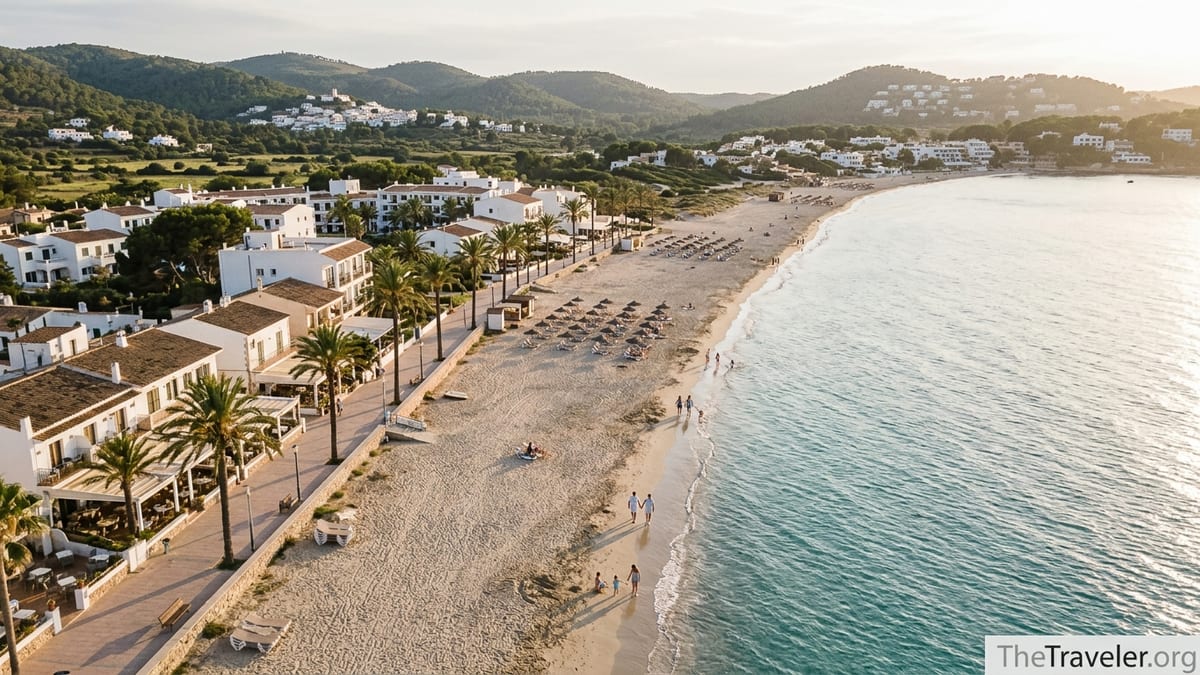
For a quieter, more family‑friendly Ibiza, look at Santa Eulalia on the east coast, Cala Llonga nearby or Portinatx in the north. Santa Eulalia has a calm town beach, palm‑lined promenade and a marina, with many mid‑range hotels and self‑catering apartments. It is seen locally as one of the most relaxed, food‑focused resort towns on the island. Cala Llonga sits in a sheltered bay with shallow water, popular for younger children, while Portinatx offers several small sandy beaches backed by pine‑covered hills and a slower pace that suits both families and couples seeking downtime.
Formentera, reached by ferry from Ibiza, is all about beaches. Many visitors stay near Es Pujols, where low‑rise hotels and apartments sit within walking distance of restaurants and a fine white‑sand beach. Couples looking for more seclusion often choose small guesthouses or agriturismo‑style stays inland and cycle or scooter to beaches such as Platja de Ses Illetes. Car‑free travelers can rely on the island bus network in summer, but the scale of Formentera makes bicycles and e‑bikes especially practical, with dedicated paths running parallel to main roads in several sections.
Menorca: Quiet Coves and Relaxed Family Holidays
Menorca is the quietest of the larger Balearic islands and a strong choice for travelers who prioritize low‑rise resorts, relatively uncrowded coves and a more local feel. Many of the island’s best beaches are small, horseshoe‑shaped bays with turquoise water framed by pines. This makes Menorca appealing for families and couples who prefer cove‑hopping and coastal walks to long party nights.
For a practical beach base with facilities, families often choose resorts in the south such as Cala Galdana, Cala’n Bosch or Son Bou. Cala Galdana, for example, offers a deep, sheltered bay with a large main hotel, apartment complexes, boat rentals and a handful of restaurants. Walking paths lead to famous unspoilt coves like Cala Macarella and Cala Mitjana, although these can involve some hiking and steps, so they suit reasonably active visitors. Son Bou has the island’s longest sand beach, with a mixture of villa developments and hotels, comfortable for those who want easy, repeatable beach days.
Travelers who want more of a town atmosphere often base themselves in Ciutadella on the west coast or Mahón in the east. Ciutadella’s old streets, small harbor and lively restaurants make it appealing for couples, and frequent buses connect to nearby resort beaches such as Cala en Blanes or Cala en Bosc in high season. Mahón, the capital, has a dramatic natural harbor, markets and a handful of boutique hotels set in old townhouses. From either town you can combine evenings in local squares with daytime exploration by bus, organized excursion or occasional taxi.
Menorca’s bus network connects major towns and popular beaches more in July and August than in shoulder seasons, so it is important to check current timetables if you will not rent a car. Some visitors still choose to stay mainly in one resort and only plan a small number of day trips. Others rent bikes for short distances. If you know you enjoy exploring many different beaches in a single week, a car will give far more flexibility, but if you are happy to focus on a couple of local coves and relax, a car‑free stay in a south coast resort or in Ciutadella can work smoothly.
Canary Islands: Winter Sun, Hiking and Large Beach Resorts
The Canary Islands are particularly attractive if you want a beach or hiking break outside the main European summer. Tenerife offers some of the broadest choice of resort styles. In the south, Costa Adeje, Playa de las Américas and Los Cristianos blend into one long developed strip with large hotels, apartment complexes, shopping centres and long promenades. This area suits travelers seeking reliable sun, multiple pools, evening entertainment and family‑friendly facilities in winter, accepting that the atmosphere is more international resort than traditional town.
Further north on Tenerife, Puerto de la Cruz offers a different balance, with traditional Canarian architecture, plazas and the famous seawater pools at Lago Martiánez. The town is hilly in parts but walkable, with many three‑ and four‑star hotels in older buildings or low‑rise complexes. For car‑free travelers, Puerto de la Cruz works well: the central bus station connects to hiking areas in the Anaga mountains, to Teide National Park via organized excursions, and to a string of local beaches. Cooler temperatures than the south are a trade‑off for more local flavor.
Gran Canaria’s main southern beach resort strip runs from Maspalomas and Meloneras through Playa del Inglés to San Agustín. Maspalomas and Meloneras have wide promenades, golf courses and many larger four‑ and five‑star hotels, convenient for winter‑sun package holidays and families. Playa del Inglés is busier and somewhat more nightlife‑oriented, although still with a wide beach and many mid‑range apartments. Buses make it easy to move between these areas without a car, and coastal walks along the seafront are popular daily routines for visitors.
For a quieter vibe within the Canaries, consider Puerto de Mogán on Gran Canaria, a compact marina village with low‑rise apartment hotels and a small sandy beach. Corralejo on Fuerteventura mixes a walkable centre with access to long dunes and surf beaches, drawing a blend of families, kitesurfers and independent travelers. On Lanzarote, Playa Blanca and Costa Teguise offer family‑friendly resort setups, while the village of Puerto del Carmen combines a long beach with a bit more nightlife and a mix of older and newer hotels. In all of these places the climate is milder in winter than much of Europe, so heated hotel pools and sheltered terraces are selling points from November through March.
Best Areas for Car-Free Travelers
If you prefer not to drive, look for compact towns with a central bus station, walkable restaurants and at least one good local beach. Palma de Mallorca is a prime example: you can step out of a boutique hotel in the old town, walk to dozens of tapas bars, then the next morning catch a bus to Port de Sóller, Port de Pollença or nearby beaches without worrying about parking. Similarly, Puerto de la Cruz on Tenerife and Las Palmas on Gran Canaria give you city infrastructure, seafront promenades and regular intercity buses, which makes combining culture and nature relatively straightforward.
On Ibiza, Santa Eulalia and Ibiza Town are the strongest bases for car‑free stays. Santa Eulalia’s promenade is flat and easy to navigate, with supermarkets, bakeries and pharmacies all within a few blocks. Buses link to central Ibiza Town, some beaches and the airport in summer. Ibiza Town’s central bus terminal connects to most of the island’s main resorts and beaches in high season, so you can plan a week of daytime cove‑hopping and evening clubbing without needing a rental car. Choosing accommodation within a short walk of the terminal keeps early‑morning or late‑night transfers manageable.
In the Canaries, staying directly in resort strips such as Costa Adeje, Maspalomas, Playa Blanca or Corralejo means you can walk to beaches, supermarkets and restaurants along the seafront, then rely on tour buses for inland volcano or hiking excursions. Many hotels advertise pick‑up points for these trips right outside reception. In smaller Balearic resorts such as Cala Galdana or Alcúdia, a car is useful but not essential if you are content to spend most days on the local beach and take only a few organized boat trips or bus excursions during your stay.
To make a car‑free island holiday smoother, focus your search filters on phrases like “near bus stop,” “central location,” and “walk to beach.” When reading reviews, look for comments about walking distances, hills and late‑night noise. A hotel that appears perfect on a map might sit up a steep road or on a busy roundabout. In many Spanish island resorts, booking slightly back from the absolute beachfront can reduce noise from bars and give better value, while still being a three‑ to five‑minute walk from the sand.
Matching Islands and Resorts to Different Types of Travelers
For families with young children, the safest bets are wide, shallow beaches with plenty of nearby facilities and traffic‑light promenades. Alcúdia and Playa de Muro in Mallorca, Santa Eulalia and Cala Llonga in Ibiza, several south Menorca resorts such as Son Bou or Cala Galdana, and southern Gran Canaria’s Maspalomas or Playa Blanca on Lanzarote all provide that combination. Look for hotels advertising family rooms, kids’ clubs, splash pools and early meal times, and note that many Spanish properties consider children over 11 as adults in pricing.
Couples may prefer smaller, atmospheric bases. Palma de Mallorca’s old town, Ciutadella in Menorca, Ibiza’s Talamanca area, Puerto de Mogán in Gran Canaria or Puerto de la Cruz on Tenerife all offer intimate restaurants, sunset walks and boutique accommodation without being too remote. For a splurge, many island fincas and rural hotels in Mallorca’s interior or Ibiza’s countryside provide pools and design‑led rooms in converted farmhouses, usually best if you are happy to hire a car or budget for taxis to reach beaches and restaurants.
Nightlife‑driven travelers will focus on Ibiza Town and Playa d’en Bossa, San Antonio for a more budget‑friendly scene, and Magaluf or parts of Playa del Inglés in Gran Canaria. In these areas, late noise is part of the experience, so booking a hotel with modern soundproofing or rooms facing away from main strips can matter. Those who love hiking and nature should look at bases such as Port de Sóller in Mallorca, Teide‑accessible towns or Puerto de la Cruz in Tenerife, inland villages on Gran Canaria’s slopes, or quieter corners of La Palma or La Gomera served by ferries and buses for a more rugged feel.
Luxury seekers will find concentrations of five‑star resorts in Costa Adeje and Meloneras in the Canaries, along with high‑end properties around Ibiza Town, Santa Eulalia, parts of Formentera and along Mallorca’s southwest coast near Portals Nous and Andratx. These hotels typically offer large pools, spas, multiple restaurants and direct sea views, with room rates that climb in peak months such as August. Booking outside school holiday periods, or choosing May, June, September and October for Balearic trips, can secure similar quality at softer prices.
The Takeaway
Spanish islands reward travelers who match their base carefully to their holiday style. Mallorca works best as an all‑rounder, with everything from party strips to historic cities and mountain villages. Ibiza divides sharply between all‑night clubbing and calm, family‑friendly coves, while Menorca shines for quiet bays and relaxed town evenings. In the Atlantic, the Canaries combine winter sun with hiking and large beach resorts, particularly on Tenerife, Gran Canaria, Lanzarote and Fuerteventura.
Think first about what you want to walk to each day: a shallow family beach, a tapas‑lined old town, a clubbing strip or a mountain trailhead. Then choose islands and specific resort areas that match that picture, checking recent reviews for details on noise, public transport and beach conditions. Whether you base yourself in Palma’s old streets, a pine‑backed cove in Menorca or a dune‑side resort in Gran Canaria, the right choice of where to stay on Spain’s islands will shape how relaxed, social or adventurous your holiday feels.
FAQ
Q1. Which Spanish island is best for a first-time visitor without a car?
Palma de Mallorca is often the easiest first choice. You can stay in the compact city, walk to restaurants and sights, then use frequent buses and organized excursions for beaches and mountain villages.
Q2. Where should families with small children stay for shallow, safe beaches?
Resorts with long, gently shelving sand such as Alcúdia and Playa de Muro in Mallorca, Santa Eulalia or Cala Llonga in Ibiza, and Son Bou or Cala Galdana in Menorca are especially suitable.
Q3. What is the best area in Ibiza for nightlife?
Ibiza Town and nearby Playa d’en Bossa are the main nightlife hubs, with easy access to major clubs and late‑night bars. San Antonio is another popular, more budget‑friendly option.
Q4. Which islands suit couples wanting quiet, romantic breaks?
Menorca’s Ciutadella or south‑coast coves, Palma’s old town, Port de Sóller, Puerto de la Cruz on Tenerife, Puerto de Mogán on Gran Canaria and parts of Formentera all work well for relaxed, romantic stays.
Q5. Are the Canary Islands better than the Balearics for winter holidays?
Yes, generally. The Canaries sit further south and usually offer milder, sunnier weather from November to March, while Balearic islands can feel cool and changeable in winter.
Q6. Where can I stay for good hiking as well as beach time?
Port de Sóller and other Tramuntana villages in Mallorca, Puerto de la Cruz and towns near Teide National Park in Tenerife, and inland Gran Canaria bases combined with coastal day trips are all strong options.
Q7. Which resorts are best avoided if I want a very quiet holiday?
Areas known for concentrated nightlife such as Magaluf in Mallorca, Playa d’en Bossa and central San Antonio in Ibiza, and parts of Playa del Inglés in Gran Canaria can feel too loud for those seeking real peace.
Q8. How far in advance should I book accommodation on Spanish islands?
For peak summer months and school holidays, booking three to six months in advance is sensible, especially for family rooms, small boutique hotels and car‑free, seafront locations.
Q9. Are all-inclusive resorts a good idea on these islands?
They can be practical for families or budget planning, particularly in larger resorts like Costa Adeje, Maspalomas, Alcúdia or Playa Blanca. Independent travelers often prefer bed‑and‑breakfast to enjoy local restaurants.
Q10. What is a realistic nightly budget for mid-range accommodation?
In high summer, a mid‑range double room in a well‑located three‑ or four‑star hotel often falls somewhere around 150 to 250 euros per night, depending on island, resort and exact dates.