


Choosing where to stay in Andalusia matters more than in many regions of Europe. Distances are short, but heat, luggage and parking can quickly turn a dream trip into a slog if you pick the wrong base. This guide focuses on bases rather than individual hotels, helping you match cities, coasts and white villages to your style of travel and the time you have.
How to Think About Bases in Andalusia
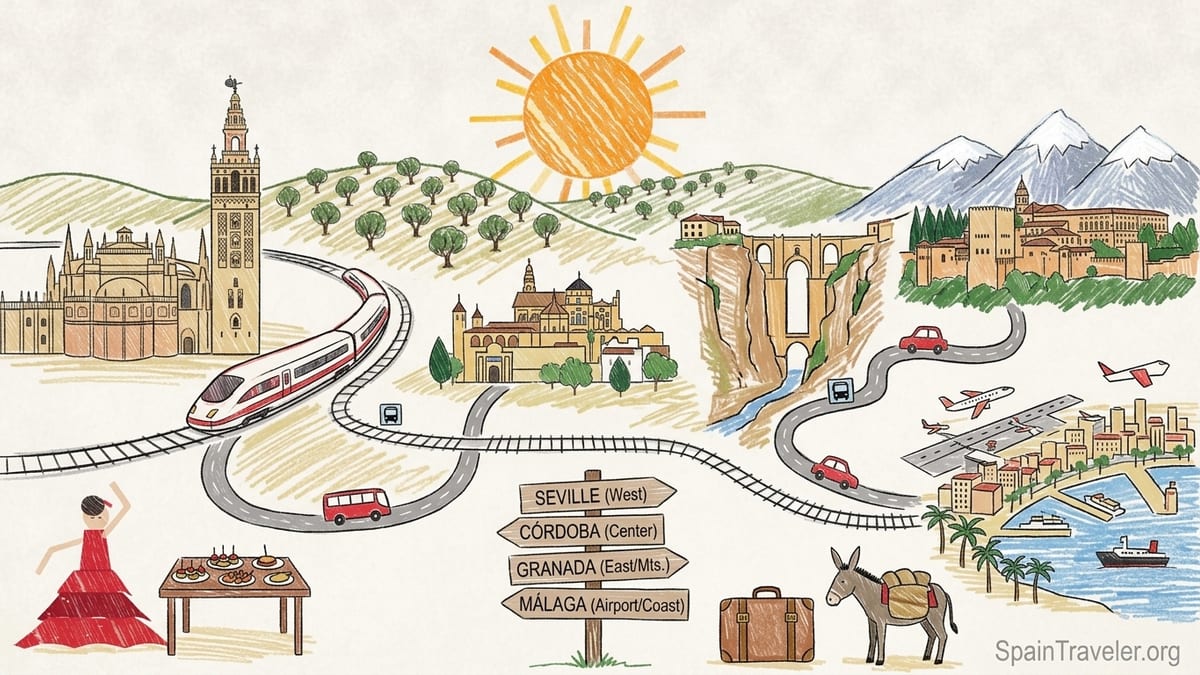
Andalusia is a big region of southern Spain that stretches from Atlantic surf beaches near Cádiz to the desert edges around Almería. High speed rail links Seville, Córdoba, Málaga, Granada and Antequera, and a web of buses fills the gaps between white villages and coast. The region is served by six commercial airports, with Málaga and Seville handling most international traffic and Granada, Jerez, Almería and Córdoba offering more limited connections. This means you can easily fly into one city and out of another, but you do need to decide where it makes sense to sleep.
The first choice is strategic. One option is to base in a major city like Seville or Málaga and use high speed trains and buses for day trips. Another is to move every couple of days, sleeping in smaller cities such as Córdoba or Cádiz. A third is to leave the cities after a couple of nights and settle into a white village like Ronda or Vejer de la Frontera with a rental car. Each approach trades hotel moves against travel time, and public transport against the freedom and parking stress of having a car.
It is also useful to separate “where to stay” from “best hotels.” In Seville, for example, the question is less about which specific hotel to book and more whether you want to be inside the medieval lanes around the cathedral, opposite the river in Triana, or near Santa Justa station for easy train access. In Málaga, you may choose between the compact historic centre, the beach suburbs such as Pedregalejo, or a practical base close to the main María Zambrano rail station.
Finally, think about weather and season. In July and August, inland cities such as Seville and Córdoba often see daytime highs well above 35 degrees Celsius, while Atlantic towns like Cádiz or Conil can be more than 10 degrees cooler. In spring and autumn, a city base works beautifully since you can walk all day and still enjoy outdoor terraces at night.
Seville: Best Base for Western Andalusia
Seville is the best overall base for western Andalusia if you want culture, nightlife and efficient day trips. The city is on the Spanish high speed rail network, with fast AVE and AVANT trains to Córdoba and Málaga and good medium distance trains and buses to Cádiz, Jerez and Huelva. Seville Airport handles a significant share of Andalusia’s international arrivals and offers a dedicated airport bus into the centre with a typical single ticket price of around six euros, making fly in city breaks easy for travellers without a car.
For most first time visitors, three to four nights in Seville works well as a base. This allows time for the cathedral, Alcázar, Triana and tapas evenings, plus at least one day trip. A common strategy is to spend three nights in Seville and use one full day to visit Córdoba by high speed train in around forty five minutes. Another is to add a fourth night and take a train or bus down to Jerez for sherry bodegas and the Royal Andalusian School of Equestrian Art, or continue to Cádiz for Atlantic light and city walls.
Staying in Seville’s historic centre puts you within walking distance of major sights and the densest cluster of tapas bars, but it can be noisy and driving is difficult. Streets around the barrio Santa Cruz and the cathedral are narrow, many properties are in pedestrian zones, and hotel car parks charge a premium. Parking on the street is limited and regulated. If you plan to rent a car, consider basing just outside the core, for example near the Prado de San Sebastián transport hub or across the river in Triana, where it is easier to access the ring roads and public car parks without squeezing down medieval lanes.
Without a car, Seville is straightforward. The airport bus connects the terminal and the centre roughly every twenty to thirty minutes at most times of day, and Santa Justa station is an easy taxi or tram ride from the old town. With a car, Seville can feel like a burden rather than a benefit unless you are using it to push farther afield into the Sierra de Aracena or rural Huelva. Many travellers now pick up a rental car only when leaving Seville, for example at Santa Justa station, to avoid paying for three or four days of parking while they are mostly on foot.
Córdoba: Compact Heritage Stop or Quiet Base
Córdoba is smaller and calmer than Seville, anchored by the great Mezquita Mosque Cathedral and a tangle of whitewashed lanes in the old Jewish quarter. It is best connected by high speed rail rather than air: the city lies on the main AVE line that links Madrid with Seville and Málaga, and journey times from Seville or Málaga by high speed train are around forty five to fifty minutes. There is a small local airport, but most international travellers arrive via Seville, Málaga or sometimes Madrid and continue by train.
For many itineraries, Córdoba works as a one night or even half day stop between Seville and Granada or between Madrid and the south. Dropping your bags near the Mezquita and walking the old quarter for an evening can be enough to feel the city. Travellers with a slower pace might stay two or three nights, using Córdoba as a quiet base with day trips by regional train or bus into the surrounding countryside and smaller towns of the Subbética hills.
Sleeping within the historic centre has obvious charm. You can wander the Mezquita courtyard at opening time, before the day trippers arrive from Seville, and then walk back to your accommodation for a siesta. However, like Seville, the central lanes can be tight and confusing for drivers, with limited access and hotel garages charging extra. If you are road tripping, you may prefer accommodation just across the river from the Mezquita or close to the modern shopping streets around Ronda de los Tejares, where underground public car parks are more straightforward.
Public transport within Córdoba is simple, with buses and taxis covering the short distances between the station, historic centre and newer districts. A car becomes useful only if you plan to explore the olive grove country, hill towns such as Zuheros, or the Via Verde greenway paths. For a pure city and heritage trip, high speed train access makes Córdoba an ideal stop rather than a long base, especially if your total time in Andalusia is under ten days.
Granada: Alhambra, Sierra Nevada and the Alpujarra
Granada is the obvious base if the Alhambra is a priority and you want access to the Sierra Nevada mountains and the whitewashed Alpujarra villages. Visiting the Alhambra requires advance ticket booking through the official ticket system, and demand often means that popular dates in peak months such as April, May, September and October sell out days or weeks ahead. Many travellers now plan at least two nights in Granada to allow a full day around their timed Nasrid Palaces visit, plus spare time to explore the Albaicín and viewpoints like San Nicolás.
Granada has a small airport with mostly domestic Spanish and some seasonal international connections, but most visitors arrive by train or bus from Madrid, Málaga or Seville. Recent rail improvements mean that high speed and long distance services now connect Granada with the rest of the Andalusian network, including links through Antequera to Málaga and Seville. Within the city, local buses, including the C3 route, climb from the centre up to the Alhambra hill, and taxis are widely used by visitors who want to avoid the steep walk.
Choosing where to stay in Granada often comes down to how much hill walking and late night noise you are comfortable with. The lower city around the cathedral and Gran Vía de Colón offers flat streets, easy access to buses, and more mid range restaurants, while the Albaicín and Realejo quarters provide atmospheric lanes and mirador views at the cost of steps and cobbles. Parking on the Alhambra hill and in the old quarter is restricted and some streets are closed to through traffic. Drivers usually look for hotels with their own garages on the edge of the centre or stay in apartments in modern districts such as Camino de Ronda, then walk or take a bus or taxi into the historic areas.
If you intend to head into the Sierra Nevada for hiking or skiing, or explore the Alpujarra villages like Lanjarón, Órgiva, Pampaneira and Capileira, a rental car can be a good idea once you leave the city itself. Road access to the mountain villages is scenic but winding, and some visitors prefer to base for a couple of nights in a village such as Capileira after their time in Granada rather than attempting long day trips. Others join organised tours that leave from Granada and avoid the need to drive mountain roads at all. For most travellers who just want to visit the Alhambra and city sights, two or three nights in Granada without a car works very well.
Málaga: City Life and Costa del Sol Transport Hub
Málaga is the main air gateway to Andalusia, handling tens of millions of passengers a year and offering connections to many European cities, parts of North Africa and a handful of long haul destinations. It is also a rail and bus hub for the Costa del Sol, with commuter trains running along the coast and long distance services to Madrid, Córdoba and Seville. From Málaga Airport, the Cercanías C1 commuter train links the terminal with Málaga city centre and coastal towns as far as Fuengirola. Journey times into the city are around twelve minutes, and services typically run every twenty minutes for a few euros per ticket, which makes airport transfers simple.
As a base, Málaga works well for travellers who want a blend of museums, food, beaches and convenient transport without needing a car. The historic centre around Calle Larios and the cathedral is compact and pedestrian, and the port area and beaches such as La Malagueta, Pedregalejo and El Palo are within walking or bus distance. Two to four nights in Málaga gives time for museums such as the Picasso and Carmen Thyssen, the Alcazaba fortress, evenings on the marina promenade and day trips by train or bus to coastal resorts like Torremolinos, Benalmádena and Fuengirola.
Staying in the old town provides the liveliest atmosphere, but the narrow streets can be noisy at night, especially around bar clusters. If you value sleep more than nightlife, consider edges of the centre or beach neighbourhoods like Pedregalejo, which are still connected by bus but quieter after midnight. Drivers will find that parking garages ring the central area while on street parking is limited. For a classic no car holiday, you can arrive at Málaga Airport, take the train into town, and move along the coast by Cercanías or bus without renting a vehicle.
Málaga also works as a final base at the end of an inland itinerary. Many travellers spend several nights moving between Seville, Córdoba and Granada, then drop their rental car at Málaga Airport and finish with two or three nights in the city. This cuts out the need for long return drives and takes advantage of the wide choice of flights out of Málaga. When local commuter trains are operating normally, they make it easy to tag on a day trip to a beach resort or to use urban rail and metro lines to move between hotel, station and port.
Cádiz and Jerez: Atlantic Coast and Sherry Country
The stretch of Atlantic coast known as the Costa de la Luz offers a cooler, breezier alternative to the Mediterranean side of Andalusia. Cádiz, surrounded by water and connected to the mainland by bridges and causeways, feels like a small city island with golden beaches on one side and a historic core on the other. Jerez de la Frontera, inland by around thirty minutes on the train, anchors the sherry triangle and is home to bodegas and an equestrian tradition. The two share an airport at Jerez, which has seasonal flights to parts of Europe and domestic Spanish services, though many visitors still arrive via Seville or Málaga and connect by train or bus.
Cádiz is a good base for travellers who want relaxed city strolling combined with easy beach access. Two to four nights allows time to walk the old walls, visit the cathedral and market, and spend afternoons on Playa de la Victoria or La Caleta. Regular trains link Cádiz with Jerez and Seville, which makes a sherry tasting day or even a longer day trip inland straightforward for those without a car. Within Cádiz itself, a car is more of a complication than a help. Parking is concentrated in underground garages or lots on the edge of the historic core, and the compact size of the city means that almost everything is reachable on foot.
Jerez offers a quieter, more spread out base. Travellers often spend two or three nights here to tour bodegas, attend horse shows or visit nearby white villages. Sleeping in the centre of Jerez keeps you close to sights and sherry houses but, as in other Andalusian towns, driving through the narrowest old streets can be awkward. Hotels with parking or modern apartments near the edges of the core reduce that stress. From Jerez, it is roughly thirty to forty minutes by train to Cádiz, with services that are frequent enough for flexible day trips.
With a rental car, the Cádiz Jerez area comes into its own for beach hopping and countryside stays. Villages like Vejer de la Frontera or Zahara de los Atunes sit above or along the coast, while Tarifa further south mixes Atlantic and Mediterranean influences. Many rural properties and farm stays outside the main towns assume that guests will arrive by car, and public transport into the countryside can be sparse. For travellers focused only on Cádiz city and sherry tours in Jerez, however, trains and occasional taxis are usually all you need.
Rural, White Village and Mountain Bases
For a slower trip that prioritises scenery and village life over big city museums, a rural base in Andalusia can be rewarding. The classic image is a white hill town with a ruined castle above winding streets. Ronda, perched on its gorge between Málaga and Seville, is one of the best known examples and has direct buses and some trains from both cities. Many travellers choose to spend two or three nights here in the middle of a wider itinerary, using it as a base for short drives into the surrounding Serranía de Ronda villages rather than as a day trip from the coast.
The Alpujarra region south of Granada offers another style of rural base. Villages like Pampaneira, Bubión and Capileira string along the Poqueira valley with simple guesthouses and mountain views, and have bus connections from Granada, although frequencies can be limited. A stay of three or four nights allows time for circular hikes between villages, long lunches on terraces and cooler evening temperatures even in summer. Further west, the Sierra de Aracena in Huelva province and the Subbética hills in Córdoba province reward travellers with jamón producing villages, cork forests and less visited footpaths.
In most of these rural and mountain areas, public transport exists but is not designed for tight sightseeing schedules. Buses may run once or twice a day, and some services are reduced outside the school year. A rental car gives you freedom to link smaller destinations, stop at viewpoints and carry luggage and groceries without worry, but it can be awkward if you try to keep the car while staying inside traffic restricted historic centres in large cities. A practical compromise is to use trains between the main cities, then pick up a car at a station such as Málaga María Zambrano, Seville Santa Justa or Granada, and drive into the countryside for the second half of your trip.
Within villages themselves, you often park on the edge and walk in, since streets near central squares may be too steep or narrow for anything but residents’ vehicles. When choosing where to stay, pay attention to descriptions of access. A house with a roof terrace and big views in an Alpujarra village might involve several flights of outdoor steps, which could be challenging with heavy suitcases. If you are road tripping, one or two rural bases of three nights each usually feels better than changing village every night.
Historic Centre vs Outskirts: Access, Noise and Parking
In almost every Andalusian city, you will face the same trade off between sleeping inside the historic centre and staying on the easier access outskirts. The centre gives you atmosphere, short walks to big sights, and the sense of living among plazas and tapas bars. The outskirts usually mean better road access, lower parking costs and quieter nights, but require using buses, trams or taxis to reach attractions.
In Seville, a hotel in Santa Cruz or near Plaza Nueva lets you stroll back from the cathedral after dinner, but you may be pulling your suitcase over cobbles and paying a premium for valet parking, if it is offered at all. A base near Prado de San Sebastián or in Triana could mean a ten to fifteen minute walk to the cathedral but simpler taxi drop offs and better access to ring roads when you arrive or depart by car. In Granada, staying near the cathedral keeps you central while avoiding the steepest hills, whereas accommodation deep in the Albaicín may require you to climb or descend steps every time you go out.
On the coast, the equation changes slightly. Areas just behind beachfront promenades in Málaga or Cádiz can be noisy in summer but very convenient if your aim is a beach holiday. A hotel two or three blocks inland might be quieter and cheaper while still keeping you within an easy stroll of the sand. In white villages, staying in the very heart of the old town can mean beautiful morning light and easy access to cafés, but local festivals or weekend events can bring late night music. Outskirts properties in these villages often come with dedicated parking and larger outdoor spaces but require a walk or short drive to reach bars and restaurants.
When deciding, consider how many times you will realistically need a car during your stay. If you are spending four nights in Seville with one planned day trip by train, it rarely makes sense to keep a car in a central garage for the full stay. If your plan is three nights in a white village with daily drives to surrounding sights, parking moves much higher up your priority list and a property with on site space becomes more valuable than a location directly on the main square.
When to Change Base and When to Stay Put
Because Andalusia’s main cities are only a few hours apart by train or car, it is tempting to sleep in a different place almost every night. In practice, frequent packing and unpacking eats into your sightseeing time and can be tiring, especially in hot weather. As a rough rule, it is usually worth changing base if it will save you more than about two hours of commuting time each day or open up experiences that are hard to reach from your current base.
An example where changing base helps is the Seville, Córdoba, Granada triangle. You could base only in Seville and do long day trips to Córdoba and Granada, but that would involve early starts and late returns with several hours of travel. Instead, many travellers choose a pattern such as three nights in Seville, one in Córdoba and two or three in Granada. This means you move only twice while still waking up inside each city. Conversely, using Seville as a base for Córdoba works well because the high speed train journey is short enough that you can be in Córdoba by mid morning and back in Seville for dinner without feeling rushed.
Along the coasts, it is often better to stay put and day trip. From Málaga, frequent trains and buses fan out along the Costa del Sol so you can visit Torremolinos, Benalmádena or Fuengirola in a single day without changing hotels. From Cádiz or Jerez, a network of regional buses links surf beaches, hill towns and smaller resorts, although schedules may be sparser than on the Mediterranean side. If your aim is rest and sea air more than sightseeing, choosing one good coastal base for a full week can be more relaxing than dividing time between multiple resorts.
White village and mountain areas reward slightly longer stays. Roads can be narrow and slow, so building in at least two consecutive nights gives you a full day without driving with your luggage. A common mistake is to try to chain several villages in consecutive nights while relying on public buses, only to discover that services are limited and you spend much of your time waiting. If you are using buses, pick one well connected village as a hub. If you are driving, cluster sights by area and keep to one or two bases for every week of travel.
Base Strategies for 5, 7, 10 and 14 Days
For a five day trip focused on culture without a car, the simplest strategy is to choose a single city base and add one or two day trips. Five nights in Seville with a train day to Córdoba works well for a first visit, especially outside high summer. Alternatively, you could stay all five nights in Málaga, using the commuter train for a beach day and an intercity train or bus to visit Córdoba for the Mezquita. This one base approach minimises packing and airport transfers while still giving you a sense of Andalusian life.
With seven days, you can comfortably fit two bases linked by high speed train. One popular pattern is three nights in Seville followed by four nights in Málaga. From Seville, you can add Córdoba or Jerez as day trips. From Málaga, you can sample the Costa del Sol towns or visit inland spots by organised excursion. For travellers interested in the Alhambra, another seven day layout is three nights in Granada and four in Málaga. You arrive in Granada, focus on the Alhambra and city, then move to Málaga for onward flights and coastal relaxation.
A ten day trip gives space for three bases without feeling frantic. An inland culture focused version might look like three nights in Seville, two in Córdoba and three in Granada, finishing with two in Málaga for flights and a final museum or beach day. Travellers who want a mix of cities and countryside could aim for three nights in Seville, three in a white village such as Ronda or an Alpujarra village, and four in Málaga or Cádiz. The key is to cluster destinations geographically so that no single travel leg dominates a full day.
With fourteen days, you can combine western and eastern Andalusia while still building in pauses. A balanced plan might be four nights in Seville as a base for western cities, two in Cádiz or Jerez for Atlantic coast and sherry, three in Granada for the Alhambra and nearby mountains, and three in Málaga for flights and the Mediterranean. Drivers might replace one of the city stretches with three or four nights in a rural base, such as a cottage in the Subbética hills or an Alpujarra village. Even with two weeks, aim for no more than four different bases to avoid turning your Andalusia journey into a constant repacking exercise.
The Takeaway
In Andalusia, the best base is the one that matches your priorities and keeps logistics simple. Seville is ideal for western cultural travel and short high speed train hops, Córdoba is a graceful stop or quiet base rather than a hub, Granada combines the Alhambra with mountain access, Málaga ties urban pleasures to the main airport and Costa del Sol trains, and Cádiz and Jerez open the door to Atlantic beaches and sherry country. Rural and white village bases reward slower travellers who are happy to drive or adapt to sparse buses.
Thinking in terms of bases instead of chasing individual hotel names helps you avoid common pitfalls such as keeping a car in a cramped old town garage for days or spending half your holiday packing. Decide first whether you will rely on trains and buses or rent a car for part of the trip. Then choose one to four bases according to the length of your stay, placing historic centre charm and parking convenience in a balance that suits your style. Once those pieces are set, the specific hotels and apartments you consider will make much more sense in the context of your own Andalusian route.
FAQ
Q1. Is it better to base in one city or move every few days in Andalusia?
For trips shorter than a week, one or two bases usually work best so you spend more time exploring and less time packing. With ten to fourteen days, three or at most four bases allow you to see both inland cities and some coast without constant hotel changes.
Q2. Do I need a car to explore Andalusia?
You do not need a car to visit major cities like Seville, Córdoba, Granada and Málaga, which are linked by high speed trains and buses. A car becomes useful if you want to spend several days in white villages, mountain areas or scattered Atlantic beaches where public transport is infrequent.
Q3. Which Andalusian city is the best first time base?
Seville is often the best all round first base for culture, food and day trip options, especially outside the hottest summer months. Málaga is a strong alternative if you want easy airport access and the option of quick beach trips by commuter train.
Q4. How many nights should I stay in Granada for the Alhambra?
Plan at least two nights in Granada so you have one full day dedicated to the Alhambra and time for the Albaicín and viewpoints. Travellers who enjoy slower evenings and possible side trips into the mountains often stretch this to three nights.
Q5. Is it practical to visit Córdoba as a day trip from Seville?
Yes, Córdoba works very well as a day trip from Seville by high speed train, with journey times of under an hour and frequent departures. Many visitors arrive mid morning, tour the Mezquita and old quarter, and return to Seville in the evening.
Q6. Where should I stay if I want both beaches and city life without a car?
Málaga is the most convenient choice, combining a walkable historic centre with beaches in the city and commuter trains along the Costa del Sol. Cádiz also offers a good mix of historic streets and long urban beaches, linked by train to Jerez and Seville.
Q7. Are historic centres in Andalusia difficult for driving and parking?
Yes, many historic centres, especially in Seville, Córdoba and Granada, have narrow one way streets, restricted access zones and limited parking. If you must drive, look for accommodation with on site parking near the edge of the old town or use public car parks and walk into the centre.
Q8. When does it make sense to stay in a white village instead of a city?
Staying in a white village makes sense if you have at least a few extra days, value scenery and quiet over museums, and are willing to drive or adapt to limited bus schedules. It works particularly well in the middle or second half of a longer trip as a slower pause between city stays.
Q9. Which base is best for visiting both Cádiz and the sherry bodegas?
Jerez de la Frontera is convenient for sherry bodegas and equestrian shows, with frequent trains to Cádiz in around half an hour for day trips. Cádiz itself is better if you prioritise beaches and coastal walks, using the train to visit one or two bodegas in Jerez.
Q10. How should I split my time on a seven day trip to Andalusia?
A balanced seven day option without a car is three nights in Seville and four in Málaga, using trains for day trips. If the Alhambra is a must, consider three nights in Granada and four in Málaga, or three in Seville and four in Granada, depending on your airport of arrival and departure.