


Most Andalusia budget guides quote neat daily averages that rarely match what you actually end up paying. To write this piece, I tracked every euro on a 9-day trip in late May 2025, traveling as a couple through Seville, Córdoba, the white villages around Ronda, Granada and Málaga. Instead of regional averages, this article walks through what we really spent on specific hotels, trains, rental cars, tapas bars, flamenco shows, Alhambra tickets, beach days and sherry tastings, and how those costs changed between big cities, the coast and rural Andalusia.
Trip Overview and Context for the Costs
The numbers in this article come from a 9-day trip for two people between 19 and 28 May 2025, starting and ending in Málaga. This timing sat just before the peak school holiday rush, so prices were higher than winter but lower than high summer or Semana Santa. We booked most accommodation two months ahead and bought major train tickets and Alhambra entries online in advance, which helped avoid last-minute price spikes that many travelers now report across Spain in 2024 and 2025.
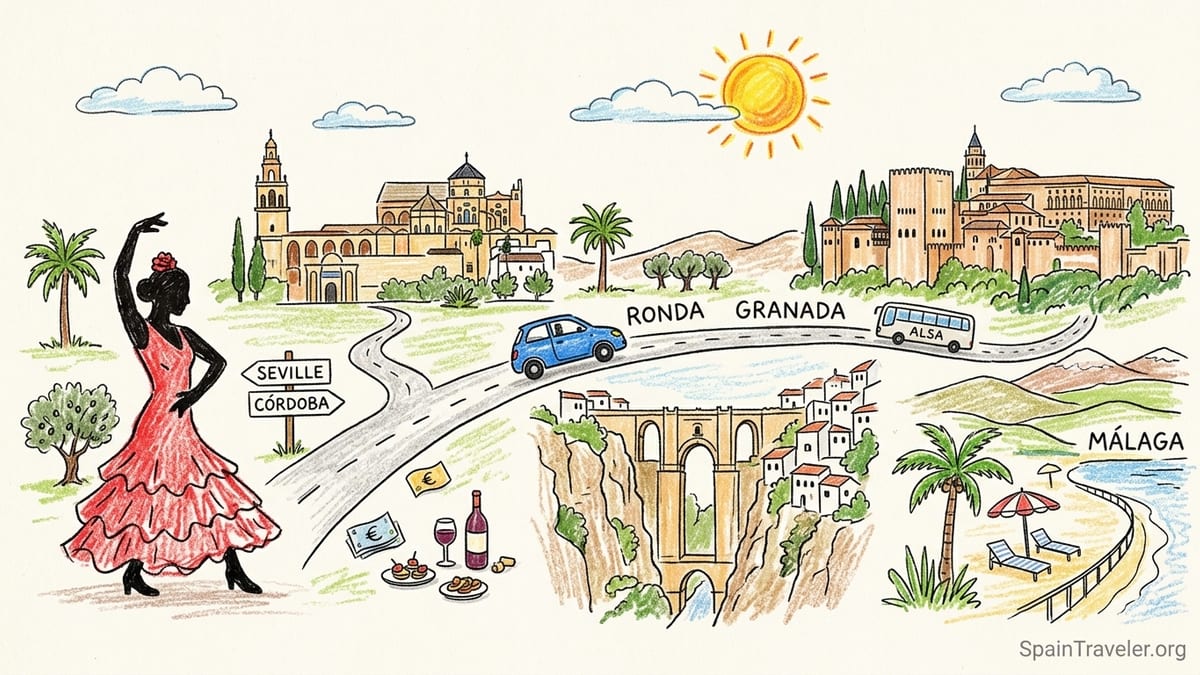
Our route was Málaga to Seville by train, Seville to Córdoba by train, Córdoba to Ronda and the white villages by rental car, then on to Granada by car and finally Granada to Málaga by bus, with a last night on the Costa del Sol. That mix of intercity trains, a four-day car rental and one coach leg produced a very different cost pattern than simply city-hopping by train, which is how many Andalusia itineraries are structured.
We traveled in mid-range comfort rather than on a strict backpacker budget or a luxury splurge. We stayed in well-reviewed three and four-star hotels in central locations, chose one simple guesthouse in rural Ronda, and avoided dorms or five-star properties. We ate daily tapas and restaurant meals, ordered wine with most dinners, and booked several paid cultural experiences such as a guided visit to the Alhambra in Granada and a flamenco show in Seville. We did not track personal shopping in this breakdown to keep the focus on core travel costs.
In total, we spent approximately 2,350 euros for two people on the ground in Andalusia for 9 days, plus 420 euros for two return flights from London to Málaga purchased in February 2025. That brought the all-in trip cost to about 2,770 euros for two, or roughly 154 euros per person per day. The rest of the article unpacks how those euros flowed into accommodation, transport, food, alcohol, attractions, tours and the occasional expensive mistake.
Flights and Airport Transfers: Getting Into Andalusia
For this itinerary, Málaga made the most sense as a gateway because of its connections and typically lower fares compared with Seville. In February 2025, we booked return flights from London Gatwick to Málaga with a low-cost carrier for 210 euros per person, including one checked bag to share. Midweek departure and return and traveling just before school half-term kept the fares in check, while flights from London to Seville for the same dates were mostly 260 to 320 euros per person when we checked.
On arrival at Málaga Costa del Sol Airport on 19 May 2025, we skipped taxis and took the C1 commuter train to Málaga María Zambrano station, which cost 2.70 euros per person one way. From there, we connected to our intercity train to Seville, which made the total airport-to-Seville journey vastly cheaper than taking a long taxi ride or private transfer. On the way home on 28 May, we stayed near Málaga’s old town and again took the C1 train back to the airport for 2.70 euros per person.
If you prefer door-to-door convenience, Málaga airport taxis in May 2025 to the city center were quoting around 25 to 30 euros per ride on official notice boards at the rank. A prebooked private transfer to Seville for the same dates started around 210 to 250 euros for two people according to several regional transfer companies that list fixed prices online, reflecting just how quickly long-distance car transfers can inflate a trip budget.
The big lesson from our experience is that for city-based itineraries, trains and local commuter services will usually keep your access costs modest. Splurging on airport transfers only makes clear sense if you have a very late arrival, mobility issues, or children and heavy luggage that make multiple transfers painful.
Accommodation: City Centers vs Rural Stays and the Beach
Accommodation was our single largest cost category, accounting for just over 40 percent of on-the-ground spending. Over 8 paid nights, we spent a total of 960 euros for two people, averaging 120 euros per night. However, the nightly rate shifted noticeably between large cities, rural Ronda and the final night on the coast, and it also depended on how central we chose to be.
In Seville from 19 to 22 May 2025, we booked a modern three-star hotel just outside the Santa Cruz neighborhood. Booking in mid-March, the rate settled at 135 euros per night for a double room with breakfast included. During spring festivals like Feria de Abril or Semana Santa, similar properties we checked for comparison were listing at 260 euros or more for the same room type, which underlines how season and major events in Seville can easily double accommodation costs.
In Córdoba on 22 May, we stayed one night in a small boutique hotel a five-minute walk from the Mezquita. The double room was 118 euros without breakfast, booked two months ahead. Had we stayed on the opposite side of the river, rooms in similar-quality properties were still available in May 2025 from around 85 euros, but being able to stroll back to the hotel late after dinner in the Judería felt worth the roughly 30-euro premium for that single night.
The cheapest stay of the trip was in the countryside. For 23 to 24 May, we based ourselves near Ronda in a family-run guesthouse with simple rooms and mountain views for 78 euros per night, breakfast included, booked six weeks out. This underlined how quickly prices fall once you leave the major city centers. By contrast, in Granada we paid 130 euros per night from 24 to 26 May for a four-star hotel near Plaza Nueva, booked directly in April as part of a flexible rate. In Málaga on 27 May, a modern hotel ten minutes from the beach and the historic center cost 145 euros for the night. Paying more for this last stay bought us a short walk to the seafront and easy access to the airport train the next morning, which felt justified after a busy week.
Trains, Buses, Rental Car and the True Cost of Driving
We deliberately mixed trains with a short car rental to compare costs and convenience. Overall, we spent 412 euros on intercity transport within Andalusia for two people. This included two medium-distance trains, one bus, a four-day rental car and associated fuel and parking. The split between modes made a noticeable difference to both budget and pace of travel.
On 19 May 2025, the high-speed train from Málaga María Zambrano to Sevilla Santa Justa cost 32 euros per person in standard class when booked about six weeks ahead through the official rail operator. For 22 May, we booked an Avant service from Seville to Córdoba that cost 17 euros per person. Seats on those routes can be cheaper if bought far in advance or during promotions, but we found that prices rose quickly inside two weeks of departure when we tracked them in April and May.
On 23 May in Córdoba, we picked up a compact rental car for four days to reach Ronda, the surrounding white villages and then Granada. Booking in early April 2025 with a well-known international rental firm, we paid 162 euros base price for four days plus 48 euros for a zero-excess insurance upgrade, bringing the rental total to 210 euros. At the desk, we declined an additional GPS unit because our phones and offline maps worked fine. Over roughly 550 kilometers of driving, we spent 52 euros on fuel at a station outside Ronda and another 18 euros topping up on the outskirts of Granada, so fuel came to 70 euros in total.
Parking was the hidden cost. In Córdoba, the rental agency was near the station so we did not pay for overnight parking there, but in Ronda we paid 15 euros for one night in an underground municipal car park close to the old town on 23 May. In Granada, between 24 and 25 May, we left the car in a private car park near our hotel at 22 euros per 24 hours. Avoiding the car inside the historic Albaicín with its restricted access was essential, but the net effect was 59 euros in parking over three days. Finally, on 26 May we dropped the car near Granada bus station and paid 18.50 euros each for an ALSA bus to Málaga booked the week before, for a total of 37 euros for that leg.
Food, Tapas, Restaurants and Drinks Across Regions
Food and drink made up the second biggest portion of our spending, at around 620 euros over 9 days for two people. This covered morning coffee and pastries, daily tapas lunches, restaurant dinners with wine, and the occasional ice cream or vermut. We self-catered only minimally, buying fruit and water in supermarkets. Prices for tapas and menus were broadly consistent with what local food guides reported for Seville in 2023 and 2024, where a tapeo with drinks usually runs around 20 to 25 euros per person in casual bars.
In Seville, we tended to eat out more than anywhere else. On both 20 and 21 May, our typical tapas lunches in the Triana and Arenal neighborhoods cost around 30 to 34 euros for two. A standard order looked like three or four tapas, one ración to share and four small beers or glasses of house wine. Individual tapas usually came in between 3.50 and 4.50 euros, cañas around 2.20 euros and glasses of basic local white wine 2.80 to 3.50 euros. Two sit-down dinners near Santa Cruz, with a shared starter, two mains and a bottle of Andalusian white wine, came to 56 euros one night and 62 euros the other, including service.
Córdoba felt slightly cheaper. On 22 May, a menu del día in a simple restaurant two streets from the Mezquita was 14.50 euros per person for three courses and bread, with drinks extra at 2.50 euros for beer or house wine. That evening we grazed on salmorejo, flamenquín and croquetas in a tapas bar off Plaza del Potro, ending up with a bill of 27 euros for six small plates and four drinks. In rural Ronda, food prices dropped again. On 23 May, dinner in a local venta outside town cost 36 euros for two main courses, shared salad, bread and a half-litre carafe of house red wine, something that would have been closer to 50 euros in Seville.
Granada stood out because of the free tapas culture. In several bars near Calle Navas and the Realejo on 24 and 25 May, each 2.70-euro glass of wine or small beer came with a generous tapa, such as tortilla, paella or small montaditos. That meant we could assemble a very filling lunch for two on 19 to 22 euros including drinks. Our most expensive dinner in Granada, at a restaurant with views towards the Alhambra, cost 68 euros for two courses each and a mid-range bottle of Rioja. On the coast in Málaga on 27 May, seafood raised the bill again. A simple dinner of grilled sardines on espeto, fried fish and salads on the beach promenade of La Malagueta cost 48 euros for two, with 7 euros extra for two glasses of chilled white wine.
Attractions, Guided Tours, Flamenco and Sherry
Paid attractions and tours were an area where costs could easily have doubled if we had booked more premium experiences. Over 9 days, we spent 296 euros on tickets and organized activities for two people. This included major monuments such as the Seville Cathedral, the Real Alcázar and the Mezquita, a guided visit to the Alhambra, a flamenco show in Seville and a small-group sherry tasting in Málaga.
In Seville on 20 May 2025, combined tickets for the Seville Cathedral and Giralda tower booked online through the official sales channel cost 12 euros per person. That afternoon, timed-entry tickets for the Real Alcázar purchased about three weeks earlier cost 14.50 euros per person. Friends who tried to buy Alcázar tickets same-day in spring 2024 reported some dates were sold out or only more expensive last-entry slots were left, so we treated prebooking as essential.
For Córdoba on 22 May, we reserved night tickets for the Mezquita’s sound and light visit at 21 euros per person instead of the 13-euro standard day admission, purely as a splurge. The atmosphere was magical and crowd numbers were lower than daytime, but if you are very cost-sensitive, the normal daytime ticket gives you the same building for far less money.
The most expensive individual ticket of the trip was the Alhambra in Granada. We booked a guided visit for the morning of 25 May 2025 through an accredited local tour company, which included Nasrid Palaces access and a three-hour English-language tour. The cost was 64 euros per person, significantly higher than the official general ticket, which around mid-2025 was still advertised in the mid- to high-20 euro range on the patronato’s ticket portal. We chose the guided option because of the complexity of the site and concern over entry times selling out, but looking back, the per-person premium of around 35 euros on top of the basic entry fee felt steep.
In Seville, we booked a flamenco show on 21 May in a small tablao near the Alameda, with live guitar, singing and dance in an intimate venue. Tickets booked two weeks ahead were 28 euros per person for a one-hour show with no mandatory drink minimum. Tourist-focused venues in the same city were advertising tickets for 40 to 45 euros including one drink, so this felt like a good balance of cost and authenticity. On 27 May in Málaga, we joined a 90-minute small-group sherry and wine tasting in a specialist bar near the market, sampling five wines plus tapas. The price was 39 euros per person and we considered it one of the best-value experiences of the week, particularly for travelers who are unlikely to visit Jerez or Sanlúcar on the same trip.
Beaches, Festivals, Parking Splurges and Other Extras
Although Andalusia’s sunshine and festivals are big draws, the direct costs of these elements were lower than many people assume, as long as you avoid staying in seafront hotels during the highest-demand weeks or in city centers during major religious celebrations. Our only true beach day was in Málaga on 27 May 2025. Two loungers and an umbrella rented on La Malagueta public beach cost 14 euros for the day, paid in cash to the attendant. Showers on the promenade were free, as were the coastal paths. Ice creams at a nearby heladería cost 3.20 euros each for two scoops.
We were not in Seville for Feria de Abril or Semana Santa, but when pricing dummy bookings for those periods in early 2026, we saw that our 135-euro Seville hotel in late May would have exceeded 280 euros per night during the peak of Holy Week, and some central properties went beyond 300 euros. That doubling of nightly rates without any change in the physical product shows how season and specific festivals drive real budgets far more than average “cost per day” statistics ever reveal. Outside those weeks, costs for attractions, food and local transport remain fairly stable.
Our biggest non-obvious extra was central parking. In Ronda and Granada we chose car parks that allowed us to walk easily into the historic centers instead of searching for free street parking further out. Over three days, as noted earlier, that decision cost 59 euros. In hindsight, in Ronda we could have parked for free on the less scenic side of town and walked 15 minutes uphill, saving about 10 to 12 euros. In Granada, however, paying for secure parking close to our hotel felt justified given the maze of one-way streets and access restrictions in the old quarters.
We did not attend any ticketed festivals or concerts, but checked prices while in Seville. In spring 2025, seats in bullrings and larger concert venues for visiting artists typically ranged from 25 to 80 euros per person depending on the event and location. Travelers planning their trip around specific concerts or premium flamenco events should factor those into the entertainment budget as separate line items, since a single big show can easily equal two or three normal restaurant dinners.
What Surprised Me, What Was Worth It and Where I Wasted Money
The single biggest surprise was how central hotel location multiplied in importance on hot afternoons. In Seville and Córdoba, paying a bit more for a room within easy walking distance of the historic sights allowed us to retreat to air-conditioning for a siesta and then head back out in the evening. The roughly extra 30 euros we paid in Córdoba for a Mezquita-side hotel instead of one across the river felt like excellent value once we realized how much we would have dreaded crossing the bridge in full sun multiple times in one day.
Conversely, the premium we paid for a fully guided Alhambra tour is one expense I would not repeat in the same way. While our guide was knowledgeable and the logistics were seamless, the group size meant we moved at a set pace and had limited time for independent wandering. Knowing now that the difference between the roughly 64 euros per person guided ticket and the standard ticket price is well over 30 euros, I would next time buy the official general visit with timed Nasrid entry and rent an audio guide or follow a researched route. That approach would save roughly 70 euros for two, enough to fund another memorable dinner or wine tasting.
Our decision to rent a car from Córdoba through Ronda to Granada did raise the transport budget, but it unlocked a string of white villages that would be slow or impossible by public transport, such as Zahara de la Sierra and Grazalema. The rental, fuel and parking combined came to about 339 euros for four days, or roughly 42 euros per person per day for two travelers. For us, the flexibility and rural scenery were worth it, but for travelers focused mainly on cities or on a very tight budget, sticking with trains and buses would cut this line almost in half.
Wine, sherry and tapas rarely felt wasteful. Because drinks and small plates in Andalusia remain reasonably priced compared with northern Europe, we could order generously without feeling anxious about the bill. The 39-euro sherry tasting in Málaga and the 28-euro flamenco ticket in Seville stood out as premium experiences that still felt proportionate to their quality. The only food-related waste came when we over-ordered in early meals, not yet calibrated to portion sizes, which occasionally added 8 to 10 unnecessary euros to a bill.
The Real Budget Drivers for an Andalusia Trip
Looking back over the spreadsheets, the dominant budget drivers were not the things most generic guides emphasize. The first and most powerful factor was season and festival timing. Our late May dates kept hotel prices in the mid-range. If we had traveled a month earlier during Semana Santa in Seville or had chosen peak August in coastal Málaga, the same quality of central hotel could easily have doubled in price, and some festival weeks see minimum-stay requirements that add further costs.
The second driver was the number of major cities on the itinerary. Each change of city came with fixed transport costs, check-in and check-out friction, and often slightly higher prices for central accommodation. If we had, for instance, cut Córdoba and spent more time as a base in Seville or Granada, we would have saved at least one set of train tickets for 17 euros per person and possibly secured a better weekly hotel rate. On the flip side, adding another coastal resort like Marbella with a seafront hotel would have pushed our nightly average upward by at least 30 to 40 euros based on the prices we checked while in Málaga in May 2025.
Hotel location was the third major variable. In Seville, Córdoba and Granada we consistently found that staying within a 5- to 10-minute walk of the main sights cost 20 to 40 euros more per night than staying just outside the center or across a river. Whether that premium is worth paying depends on your tolerance for walking in the heat and for late-night public transport. For us, central stays were worth it in Seville and Córdoba but could probably have been trimmed down one level in Granada without significantly affecting the experience.
Car rental and attraction load each added a clear but manageable layer of cost. The four-day rental and related fuel and parking costs added roughly 339 euros total, which would not make sense for a minimalist city break but transformed the rural part of our trip. Attractions and tours totaled 296 euros, but that number could easily be halved by skipping guided tours and premium time slots and focusing on self-guided visits with standard tickets, especially at the Alhambra and the Mezquita. Coastal resort level and beachfront proximity only influenced our spending on the very last night, but based on price checks in May 2025, a week in a four-star seafront hotel in more exclusive Costa del Sol towns can absorb a budget very quickly.
FAQ
Q1. How much did your 9-day Andalusia trip cost per person in total?
Including return flights to Málaga from London and all on-the-ground spending on hotels, food, transport and activities, the trip cost about 2,770 euros for two people, or roughly 1,385 euros per person for 9 days.
Q2. How much should I budget per day in Andalusia for mid-range travel?
Based on this trip, a realistic mid-range budget in 2025 for someone staying in central three-star hotels, eating out twice a day and paying for a few major attractions is around 130 to 170 euros per person per day, with the upper end more likely in peak season or if you add guided tours.
Q3. Which Andalusian city felt most expensive?
Seville felt the priciest overall because we spent more on central accommodation and ate out more often, although Granada produced the single most expensive ticket in the form of a guided Alhambra visit at 64 euros per person.
Q4. Is renting a car in Andalusia worth the extra cost?
Renting a compact car for four days from Córdoba through Ronda to Granada cost us 210 euros in rental fees plus 70 euros in fuel and 59 euros in parking for two people. It was worth it to reach rural white villages and scenic viewpoints that are awkward by bus, but for a city-only itinerary you can save a lot by relying on trains and coaches instead.
Q5. How much did you spend on food and drink?
We spent about 620 euros over 9 days for two people, or roughly 34 euros per person per day. That covered breakfast pastries, daily tapas lunches, restaurant dinners with wine and some extras like ice cream and coffee, without self-catering beyond water and fruit.
Q6. Are guided tours like the Alhambra worth their higher prices?
Our guided Alhambra visit at 64 euros per person was informative, but because the standard official ticket is far cheaper, we felt we had overpaid for the group format. For travelers comfortable reading up in advance, booking the standard ticket and using an audio guide is likely a better value trade-off.
Q7. How much does it cost to see flamenco in Seville?
We paid 28 euros per person in May 2025 for a one-hour show in a small tablao without mandatory drinks. Larger, more tourist-oriented venues often charge between 40 and 45 euros including a drink, so it is possible to see high-quality flamenco for under 30 euros if you look for smaller venues.
Q8. Did you find beaches in Málaga expensive?
Not particularly. Two sun loungers and an umbrella on La Malagueta beach cost 14 euros for a full day in late May 2025, and a seafood dinner for two on the promenade with wine came to about 55 euros, which felt reasonable compared with other European coastal cities.
Q9. How much did airport transfers add to your budget?
Because we used the C1 commuter train between Málaga airport and the city, airport transfers cost just 2.70 euros per person each way. Using taxis would have increased that to around 25 to 30 euros per ride, and private long-distance transfers between Málaga and Seville can run above 200 euros.
Q10. What single factor would most change your Andalusia budget next time?
Season and event timing would make the biggest difference. Shifting the same itinerary into Semana Santa in Seville or peak August on the Costa del Sol could easily add hundreds of euros in hotel costs alone, whereas traveling in late autumn or January would probably lower nightly rates by 20 to 40 percent in many places.