


I landed in Seville on a hot June afternoon with a packed itinerary, a rental car reservation, and a very incomplete idea of what Andalusia really was. Over 16 days, I looped through four provinces, mixed trains and long drives, based myself in Seville, Granada and Málaga, and made detours into white villages, the Sierra Nevada foothills and the Atlantic coast near Cádiz. I thought I was coming for monumental cities, tapas and flamenco. What I found instead was a region of geographic extremes, punishing summer heat, sleepy afternoons, crowded icons, and quiet inland corners that felt like a different country from the beaches. This guide pulls together what I learned on that first trip so you can plan a smarter second one than I did.
Trip Overview: How I Actually Traveled Andalusia
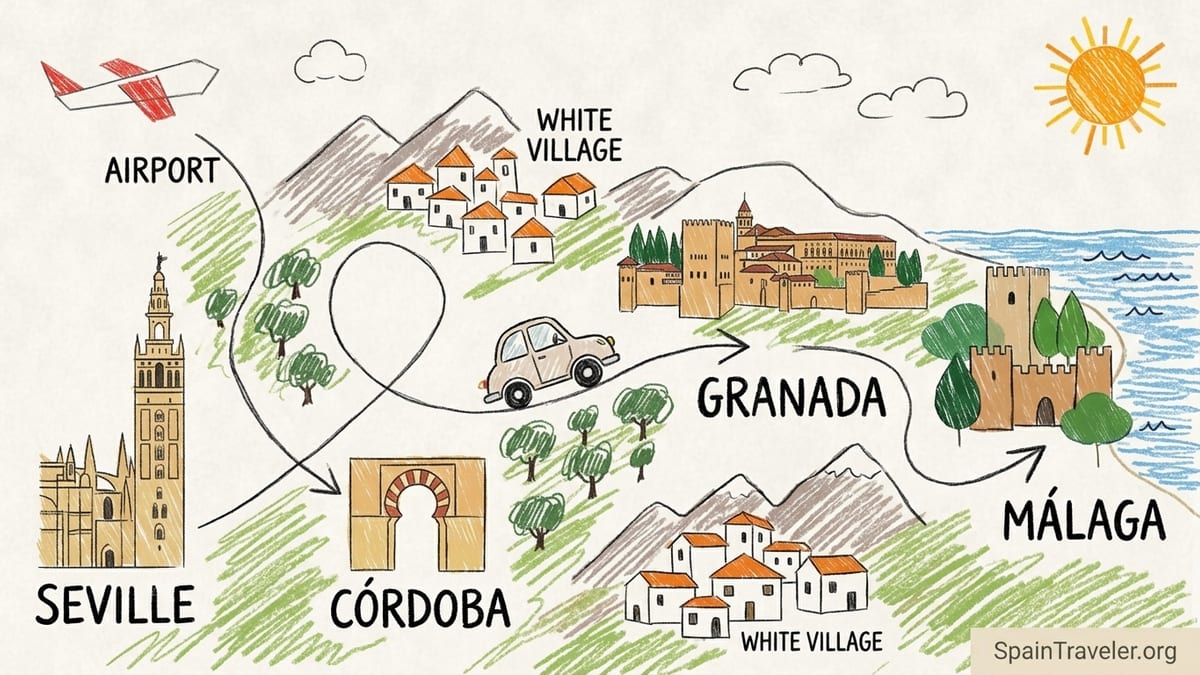
My route started and ended in Seville Airport, because it had the best flight connections and car rental options from the United States. I spent a total of 16 days in Andalusia, visiting parts of the provinces of Seville, Córdoba, Granada and Málaga, plus a long day trip into Cádiz province on the Atlantic. My bases were three cities: four nights in Seville, four in Granada, four in Málaga, with the remaining nights split between a white-village stay and a rural guesthouse inland from the coast.
I made the classic first-timer mistake of trying to combine Seville, Córdoba, Granada and Málaga in too tight a window. The first draft of my plan squeezed them all into 10 days, connected mostly by train. On paper the distances looked short. In reality, the heat, crowds and constant hotel changes made it exhausting. I ended up extending the trip to 16 days by cutting other parts of Spain, which allowed for slower travel but still left me wishing for more time in fewer places.
Transport was a mix. I used trains for the main Seville to Granada leg, a journey of just under three hours on Renfe-operated services. I picked up a rental car on the edge of Granada at the start of a five-day loop through the Alpujarra villages, the Costa Tropical, inland Málaga and the Cádiz coast, then dropped it on arrival in Málaga city to avoid driving in the historic core. Buses filled the gaps along the coast, particularly on stretches where trains simply do not exist and regional operators cover everything from resort towns to little coves.
Before going, I imagined Andalusia as a relatively flat, sunbaked land of flamenco patios and orange trees, anchored by three big cities. That was partially true in the Guadalquivir valley around Seville and Córdoba. What I did not grasp from guidebooks was how sharply the landscape rises into real mountains, how dry the Tabernas and eastern Almería feel compared with the lush Atlantic coast, or how different life feels in a white village clinging to a hillside compared with the nightlife promenades of Marbella or Málaga. The gap between the Andalusia of postcards and the Andalusia on the ground was one of the trip’s most useful lessons.
Summer Heat, Street Life and the Shock of Andalusian Rhythms
My trip fell in June and early July, when average highs in Seville often sit well above 33 degrees Celsius and can spike closer to 40. That is 91 to 104 degrees Fahrenheit, and it shapes everything. I arrived thinking I could sightsee all day with a hat and a water bottle, the way I might in late spring in Italy. Within two days in Seville I learned that Andalusia in summer runs on a different clock.
Mornings were magical. In Seville’s Santa Cruz neighborhood, the streets around the cathedral stayed relatively quiet until around 9 a.m. I quickly learned to book the earliest possible entry slots for major sights. At the Real Alcázar, an 8:30 or 9 a.m. arrival meant shaded courtyards and gardens that were still cool enough to enjoy. By late morning, sunlight bounced off tiled patios and stone walls, and the temperature climbed fast. Street musicians and café terraces came alive only after the heat had peaked and shadows lengthened again.
The heat also explained the local eating rhythm. I made the mistake on my first night in Granada of turning up for dinner at 7:30 p.m. The restaurant staff were pleasant but surprised, and I shared the terrace with other foreign visitors while locals were still at home. By 10 p.m. in Seville or Málaga, however, tapas bars in neighborhoods like Triana or Soho were standing-room-only, families with children strolled the promenades, and the city finally felt fully awake. If you are not prepared to shift your day, Andalusia in summer can feel both too hot and mysteriously empty at the wrong hours.
Siesta is not a tourist gimmick. In small inland towns and white villages, I repeatedly encountered locked doors between roughly 2 p.m. and 5 p.m., from family-run shops to some cafés. On a day trip from Granada into the Alpujarra, I arrived in Pampaneira around 3 p.m. assuming I could browse craft shops and grab lunch after a hike. Instead, shutters were down, the main streets were deserted, and the only open bar was running a reduced menu. It forced a change in habit: heavy sightseeing early, lunch by 1:30 p.m., reading or resting indoors during the worst of the heat, then heading back out toward evening.
Monumental Cities: Beauty, Crowds and Practical Headaches
The famous Andalusian cities are rightfully popular, but experiencing them well requires more planning and energy than I expected. In Seville and Granada, tickets for marquee sights like the Alcázar and the Alhambra often sell out days in advance in high season. I booked my Alhambra visit about two weeks before arrival and still had limited options for Nasrid Palace time slots. Inside, even with timed entries, the most ornate rooms filled shoulder to shoulder around midday. Photographing intricate stucco and tilework while staying patient in narrow passageways is part of the experience.
In Córdoba, I tried to squeeze a visit to the Mezquita, the old Jewish quarter and the Roman bridge into an afternoon stop between Seville and Granada. On paper it worked, thanks to direct trains from Seville taking under an hour. In reality, the station-to-center walk in high heat, queuing for entry, and navigating narrow lanes behind tour groups left me drained. I left with hazy memories rather than the contemplative experience the Mezquita deserves. In hindsight, Córdoba needed at least one overnight for early and late light in the historic core.
Driving into these cities taught another hard lesson. My original Seville hotel was inside the old town, down alleys barely wider than the car’s mirrors, in a restricted traffic zone that relies on license-plate permissions. Even with satellite navigation, I met dead-end bollards, one-way streets and sudden “no entry” signs. Scratches on walls told the story of drivers who misjudged. After 40 minutes of stress, I bailed to a paid garage on the edge of the center and walked 15 minutes with my luggage. For future trips I would either stay slightly outside the historic core with guaranteed garage parking or skip the car entirely while in big cities.
Parking in Granada and Málaga also required more thought than I had given it. Older central neighborhoods often limit street parking to residents, with fines for violations. In Granada, my guesthouse near the Albaicín warned me to enter by a specific route to avoid automated cameras that issue tickets to unauthorized vehicles. I learned to email or call ahead and ask accommodations explicitly about access permits, recommended garages and realistic daily parking costs. Paying for a secure garage on the outskirts and walking or using public transport into the old town felt expensive at first, but it was still cheaper than a potential fine and far less stressful than navigating with a car.
White Villages and Mountain Roads: Beauty at a Different Pace
Leaving the big cities for the white villages changed the trip’s rhythm completely. I based myself for two nights in a small pueblo blanco in the mountains between Málaga and Granada, in a simple guesthouse with a rooftop terrace. The streets were a maze of steep, whitewashed alleys, often too tight for cars. Locals used tiny vans or motorcycles, and parking sat below the village, which meant climbing steps with luggage under the afternoon sun.
The reward for that effort was silence and space. In contrast to Seville’s late-night buzz, the village square filled briefly around 9 p.m. when families came out for a stroll, then emptied soon after midnight. Mornings were for practical errands. Elderly residents chatted on doorsteps as delivery trucks inched through lanes that would be pedestrian-only in most other countries. The cooler mountain air made short hikes possible even in early afternoon, especially on shaded paths out of the direct sun, something that was unthinkable in central Seville at the same hour.
Driving between villages brought its own learning curve. The mountain roads were generally well paved but narrow and full of blind switchbacks. Locals drove confidently, often faster than visitors would like, and I had to get used to tight passes, using lay-bys to let others overtake, and trusting guardrails on steep drops. Distances on the map meant far more in time once you added in slow climbs and photo stops. A route I had expected to cover in an hour could easily take 90 minutes or more.
In the Alpujarra region south of Granada, villages like Capileira and Bubión felt almost alpine, with terraced fields and views toward the Sierra Nevada peaks. Even on a summer day, evening temperatures dropped enough for a light jacket, a shock after the baking pavements of the Guadalquivir valley. This was where Andalusia’s reputation for geographic extremes made sense. Within a three-hour drive I had gone from semi-desert plains to High Sierra slopes, a contrast that changed not only the scenery but the way locals organized their days.
Coasts Compared: Mediterranean Buzz vs Atlantic Breeze
Before traveling, I assumed that “the coast” was one unified strip of beaches and resorts. In reality, the Mediterranean and Atlantic sides of Andalusia felt like two different trips. I first reached the Mediterranean near Nerja, east of Málaga, arriving by car down a highway of tunnels and viaducts that hugged the cliffs. The Costa del Sol around Málaga and Torremolinos was dense with apartment blocks, large hotels and beach clubs, with long promenades lined by palm trees, ice cream stands and late-night bars.
On the Mediterranean, beaches tended to be a mix of dark sand and pebbles, with clear, relatively calm water and organized services. Sunbed and umbrella rentals were widely available, typically priced per day, while beach chiringuitos offered grilled fish and salads. Even in early summer, some stretches became crowded by late morning, particularly weekends. It worked well for a quick swim between city sightseeing, but it rarely felt secluded.
The Atlantic coast near Cádiz told a very different story. I drove west from Málaga, skirting past busier stretches, and spent a day between Vejer de la Frontera and the beach at El Palmar. Here the air felt cooler, with more breeze and Atlantic waves that drew surfers even in early summer. The beach stretched in a long, mostly low-rise line, with sand dunes and wooden walkways rather than high-rise towers. Facilities still existed, but the overall atmosphere was more laid-back and spaced out than the tightly built Costa del Sol.
Water conditions also differed. On the Atlantic, currents and waves could be stronger, and lifeguard coverage varied by beach and season, so I found myself paying closer attention to flags and local advice, especially when swimming outside of mid-summer. The Mediterranean, by contrast, felt more like a giant warm pool on calm days, though jellyfish warnings can appear in some periods. The key lesson was that “Andalusian beach” does not mean one thing. Deciding between a sociable Mediterranean base near Málaga and a quieter Atlantic town near Cádiz shapes the entire feel of a trip.
Rural Interiors and the Tabernas Edge
Inland Andalusia between major cities and away from the mountains was the part of the region I had imagined least clearly, and it ended up being the most surprising. Driving across the interior of Granada and Almería provinces, the landscape flattened into wide valleys of olive groves, solar farms and agricultural plots, occasionally punctuated by rocky outcrops and low ranges. In some stretches, particularly approaching the semi-desert areas around Tabernas, the land turned dry, with scrub vegetation and ochre hills that looked more like film sets than the Europe I knew.
Stopping in rural towns along these roads revealed a different daily rhythm from both coastal resorts and big cities. Bars on main squares were often the only places open through the afternoon, serving simple plates to local workers. English was less widely spoken than in Málaga or Seville, but a combination of basic Spanish, pointing at menus and plenty of patience worked. Prices were notably lower too, from coffee to lunch specials. It felt like stepping behind the tourism curtain, where Andalusia is more about agriculture and logistics than palaces and beaches.
The downside of this interior route was how tiring long-distance driving could become in the heat. Air conditioning in the car was essential. Fuel and rest stops needed forward planning, as some stretches had limited services. I underestimated how draining three or four hours of driving under intense sun would be, even on good roads. I arrived in my rural guesthouse near Guadix more tired than after a full day of city walking, which was not how I had pictured “a scenic drive.”
What this part of the journey gave me, though, was a much clearer sense of Andalusia as a region of working landscapes rather than only heritage backdrops. Seeing crews tend to olive orchards and greenhouses while tabernas filled each morning made the cities feel less like isolated attractions and more like hubs in a wider, complex territory.
Trains, Buses, Cars and the Cost of Moving Around
On maps, Andalusia’s cities cluster relatively close together, which tempts many visitors into fast-paced itineraries strung along rail lines. Trains between Seville, Córdoba, Málaga and Granada are generally modern and comfortable, and journey times between major hubs are often in the two to three hour range. Booking ahead online helped secure better departure times, particularly in summer, though I did find that some slower regional services could be purchased at the station on the day of travel without difficulty.
Where trains fell short was along the coast and into smaller towns. For example, there is frequent rail service linking Málaga city with nearby beach communities to its west, but not all attractive coastal villages have stations. Between some Mediterranean and Atlantic points, buses were the only realistic public transport option without awkward backtracking. A regional bus operator covered many of these routes, running everything from direct intercity connections to stopping services that linked clusters of resorts and industrial zones.
Using buses demanded more flexibility. Schedules often ran less frequently outside peak commuting times, and some routes had reduced service on weekends. Buying tickets online in advance where possible simplified things, but I still had days where a missed bus or delayed departure changed my plans. On the positive side, buses reached small towns and white villages that trains never touch, making them essential for car-free travelers.
Driving offered the most freedom but also the most stress, especially near old towns. Highways and major regional roads were well maintained and clearly signed, and fuel stations were easy to find along these corridors. The complications arose once I left those roads and faced narrow lanes, low-speed urban grids and restricted traffic zones in historic centers. I learned to combine modes: use a car for cross-country and rural segments, then rely on walking and public transport inside big cities, even if it meant arranging pick up and drop off locations away from central hotels.
What I Would Do Differently on a Second Andalusia Trip
Looking back, my biggest mistake was trying to cover too many headline cities and landscapes in one go. For a second trip, I would slow down and group experiences more coherently. Instead of four bases in 16 days, I would likely choose three: one in Seville or Córdoba to explore the Guadalquivir valley, one in Granada or a nearby village to balance the Alhambra with the Sierra Nevada and Alpujarra, and one entirely focused on either the Atlantic or Mediterranean coast, rather than trying to split time between both.
I would avoid driving into historic centers. That means booking accommodation either near public transport hubs or in districts with clear access routes and confirmed parking arrangements, then leaving the car in a garage for the duration of each city stay. For example, I would arrive in Seville by train or airport transfer, spend several car-free days there, then pick up a rental car only when leaving for rural or coastal segments, returning it again before the final city stop.
Season and daily rhythm would also factor more heavily into planning. In high summer, I would schedule big-ticket monuments for the very first time slots, commit to long midday breaks indoors, and plan most intercity journeys either early in the morning or in the cooler evening hours. If my dates were flexible, I would seriously consider late spring or early autumn for more manageable temperatures and smaller crowds, while still enjoying long daylight hours.
Finally, I would give inland Andalusia more dedicated time. Instead of treating rural interiors, white villages and semi-desert landscapes as quick detours between the cities and coasts, I would devote several nights to a single inland base. That might mean a farm stay in olive country near Jaén, a cave house near Guadix, or a small hotel in a white village with good hiking access. The contrast between these slower, working landscapes and the bustling cities is where the region’s true character emerged for me. A second trip would lean into that contrast rather than racing between postcards.
FAQ
Q1. How many days do I really need for a first trip to Andalusia?
For a balanced first visit that includes at least two major cities, some time in a white village and one coastal area, around 12 to 14 days works far better than a rushed week. With less time, it is wiser to pick either Seville and Córdoba plus the Atlantic, or Granada and Málaga plus nearby Mediterranean beaches, rather than trying to fit everything in.
Q2. Is it worth renting a car, or can I rely on trains and buses?
If you are only visiting big cities such as Seville, Córdoba, Málaga and Granada, you can comfortably rely on trains and buses. Renting a car becomes worthwhile if you want to spend real time in white villages, the Alpujarra, rural interiors or quieter coastal towns without rail links. A hybrid approach often works best, picking up the car when you leave the cities and dropping it before your final urban stop.
Q3. How bad is the summer heat in Andalusia for sightseeing?
In peak summer, afternoon temperatures in parts of Andalusia often climb well above typical comfort levels for walking tours. Sightseeing is still possible, but it requires early starts, long midday breaks indoors, plenty of water and sun protection, and realistic expectations about how much you can do in one day. If you are sensitive to heat, consider traveling in late April, May, late September or October instead.
Q4. Are the famous sights like the Alhambra and Seville’s Alcázar overcrowded?
The most popular monuments draw substantial crowds, especially from late spring through early autumn and during holiday periods. Timed tickets help regulate entry, but interior spaces can still feel busy. Booking several weeks in advance where possible, aiming for the earliest time slots, and visiting shoulder-season months all make a noticeable difference to the experience.
Q5. Is parking really that difficult in old towns?
Historic centers in cities such as Seville and Granada are full of narrow one-way streets, restricted traffic zones and resident-only parking. Driving directly to a hotel door there can be stressful and may risk fines if you cross into controlled areas without authorization. Using designated garages on the edge of old towns, or choosing accommodation with clear parking access outside the tightest cores, reduces both stress and cost.
Q6. How different are Andalusia’s Mediterranean and Atlantic coasts?
The Mediterranean coast around Málaga tends to be more built up, with long promenades, frequent public transport and a lively atmosphere that suits travelers who want city comforts with beach access. The Atlantic coast near Cádiz generally feels breezier and more open, with longer stretches of sand, a slightly cooler climate and a somewhat more relaxed, less urbanized vibe. Choosing one or the other can significantly change the tone of your stay.
Q7. Can I visit Córdoba as a day trip, or should I stay overnight?
High-speed trains make Córdoba technically feasible as a day trip from Seville or even Málaga, and many travelers do it. However, staying at least one night allows you to experience the Mezquita and old quarter in the softer light of early morning and evening, avoid the hottest hours and busiest crowds, and explore at a more comfortable pace.
Q8. Will I manage with only English, especially in rural areas?
In major tourist centers, staff at hotels, many restaurants and major attractions often speak some English. In rural interiors, inland towns and small villages, English is less common. Basic Spanish phrases, a translation app and a willingness to communicate through gestures usually go a long way. Being patient and respectful of the language difference makes interactions smoother and more enjoyable.
Q9. What is the best way to deal with the Andalusian late dining schedule?
Accepting the local rhythm helps. Plan a substantial late breakfast or early lunch, then a lighter snack or rest during the afternoon. Aim for dinner reservations around 9 p.m. or later if you want to eat alongside locals. In cities, some restaurants and tapas bars do serve earlier, but they may feel quieter and more geared toward visitors at that time.
Q10. How should I structure a second trip if I have already seen the main cities?
For a return visit, you might focus on one city you loved as a short anchor stay, then devote most of your time to inland and coastal contrasts. For example, combine a few nights in Granada with several days in the Alpujarra, or pair a short Seville stay with a week on the Cádiz coast and side trips into rural olive country. Concentrating on fewer areas in more depth often reveals a richer, more nuanced Andalusia.