


Andalusia is one of Europe’s most rewarding regions to explore, but deciding whether to travel by train or by car can shape your whole experience. High speed rail now links Seville, Córdoba, Málaga and Granada in as little as 45 to 80 minutes between cities, while a dense web of highways and mountain roads reaches white villages, coastlines and natural parks that trains never touch. The best choice is rarely “all train” or “all car,” but a mix tailored to how you actually want to spend your days.
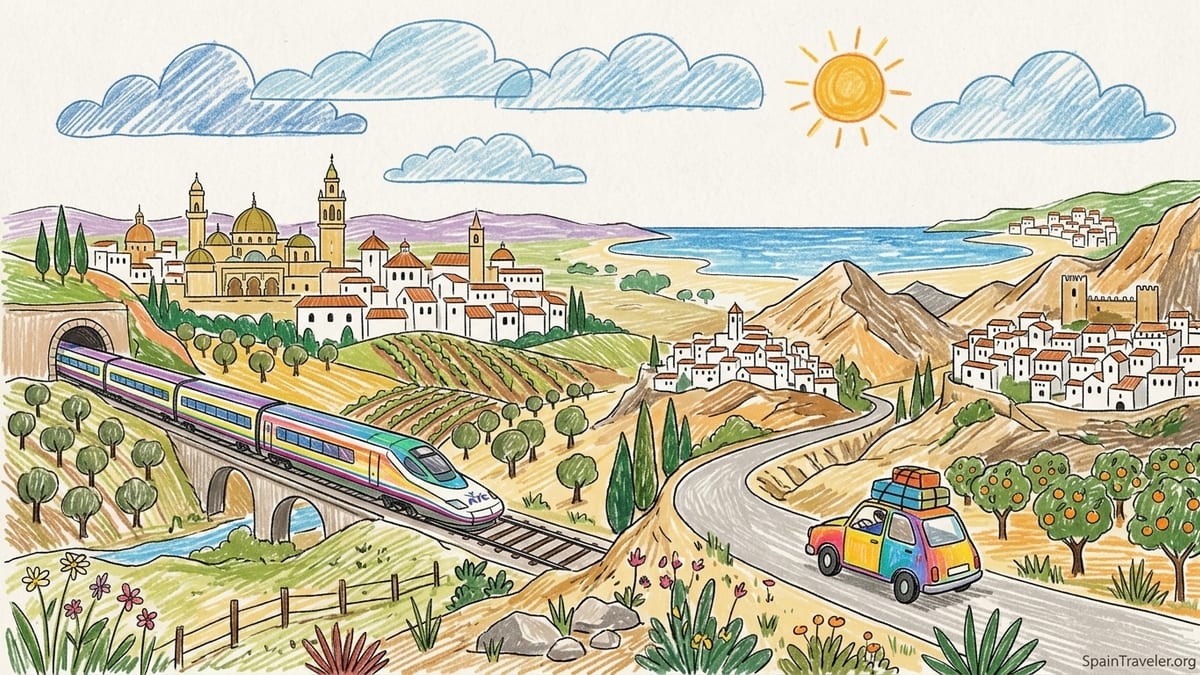
Understanding Andalusia’s Transport Landscape
Before comparing train and car, it helps to understand how Andalusia is laid out. The region’s four headline cities for most visitors are Seville, Córdoba, Málaga and Granada. All four are connected by medium and long distance trains, including high speed AVE and Avant services. Seville to Córdoba typically takes around 45 minutes on AVE or Avant, Córdoba to Málaga about 1 hour, and Seville to Málaga around 1 hour 55 minutes via Córdoba on the fastest options, so rail is genuinely time competitive with driving once you factor in traffic and parking.
Granada joined the high speed network more recently, and there are now direct AVE or Avant services between Seville, Córdoba and Granada, as well as links to Málaga via Antequera. For example, current timetables show Córdoba to Granada in around 1 hour 30 minutes on direct services, and Málaga to Granada in about 1 hour 10 minutes on Avant trains via Antequera. These times fluctuate slightly by season and train category, but they are a good planning baseline.
Once you leave the city corridors, the picture changes. The classic white villages of Ronda, Grazalema, Zahara de la Sierra or Frigiliana, the Alpujarra villages south of Granada, and nature areas like Doñana, the Sierra de Grazalema, Sierra Nevada or Cabo de Gata are reached by car or a combination of regional buses and taxis. There are regional and suburban trains in some directions, but they do not reach most hill towns or coastal stretches directly. This is where a rental car can transform what you see in a limited time.
Overlaying all of this is Spain’s motorway network. The A-7 autovía runs toll free along the Mediterranean coast and provides a fast backbone between Málaga, Motril and Almería, while the AP-7 Autopista del Mediterráneo remains a tolled alternative on parts of the Costa del Sol near Marbella and Estepona. Inland, routes like the A-92 link Seville and Granada, and the A-45 connects Córdoba and Málaga. These long distance roads are modern and efficient, but they funnel you past many of the small towns that make Andalusia special unless you consciously plan detours.
City-Only Trips: Trains and Feet Win
If your focus is the “big four” cities, trains almost always beat a car. Seville, Córdoba, Granada and Málaga all have historic centers dense with monuments, narrow streets and low emission or restricted traffic zones that make driving a nuisance. Seville and Córdoba were early adopters of low emission zones, and Málaga and Granada have since defined large central areas where older vehicles face restrictions or are completely banned from through traffic, with rules tightening in recent years. Rental fleets generally use newer cars that comply with emission labels, but you still need to navigate cameras, one-way systems and rules about who can cross certain streets.
By contrast, train stations in these cities are practical arrival points. Seville Santa Justa sits around 20 to 25 minutes on foot or a short taxi ride from the cathedral and Santa Cruz. Córdoba’s station is about a 15-minute walk straight down Avenida de América and Avenida del Gran Capitán to the historic center. Málaga María Zambrano is roughly 20 minutes on foot from the old town and ten minutes from the port area, with frequent local trains to the airport and coastal suburbs. Granada’s station is a bit farther from the Albaicín and the Alhambra slopes, but city buses and taxis are inexpensive and frequent.
Real-world example: a traveler landing in Madrid and heading straight to Seville could take a high speed AVE to Seville in around 2.5 hours, then connect to Córdoba the next day in 45 minutes and on to Granada in 1.5 hours, all without ever touching a car. The cost on basic advance fares for each leg often falls in the range of a modest hotel night if booked several weeks ahead. In return you avoid urban driving, multi-day parking charges and the stress of threading a compact SUV past pedestrians in a medieval lane.
Within these cities, you move mostly on foot, occasionally supplemented by trams, buses, taxis or ride-hailing services. Many first-time visitors are surprised how walkable the centers are: Granada’s cathedral, the lower Albaicín and the main tapas streets all cluster within a small radius. Seville’s cathedral, Alcázar, Santa Cruz and riverside are likewise close together. For this kind of city-hopping itinerary, trains and walking keep logistics simple, and adding a car often adds little value.
White Villages and Rural Andalusia: Where the Car Shines
The moment your wish list fills with “pueblos blancos,” secluded beaches or high mountain villages, the case for renting a car strengthens. Places like Ronda, Zahara de la Sierra, Grazalema, Setenil de las Bodegas, Frigiliana, Capileira, Pampaneira or the small towns around Arcos de la Frontera are reachable by public transport, but services are infrequent and often designed around local commuting rather than tourist timetables. Even popular routes like Málaga to Ronda or Granada to the Alpujarras may have only a few buses a day outside peak holidays.
Consider a traveler based for three nights in Málaga who wants to visit Ronda and a couple of white villages along the way. Doing this by public transport could involve a morning bus to Ronda, several hours there, then either returning directly to Málaga or attempting a chain of rural buses to reach smaller villages. It is achievable, but your day becomes tied to departure boards. With a car, you could leave Málaga mid-morning, drive the scenic route via Ardales and El Caminito del Rey, spend lunch in Ronda and then detour through Grazalema and Zahara de la Sierra before heading toward Seville or back to the coast.
Mountain and park areas follow a similar pattern. The Sierra de Grazalema Natural Park, Sierra de las Nieves near Ronda, the Alpujarras south of Granada, and Cabo de Gata in Almería province are threaded with small roads, trailheads and miradors with minimal public transport. For example, reaching trailheads above Capileira in the Alpujarras, or remote beaches like Playa de los Muertos in Almería, is markedly easier with your own wheels. Taxis can bridge some gaps, but costs add up quickly compared to a few days of car rental.
That said, the same elements that make these areas charming also make them demanding for drivers. White villages often have extremely narrow lanes, steep gradients and very limited parking close to their historic cores. Many signpost resident-only stretches and camera-controlled entries. In practice you often park in a lot or roadside space on the edge of town and continue on foot for the last five to ten minutes. For reluctant or inexperienced drivers, this can be stressful, so it is worth honestly judging your comfort level before committing to a rural-heavy itinerary with a car.
Coastal Travel and Nature Parks: Train, Bus and Car Compared
On the Andalusian coast, the decision between train and car depends heavily on which stretch you plan to explore. The Costa del Sol west of Málaga, including Torremolinos, Benalmádena and Fuengirola, is linked by a frequent suburban train that runs directly from Málaga city and the airport. For visitors staying in these resort towns, it is entirely feasible to skip a car, use the train and local buses, and rely on organized excursions for occasional inland trips.
Farther west, toward Marbella and Estepona, the railway peters out. The main spine becomes the A-7 coastal road, with the tolled AP-7 Autopista del Mediterráneo running inland as a faster alternative on some sections. Drivers choosing the toll road pay for time saved and a slightly less congested journey, while the free A-7 hugs the coast more closely at the price of roundabouts, local traffic and lower limits. Buses do connect Málaga with Marbella, Estepona and Algeciras, but they are less flexible than a car if you want to stop at smaller coves or visit inland villages along the same route.
On the eastern side, from Málaga toward Nerja, Almuñécar and Motril, coaches use the free A-7 autovía, with many direct buses connecting Málaga, Granada and these coastal towns. You can comfortably reach Nerja by bus from Málaga in under 90 minutes. However, continuing into nature areas like the Sierras de Tejeda, Almijara and Alhama, the quieter coves near Maro, or beyond Motril toward picturesque coastal hamlets, becomes much simpler by car. The same is true if you want to combine coastal time with a day trip into the Alpujarras or inland villages like Frigiliana and Cómpeta.
For major nature parks away from the coast, public transport is even thinner. Doñana, for example, is usually visited on organized 4x4 excursions from Sanlúcar de Barrameda or El Rocío. You can reach those towns by bus, but a car makes it easier to combine them with other lesser-known wetlands or villages along the Guadalquivir. Sierra Nevada’s ski area, the Alpujarras villages, and remote walking routes around Cazorla or Despeñaperros all lean strongly toward car access if you want to choose your own start and end points each day.
Luggage, Stations, Parking and Old-Town Restrictions
The practicalities of moving yourself and your bags are often what decide between train and car. With trains, your main concern is getting luggage from your accommodation to the station, plus managing it on board. Spanish high speed and long distance trains allow generous luggage for typical travelers: rolling suitcases and backpacks fit into overhead racks or dedicated luggage shelves at carriage ends. There is no separate check in process, so you arrive, pass security screening where present, walk to your platform and board.
Train stations in Andalusia are modern, with clear signage and facilities like cafes, small shops and restrooms. However, their urban locations can mean a 15 to 25 minute walk to some hotels. If you travel light, this is a pleasant stroll through the city. With multiple large cases or mobility challenges, you may rely more on taxis. In Seville and Córdoba, taxi ranks sit right outside the main station doors, and typical rides into the historic center are short and moderately priced.
Driving changes the luggage calculation. You can load suitcases straight from airport carousel to trunk and avoid repeated packing and unpacking for train legs. Yet you often pay for this in parking and access constraints. Old towns across Andalusia restrict traffic into their narrow cores both for preservation and for air quality, using a mix of resident permits, hotel guest exceptions and camera enforcement. Málaga, Seville, Córdoba and Granada all operate low emission or restricted zones that can generate fines if you stray into the wrong street without authorization. As a visitor with a rental car, you normally park in a public garage at the edge of the center or in your hotel’s underground parking, then explore on foot.
Parking prices vary widely, but central garages in major cities commonly charge a daily cap that can rival a budget hotel room over several days. On a two-week trip where you keep a car the entire time but spend half of that stay deep inside historic centers, those daily parking fees and the unused days when the car sits idle can quietly outstrip the savings of avoiding train tickets. In small villages, the opposite can be true: parking is often free or low cost, as long as you respect designated areas and do not attempt to nose into alleys that look like they belong to residents.
Costs, Booking, Fuel, Tolls and Airport Rental Logistics
Cost comparisons between trains and cars depend on party size and your willingness to book in advance. For solo travelers and couples, advance fares on AVE and Avant trains between Andalusian cities are usually cheaper than renting a car and paying for fuel and parking, especially if you only need point-to-point transport. For example, Seville to Córdoba or Málaga can often be booked weeks ahead at prices that undercut the per-person share of a car rental plus motorway fuel. Families and groups of four or five, on the other hand, may find that a compact or intermediate rental becomes good value once you spread costs over several people.
Booking trains in Spain rewards some preparation. Demand on prime departure times between Seville, Córdoba, Málaga and Granada is high in spring and autumn, and the cheapest fare classes sell out first. Buying tickets a few weeks in advance usually secures better prices and more choice of times. There is a mix of operators on some corridors, including Renfe’s AVE and Avant brands and competitors on certain long haul routes into Andalusia, so it can be worth comparing options on your chosen dates rather than assuming a fixed price.
For car rentals, Málaga Airport is the main gateway for many visitors. The terminal building hosts desks for large international brands and Spanish chains, with additional companies operating from off-airport depots served by shuttle buses. Reviews and comparison guides consistently note that in peak summer months you can spend 30 minutes or more queuing at on-site desks, and longer if you choose very low cost off-airport providers whose shuttles and check in processes become congested on weekend changeover days. Some midrange brands with desks inside the terminal are praised for quicker pick up and drop off, which can matter if your time is tight.
It is also important to budget the hidden time of a rental. Collecting the car on arrival can easily absorb an hour once you allow for walking to the rental hall, queueing at the counter, inspecting the vehicle and navigating out of the parking structure. Returning it often means refuelling, following signs back into the correct level of the airport car park, checking the car and walking back to the terminal. For short stays of only two or three days, especially if most of that time is urban, that extra time can cancel out some of the perceived convenience of “having a car.”
On the road, fuel prices in Spain fluctuate but generally sit a little below or around many northern European levels, and modern diesel or petrol compact cars are efficient on the long, steady gradients of Andalusian highways. The free A-7 coastal autovía and inland autovías like the A-92 keep driving costs lower than in some countries with extensive tolling. Where tolls remain, such as sections of the AP-7 on the Costa del Sol, charges are collected at toll plazas or through electronic tolling systems managed by the concessionaire. For most leisure travelers, it is perfectly possible to plan routes that avoid the tolled sections and use the free alternatives instead, although you may encounter more local traffic.
Hybrid Strategies: Trains for Cities, Short Rentals for Countryside
For many visitors, the strongest option is a hybrid itinerary: use trains between the major cities and pick up a car only for a compact window focused on villages, mountains or rural coast. This approach reduces the number of days you are paying for a parked vehicle and avoids urban driving at your most jetlagged or disoriented.
One practical scenario looks like this. You arrive in Seville and spend three nights exploring the city entirely on foot, perhaps with a day trip to Córdoba by train. On day four, you board a morning AVE or Avant to Málaga, drop your bags at a central hotel, then walk over to a rental counter near María Zambrano station to collect a car for three days. With the car, you loop through Ronda, Grazalema and the white villages, or explore the Axarquía east of Málaga and inland towns like Frigiliana, before returning the car to Málaga and catching a train or flight onward. Reddit users and local guides have noted that picking up a car at city locations by the station can be more relaxed than diving straight into airport roads, particularly if you are already oriented in the city.
Another hybrid example centers on Granada. You could take the train from Seville to Granada via Córdoba, stay car free for two or three nights to enjoy the Alhambra and Albaicín, then pick up a rental on your last morning to drive into the Alpujarras or down to Cabo de Gata for several days of hiking and quiet beaches. At the end of that rural segment, you might drive to Málaga Airport, return the car and fly out, avoiding the need to circle back inland by train. This pattern lets each mode play to its strengths: high speed rail between cities, car for sparsely served regions, and feet or public transport in dense historic areas.
Hybrid strategies are particularly useful for travelers nervous about full-trip driving. Limiting the rental to four or five consecutive days and planning those around country hotels, rural guesthouses or beach apartments where parking is simple removes much of the stress. You still get the freedom to stop at viewpoints, vineyards and remote trails, but you hand back the keys before tackling big-city ring roads and underground garages with tight ramps and pillars.
Who Should Choose What: Traveler Scenarios
Different traveler types will weigh train and car very differently. For first-time visitors focused on Seville, Córdoba, Granada and perhaps Málaga, especially those who are anxious about driving in foreign countries, the train plus local transport combination is ideal. You book high speed tickets between cities, choose centrally located hotels or apartments, and let taxis or occasional buses handle the edges. Your days center on walking tours, museums and food, not finding parking or refuelling.
For repeat visitors or confident drivers who want to explore beyond the main postcard cities, renting a car for at least part of the trip becomes more compelling. A couple flying into Málaga who already know Seville and Córdoba might skip those entirely and design a circuit along the lesser-known coastline east toward Almería, into the Alpujarras, then up through villages in Jaén province before looping back via Ronda. In such cases, piecing together regional buses would be slow and inflexible compared to simply driving.
Families with young children often appreciate the flexibility of a car for naps, quick stops and carrying beach gear or hiking equipment, but must also account for child seats and the hassle of parking larger vehicles in tight villages. Travelling grandparents may value the comfort of trains on intercity legs, avoiding long hours behind the wheel, then rely on shorter rental days when everyone is well rested and focused on specific rural attractions.
Budget-conscious backpackers and solo travelers, meanwhile, may wish to avoid both parking costs and one-person rental rates by leaning on rail and bus networks, then selectively hiring local taxis to fill in gaps for hikes or sunset viewpoints. In communities like Nerja, Vejer de la Frontera or Arcos de la Frontera, it is common to stay car free in town while using occasional taxi rides to trailheads or nearby beaches that would otherwise require complex bus combinations.
The Takeaway
There is no single correct way to travel in Andalusia, but there are clear patterns that align transport choices with the kind of trip you want. High speed and regional trains excel at moving you quickly and comfortably between Seville, Córdoba, Málaga and Granada, with minimal stress around old-town driving, emissions rules and parking. Buses extend that network to many secondary towns and coastal resorts, and work well for simple point to point journeys, especially along the Costa del Sol or between Málaga and Nerja.
Cars shine in white village country, mountain parks and more remote coastal stretches, but they come with their own hidden costs in time, parking fees and the mental load of navigation in historic centers. You save the most and enjoy the experience when you rent the car only for the days you are truly using it, rather than as an all-trip habit. Hybrid itineraries that combine trains for city hops with compact rental periods for rural exploration give many travelers the best of both worlds.
Ultimately, your comfort behind the wheel, your appetite for spontaneity and your group size should guide your decision. City-focused first timers and solo travelers will usually be happiest sticking to trains and buses, while countryside enthusiasts, photographers, hikers and families may gravitate toward at least a few days of driving. The key is to shape your transport around your priorities, not the other way round: in Andalusia, the right mix of rail, road and walking can turn a good itinerary into a memorable one.
FAQ
Q1. Is it worth renting a car if I am only visiting Seville, Córdoba and Granada?
For a trip limited to Seville, Córdoba and Granada, a car is usually more trouble than it is worth. High speed and medium distance trains connect these cities in around 45 to 90 minutes, stations are close to the centers, and old-town restrictions plus parking costs make driving inconvenient. Most visitors on such itineraries rely on trains and walking, perhaps with the odd taxi, and never miss having a car.
Q2. How far in advance should I book trains between the major Andalusian cities?
For popular seasons like spring and autumn, booking intercity trains at least a few weeks in advance is wise if you want the lowest fares and the widest choice of departure times. Some promotional tickets appear several months ahead, and the cheapest fare classes on busy morning and late afternoon services between Seville, Córdoba, Málaga and Granada often sell out first.
Q3. Are there toll roads I need to worry about on the Costa del Sol?
On the Costa del Sol, the main free route is the A-7 autovía, which runs along the coast and connects towns like Málaga, Nerja, Marbella and Estepona. A tolled alternative, the AP-7 Autopista del Mediterráneo, still operates on some stretches near Marbella and Estepona. Many visitors simply use the A-7 and accept a bit more local traffic to avoid tolls, but if you are short on time the AP-7 can save some minutes on longer west coast drives.
Q4. How much time does renting a car at Málaga Airport actually add?
At Málaga Airport, you should allow at least an extra hour on arrival to collect a rental car in normal conditions. This includes walking to the rental hall, waiting your turn at the desk, inspecting the car and exiting the parking structure. In peak holiday periods, especially summer weekends, queues can be longer, and off-airport shuttle-based companies can add additional waiting and travel time compared with in-terminal providers.
Q5. Can I visit white villages like Ronda and Frigiliana without a car?
You can reach some white villages by bus or a mix of train and bus. Ronda, for instance, has both rail and coach connections from Málaga and Seville, and Frigiliana is linked by local bus from Nerja. However, without a car you are dependent on fixed timetables and may find it harder to combine several villages in one day. A short car rental of two or three days is often the most efficient way to see multiple hill towns on one trip.
Q6. Are low emission zones a problem for rental cars in Andalusian cities?
Low emission and restricted traffic zones are active or planned in Seville, Córdoba, Málaga and Granada, mainly covering their central areas. Most rental cars are modern enough to meet emissions standards, but cameras and local rules still limit through traffic. As a visitor, the practical solution is usually to park in a public garage or hotel parking on the edge of the zone and explore on foot, rather than trying to drive to the exact door of every sight.
Q7. What is the best base city if I want to combine trains and a short rental?
Málaga and Granada both work very well as bases for hybrid strategies. Málaga has a major airport, a central station with high speed links and several rental agencies near the station as well as at the airport, making it easy to switch between train and car. Granada is excellent for a few car free days focused on the Alhambra and historic areas before you rent a car to visit the Alpujarras, rural coast or interior villages.
Q8. Is driving in Andalusia difficult for foreign visitors?
Driving between cities and on main highways is straightforward for most foreign visitors, with good road surfaces and clear signage. The biggest challenges come in old towns and white villages, where streets can be extremely narrow, steep and confusing. If you are nervous, plan to park on the outskirts in signposted lots and walk into the historic center, and avoid trying to thread a car through medieval cores just to reach a doorfront.
Q9. How should a family with children think about train vs car?
Families often appreciate trains for the freedom children have to move a little, use restrooms and look out of the window without being strapped in for long drives. For city-to-city travel, this can be easier than hours on the road. A car still has advantages for day trips with beach gear or hiking equipment and for reaching rural houses or villas, so many families combine trains for longer legs with a shorter car rental anchored around one or two countryside stays.
Q10. If I only have one week, what is a realistic mixed itinerary?
In one week, a realistic mixed itinerary might be three nights in Seville, reached by train or flight, then a train to Málaga for one night in the city followed by a three-day car loop through Ronda and nearby white villages before returning the car in Málaga and flying out. This keeps long distances on fast trains, focuses your driving on scenic countryside where it adds value, and avoids paying for a car while it sits unused in big-city garages.