


After several trips across Andalusia spread over a few years, I stopped trying to “collect” cities and started asking a simpler question: if I came back with limited time, where would I actually stay again, and for how long? The region’s official highlights focus on the big four cities and a checklist of monuments, but my own map now looks very different. It is shaped by how evenings felt, how long journeys actually took, and which places worked as easygoing bases rather than exhausting trophies.
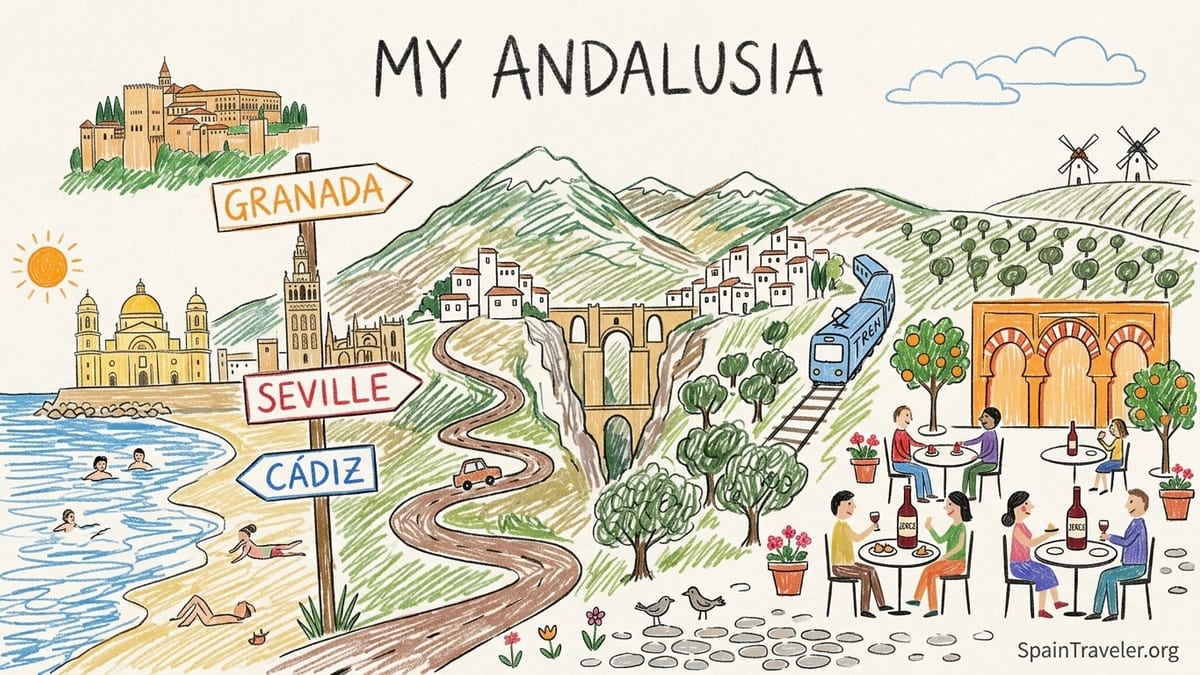
How I Traveled Andalusia and What I Look For
Across my Andalusia trips I have spent roughly three weeks on the ground, broken into a first classic circuit of Seville, Córdoba and Granada, and later returns that focused on Cádiz, Jerez de la Frontera, Ronda and a handful of white villages and coastal pockets. I traveled mostly by train and bus between major hubs, then rented a car for short stretches around Ronda and the Pueblos Blancos. The places below are not a complete map of Andalusia, just the ones that genuinely earned more of my time.
When I choose where to stay, I care less about ticking every museum and more about what it feels like after 8 p.m. I notice whether I can wander to dinner without a reservation, if there are lived-in bars rather than only tourist terraces, and whether I can reach a supermarket and bakery on foot. I also compare heritage-heavy cities, coastal bases, white villages, mountain towns, wine areas and nature destinations, because each delivers a very different kind of trip.
For context, I traveled in shoulder seasons, mainly April and late September into early October, when daytime highs sat around the mid-20s Celsius and nights were cool enough for a light jacket. Peak summer brings very different conditions, especially in Seville and Córdoba where heat warnings are common. I checked local forecasts directly before moving between cities and adjusted plans when inland highs spiked above 35°C, which shaped how long I stayed in some places and why a few famous names became day trips rather than bases.
Everywhere I mention below is somewhere I have personally stayed or visited as a day trip. I have skipped several very famous coastal resorts and inland towns that did not appeal enough to earn at least one full day of my time. The goal is not an encyclopaedia of Andalusia, but a realistic short list to help you decide where to linger and where to just spend an afternoon.
Seville: Heritage-Heavy City I Would Return To, in Short Bursts
I have stayed in Seville twice, both times for three nights. For me it delivers a heritage-heavy city break, full of monumental sights and strong food culture, but also feels intense and slightly overwhelming if you try to do too much too fast. On my first visit I stayed near the Museo de Bellas Artes, about a 15 minute walk from the cathedral, which kept me out of the most crowded alleys at night but still within easy reach of tapas streets like Calle Zaragoza and the riverfront.
That six-night total across two trips felt about right. With three nights at a time I could see major sights like the Cathedral and Giralda, Real Alcázar and Plaza de España at a relaxed pace, then leave before the crowds and heat wore me down. Trains from Madrid and Córdoba made Seville one of the easiest cities to reach, with high speed services cutting travel time from Madrid to around two and a half hours and Seville to Córdoba in under an hour. From Seville’s Santa Justa station I could walk or take a short taxi to the historic core without navigating steep streets or complicated transfers.
Evenings in Seville felt busy in a good way. Streets were full of locals on paseo, small bars stood shoulder to shoulder, and it was easy to eat well without spending much by ordering a few montaditos and raciones to share. In April I could sit outside until late in a light sweater. The flip side was that central streets near the cathedral sometimes felt like open air corridors for tour groups, especially when large cruise ship crowds came up from Cádiz for the day. That made me glad I did not choose Seville as a very long base.
I would not use Seville as a hub for the entire region even though transport connections are excellent. Routes to Granada and Málaga involve either buses or longer train combinations, and long days of sightseeing followed by early departures get tiring. For me Seville works best as a three night bookend to a trip, rather than a one week base. Next time I would return for another short stay rather than stretch it further, and I would again avoid the very hottest summer weeks.
Cádiz: Coastal Base With Everyday Charms
I spent four nights in Cádiz and it ended up being my favorite coastal base in Andalusia. Rather than a beach resort, the old city felt like a compact, lived-in peninsula town where daily life was as interesting as the headline sights. I stayed in the historic center near the Mercado Central, which meant I woke to the sounds of stallholders setting up for the day and could walk to La Caleta beach in about 15 minutes for sunset swims.
Four nights felt comfortably right. It gave me time for a half day wandering the layered fortifications, a morning at the market followed by a long lunch, a lazy beach afternoon and a day trip to nearby wine country without feeling rushed. Cádiz is fairly easy to reach, though not as direct as Seville. I arrived by train from Seville with a change at Jerez, a journey of around two hours depending on the connection. The station sits at the base of the old town, and from there I walked 10 to 15 minutes into the historic grid without needing a taxi.
Evenings in Cádiz felt very different from the big inland cities. Instead of grand set piece monuments, the city’s magic came from small plazas filled with children playing, tapas counters serving simply fried fish, and older residents perched on chairs outside their front doors chatting in the warm air. Prices at neighborhood bars were noticeably lower than in Seville; for example, I consistently paid only a few euros for a glass of house sherry and similar modest amounts for plates of tortillitas de camarones. There were visitors around, but most of the voices I heard were Spanish, which gave the evenings a relaxed, local rhythm.
Cádiz worked extremely well as a base. From here I took an easy day trip inland to Jerez de la Frontera by frequent regional train. Coaches and regional trains also link Cádiz with towns along the Costa de la Luz for those who want more of a beach focus, though I was content with La Caleta and the city’s urban seafront. If I returned to this part of Andalusia I would happily stay another four or five nights in Cádiz, using it as a slow-paced anchor for both coastal walks and occasional inland forays.
Jerez de la Frontera: Wine Area That Deserved More Time
I first visited Jerez de la Frontera as a hurried day trip from Cádiz, then came back on a later trip and spent two nights. Both times I left feeling I had shortchanged the city. Jerez is famous for sherry bodegas, flamenco and horses, but the reason I would return is its combination of wine culture and easygoing, noncoastal Andalusian life that feels much less touristy than Seville or Granada.
The city is straightforward to reach. Regional trains from Cádiz take around 45 minutes and from Seville roughly an hour, and the station sits close enough to the center to walk with a small suitcase. On my overnight stay I based myself near Plaza del Arenal, which kept me within a 10 minute walk of several major bodegas and the compact old quarter. Prebooking bodega tours directly was important, since many run only one or two guided visits in English on certain days, and some smaller houses focus entirely on Spanish language visits.
Two nights were enough to tour one or two bodegas and wander the central streets, but not enough to explore the surrounding wine countryside or smaller cellars beyond the core. Next time I would stay three or four nights, rent a car for at least a day and combine bodega visits with drives through the wider Sherry Triangle, including Sanlúcar de Barrameda for its manzanilla and more coastal atmosphere. Evenings in Jerez felt particularly enjoyable. Locals spilled out of bars into small plazas, flamenco peñas advertised live performances, and I rarely heard English spoken around me. Tapas prices were similar to Cádiz, with generous raciones of local dishes such as ajo caliente and chicharrones served at modest prices.
Jerez worked well as a base for sherry and flamenco focused days, but I would not choose it as my only hub for wider Andalusia. Connections to inland cities involve changes and longer travel times, and the charm of Jerez lies in staying put, visiting bodegas on foot and embracing slow evenings rather than using it as a springboard. If you care about wine and want a city that still feels primarily for locals, it is worth at least two nights and arguably more.
Ronda and the Pueblos Blancos: Spectacular but Exhausting if You Rush
I have stayed in Ronda twice, for two and then three nights, and used it as a base to explore several white villages by rental car. Ronda itself delivers a mountain town experience with dramatic views, famous bridges and a clear divide between the historic and newer quarters. The first time I arrived by bus from Seville, a twisting but scenic journey that took roughly three hours and left me stepping out almost directly into the new town’s grid. On the second trip I came by car from Málaga, climbing gradually into the Serranía de Ronda.
Three nights felt like a better fit than two. The first day was inevitably consumed by the main views of the Puente Nuevo, the old town lanes and the viewpoints into the gorge, which are understandably crowded. The second and third days allowed for quieter walks along less obvious paths, visits to small museums and a half day spent simply sitting on a terrace watching light change over the surrounding hills. Ronda is not hard to reach, but it does require a commitment to winding roads or bus routes that can feel tiring if you attempt to arrive and leave in quick succession.
From Ronda I drove to several Pueblos Blancos, including Zahara de la Sierra and Grazalema, each in the orbit of the Sierra de Grazalema Natural Park. These villages were spectacular but could be exhausting if treated as a rapid checklist. Steep streets, strong sun and the temptation to climb to every mirador made me glad I kept actual sightseeing short and focused on lingering over coffee and simple lunches instead. I found that two villages in a single day were plenty, especially when accounting for narrow mountain roads and time spent finding parking near historic centers without encroaching on residents’ spaces.
Evenings in Ronda had a pleasant small city feel. There were enough restaurants and bars to try something different each night, but also a sense that most day trip crowds left by late afternoon once coach groups departed back to the coast. It worked well as a base for exploring several white villages and nearby hiking routes, but I would not recommend every Pueblo Blanco as an overnight stop. For me, staying in Ronda for three or four nights and treating Zahara, Grazalema and similar villages as targeted day trips provided the best balance between spectacular scenery and actual rest.
Granada and Córdoba: Essential Icons That Worked Better as Short Stays
I approached Granada and Córdoba with high expectations shaped by every guidebook and tourism campaign, and they remained some of the most impressive places I have visited anywhere in Spain. At the same time, both cities worked better for me as concentrated, shorter stays rather than extended bases. I spent three nights in Granada and two in Córdoba, timed around prebooked entrance slots to the Alhambra and the Mosque Cathedral respectively.
Granada was relatively easy to reach by train from other Andalusian cities, though some routes involved changes at Antequera. Once in the city, I based myself downhill from the Albayzín, which kept me close enough to walk up to viewpoints such as Mirador de San Nicolás without committing to staying in the steepest alleys. The Alhambra itself required advance planning, including buying tickets for specific entry windows and arriving early to clear security. That one site and the surrounding Generalife gardens easily filled a full day, while my remaining two days centered on walking old neighborhoods and visiting the cathedral area.
Evenings in Granada felt split between student energy, especially around tapas bars where small plates were still served free with drinks, and tourism around the most scenic viewpoints. With three nights I enjoyed this mix, but I also found the steep walks and crowds around the Alhambra tiring enough that I was ready to move on. Next time I would likely repeat a two or three night stay, but I would not stretch it longer unless I were using Granada mainly as a base for surrounding mountains and villages rather than repeat visits to the monument zone.
In Córdoba I stayed a short walk from the historic center for two nights, arriving by high speed train from Seville in under an hour. That brief stay felt about right. The Mosque Cathedral dominated my first morning, and even with timed tickets and crowd controls it remained one of the busiest interior sights I have experienced. The surrounding Jewish quarter offered striking streets, but in peak hours it felt almost like a stage set, with groups tightly packed into narrow lanes. Evenings were more enjoyable, once day trippers from Seville and Madrid had left and the patios and small restaurants around the center calmed down.
For me, both Granada and Córdoba were essential but slightly exhausting. They delivered some of the most memorable individual sights of my trip, yet I would not choose either as a very long base. Two to three nights in each, carefully timed to avoid the hottest months and combined with bookings for headline monuments, felt like the right level of immersion before pivoting to smaller cities and coastal or mountain settings.
Underrated Corners: Úbeda, Baeza and Smaller Nature Escapes
One of the most rewarding detours I made in Andalusia was to the Renaissance towns of Úbeda and Baeza in the province of Jaén. I stayed two nights in Úbeda and visited Baeza as a day trip by short local bus. Official tourism campaigns mention these twin UNESCO listed towns as architectural highlights, but they receive far fewer visitors than Seville or Granada. That relative quiet, combined with wide plazas framed by olive covered hills, gave the trip a very different feel.
Reaching Úbeda without a car required some effort. I traveled by bus from Granada, which took several hours with intermediate stops and deposited me at a station outside the historic core. From there I took a short taxi up to my guesthouse rather than drag luggage up the hill. That small friction in reaching Úbeda probably explains why it receives fewer casual visitors, but once I arrived, the town’s scale made it easy to navigate entirely on foot. Main squares and palaces were a 10 to 15 minute stroll apart, without the steep climbs of Granada or some white villages.
Two nights were enough to explore Úbeda’s principal Renaissance buildings at a relaxed pace and still have a full afternoon for Baeza. A local bus connected the two towns in under half an hour, and I spent my time in Baeza walking between its cathedral quarter and university area while stopping in modest bars that clearly served regular students and residents as much as visitors. Evenings in Úbeda were notably calm. Many restaurants closed earlier than in Seville or Cádiz, and I quickly learned to adjust my dinner times and make informal reservations for popular weekend spots. The atmosphere was less about nightlife than about long, quiet conversations on terraces overlooking the sea of olive groves.
Beyond Úbeda and Baeza, I made shorter forays into nature destinations around Ronda and Grazalema, treating them as daytime escapes for walking rather than overnight stops. Simple circular trails starting near Grazalema village or viewpoints reached from minor roads around Zahara delivered big landscapes with relatively little planning. These excursions confirmed for me that nature destinations in inland Andalusia often work best as satellite trips from a comfortable base with good amenities, rather than as isolated one night stays, especially if you are traveling without your own car.
Places That Felt Overrated or Better as Day Trips
Across different visits I intentionally tested the idea of using certain famous places as bases rather than day trips, and a few ended up feeling overrated once I stayed overnight. One example was the immediate area around the most heavily photographed viewpoints in Granada’s Albayzín. Spending too many evenings there, rather than simply visiting for sunset and then retreating downhill, left me feeling like I was living inside a postcard dominated by short term visitors rather than in an actual neighborhood.
I also explored parts of the Costa del Sol as potential bases between inland cities. While Málaga itself has grown into a cultural city break destination, smaller resort strips between Málaga and Marbella did not appeal enough for me to stay overnight. When I visited during the day, long waterfront promenades and dense lines of sun loungers, combined with clusters of international chain restaurants, made these stretches feel interchangeable with many other European beach resorts. I preferred to keep my coastal nights in Cádiz, where the balance between tourism and local life felt more grounded.
Some white villages, too, worked better as brief visits. While I loved the views from villages such as Zahara de la Sierra and Setenil de las Bodegas, I was glad I did not book tiny guesthouses there for multiple nights. Services were limited outside peak hours, and steep layouts meant that every short walk involved climbs that became tedious after a full day. Dropping in for two or three hours, with time for a simple meal and slow walk, gave me most of the reward without the logistical downsides.
The common theme among these “overrated as bases” places was that they were extremely photogenic and absolutely worth seeing, but often lacked enough varied evening options or transport connections to justify longer stays. Seen through that lens, they became excellent day trips from larger hubs such as Ronda, Cádiz, Jerez or Málaga, rather than anchors in their own right. Recognizing this helped me trim my itinerary and avoid check-out, check-in fatigue.
The Takeaway
After multiple trips, my mental map of Andalusia has shifted from a series of must-see monuments to a smaller set of places where I would gladly spend my own time again. Seville, Granada and Córdoba still matter deeply. They deliver some of Europe’s great urban experiences and architectural ensembles, but they shine brightest for me in focused two to three night bursts. Their combination of crowds, heat and intensity makes longer stays feel more like work than leisure unless you deliberately slow your pace and skip some classic sights.
By contrast, Cádiz, Jerez de la Frontera, Ronda and the twin towns of Úbeda and Baeza emerged as the places I now recommend most strongly as bases. They offered enough history and culture to fill several days, but also left space for unstructured evenings, supermarket runs and aimless walks that are hard to squeeze into fast city hops. From these hubs I could fan out into wine country, white villages and nature reserves on day trips, returning each night to familiar streets and nearby cafés.
In practical terms, if I had ten to twelve days in Andalusia, I would now spend three nights in Seville, four or five between Cádiz and Jerez, and three or four in Ronda with one or two day trips into the Pueblos Blancos or up to small hiking areas. With a longer stay I would add two nights in Úbeda to see a different province and style of architecture. The exact mix will always depend on the season and your interests, but thinking in terms of a few strong bases, plus targeted day trips to more intense or remote places, has consistently led to more enjoyable journeys for me than trying to sleep in every pretty town on the map.
Most importantly, allow room in your plan to respond to the weather, to how tired your legs feel after stone alleys and hills, and to places that surprise you. The most memorable moments from my time in Andalusia were not just inside its greatest monuments, but in everyday scenes, like an unhurried glass of fino in a Jerez plaza or watching families gather on Cádiz’s seafront as the sun dropped into the Atlantic. Leaving a little slack in your schedule and choosing bases that feel good after dark makes those moments much more likely to appear.
FAQ
Q1. How many days do I need for a first trip to Andalusia?
For a first trip focused on a mix of cities and smaller towns, I found that ten to twelve days worked well. That allowed three nights in Seville, two or three in Granada, two in Córdoba and a few nights in one coastal or mountain base without rushing every transfer.
Q2. Is it better to travel around Andalusia by train, bus or rental car?
Between major cities such as Seville, Córdoba, Málaga and Granada, I relied on trains because high speed and regional services were frequent and comfortable. For exploring white villages and some nature areas around Ronda and Grazalema, renting a car for a few days gave far more flexibility than buses with limited schedules.
Q3. Which city worked best as a relaxed base instead of just a day trip?
For me, Cádiz was the best relaxed base. Four nights there provided a coastal setting, manageable size, good food options and easy train access to Jerez and inland sherry country, all without the intense crowds of the bigger inland cities.
Q4. Are Granada and Córdoba worth visiting if they can feel crowded and exhausting?
Yes, both are absolutely worth visiting, but I found they worked best as shorter stays of two to three nights each. Planning ahead for timed monument tickets and visiting outside peak heat and midday tour bus hours helped a lot.
Q5. Do I need to book tickets for the Alhambra and Mosque Cathedral in advance?
In my experience it was important to book both well ahead, especially in spring and autumn. I reserved Alhambra tickets several weeks in advance and chose specific time slots, and I secured Mosque Cathedral entry times ahead of arrival in Córdoba to avoid queuing and potential sellouts.
Q6. Is it worth staying overnight in small white villages like Zahara de la Sierra?
I preferred to visit most white villages as day trips from a base in Ronda. The villages were beautiful but often steep, with limited evening options, so dropping in for a few hours gave me most of the reward without the logistical compromises of staying overnight.
Q7. Which month felt most comfortable for sightseeing on foot?
I found April and late September into early October the most comfortable, with warm days and cooler evenings. In July and August, especially in inland cities like Seville and Córdoba, daytime heat frequently climbed high enough to make long walks and midday sightseeing difficult.
Q8. How expensive did food and drink feel in Andalusia compared with other parts of Spain?
Overall I found food and drink reasonably priced, especially outside the most touristed cores. Simple tapas, local fried fish plates and glasses of regional wine or sherry were generally modestly priced in Cádiz, Jerez and Ronda, while central areas of Seville and Granada were a bit higher but still felt fair for the quality.
Q9. If I only have time for one wine-focused stop, should I choose Jerez or another area?
Based on my stays, Jerez de la Frontera is the strongest choice for a wine-focused stop. It combines major sherry bodegas within walking distance of the center, smaller traditional bars and easy rail links to Cádiz and Seville, all in a city that still feels oriented toward locals.
Q10. Is it necessary to speak Spanish to travel comfortably around Andalusia?
While I found some English spoken in larger cities and tourist sites, having basic Spanish phrases made everyday interactions, especially in smaller towns, markets and local bars, notably smoother. Even simple greetings and orders were appreciated and often led to warmer exchanges.