


Planning Andalusia with kids can feel overwhelming: intense summer heat, big historic cities, long driving distances and a coastline that stretches from the Mediterranean to the Atlantic. The good news is that with the right bases, realistic travel days and age-appropriate activities, southern Spain can be one of Europe’s easiest and most rewarding regions for families. This guide looks at how to structure a family trip around Andalusia’s main hubs and coastlines, with practical detail on transport, accommodations, nap-friendly schedules and what really works for toddlers, primary-school children and teenagers.
Choosing the Right Base: City, Coast or Countryside
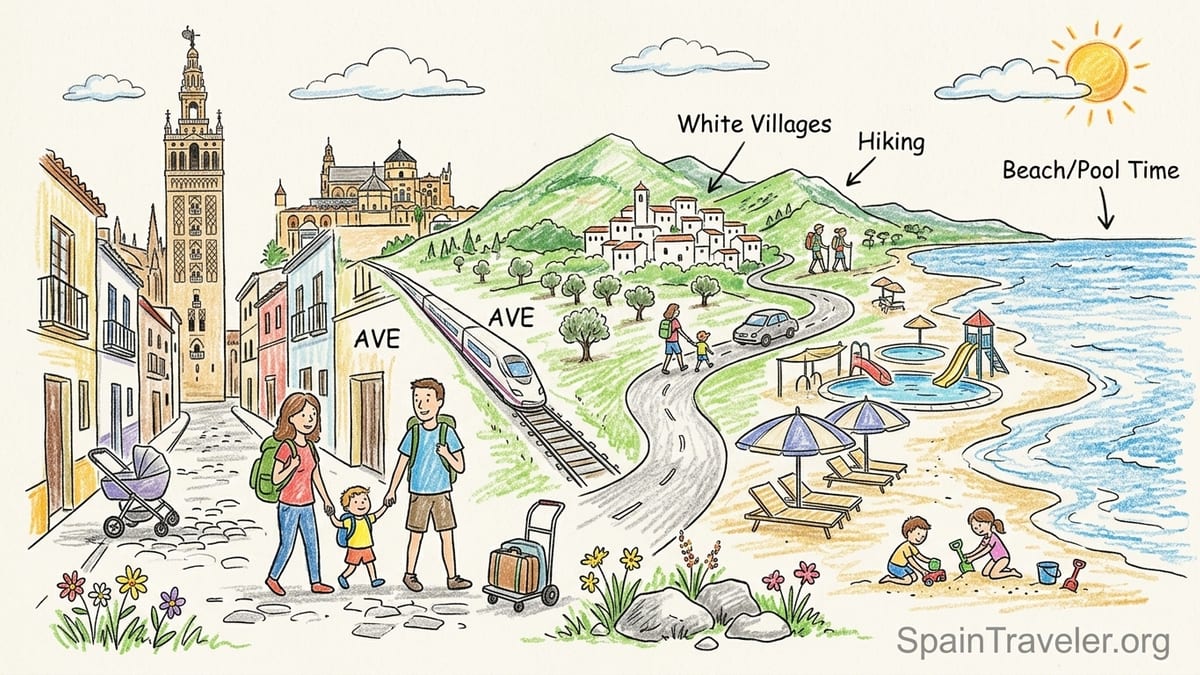
For a first or second trip to Andalusia with children, most families are choosing between three main styles of base: a historic city like Seville, Málaga or Granada; a Mediterranean strip such as the Costa del Sol; or a quieter Atlantic or inland setting where the focus is nature rather than sightseeing volume. Each works, but the logistics are different, especially when naps, strollers and early bedtimes are part of the picture.
City-heavy trips suit families who value walkability and culture over pool time. Seville, Málaga, Córdoba and Granada are all well connected by rail, with typical high-speed train times around 40 to 45 minutes between Seville and Córdoba and about 2 hours between Málaga and Seville when you include regional trains. This makes it realistic to base in one city for four or five nights, then add a second base rather than packing and unpacking every other day.
Coast-heavy trips are usually easier with younger children because you can build each day around the beach or the hotel pool, then add occasional half-day excursions. On the Costa del Sol, for example, family-oriented resorts in Benalmádena, Fuengirola or Estepona often include children’s pools, splash areas and on-site kids’ clubs, which means parents are not trying to entertain a five year old with museums every day. Apartment-style resorts are common here, so you can cook simple meals and keep familiar snacks on hand.
Rural and mountain bases suit repeat visitors or families with older kids who enjoy hiking and slower evenings. White-village areas inland from Marbella or around Ronda, for instance, give you cooler nights and easy short walks but usually require a hire car. These are best when children can handle curvy roads without motion sickness and do not need playgrounds or sandy beaches every day.
City-Heavy vs Coast-Heavy Itineraries With Children
A city-focused Andalusia itinerary might split 10 days between Seville, Córdoba and Granada, travelling primarily by train. This works well with school-age children and teenagers who can walk several kilometres a day and handle museum visits of 60 to 90 minutes at a time. With this style, you might spend a morning exploring a cathedral or palace, have a long lunch in the shade, and then retreat to your accommodation for air conditioning and screen time before an evening stroll.
A coast-focused trip using Málaga or the Costa del Sol as a base feels very different. Here, the rhythm is likely to be beach or pool time between breakfast and lunch, siesta hours indoors, then a gentle promenade along a seafront like Fuengirola’s or Torremolinos’ after 7 pm when the sun softens. Day trips can be short and simple: a 30-minute local train ride to Málaga for the Alcazaba and a quick visit to a museum, or a short drive to a nearby white village or water park, before heading back for pool time.
Mixed itineraries try to give each age group something they value. Families with children from both toddler to teen might start with three city nights in Seville for monuments and flamenco, then move to a coastal base near Málaga or Marbella for five or six nights of pool-and-beach downtime. This avoids the burnout that comes from attempting three historic cities back to back while also keeping teenagers engaged with some urban energy and shopping streets.
When you sketch routes, remember that on the map Andalusia looks compact, but travel days still add up. Driving between Seville and Granada usually takes close to three hours without long stops, and Seville to the eastern Costa del Sol is similar. For younger kids, it often makes sense to cap car or train journeys at about two hours in one stretch and to make those transfers on non-sightseeing days so you are not demanding long attention spans in both the car and the city.
Heat, Siesta and Shade: Making Summer Family-Friendly
Andalusia’s summer heat is often the biggest shock to visitors with children. In July and August, inland cities like Seville and Córdoba can see afternoon highs around or above 40 degrees Celsius, while coastal areas are notably cooler due to breezes. For families, this changes how you plan the day, especially with toddlers and babies who cannot regulate their temperature as effectively as older children.
A practical schedule for summer might involve an early-morning outing from about 8.30 am to 11 am to see an outdoor site or playground, then a long indoor break from late morning until around 5 or 6 pm. Many Spanish families do exactly this, retreating inside during the extreme heat. If your accommodation has a pool, this midday slot is actually better used earlier or later in the day, because pool decks often lack full shade at noon. Lightweight UV swimsuits, wide-brim hats that can be secured under the chin and clip-on stroller fans are useful investments if your trip falls in peak summer.
On the coast, the heat is usually more manageable, but shade still matters. Mediterranean beaches near Málaga or Nerja often rent sun loungers and umbrellas by the day or half-day. Prices vary by resort and season, but it is common to pay a modest fee for two loungers and a parasol on a supervised stretch of sand. For families, this is often worth it because it gives babies and toddlers a defined shady patch and a clear home base, which helps when you are juggling sand toys, snacks and naps.
Shoulder seasons from late March to early June and late September to October are often more comfortable for sightseeing with children, particularly in the cities. Outside peak dates, you can sightsee more easily through the middle of the day without risk of heat exhaustion, and children are less likely to become cranky from constant sunscreen applications and glare. However, evenings can be cooler, especially inland and in the mountains, so layered clothing becomes more important for kids who fall asleep in strollers or on the way back from dinner.
Strollers, Historic Streets and Getting Around
Andalusian historic centres are beautiful but rarely designed for strollers. In old quarters of Córdoba or Granada, streets are often cobbled or paved with uneven stones. Sidewalks can be narrow or disappear altogether, and ramps into small shops and cafes are not guaranteed. Parents who have travelled recently often note that a stroller is still useful, but that a lightweight, narrow model with good suspension and larger wheels makes life easier than a bulky travel system.
In many major monuments, such as fortress complexes or older churches, strollers may be restricted in certain areas because of steps or narrow passages. Families sometimes find it easier to use a soft-structured baby carrier for babies and younger toddlers inside busy monuments and then switch back to the stroller on flatter streets. Because baby-changing facilities are not standard in every restaurant bathroom, a stroller that reclines almost flat can double as a changing and napping surface in a quiet corner when needed.
Public transport within cities is generally manageable with children, though metro and tram systems are limited outside Málaga and Seville. City buses are common, but a family with two or more kids and a stroller may find that walking or using an occasional taxi is more predictable. In coastal areas around Málaga, a commuter rail line connects the city to towns like Torremolinos, Benalmádena and Fuengirola. Trains are step-free or nearly so at most stations, which can be easier with a stroller than local buses.
For intercity journeys, high-speed and regional trains avoid the stress of driving into old towns and dealing with parking. Train stations in Seville, Málaga, Córdoba and Granada typically have elevators or ramps, making them more manageable with luggage and strollers than older European stations in some other regions. On the other hand, once you move into rural white-village territory or some Atlantic beaches, train connections disappear and buses may be sporadic, so a rental car becomes more tempting for families who want flexibility and shorter door-to-door travel times.
Car Seats, Driving Times and When a Rental Car Helps
Spain requires children to use appropriate child restraint systems in vehicles until they reach a height of about 135 centimetres. The law focuses on height and weight rather than age, but in practice this means that most children up to roughly 10 or 11 years old need some form of car seat or booster. Rear-facing infant seats are used for the youngest age group, followed by forward-facing seats and then booster cushions for older children. Advice from road-safety campaigns in Spain also stresses placing young children in the back seats and not using a rear-facing seat in a front seat with an active airbag.
Most international car rental companies operating in Andalusia can provide child seats for an additional daily fee, though the cost can add up for longer trips or multiple children. Many parents choose to bring their own compact travel car seat or folding high-back booster, especially if they are already using one at home that the child finds comfortable. If you plan to rely on taxis for airport runs and city rides, check in advance whether you are comfortable using a service without a fixed child seat, or whether you want to pre-book a transfer that confirms seat availability.
A rental car becomes significantly more useful once your plans include smaller coastal towns beyond the main rail line or inland villages. Reaching a rural villa near a white village, visiting several beaches on the Costa de la Luz in one day, or combining a coastal stay with a mountain walk, all become smoother with a car. In contrast, a route limited to Seville, Córdoba, Granada and central Málaga can usually be managed comfortably by train and short taxi rides, without the stress of navigating narrow one-way streets and city parking garages.
With children, it is wise to keep individual driving stretches to about two hours where possible and to schedule breaks in service areas that have shaded outdoor space or indoor play corners. On longer days, such as a transfer from Granada to a resort town east of Málaga or from Seville towards the eastern Costa del Sol, consider a lunch stop in a secondary town to let kids run around before the next segment. Audiobooks, offline movies and familiar snacks will make these transfers feel more like a break than a chore.
Where Families Sleep: Hotels, Apartments and Pools
Accommodation choices in Andalusia can shape your days as much as the sights. Traditional hotels work well for short city stays and for families with teenagers who appreciate separate rooms. However, standard hotel rooms in historic centres may be tight for families of four, and true family rooms that sleep five can be limited. When searching, look specifically for “family rooms,” “suites” or small local apartment-hotels if you want everyone in one space without needing to pay for two separate rooms.
Apartments and aparthotels are particularly handy for families with babies and toddlers. A separate bedroom makes it easier to keep a dark, quiet sleep space while parents stay up. A simple kitchen helps with breakfast on an irregular schedule and for children who are still adjusting to local flavours. In coastal zones and residential neighbourhoods of cities like Málaga, you will find a wide range of managed apartments, some with access to a shared pool. Look for properties that mention baby cots, high chairs and washing machines if you are travelling for more than a week.
On the Mediterranean coast, family-focused resorts along the Costa del Sol often bundle pools, kids’ clubs and on-site restaurants, creating self-contained environments. Many have children’s splash pools only a few centimetres deep, slides suitable for under-12s and organised activities for children from about four years upwards. These resorts are often set slightly back from the town centre, so families without cars should check how long it takes to walk or use a shuttle to the beach or local supermarket.
In inland cities and smaller mountain towns, a pool is less common, especially in historic buildings. If you are visiting in the hotter months with younger children, a modest guesthouse with a courtyard pool or an apartment complex with a small shared pool can make the difference between frazzled afternoons and calm ones. In cooler months, you may be able to compromise on the pool and instead prioritise central locations that let you walk back easily for naps, which becomes more valuable than water play when temperatures drop.
Age-Based Planning: Toddlers, Primary School Kids and Teenagers
Toddlers and preschoolers thrive on routine and repetition, so they often do best on coast-heavy trips where you can recreate the same basic day. A typical toddler-friendly Andalusian day might include a slow breakfast at the apartment, an hour or two of sand play on a gently sloping Mediterranean beach, then an early lunch in a shaded chiringuito where parents can take turns walking a tired child in the stroller while waiting for food. After a nap back at the accommodation, the late afternoon can be spent in a local playground or shallow pool before an earlier dinner at home or a simple takeaway picnic.
Primary school children are usually more resilient and curious. They can handle shorter city tours if there is some hands-on or animal element, such as a compact urban zoo, an interactive science museum or a boat trip in a city port. For this age group, many parents find that alternating “city day” and “water day” works well. For instance, from a base in Málaga, you might spend one day in the historic centre exploring a hilltop fortress and a museum, then follow with a full beach day in Benalmádena that includes a few hours at a water park or a marina visit.
Teenagers often appreciate independence, Wi-Fi and somewhere to people-watch more than a bucket-and-spade beach. Historic cities with strong cafe culture, street life and shopping streets, such as Seville or Málaga, can be more satisfying for them than entirely rural stays. When choosing accommodation, consider whether a teen will have their own bed and enough privacy, and whether the area feels safe for them to wander a short distance alone in the early evening while younger siblings are bathing or winding down. Activities like urban street-art walks, live music in plazas or guided food tastings can keep older kids engaged with the destination rather than glued to their phones.
In mixed-age families, compromise is essential. One strategy is to let teenagers contribute one activity or restaurant choice in each destination while designing mornings around younger children’s needs. Another is to split the group occasionally so that one adult takes younger kids for an early night while another stays out a bit later with the older child. Andalusia’s relaxed, late-running street life makes this feasible, but having accommodation within 10 to 15 minutes’ walk of your preferred evening area keeps logistics manageable.
Meals, Naps and Andalusian Timetables
Spanish meal times run later than in many northern European or North American households, which can challenge family routines at first. Lunch service in many sit-down restaurants peaks around 2 to 3 pm, and kitchens may not open for dinner until 8 pm or later. With children, especially younger ones, it helps to lean into self-catering and snacks to bridge the gap. Having fruit, yoghurt, crackers and simple sandwich ingredients in the apartment makes it possible to serve an early dinner for a toddler while adults plan to eat a second, lighter meal later.
For naps, a compact travel stroller that reclines can buy you extra flexibility. Many Spanish children nap in their strollers during late-afternoon walks, and locals are used to seeing prams under cafe tables at 10 pm. Still, it is wise to preserve at least one proper in-room nap for babies and sensitive toddlers most days, especially when they are still adjusting to a new time zone. Choosing accommodation close to green spaces or playgrounds means one adult can take older siblings to burn energy while another stays in the apartment during nap time.
Breakfast can be the simplest meal to adapt, since Andalusian cafes usually open earlier than restaurants. Bakeries and local bars serve toasted bread with tomato, olive oil and ham, along with pastries and fresh orange juice. If your children wake at 6 am, you may still want cereal and fruit stocked at home for the first hour or two, then head out around 8.30 or 9 am for a second, more local-style breakfast that doubles as a pre-sightseeing break.
In the evenings, it is normal to see children out in plazas until 10 or 11 pm, especially in summer. If your kids can cope with a later bedtime, you may find that everyone is happier following the local rhythm: a quiet, cool afternoon indoors, then a lively, social evening when temperatures are milder. On the other hand, if your children melt down after 8 pm regardless of naps, lean on takeaway and early home dinners. Andalusia’s child-friendly culture means no one will be surprised to see families leaving a restaurant at 7.30 pm even if most locals are arriving later.
Beaches, Nature and Easy Day-Trip Ideas
Even if your main base is inland, you can usually manage at least one beach or nature day during a week in Andalusia. From Seville, for example, train and bus connections make the Atlantic coast around Cádiz or inland day trips to nearby historic towns realistic. Travel times by train from Seville to Cádiz are often around one hour and forty-five minutes, which is just about tolerable with school-age children if you bring activities and snacks. From Málaga, Mediterranean beaches are reachable in as little as 20 minutes by local train, making spontaneous half-days by the sea possible even in the middle of a city stay.
Families who want a stronger nature component can look at national parks and mountain ranges at a parent level when planning, even if they ultimately focus on one in detail later. Areas under protection such as Doñana, Sierra Nevada, Cabo de Gata and Sierra de las Nieves each offer a different combination of wetlands, high peaks, volcanic coastline or forested hills. With children, guided boat trips, gentle signed trails and visitor centres with exhibits in multiple languages are often more realistic introductions than long summit hikes.
On the coast, calm, shallow beaches are friendlier for younger children than dramatic surf. Parts of the Mediterranean around the Costa del Sol often feature long promenades, playgrounds near the sand and lifeguards in high season, which reassures parents. Many Atlantic beaches further west are spectacular but can be windy and have stronger waves, which older kids may love but which require closer supervision and clear rules about where and when they can swim.
Wherever you choose, build in rest days when you do not attempt any major excursion. A simple morning at the local playground, a visit to a neighbourhood market to buy fruit and picnic supplies, and an afternoon at the pool can be just as memorable as a big-name monument. Children often remember feeding fish in a harbour or playing on a small town square’s climbing frame as clearly as they remember castles and cathedrals.
The Takeaway
Andalusia with kids rewards realistic planning more than rigid sightseeing checklists. The region’s cities, coasts and mountain areas all have something to offer families, but the best trip for a toddler-heavy household will look very different from one tailored to two teenagers. Start by deciding whether you want more city energy, more sand between your toes, or a balance of both, then pick one or two well-connected bases rather than trying to see everything.
Pay attention to the practical details that shape children’s days: summer heat, nap windows, stroller-friendliness, car seats and the late Spanish timetable for meals. Choose accommodation that supports your family’s natural rhythm, whether that is an apartment with a washing machine and dark bedroom for naps or a resort with multiple pools and kids’ activities. Think of trains as your friend between major cities and look at renting a car only when you genuinely need the freedom to reach smaller towns or nature areas.
Most of all, remember that family trips to Andalusia do not have to look like adult itineraries with children dragged along. Let younger ones set the pace, allow space for teenagers to explore within clear boundaries, and accept that a few long lunches or slow playground afternoons are not time lost. In a region built around plazas, promenades and late-evening social life, Andalusia is well placed to meet families where they are, one ice cream, castle rampart and sunset walk at a time.
FAQ
Q1. Is it better to base in one place or move around with kids in Andalusia? For most families, especially with younger children, it is easier to choose one or two bases and use day trips rather than packing every two days. A common pattern is four nights in a city like Seville or Málaga and five or six nights on the coast, which limits long travel days and gives children time to settle.
Q2. Do we really need a car seat if we are only taking a few short taxi rides? Spanish law requires appropriate child restraints until children reach about 135 centimetres in height, and safety agencies strongly recommend using a proper seat even for short journeys. If you know you will use taxis several times, consider bringing a compact travel seat or pre-booking transfers that provide suitable car seats.
Q3. How stroller-friendly are Andalusian cities? Modern parts of cities like Málaga and Seville are reasonably stroller-friendly, but historic centres often have cobblestones, narrow pavements and occasional stairs. A lightweight, narrow stroller with good wheels works better than a bulky model, and pairing it with a baby carrier for monuments with many steps gives maximum flexibility.
Q4. What is the best time of year to visit Andalusia with children?Spring and autumn are usually most comfortable, with warm days and cooler nights. In July and August, inland cities can become extremely hot, so families often prefer coastal bases at that time or plan very early and very late sightseeing with midday breaks indoors.
Q5. Can we rely on trains for a whole family itinerary?For routes between major cities such as Seville, Córdoba, Málaga and Granada, trains work very well and often beat driving on both speed and stress. Once you want to explore smaller coastal towns away from the rail line or inland villages, you may need buses or a rental car, but a core itinerary can be entirely rail-based.
Q6. Are Andalusian restaurants welcoming to children who eat early?Yes, Spain in general is very child-friendly, and staff are used to families. Kitchens open later than some visitors expect, but casual tapas bars, bakeries and supermarkets make it easy to assemble early simple meals for children, even if adults eat a second, later meal.
Q7. How much time should we allow between cities when travelling with kids?As a rule of thumb, try to keep individual legs to about two hours of travel, though some routes will be a bit longer. Build in extra time for bathroom stops, snacks and delays, and treat transfer days as travel-only days rather than also trying to sightsee heavily at both ends.
Q8. Is it worth paying extra for a pool at our accommodation?In hotter months, a pool can transform late afternoons and give children a reliable daily highlight, especially in inland cities where beaches are far away. Outside summer, a central location near parks and playgrounds can be just as valuable and sometimes more budget-friendly than paying for pool access you will barely use.
Q9. How can we balance different ages in one family itinerary?One approach is to alternate city and beach or pool days, letting younger children recharge and older ones enjoy variety. Involve teenagers in choosing at least one activity or meal in each place, and consider splitting the group occasionally so older kids can stay out a little later while younger ones keep their earlier bedtime.
Q10. Are there medical or emergency facilities easily available for families?Major cities and larger coastal towns in Andalusia have public hospitals, private clinics and pharmacies, and many pharmacists can offer basic advice in English. For rural or mountain stays, it is sensible to note the nearest larger town with medical services in advance and to carry any regular medications in your day bag so minor issues do not derail your plans.