

Andalusia is one of those regions that can overwhelm you with possibilities. Between the Moorish palaces, tapas bars, sherry bodegas, white villages, flamenco caves and wild sierras, it is easy to build a bucket list and still end up with a slightly generic trip. After several visits spread across spring and autumn, I have learned that the most famous sights are not always the experiences I would actually repeat, and that some of my best memories came from low-key evenings and quiet backroads. This article focuses on individual experiences I have personally done, with the exact places, prices I paid, conditions on the day and whether I would honestly make the effort again.
Moorish & Islamic Heritage Worth the Early Alarm
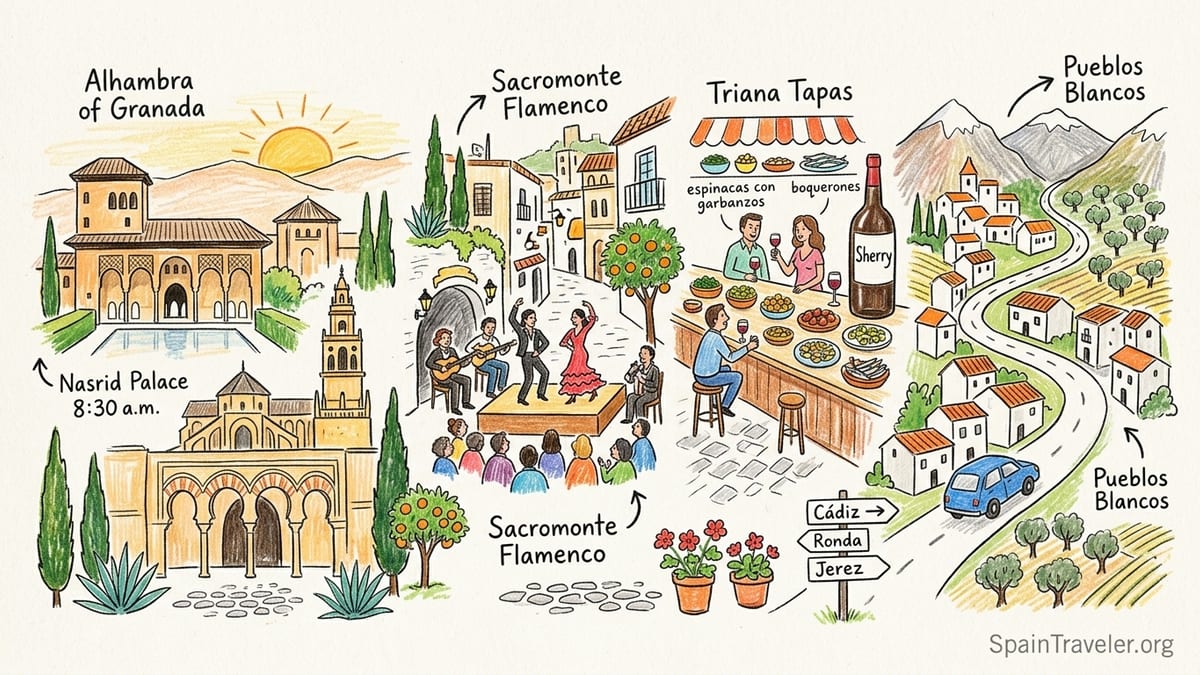
My first encounter with Andalusia’s Islamic heritage was the Alhambra in Granada, on an October trip where sunrise did not feel cruelly early. I booked a General Day Visit through the official Patronato site about six weeks ahead for 19 euros, which included the Nasrid Palaces, Generalife and Alcazaba. Entry to the Nasrid Palaces was tied to a fixed time slot, and I chose 8:30 a.m. The guide was not included; instead, I rented the official audio guide on site for 6 euros. Crowds were light in the first hour, but by the time I reached the Patio de los Leones around 10:00 a.m., it was shoulder to shoulder with tour groups. The weather was cool and clear, around 15 degrees Celsius at dawn, climbing toward 22 by midday. Despite the crowding later, I would absolutely repeat this visit, with the same early slot and a firm plan to leave by noon rather than trying to see every corner.
By contrast, the Real Alcázar in Seville felt both more intimate and more frantic. I visited in late April and again in early October on separate trips, booking tickets online once through the official system for 15.50 euros general admission and once as part of a small-group guided tour that cost 35 euros total. The guided tour included a licensed local guide who communicated clearly, paced the group well and navigated the ticket checks and security line for us. In April, under a dry 27 degree sky and bright sun, the crowds were intense by 10:30 a.m., to the point that some of the smaller tile-lined rooms became bottlenecks. In October, on a slightly overcast 23 degree day, the atmosphere was calmer. I would not repeat a mid-morning high-season slot again unless it was the only time available, but I would certainly return in a quieter shoulder season or late-afternoon session, ideally with the guide, because the historical explanation added a lot.
The Mezquita Cathedral in Córdoba was my most conflicted Moorish site. I visited twice, once in May on a damp day with light showers, and once in September under a dry blue sky. I bought tickets on site in the Patio de los Naranjos for 13 euros after the April 2026 tariff changes, arriving shortly after the 10:00 a.m. opening. There are guided group tours in multiple languages, but I chose the basic entry both times and used a printed plan of the interior instead of an audio guide. On the rainy May visit, the courtyard was almost empty and the forest of columns felt nearly silent, which was magical. The September visit, around 11:00 a.m., was far more crowded, with flag-following groups blocking some of the best vantage points. I would pay again, but only for the earliest slot possible or for the special nighttime visit, which is more expensive at around 25 euros but strictly controlled on numbers. For daytime sightseeing, one visit in the right conditions is probably enough for many travelers.
Finally, the lesser known Moorish remains often felt more rewarding per hour spent. In Córdoba, the Alcázar de los Reyes Cristianos cost me 4.50 euros for standard entry, paid at the ticket office on a warm October afternoon with scattered clouds. There were visitors, but nothing like the crush inside the Mezquita. I spent about ninety minutes walking the ramparts and gardens, and I would repeat it as part of a half-day Córdoba itinerary without hesitation, especially because you can pair it with a slow wander through the nearby riverside and Jewish Quarter rather than rushing from monument to monument.
Flamenco Nights: When It Feels Alive vs Staged
I have experienced three very different flamenco evenings in Andalusia, each in a different setting and price range. The most touristy was a tablao show in Seville near the Santa Cruz district, which I booked online the day before through a ticketing platform for 38 euros including a drink. The performance lasted about an hour. The technical quality was high, with strong guitar work and impressive footwork from the dancers, but the show was tightly choreographed for tour groups. The hall was at least three quarters full on a mild May evening, and the staff were efficient but brisk, hustling people in and out for the next sitting. I would not repeat this specific show at that price, not because it was bad, but because it felt interchangeable with similar experiences in Madrid or Barcelona.
The most memorable flamenco I saw was in Granada’s Sacromonte neighborhood, in a small cave-style venue with bench seating. I booked at a local ticket office earlier the same day for 25 euros, show only, no drink or dinner. The performance ran just over an hour. The cave was packed, maybe fifty people, but the closeness worked with the rawness of the singing and the proximity of the musicians. On a cool March night, with light drizzle outside, the walk up through the narrow streets and glimpses of the Alhambra lit up on the hill opposite became part of the experience. The performers seemed to be responding to each other in real time rather than following a scripted sequence. I would absolutely repeat this kind of Sacromonte flamenco, even if the seating is cramped and the tourist presence obvious, because the energy felt genuinely local.
My most low-key flamenco moment was in a bar in Jerez de la Frontera, during a late autumn evening when the city was quiet. There was no entry fee, just a minimum spend that worked out to about 12 euros for two drinks and a shared plate of cheese. An older singer and guitarist began an informal session at the back of the bar around 11:00 p.m., joined gradually by friends. There were a handful of other visitors, but most of the room was filled with locals who seemed to know the lyrics. The performance was not as polished as the big stage shows, and the acoustics were patchy, but it felt spontaneous. I would not count on recreating this exact bar or night, because it depended so much on timing and luck, yet I would absolutely make time again for a late-night wander in Jerez’s center to see what emerges rather than locking my whole evening into a pre-booked, high-priced tablao.
In practical terms, I would build a trip around flamenco only if you are willing to look beyond the headline venues. A single intimate show in Granada or Jerez, at around 20 to 30 euros, backed by a flexible evening where you can follow recommendations from locals, has been far more satisfying than back-to-back dinner shows in Seville that cost closer to 50 euros once food and drinks are added.
Tapas Evenings & Sherry Bodega Visits That Earned Their Reputation
Tapas is the experience I have repeated most in Andalusia, and it is also the one where planning the least has usually delivered the richest evenings. In Seville, my best night was not the carefully researched list of “must eat” bars around the cathedral, but a loose crawl through the Triana neighborhood on the west bank of the river. On a mild April evening around 20 degrees, a friend and I crossed the bridge after sunset and simply followed the liveliest-looking terraces that still had some locals at the counter. Our spend over the night was around 30 euros each, spread across four bars, including small plates like espinacas con garbanzos, grilled pork loin montaditos and boquerones en vinagre, plus three glasses of local wine or beer apiece. None of the bars charged a cover or required a booking; we simply moved when the energy shifted. I would repeat this exact style of night in Triana or in Granada’s Realejo, where ordering a drink often brought a small tapa included, because it allowed room for surprise.
By contrast, a highly recommended “gastro tapas” meal I booked in central Málaga, at 55 euros per person for a set tasting menu, left me satisfied but not eager to return. The cooking was refined and the wine pairing thoughtful, and service on a warm September night was excellent. Yet the experience felt like it could have taken place in any well-reviewed European city. The restaurant was full of visitors speaking foreign languages, and we had to reserve online with a deposit several days ahead. For travelers on tighter budgets, I would not build an itinerary around this kind of high-end tapas spot. One such meal can be a nice treat, but the more interesting Andalusian food memories have come from walk-in bars where the chalkboard menu changes with the market.
For sherry, the standout experience I would repeat was a guided tour of Bodegas Tío Pepe in Jerez de la Frontera. I booked directly on the official system two days before visiting and paid 21 euros for an English-language tour with a tasting of several wines at the end. The visit lasted around ninety minutes, including the walk through the cellars and a seated tasting with clear explanation from a bilingual guide who handled questions about production, classification and food pairing with ease. The group size was around twenty people on a sunny October afternoon with temperatures near 24 degrees. It was undeniably a well-oiled tourist operation, complete with branded merchandise, but the combination of history and technical detail made it feel substantial. I would gladly pay again for this tour, perhaps trying a more in-depth premium tasting if available, and I would schedule it as a half-day anchor for a Jerez visit.
In contrast, another sherry bodega visit in the same city, booked through a third-party agency for 18 euros, felt thin. The group was larger, the guide’s explanations more generic and the tasting rushed at the end, with little time to compare styles. The experience lasted just under an hour on a hot June afternoon, and we shuffled mostly along a single pre-set route. I would not repeat that particular tour, and it underscored the value of checking whether a winery manages tours directly or outsources them. If you are short on time, I would base a Jerez day around one solid Tío Pepe visit or a carefully chosen independent bodega and then spend the rest of the time walking the compact historic center and tapas bars rather than stacking multiple similar tours.
Driving Through White Villages & Coastal Roads
Renting a car and driving through Andalusia’s white villages has been one of the most rewarding and flexible experiences, though not entirely stress-free. On a spring trip, I rented a compact manual car in Málaga for four days at about 40 euros per day including basic insurance. The highlight day was a loop from Ronda through Zahara de la Sierra, Grazalema and back to Ronda. Fuel for the day cost roughly 25 euros. The weather in late April offered sun with some high cloud, around 22 degrees in the afternoon and cooler in the passes. Traffic was light once off the main road, and parking in the villages ranged from free roadside spaces to small municipal lots charging a couple of euros for several hours. I would absolutely repeat this route, with the same modest-sized car, and I would again avoid weekends that coincide with local festivals when parking tightens.
By comparison, a coastal driving day on the Costa del Sol, from Málaga east to Nerja and Frigiliana, was more mixed. The morning drive on the highway was straightforward, and the cliffside views around Nerja were lovely under a bright June sky. Parking at the beach area required patience and a few laps, and I ended up paying around 12 euros for several hours in a private lot. The Balcón de Europa itself was crowded with tour groups by late morning, and by midday the beaches felt packed. The drive up to Frigiliana in the afternoon redeemed the day somewhat, with its stepped streets and whitewashed houses quieter than the coast, but traffic on the return journey into Málaga was dense and slow. I would not build an entire Andalusian itinerary around this coastal strip by car, though I might still include one such day if combining it with inland villages like Cómpeta or with time-sensitive plans like a cave visit.
A separate coastal road trip that I would eagerly repeat ran between Cádiz and Tarifa. I rented another small car in Cádiz for a two-day one-way journey, paying about 45 euros per day including drop-off fees. The route along the Costa de la Luz included stops at wind-swept beaches like Zahara de los Atunes and Bologna, where off-season parking in October was free and easy directly behind the dunes. The weather alternated between clear skies and patches of sea mist, with strong Atlantic wind but comfortable temperatures around 20 degrees. Even with these variable conditions, the crowd levels were low outside Spanish school holidays, and I frequently had long stretches of sand almost to myself. I would absolutely repeat this stretch, particularly in late September or early October, and I would again avoid the peak of summer when the same beaches are far busier.
If you are nervous about mountain driving, it is worth knowing that some white-village roads involve tight bends and occasional steep drops with minimal guardrails. I am a reasonably confident driver and still found a few stretches near Grazalema demanding, especially in rain. For that reason, while I would repeat the white-village loops, I would not do them on days with poor weather or in a large rental car that is harder to maneuver through narrow village streets.
Beaches, Mountains & National Parks
Beach days in Andalusia have varied sharply depending on location and season. My least enjoyable day was a peak-August visit to a well-known urban beach in Málaga. I arrived around 11:00 a.m. under blazing 32 degree heat, paid approximately 6 euros for a sunbed and umbrella, and within an hour found myself hemmed in on all sides by other visitors. The water was refreshing and there were plenty of chiringuitos serving fried fish and cold drinks, but the noise level and lack of space made it feel more like a festival crowd than a relaxing seaside escape. I would not repeat an August urban-beach day here unless I had no other options.
In contrast, an October day near Conil de la Frontera on the Costa de la Luz remains one of my favorite Andalusian beach experiences. I reached the area by bus and taxi, paying a total of around 15 euros from Cádiz, and spent the afternoon on a long, windswept stretch of sand under a mix of sun and thin cloud, with air temperatures near 22 degrees and water on the cool side but swimmable. There were other people walking dogs and a few surfers, but plenty of empty space. I brought my own towel and umbrella, so the only on-the-day spending was about 12 euros for a simple lunch and drink at a beach bar. I would absolutely repeat this kind of shoulder-season Atlantic beach day and would consider organizing a trip around it if I needed a low-key break between city sightseeing.
Hiking in Andalusian national and natural parks has been consistently rewarding. In the Sierra de Grazalema Natural Park, I joined a small guided hike in the pinsapar, a unique fir forest accessible only with a permit. I booked through a local guiding company for 50 euros per person, including the permit and transport from Grazalema village. The hike took most of the day, roughly five hours walking plus stops. The guide was knowledgeable about flora and conservation issues and kept a moderate pace, suitable for reasonably fit walkers. In late October, the weather was cool and partly cloudy, around 15 degrees in the shade, which was ideal for hiking. Group size was eight, and the trails were quiet aside from occasional other small parties with guides. I would definitely repeat this experience, although I would make sure to pack warmer layers and a waterproof jacket even if the forecast seems benign.
Another memorable hike was on the Caminito del Rey near Ardales. I booked a self-guided ticket with mandatory helmet and security briefing for 18 euros, plus about 11 euros for a round-trip shuttle between the northern and southern entrances. I drove to the meeting point from Málaga in a rental car, took about three hours to walk the roughly eight-kilometer route, and finished in time for a late lunch. The gorge scenery was spectacular, and the walk felt safe despite the exposure in certain sections. On a clear March day with temperatures around 18 degrees and a light breeze, the conditions were perfect. Crowd levels were moderate; entry is timed, and while there were always other people on the boardwalks, it never felt like a crush. I would repeat this walk, but I would avoid days with forecast rain or strong wind, when authorities sometimes close access for safety.
Not every nature experience has to be organized. Several times I have taken local buses from Granada into the lower Alpujarras and simply walked between villages like Capileira and Bubión on marked footpaths, spending only a few euros on bus tickets and around 15 euros on simple lunches. These walks require some stamina due to slopes and altitude, but they can be tailored in length and do not need a guide in clear weather. I would happily repeat these unscheduled village-to-village rambles, especially in spring when the hillsides are green and dotted with wildflowers.
Horse Culture, Cycling & Active Days
Andalusia’s horse culture is most visible in cities like Jerez de la Frontera and Seville. I attended an equestrian show in Jerez at the Royal Andalusian School of Equestrian Art, paying 32 euros for a mid-range seat reserved in advance through the official booking system. The performance lasted about ninety minutes on a dry April afternoon, under filtered sunlight streaming into the arena. The precision riding and traditional costumes were impressive, and commentary in both Spanish and English explained each segment. The stands were mostly full, but the atmosphere felt calm and respectful rather than noisy. I would repeat this experience once per decade of visits, but I would not arrange an entire itinerary around it unless I were a serious horse enthusiast. It is a polished, somewhat formal event rather than an intimate encounter with working stables.
In Seville, I tried a horse-drawn carriage ride around the historic center during my first visit, splitting the cost of 60 euros for about forty minutes among three people. We negotiated the price lightly but stayed within the standard rates displayed near the ranks. The ride took us past Plaza de España, the Maria Luisa Park and the cathedral. The horse appeared well cared for, and the driver shared basic commentary, but the experience was highly touristic, with other carriages forming small traffic jams in narrow streets. On a warm May evening around 25 degrees, it was a pleasant way to see the city without walking, but I would not repeat it now that I know Seville’s layout better. For a first-time visitor with mobility issues, though, it can be useful.
Cycling wise, my most worthwhile ride was a half-day guided tour in Seville using city bikes. I booked with a local company for 30 euros per person, which included the bicycle, helmet if desired, and a three-hour circuit with an English-speaking guide. We met in the late afternoon on a sunny March day around 20 degrees and rode mostly on segregated bike lanes and riverside paths, stopping frequently for explanations and photos. Group size was about ten riders. Traffic interactions felt manageable even for less confident cyclists, and the guide adapted pace so no one was dropped. I would repeat this kind of city bike tour in Seville or perhaps Málaga because it offers orientation and local context while staying active. By contrast, a solo attempt to cycle along busy coastal roads near the Costa del Sol with only painted lanes felt stressful, and I cut the ride short after about an hour. I would not repeat road cycling on main coastal arteries unless significant new infrastructure was in place.
For more serious riders, Andalusia offers multi-day routes in the sierras, but I have not completed those, so I cannot recommend specific companies or itineraries first-hand. Given the heat in summer and the hills involved, I would choose spring or late autumn and consider e-bike support if doing longer distances. Based on my experience, casual cyclists are better off focusing on city-based tours or short sections of converted rail trails rather than committing to ambitious road itineraries without clear information on traffic conditions.
Festivals & Local Culture: When Timing Matters
Festivals can transform Andalusian cities, for better and worse. In Seville, I visited just before the Feria de Abril one year and during the opening days another year. Accommodation prices rose sharply during the fair period, and many hotels required multi-night minimum stays. I spent about 20 euros on entry to the fairground area and a couple of rides and drinks in public casetas, with additional cost for taxis due to traffic restrictions. On a warm spring evening with temperatures in the mid-20s, the illuminated entrance arch and the swirl of flamenco dresses made for remarkable people watching. However, crowds were intense, and restaurant bookings in the center were harder to secure. I enjoyed experiencing the atmosphere once, but I would not plan a short Seville trip around Feria dates again unless I had local contacts with access to private casetas and a flexible budget.
In Granada, I stumbled into a smaller neighborhood festival in the Albaicín on a June afternoon, with temporary stages, food stalls and children’s activities. The cost to participate was essentially what I chose to spend on food and drinks, around 15 euros for a couple of snacks and beers. The weather was hot but tolerable in the shaded narrow streets, and crowd levels were moderate, mostly local families. This kind of serendipitous festival is hard to plan, but I would gladly design future trips to include at least one weekend in a major city and leave some unstructured afternoons to see what is happening in plazas and parks.
Holy Week processions are another major draw. I watched processions in Córdoba one year, standing along the route in the early evening. There was no ticket cost, but I did pay more than usual for a central hotel room booked several months ahead. On a dry but cool night around 14 degrees, the combination of incense smoke, marching bands and candlelit floats was atmospheric and moving. The crowd was dense but generally respectful, with families and older residents clearly treating it as a regular part of their calendar. I would repeat a Holy Week visit to Córdoba or Granada, but I would avoid attempting to move frequently from city to city during that period, as transport and accommodation pinch points become real.
Overall, I recommend aligning a trip with one major festival only if you are prepared to accept higher prices and reduced flexibility. The cultural payoff can be immense, but it is not essential to enjoy Andalusia. Many of my favorite cultural glimpses have been free or low-cost events I discovered by reading city posters or asking hotel staff what was happening that week.
The Takeaway
Looking back across several Andalusian journeys, the experiences I would genuinely repeat cluster around a few themes. First, I would prioritize one or two major Moorish sites with careful timing, such as an early Alhambra slot or a quieter-season visit to the Real Alcázar, rather than trying to tick off every famous monument. Second, I would anchor evenings around neighborhoods that lend themselves to wandering, like Triana in Seville or the old quarters of Granada and Jerez, instead of locking every night into pre-booked shows and restaurant tables. Third, I would keep time in the itinerary for at least one inland driving loop through white villages or a guided hike in a natural park, accepting that this means saying no to some coastal bucket-list spots.
I would also design trips with the seasons in mind. My most enjoyable flamenco and tapas nights happened in spring and autumn when outdoor terraces were comfortable and city streets lively but not overwhelmed. Beach days on the Atlantic in October, sherry tastings in Jerez under soft autumn light, and hikes in the sierras when temperatures hovered in the mid-teens all beat out high-summer experiences that were hotter, more crowded and often more expensive. Even if your dates are fixed, you can still adjust your daily rhythm, aiming for early-morning monuments, long late lunches, siestas and evening strolls.
Finally, I would encourage building your Andalusia itinerary around a mix of one or two headline experiences you know you care about deeply and a larger number of flexible, low-commitment blocks of time. A single pre-booked sherry bodega visit, a carefully chosen flamenco performance and one big monument ticket can serve as anchors. Around them, leave room for the unplanned: the bar that turns into an impromptu flamenco session, the village you decide to linger in because the terrace feels right, or the quiet corner of a Moorish garden where you choose to sit a little longer. Those have been the moments that stayed with me long after ticket times and queue statistics faded.
FAQ
Q1. Is the Alhambra in Granada really worth the effort of pre-booking and an early start?
The Alhambra has been worth the effort for me when I booked an early Nasrid Palace slot and left by midday to avoid peak crowds. I would not visit again with a late-morning entry in high season.
Q2. If I only have time for one Moorish monument besides the Alhambra, which would you repeat?
I would choose the Real Alcázar in Seville in shoulder season, ideally with a small-group guide, because the combination of palace rooms and gardens offers several hours of rich exploration.
Q3. Is it necessary to book flamenco in advance, or can I rely on spontaneous finds?
For big tablaos in Seville, advance booking is often necessary. For smaller venues in Granada or Jerez, I have done well booking same-day or simply asking locals for recommendations once in town.
Q4. Would you rent a car again for white-village and coastal drives in Andalusia?
Yes, I would happily rent a small car again for white-village loops and the Cádiz to Tarifa coast, but I would avoid large vehicles and steer clear of peak summer weekends on the Costa del Sol.
Q5. Are sherry bodega tours in Jerez worth the time if I am not a wine expert?
My visits, especially to Bodegas Tío Pepe, have been worthwhile even as a casual drinker, because guides explain production clearly and the tours also cover local history and architecture.
Q6. How many days would you devote to Seville on a first trip, based on experiences you would repeat?
Based on visits I would do again, I would allocate at least three full days to Seville, with one for the Alcázar and cathedral area, one for Triana and the river, and one flexible for cycling or day trips.
Q7. Is it better to experience Andalusian beaches on the Mediterranean or Atlantic side?
For a relaxed atmosphere and more space, I would repeat October days on the Atlantic Costa de la Luz rather than peak-summer days on busy Mediterranean urban beaches.
Q8. Would you plan a trip around a major festival like Feria de Abril or Holy Week?
I would consider timing a longer trip so that it overlaps with one major festival, but I would not plan a short, first-time visit around these events because of higher costs and reduced flexibility.
Q9. Are guided hikes and activities in Andalusian national parks necessary, or can I go alone?
For permit-controlled areas like the pinsapar in Sierra de Grazalema, I found guided hikes essential. For simpler village-to-village walks in the Alpujarras, I have been comfortable going alone in good weather.
Q10. If I want a slower-paced trip, which experiences from your travels would you build around?
I would build a slower trip around a mix of long tapas evenings in neighborhoods like Triana, one or two village-based stays with short hikes, and a couple of half-day cultural visits such as a sherry bodega or smaller Moorish palace.