


After a decade of trips up and down the Andalusian coast, I have stopped chasing lists of “best beaches” and started paying attention to the places I quietly book again. The beaches below are not a greatest-hits compilation of Andalusia’s entire shoreline. They are the specific stretches of sand and pebbles where I have swum, walked, shivered, burned, paid for parking, queued for showers, and still thought, “Yes, I would come back here.” Just as important, there are a few where I would not.
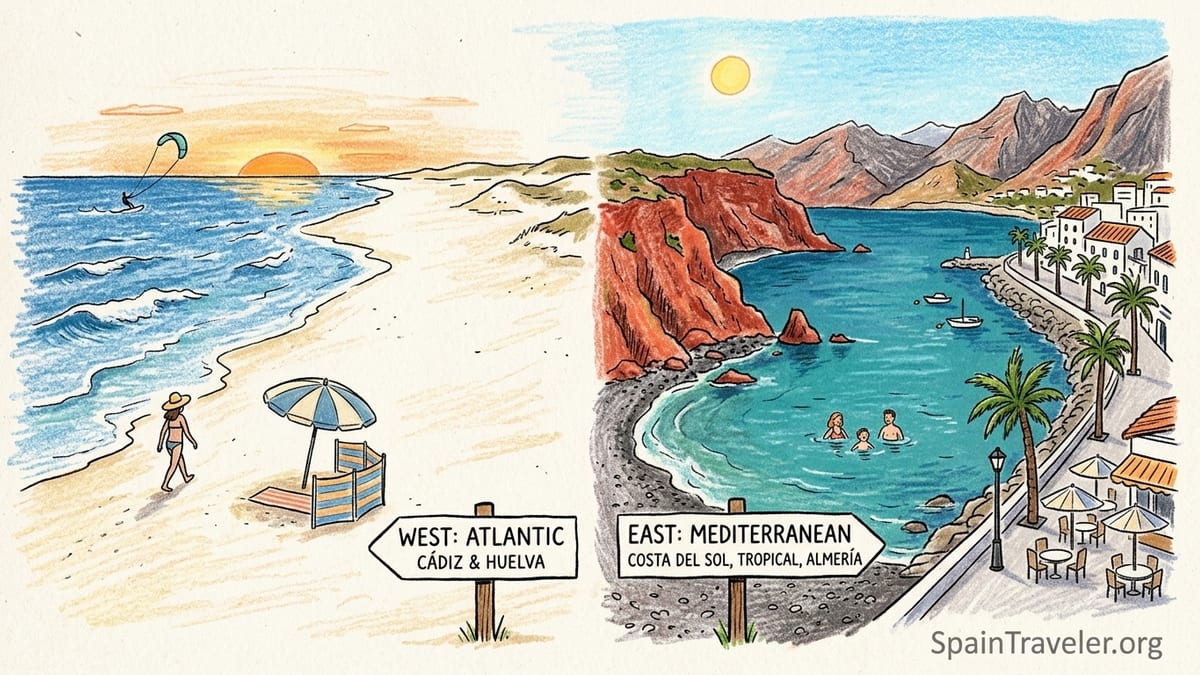
Atlantic vs Mediterranean: Two Very Different Seas
Andalusia is often marketed as a single sunny coastline, but traveling it by car makes one thing obvious very quickly. You are dealing with two very different bodies of water. West of Tarifa, the Costa de la Luz in Cádiz and Huelva faces the open Atlantic. The sand is pale and fine, the beaches are huge, the wind can be fierce, and even in August the water can feel bracing, rarely reaching the warmer summer temperatures of the enclosed Mediterranean further east. The Mediterranean coasts, from the Costa del Sol through the Costa Tropical to Almería, feel like a different country entirely, with steeper coves, darker or pebbly beaches and generally warmer, calmer water.
That split matters when you are choosing where to go. On the Atlantic side, I have returned for long walks on hard sand, sunsets that seem to last an hour, and proper waves that make bodyboarding and beginner surfing worthwhile. On the Mediterranean, my repeat visits tend to be about reliable swimming conditions, shorter walks from parking to the water, more shade from surrounding cliffs and promenades, and a wider choice of cafés within flip-flop distance. Neither side is “better,” but they serve different kinds of trips.
Because this is a firsthand comparison, I only recommend beaches I have personally visited long enough to understand their rhythms. That typically means at least half a day in high season, with time spent both in the water and paying attention to parking, facilities and crowd patterns. Where I only had a quick stop or where one bad experience would not be fair to generalize, I either mention it with caveats or leave it out entirely.
Costa de la Luz Cádiz: Wide Atlantic Sands and Wind
On the Cádiz stretch of the Costa de la Luz, the beach I have returned to most often is Playa de la Barrosa, in Chiclana de la Frontera. It runs for roughly eight kilometers, with broad white sand and a wide intertidal zone that at low tide turns into a hard, walkable runway. This is pure Atlantic sea: open, slightly cooler than the Mediterranean and with a more noticeable swell, especially on days with a moderate westerly wind. On my last summer visit I swam several times under a yellow flag, with chest-high rolling waves that were fun for adults but intimidating for very small children. I stayed about six hours, from late morning through sunset, long enough to see the changing light on the Castillo de Sancti Petri offshore.
The sand at La Barrosa is fine and pale, easy on bare feet but prone to blowing when the Levante easterly wind kicks in. Shade is limited on the open beach, so regulars either bring substantial umbrellas or rent loungers with canopies from the licensed concessions behind the most built-up sections. In the central zones near the main access points there are lifeguard towers in summer, toilets, foot showers and wooden walkways, along with seasonal beach bars and full-service restaurants behind the promenade. Parking ranges from free roadside spaces further back to paid lots closer to the main accesses, and in August it is realistic to spend 10 to 15 euros for a full day in a guarded car park simply to avoid a hot, sandy trudge.
La Barrosa is not a quiet retreat. In July and August, it is busy from mid-morning and can feel crowded near the central chiringuitos. I would still return, but mainly for specific purposes: long walks on firm sand at low tide, a day that mixes swimming with proper Atlantic waves, and late-summer evenings when the sun sets over the ocean and the restaurants stay open late. For families with nervous swimmers, I would recommend staying close to the lifeguard posts, watching the flag system carefully and planning around the wind forecast, since Levante days can make the surface choppy and bring more sandblasting on shore.
By contrast, a Cádiz-area Atlantic beach I do not plan to revisit is a smaller, more urban stretch near central Cádiz that I sampled for an afternoon. Although it had fine sand and a classic city-beach feel, the combination of traffic noise behind the promenade, very limited free parking and a noticeable smell of algae and urban runoff after recent weather made it a one-and-done experience for me. It may serve locals well for a quick dip, but as a traveler with a car I find the balance of effort and reward far better at La Barrosa and other larger Atlantic beaches further south and north, where the urban pressure eases and dunes or pine forests sit behind the sand.
Costa de la Luz Huelva: Long Walks and Quiet Dunes
Further west, in the Huelva section of the Costa de la Luz, the Atlantic character continues but with a slightly different mood. The beaches I have revisited here are less built up than much of Cádiz and far quieter than the Costa del Sol. One example is the stretch near Matalascañas, on the edge of Doñana National Park. I have spent multiple shoulder-season days here, usually four to five hours at a time, walking north along the sand away from the main resort area. The sea is the same Atlantic mix of cooler temperatures and moderate swell, with flags typically green or yellow on my visits. Waves are softer than around some open-coast Cádiz spots but still enough for playful jumping and bodyboarding.
The sand is again fine and light, excellent underfoot and ideal for long walks. One of the main reasons I return to this coastline is that, outside peak August weekends, you can still find large spaces to yourself simply by walking fifteen to twenty minutes away from the main access points. Shade is almost entirely self-provided; the dunes behind the beach are protected and not suitable for setting up under pines as you might around some Mediterranean coves. Facilities cluster around the town section: seasonal lifeguards, showers, a few beach bars and basic shops. Once you walk north along the shore, you leave the infrastructure behind. That trade-off is exactly why I like it.
Parking around Matalascañas is a mix of street spaces and informal surface lots. In high summer, you may pay a small day rate to park close to the beach, similar in range to the Cádiz coast. Crowd levels are very sensitive to the calendar. A sunny Saturday in late July looks and feels busy along the central promenade, while on weekday mornings in June I have walked in near solitude once past the first cluster of umbrellas. I would recommend this general Huelva stretch primarily to travelers who care as much about walking as swimming and who are comfortable bringing their own shade, snacks and water for a half-day along an almost featureless, horizon-to-horizon shoreline.
Costa del Sol: Convenience, Crowds and Urban Comfort
The Costa del Sol, in Málaga province, is where I have logged the most individual beach days, but paradoxically it is the coast I am least likely to recommend to someone seeking a “special” beach. This is Spain’s busiest coastal strip, with more than a hundred urban and semi-urban beaches backed by promenades, apartment blocks and hotels. My time here has mostly been divided between mid-size city beaches in towns like Fuengirola and Torremolinos, and a few smaller coves around the eastern end of the province near Nerja. I typically stay three to five hours at a time, using the beach as one of several daily activities rather than a full destination in itself.
The sea on the Costa del Sol is the Mediterranean. In summer, water temperatures are generally warmer than on the Atlantic side, and the swell is usually modest. On many visits I have swum under a green flag with only low, lapping waves. That makes these beaches reliable for families with younger children or for travelers who want to float or do short swims without thinking about rips and sets. The trade-off is that the water can feel less invigorating on very hot days, and the more urban beaches may have slightly more litter and floating debris near the surface, especially after storms.
Sand here varies from dark volcanic-looking grains to coarser shingle. On popular stretches, loungers and umbrellas are available through licensed concessions that might charge around 10 to 15 euros for two beds and an umbrella for the day in high season, which can feel like good value when shade is scarce and the promenade is baking. Shade from trees is minimal, but tall buildings and cliffs can give some relief early and late in the day. Facilities are the strong point: lifeguards in season, frequent showers and toilets, children’s play areas and a dense lineup of chiringuitos serving seafood, cold beers and simple menus del día. You can step off the sand and find supermarkets, pharmacies and bus stops within minutes.
For many travelers, those conveniences are exactly what they want, and I do use Costa del Sol beaches when I am staying nearby for other reasons. However, there are urban stretches I now actively avoid. One central Málaga-area beach I used several times for quick dips, for example, had heavy traffic noise from a multi-lane road, crowds packed almost towel-to-towel in August and relatively little charm once you looked away from the water. After two or three such visits, I realized I never stayed more than two hours and always ended up taking the train elsewhere the next day. For a first introduction to Mediterranean swimming in Andalusia, I think there are more rewarding options further east and west if you have a car and a bit more time.
Costa Tropical: Steep Coves and Clear, Swimmable Water
Granada’s Costa Tropical is where I find myself planning explicit returns. Here the Sierra Nevada range drops rapidly into the sea, creating smaller, steeper coves with darker sand or pebbles and generally clear, relatively calm water. One of my personal “I would come back again” beaches is La Herradura, in the municipality of Almuñécar. It is a long, horseshoe-shaped bay of over two kilometers, framed by Punta de la Mona on one side and Cerro Gordo on the other, which helps shelter it from the open sea. Several official and local sources classify La Herradura as a family-friendly urban beach with calm waters and good facilities, and that has matched my own experience across multiple visits of four to six hours each.
The “sea type” here is Mediterranean, but the shape of the bay and the sheltering headlands mean the water is often particularly flat, with only slight wave action on most summer days. I have comfortably swum long, parallel-to-shore laps in waist-to-chest-deep water even when there was a modest wind on the headlands. The seabed near the shore is a mix of coarse dark sand and fine pebbles, so water clarity is often good once any small surface chop settles. Families use the gently sloping entry for children, and further out the rocks around the headlands support snorkelling and diving operations. My longest single stay at La Herradura was a full day from late morning to early evening, broken up by swims, a late lunch and time under a rented umbrella.
Shade at La Herradura comes from a mix of umbrellas on the sand and the orientation of the bay itself. In the morning, much of the beach is in full sun, but by late afternoon some sections closer to the promenade begin to benefit from the angle of the light and nearby buildings. Facilities are a strong point: a paved promenade runs the length of the bay, with restaurants, cafés, ice-cream shops and small supermarkets. In season there are lifeguards, public showers, toilets and platforms for people with reduced mobility. Several parking options exist behind the seafront, from free curbside spaces on back streets if you arrive early to paid underground or surface lots closer to central access points. In August evenings, parking can be tight, but outside peak times I have always found a space within a ten-minute walk.
La Herradura’s crowd level fluctuates with the calendar. In high summer afternoons, the central sections can feel busy, with layers of umbrellas closer to the water. Yet even in August I have found that walking toward one of the headlands opens up more breathing room. The overall atmosphere leans Spanish family rather than heavy nightlife, and the water remains the main attraction. Among all the Andalusian beaches I have used, this is one of the clearest choices for travelers who prioritize calm swimming, easy food options and a manageable, compact bay over vast empty horizons.
Almería Coast: Dry Landscapes and Wild Feeling
Continuing east into Almería province, the coastline becomes drier and more rugged, culminating in the protected landscapes of Cabo de Gata and then a series of longer, more open Mediterranean beaches further north. The general pattern I have noticed across my visits is stronger sun, sparser shade and a slightly wilder feel, even where small resort developments exist. The sea remains Mediterranean, but the relative lack of large river mouths and the presence of rocky headlands mean the water can feel particularly clear compared with some more urban Costa del Sol stretches.
On the Almería coast I have spent repeated days on a mid-size beach outside the main city, with a mix of local families and campervans tucked discreetly behind the shore. I usually stay four to five hours, bringing my own umbrella and cooler. The sand is a blend of coarse grains and small pebbles, which makes it less comfortable for long barefoot walks but easier to keep gear relatively sand-free. Waves tend to be modest, though on days with stronger wind the surface can chop up and swimmers may face a slightly more energetic entry and exit. Even then, the swell is usually manageable for confident swimmers, and lifeguards operate from towers during peak season.
Facilities along this stretch are more basic than on the Costa del Sol or at La Herradura. There may be one or two seasonal chiringuitos set back from the water, offering grilled fish, salads and cold drinks, and sometimes a small kiosk renting umbrellas and loungers in the center of the bay. Showers and toilets exist near the main access point but are fewer in number, so in busy August periods small queues can form in late afternoon. Parking, on the other hand, is relatively straightforward. Most of my visits have ended with me parking free on wide, unpaved areas behind the dunes or on the edge of the access road, without the need to navigate multistory garages or paid lots.
I return to this kind of Almería beach when I want a blend of a wilder landscape and still-manageable logistics. What it is actually good for: calm to moderately wavy swimming when the wind forecast is favorable, sunbathing with relatively few tall buildings in sight, and a feeling that countryside and beach still meet without as much concrete in between. I would not recommend it for travelers who insist on abundant natural shade or who need dense services right on the promenade. Compared with the easier urban set-up of the Costa del Sol or the compact horseshoe at La Herradura, Almería demands more self-sufficiency but rewards you with space.
Beaches I Would Skip Next Time and Why
Not every Andalusian beach I have visited has earned a return. Besides the already mentioned over-urban stretch in central Málaga and the less appealing city-side Cádiz beach, there are a few categories I now quietly filter out when planning trips. The first is any narrow urban beach pressed between a busy multilane road and the sea, with little more than a thin ribbon of sand, a constant background of traffic noise and a view punctuated mainly by hotel towers. I have tried several such beaches on the Costa del Sol, staying maybe one to two hours at most for a quick swim between other commitments. The sea itself was usually fine, but the overall experience felt more like using an outdoor pool by a highway than visiting a coastal landscape.
The second category is beaches where parking stress overwhelms any charm. One small Mediterranean cove I tried east of Málaga had attractive clear water and dark pebbles, but on an August Saturday the access road jammed solid by mid-morning, with drivers circling and double-parking in ways that made both arrival and departure unpleasant. By the time I reached the sand, I had already spent nearly an hour navigating and negotiating with other drivers over space. The beach itself, charming as it was, was packed. That day lasted about three hours, and I left thinking that almost any slightly less perfect cove with easier access would have been a better choice.
Finally, I am cautious about returning to some exposed Atlantic beaches near Tarifa for long swimming days. The combination of strong Levante winds, bigger Atlantic swell and the popularity of kite and windsurfing can produce a shoreline that is wonderful to watch but less relaxing to swim in if you are not specifically there for water sports. On one visit I spent around three hours on such a beach, mostly walking and sitting behind a windbreak, with only a short swim during a lull. The wind-blown sand and constant whine of kites on days like that make me more likely to steer general beach days toward calmer Atlantic stretches further north or to the more sheltered Mediterranean side.
The Takeaway
After years of experimenting, the Andalusian beaches I would actually return to fall into a few clear roles. For long, horizon-to-horizon Atlantic walks, sunsets and a sense of space, the wide sands of the Costa de la Luz in Cádiz and Huelva still draw me back, especially around La Barrosa and the quieter stretches edging Doñana. The sea here is better for those who like some wave energy and who do not mind slightly cooler water. For urban convenience, short swims between errands and maximum services per square meter, the Costa del Sol remains unmatched, even if many of its beaches have become utility stops rather than destinations of choice for me.
When I simply want to swim and linger by clear, relatively calm water within reach of good food, the compact coves of the Costa Tropical, led by La Herradura’s sheltered bay, are the places I mark on the map for future trips. They offer a balance of scenery, manageable parking, family-friendly swimming and enough restaurants and cafés that you do not have to plan every detail in advance. Further east, on the Almería coast, I seek out beaches where the drier, wilder landscape meets the Mediterranean, trading some shade and services for more space and clearer views.
Andalusia is not one coastline but several. Understanding the differences between its Atlantic and Mediterranean faces, and between its hyper-urban and more natural stretches, is the key to finding the beaches you personally would return to, not just the ones that look good on postcards. If you care about sea type, sand, wind, waves, shade, facilities, parking and crowd pressure, it is worth matching each trip to a particular coastal zone rather than treating them as interchangeable.
FAQ
Q1. Is the Atlantic or Mediterranean side of Andalusia better for family swimming?
The Mediterranean side, especially sheltered bays like La Herradura on the Costa Tropical, usually offers calmer water and gentler waves, which I have found better for young children and less confident swimmers than the more energetic Atlantic surf.
Q2. Which Andalusian beaches are best if I want proper waves for surfing or bodyboarding?
The Atlantic Costa de la Luz in Cádiz and Huelva generally has more consistent swell and cooler, more energetic water, so larger beaches like those near Chiclana or the open stretches west of Tarifa tend to offer better conditions for surfing and bodyboarding than the typically calmer Mediterranean coves.
Q3. How important is the beach-flag system when choosing where and when to swim?
Very important. On all my visits I pay close attention to the colored flags raised by lifeguards, which indicate whether conditions are safe, require caution or are unsuitable for swimming. A green or yellow flag on a lifeguarded Mediterranean bay usually means reasonable conditions for recreational swimming, while persistent red flags on open Atlantic beaches make me limit water time or focus on walking instead.
Q4. Are Andalusian beach parking fees significant enough to affect trip planning?
They can be. On popular Atlantic and Costa del Sol beaches in peak summer, I have often paid around 10 to 15 euros per day for guarded parking close to main accesses, which is worth factoring into your budget and may justify arriving early or choosing slightly less famous stretches where free roadside or informal parking is easier.
Q5. Do I need to bring my own shade, or can I rely on umbrellas and loungers for rent?
In heavily developed areas like much of the Costa del Sol and in larger resorts on the Costa de la Luz and Costa Tropical, I have almost always found commercial loungers and umbrellas for rent in season. On quieter, more natural stretches, particularly on the Huelva and Almería coasts, services are sparser and I have been glad to bring my own sturdy umbrella and windbreak.
Q6. How crowded do Andalusian beaches really get in August?
In August, urban and famous resort beaches can be extremely busy from late morning until early evening, with towels laid almost edge to edge on some Costa del Sol stretches. I have mitigated this by arriving early, leaving for a long lunch or siesta and returning for the softer light from late afternoon onward, or by walking twenty minutes away from main access points along longer Atlantic beaches.
Q7. Is it realistic to visit multiple coastal zones in one Andalusian trip?
Yes, but it requires some planning. I have comfortably combined a few days on the Atlantic Costa de la Luz with a later stop on the Costa Tropical or Almería coast by car, accepting one or two longer driving days. Doing so makes the contrasts between sea conditions, landscapes and crowd levels very clear and can help you decide which zone you would prioritize on a future, shorter trip.
Q8. Are there good options for travelers who want quieter beaches but still need basic facilities?
Yes. In my experience, medium-size beaches on the edges of towns, rather than directly in front of major resorts, often offer a compromise of showers, seasonal lifeguards and one or two chiringuitos without the intense density of central urban sands. Parts of the Huelva coast and less famous Almería bays fit this pattern particularly well.
Q9. How does wind affect the beach experience across Andalusia?
Wind is a major factor, especially on the Atlantic side. Strong Levante winds around Tarifa and some Cádiz beaches can create large chop, flying sand and a constant background noise of kites, which is great for wind sports but less comfortable for relaxed swimming or reading. On more sheltered Mediterranean bays I have mainly encountered gentler breezes, with only occasional days where umbrellas needed extra anchoring.
Q10. If I have only one day, which coast would you personally choose?
If I had a single day and wanted the highest chance of enjoyable swimming, food and manageable logistics, I would personally choose a sheltered Mediterranean bay on the Costa Tropical, such as La Herradura, where my own repeat visits have consistently delivered clear, swimmable water, a walkable promenade and enough services that the day can unfold without much advance planning.