


I did not design a perfect Andalusia driving loop on a map. I built it the messy way, over several trips, by actually renting cars in Seville and Málaga, getting lost in whitewashed hill towns, inching through historic centers I should never have entered, and parking a perfectly good rental for days while I explored cities on foot and by train. This is what I learned from real roads driven between Seville, Córdoba, Granada, Ronda, the white villages, the mountains of Grazalema, and the Costa del Sol, and how I would plan the route differently next time.
Reconstructing the Real Route, Not a Perfect Loop
Across several visits to Andalusia, my actual driving route looked nothing like the tidy loops you see in brochures. I first flew into Seville and did what many first timers do: I picked up a rental car directly at Seville Airport because it felt efficient. From there I drove Seville to Ronda, then on to the white villages of Zahara de la Sierra and Grazalema, continued to Málaga, and dropped the car at Málaga Airport. On later trips I added city stays in Cádiz and Córdoba, sometimes with a car I barely used and sometimes with no car at all, relying on trains along the main corridor between Seville, Córdoba and Granada.
In practice, that meant a route that zigzagged rather than circled. One leg went Seville to Ronda to Zahara and back to Ronda. Another time I drove Málaga to Ronda, looped through Grazalema and Zahara, then cut across to Jerez and the Atlantic coast before returning the car in Seville. I also made the classic coastal run from Málaga along the A-7 towards Nerja and Frigiliana, and a separate mountain drive from the Costa del Sol up to Ronda.
Looking back, the map shows something important. The motorway triangle between Seville, Córdoba, Málaga and Granada is better done by train or bus, while driving is genuinely valuable in the triangle of Ronda, the white villages and the Grazalema Natural Park, and again along certain quieter stretches of the Cádiz and Málaga coasts. The story that follows comes from those specific drives, not from hypothetical detours I never took.
Renting the Right Car: Pickup, Class and Insurance Choices
On my first trip I rented a compact car directly at Seville Airport, timing pickup a couple of hours after landing to allow for immigration and baggage. Counter staff were eager to upgrade me to a larger SUV, but I had already read warnings that streets in Ronda and the white villages can be as narrow as 2 meters across. In practice, a compact hatchback such as a Seat Ibiza or similar was ideal. It was small enough to squeeze into tight parking garages and thread through stone arches, but still comfortable on the motorways.
Base rental prices fluctuated, but in recent years I consistently found that a week in a compact with manual transmission, booked in advance, cost in the region of a few hundred euros, plus airport surcharges. When I accepted a last minute counter offer for full coverage on my first visit, I effectively doubled the rental price. On later trips I ran the numbers more carefully. Using an annual excess policy from a specialist insurer worked out significantly cheaper over time than paying the rental company’s top tier insurance each time, while still allowing me to walk away from small scratches and stone chips without fear.
The most worthwhile extras were simple: a second driver added for a modest daily fee, and clear documentation of fuel policy. Almost all my Andalusia rentals came with a fair full to full system. I learned quickly to refuel at a station just outside the return airport rather than rely on the rental company’s refill service, which carried a noticeable premium. One practical note about refueling: on rural stretches between Zahara, Grazalema and Ronda, fuel stations are sparse, so I started topping up when the tank dropped below half rather than waiting for the warning light.
The experience also taught me one administrative detail that matters in Spain. Some historic centers in Córdoba and Granada are classed as low emissions or restricted zones, monitored by cameras. I never received a fine, but other travelers I met in hotel lobbies did. They had followed GPS instructions straight into zones where only residents may drive. Now, I always ask hotels in major cities for written driving and parking instructions before I collect the car.
Motorways vs Mountain Roads: How Driving Actually Felt
Driving in Andalusia breaks into two very different experiences. On one side are the main motorways, such as the A-4 between Seville and Córdoba, the A-45 and A-92 between Málaga, Antequera and Granada, and the A-7 along the Costa del Sol. On the other are the mountain and rural roads that connect places like Ronda, Zahara de la Sierra, Grazalema and Arcos de la Frontera. Learning to respect the difference saved me both stress and time.
The motorways generally felt smooth and predictable. Speed limits around 120 km/h applied to the major autovías, dropping to 100 km/h or less near junctions and urban areas. Between Seville and Córdoba the A-4 ran arrow straight through olive country, with good visibility and regular service stations. On that route I barely needed advanced driving skills. Cruise control and a podcast were enough. The downside was that these fast roads mostly bypassed the landscapes and towns I had come to see, which is why I started combining trains for these segments and saving my driving energy for the hills.
The contrast was immediate when I turned off towards Ronda. The climb from the coast at San Pedro de Alcántara up to Ronda on the A-397 delivered some of the most memorable driving of my life. The road was well surfaced but relentlessly winding, with tight bends and steep drop offs defended only by low barriers. Heavy trucks and buses took the same road, which meant I had to be patient rather than attempt risky overtakes. It was rarely frightening, but it demanded full concentration. Journey times on those 50 to 60 kilometer stretches expanded to an hour or more.
Inside the white villages and small towns, the challenge changed again. Streets in Zahara de la Sierra and parts of Ronda are not only narrow but also steep, paved with polished stone that can feel slick after rain. At least once I had to fold in the wing mirrors and edge past a parked van with centimeters to spare on either side, while pedestrians pressed themselves into doorways. The experience cured me completely of any desire to rent a large SUV in Andalusia. A compact car, or even a small crossover at most, is the right tool for these environments.
City Sections: When the Car Became a Burden
Several of my biggest mistakes involved keeping a car when I should have switched to trains or simply walked. The first was starting with a car in Seville. After an anxious evening arrival at the airport, I took the ring road towards the center and then followed the GPS down ever narrower one way streets, searching for my hotel near the old town. I brushed a curb avoiding a delivery truck and, worse, I inadvertently passed a sign marking restricted access near the cathedral. Although I never saw a fine, the stress was out of proportion to the short distance covered.
Once parked in an underground garage near the Alameda de Hércules, the car stayed unused for almost three full days. Seville’s historic center is flat and very walkable, and the tram and bus network reaches out to the more modern districts. Between the Alcázar, the cathedral, the Santa Cruz neighborhood and the riverside, every destination lay 20 minutes away on foot. I found myself paying daily parking fees solely to leave the car immobile under fluorescent lights.
I repeated a version of that mistake in Córdoba. Tempted by the idea of flexibility, I arrived by car from Ronda, following the A-45 north. As I crossed the river and approached the Mezquita, the traffic signs multiplied. Zones of restricted access, bus and taxi only lanes, and one way side streets combined with a navigation app that kept recalculating through forbidden segments. I eventually retreated and parked in a commercial garage near the train station. For two days the car stayed in that same spot while I explored the historic center on foot and crossed the Roman bridge at sunset.
Those experiences changed my approach. On later trips I arrived in Córdoba and even Granada by train instead of by car, met friends at centrally located hotels, and only picked up a rental after leaving the larger cities. It felt counterintuitive at first not to use a car for the entire holiday, but the relief of avoiding urban driving more than compensated for the minor extra planning.
White Villages, Rural Nature and the Roads That Make Them Possible
Where a car transformed Andalusia for me was in the band of mountains and white villages between Ronda, Zahara de la Sierra, Grazalema and Arcos de la Frontera. There is public transport here, but it is infrequent and does not connect the smaller villages in a way that makes day trips realistic. Behind the wheel, I stitched together hilltop castles, reservoir viewpoints and cork oak forests in a way that would have been impossible otherwise.
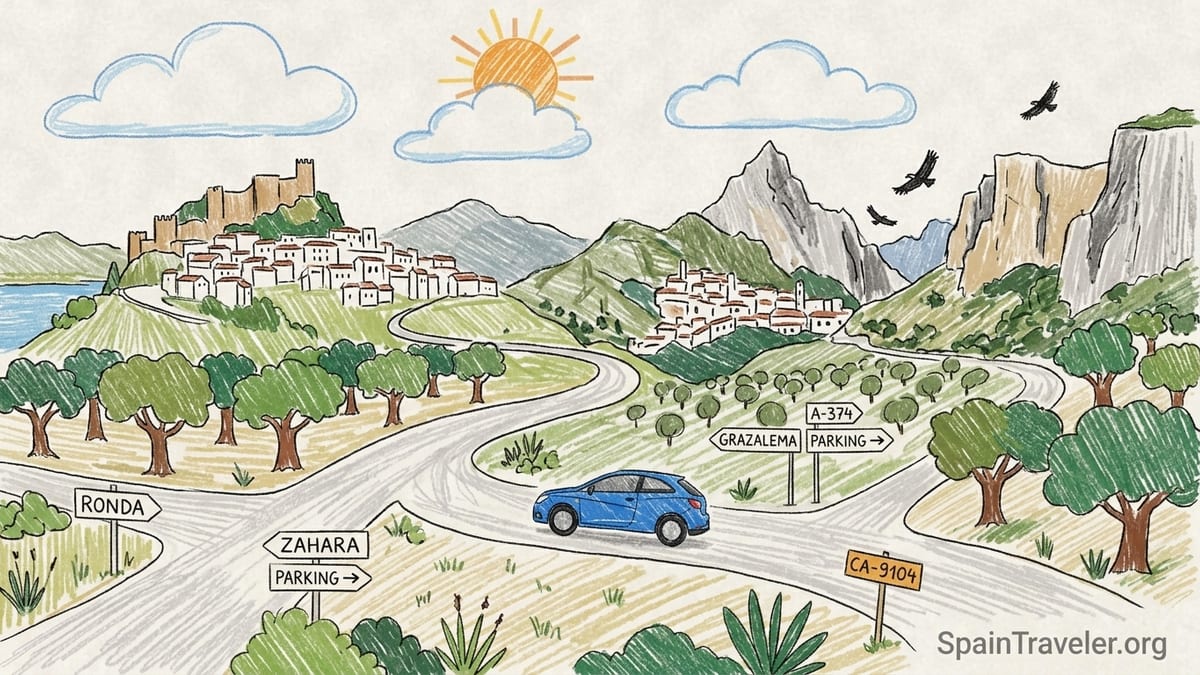
One specific drive stays with me. Leaving Ronda in the morning, I headed northwest on the A-374 and then the CA-9104 towards Zahara de la Sierra. The journey was only about 40 kilometers, but the drama unfolded across every bend. The road traversed open pastures and then dived into a succession of viewpoints over the turquoise Zahara-El Gastor reservoir. I stopped at a simple mirador with a stone wall and watched vultures circling above the cliffs. From Zahara, the climb towards Grazalema was steeper still. At Puerto de las Palomas, the high pass between the two villages, a small gravel lay-by offered a panorama back across the lake and out towards the flatlands of Cádiz province.
In practical terms, that day also taught me about parking strategy in white villages. I initially drove right up into Zahara’s narrow lanes and found myself facing a stone arch framed by parked cars. There was technically room to pass, but another driver coming downhill stared at me with a look that said I did not belong there. I reversed awkwardly, rejoined the main road, and this time followed the universal Andalusian rule: wherever you see a sign for public parking on the edge of a village, use it. In Zahara this meant leaving the car in a gravel lot below the village and walking the final 10 or 15 minutes uphill.
A similar pattern played out in Grazalema, where the designated parking just outside the historic center spared me from threading a car through streets designed for donkeys. In both villages, once I had parked sensibly, the experience opened up. I wandered through whitewashed alleys, pausing at bakeries and tiny bars, and followed short hiking paths into the surrounding natural park. Without the car I would not have reached these trailheads or watched the late afternoon clouds snag on the limestone peaks, yet the key was knowing when to leave the vehicle and continue on foot.
Coastal Drives, Parking Puzzles and When Trains Win
The other place where driving proved both rewarding and challenging was the coast. From Málaga I followed the A-7 east towards Nerja and then turned inland to Frigiliana. The motorway section was straightforward, although traffic around Málaga and the western Costa del Sol thickened at commuter times and on summer weekends. Service stations and roadside restaurants were frequent. Exit ramps, however, came quickly, and it was easy to miss a turn and be forced into a several kilometer loop before trying again.
Parking was the coastal headache. In Nerja I found underground garages well signposted from the main road, but street parking near the Balcón de Europa viewpoint was heavily regulated, with blue painted lines and ticket machines. Rates per hour were not ruinous but added up over a full beach day. In some smaller coastal towns closer to Cádiz, informal dirt lots existed near the dunes, but local police occasionally patrolled and ticketed cars left where they blocked emergency access.
I also experienced a more subtle problem in Cádiz itself. Arriving by car from Jerez, I entered the isthmus that connects the historic city to the mainland and almost immediately wished I had taken the train. The walled old town is a maze of tight streets and limited access zones, and on the day I arrived a cruise ship was in port, amplifying congestion. After half an hour circling one way streets, I accepted defeat and parked in a paid garage close to the cathedral. The car did not move for two days while I walked the sea walls and alleyways. It might as well have been back at the airport.
Comparing those experiences with later trips by rail clarified the pattern. Trains between Málaga, Córdoba, Seville and Cádiz were clean, punctual and reasonably frequent, especially on the main high speed lines. Where my early trips had involved driving between every pair of cities, later journeys combined fast trains for the long legs with targeted car rentals for the rural days. In other words, I learned to use the car where the road itself was the attraction and to abandon it where streets turned into puzzles.
Costs, Parking Strategies and Small Everyday Details
Across these trips, some numbers and habits repeated. Fuel prices shifted with the global market, but as a rough guide I usually paid in the region of one and a half to two euros per litre at standard stations, with motorway service areas sometimes slightly more. A full tank in a compact car delivered several hundred kilometers of range, more than enough for most day trips around the white villages or between major cities. Tolls were far rarer than in parts of France or Italy. On my usual routes between Seville, Ronda, Málaga, Granada and Córdoba, I did not encounter major toll motorway sections at all, which kept driving costs relatively predictable.
Parking, by contrast, required constant attention. In larger cities many on street spaces were painted blue, indicating paid parking with a time limit. I grew used to hunting for white painted spaces, sometimes a ten minute walk from the sights, to avoid running back to feed the meter. Underground garages with ticket barriers were the fallback option, especially when arriving tired in the evening or during festivals when locals filled every available free space early in the day.
One recurring mistake was underestimating walking distances with luggage. On arrival in Ronda one year, I spotted a free on street space in the lower town and snatched it, proud of avoiding garage fees. The next 20 minutes involved hauling a suitcase up a steep hill to reach my guesthouse near the Puente Nuevo bridge. It would have been worth paying for nearer parking just for that first night. Later, once I had settled in, I could happily leave the car a little further away while exploring on foot.
Navigation technology deserves a final mention. Smartphone maps were invaluable on motorways and rural roads, but occasionally disastrous in historic centers. More than once an app insisted I follow a narrow alley that clearly served only residents, or guided me right up to bollards guarding pedestrian squares. Eventually I developed a system. On approach to any historic area, I would consult a paper map or the hotel’s written directions, then mentally set a perimeter beyond which I refused to drive. If the navigation app suggested a line that pierced that perimeter, I ignored it and instead aimed for a known parking garage at the edge.
The Route I Would Drive Next Time
Having lived through detours, unnecessary city driving and idle rental days, I would now plan an Andalusia road trip very differently, based on the stretches of road that genuinely enriched the journey. It would start with trains along the main urban spine and reserve the car for the white villages, mountain parks and select sections of the coast.
The revised route would look like this. I would fly into Seville and spend at least two nights in the city without a car, exploring the Alcázar, cathedral and Triana neighborhood entirely on foot. When ready to leave, I would walk back to the station and take a fast train to Córdoba for a night or two, again car free, staying close to the Mezquita and crossing the Roman bridge at dusk. Only after leaving Córdoba would I introduce a car, either by taking another train to Málaga and picking up a compact at the airport, or by renting in Córdoba if schedules suited.
From Málaga I would drive into the interior, heading to Ronda for at least two nights. One full day would be reserved for the drive through the white villages, following the scenic road towards Zahara de la Sierra, stopping at a reservoir viewpoint and walking up to the castle, then continuing over the high pass to Grazalema. I would park in edge of village lots at both stops and keep the day’s schedule to no more than two or three significant pauses, resisting the temptation to cram every white village into a single daylight window.
After Ronda and Grazalema, I would have options. One appealing leg would lead west towards Arcos de la Frontera and then down to Jerez and the sherry country, picking a rural hotel with on site parking and using the car to explore vineyards and small towns. Another would loop back to the coast, perhaps via Marbella and on to Nerja and Frigiliana, before returning the car in Málaga. In either case, I would avoid driving directly into the cores of larger cities like Seville, Cádiz or Granada, opting instead to drop the car on their outskirts or at airports and complete the final approach by public transport.
That route is less tidy than the perfect circles drawn in marketing brochures, but it reflects what Andalusia taught me. The car is a key to the spaces between cities: to narrow roads curling up to remote white villages, to reservoirs gleaming below castle ruins, to hidden coves along the Atlantic and Mediterranean coasts. Inside the great Moorish cities themselves, however, it turns into luggage on wheels. The art of an Andalusia road trip is knowing when to drive, when to park and walk, and when to let the high speed trains do the work.
The Takeaway
My real Andalusia road trips were not defined by a single loop but by a series of lessons learned on specific stretches of asphalt. Collecting a compact car at Seville or Málaga airports worked best when I immediately headed for the hills or coast, not when I plunged into old towns dense with restrictions. Motorways between the big cities were efficient and mostly stress free, yet rarely as rewarding as the mountain roads that rose from the Costa del Sol towards Ronda or threaded the passes between Zahara de la Sierra and Grazalema.
In cities like Seville, Córdoba and Cádiz, the car spent days unused in underground garages while I discovered that every important sight sat within a walkable radius or a short tram ride. Those days taught me to trust the rail network for long urban hops and to rent cars only for the rural segments where public transport thins. In the white villages and natural parks, driving opened up a different Andalusia entirely, one of cork oaks, raptors, reservoir views and tapas bars where I heard little English.
If there is one habit I would pass on, it is to reconstruct your own route from real needs rather than from an abstract idea of a road trip. Ask where a car will genuinely add value and where it will quietly drain energy and money. Consider picking up your rental only when you leave your first major city and dropping it before entering the next. Choose a compact car, learn the local parking color codes and respect every sign that hints at pedestrian priority. Do that, and Andalusia’s roads will feel less like an obstacle course and more like an invitation into corners of the region that trains and buses rarely reach.
FAQ
Q1. Is it better to pick up a rental car in Seville or Málaga for an Andalusia road trip?
Both airports work, but Málaga often has more rental options and competitive pricing, and it sits closer to popular coastal and mountain routes, while Seville is a natural start if you plan to explore the white villages and then finish on the coast.
Q2. What type of car is best for driving through Andalusia’s white villages?
A compact hatchback is ideal because streets and parking garages in places like Ronda, Zahara de la Sierra and Grazalema are narrow, and smaller cars are easier to maneuver and park than SUVs.
Q3. Do I need to worry about toll roads in Andalusia?
On common routes between Seville, Córdoba, Málaga, Granada and the main white villages, most major roads are toll free, so many road trips can be completed without paying motorway tolls, though you should still watch for local exceptions.
Q4. How difficult is parking in cities such as Seville, Córdoba and Cádiz?
Parking close to historic centers is often limited and regulated, with many streets restricted to residents or short term paid parking, so it is usually easier to leave the car in an underground garage or at the edge of the center and walk in.
Q5. Are the mountain roads around Ronda and Grazalema safe for inexperienced drivers?
The surfaces are generally good, but these roads are steep and winding with sharp bends and some exposed edges, so they require concentration and moderate speeds, and very nervous drivers may prefer to limit how much time they spend on them.
Q6. Should I keep a rental car while staying several days in Seville or Córdoba?
For most visitors it is not necessary, because the historic centers are compact and walkable and public transport covers longer distances, which makes city parking fees and urban driving more trouble than they are worth.
Q7. Is fuel expensive in Andalusia compared with other parts of Europe?
Fuel prices in Spain are typically in the mid range by European standards, and while exact figures change, many travelers find refueling in Andalusia slightly cheaper than in countries like France or Italy.
Q8. How much driving can I realistically do in one day on an Andalusia road trip?
On motorways you can cover several hundred kilometers in a few hours, but once you include white villages and mountain roads it is wise to limit yourself to two or three main stops and expect journeys of 150 to 200 kilometers to take most of the day.
Q9. Do I need an international driving permit to rent a car in Andalusia?
Many travelers from within the European Union can use their national licenses, while visitors from some non EU countries may be asked for an international permit alongside their home license, so it is best to check the latest requirements before travel.
Q10. Is it easy to combine trains and driving on a single Andalusia itinerary?
Yes, many travelers take high speed or regional trains between major cities such as Seville, Córdoba, Málaga and Granada, then rent a car for a few days to explore the white villages, mountains or coastal areas that public transport does not cover well.