


The Spanish Pyrenees stretch for more than 400 kilometres from the Atlantic to the Mediterranean, a sawtooth wall of peaks, deep valleys and stone villages spread across several provinces. Trying to cram the entire mountain chain into a hurried one-week loop often means too many hours behind the wheel and not enough time on the trails or in the villages. This guide takes a different approach: a modular, self-drive itinerary you can build section by section, combining two or three regions depending on how long you have and where you start from.
Why a Modular Road Trip Works Best in the Spanish Pyrenees
Spain’s official tourism material presents the Pyrenees as ideal road trip country, highlighting fly-and-drive itineraries that link dispersed valleys and small towns by car. The reason is simple: buses and trains tend to serve only the main corridors such as Zaragoza to Huesca or Lleida to La Pobla de Segur, while many of the best hiking bases and viewpoints sit up side roads or at the heads of valleys. A rental car makes it far easier to reach places like the Selva de Irati in Navarre, the Tena Valley above Biescas or the backroad up to Benasque, all of which are awkward or time-consuming by public transport.
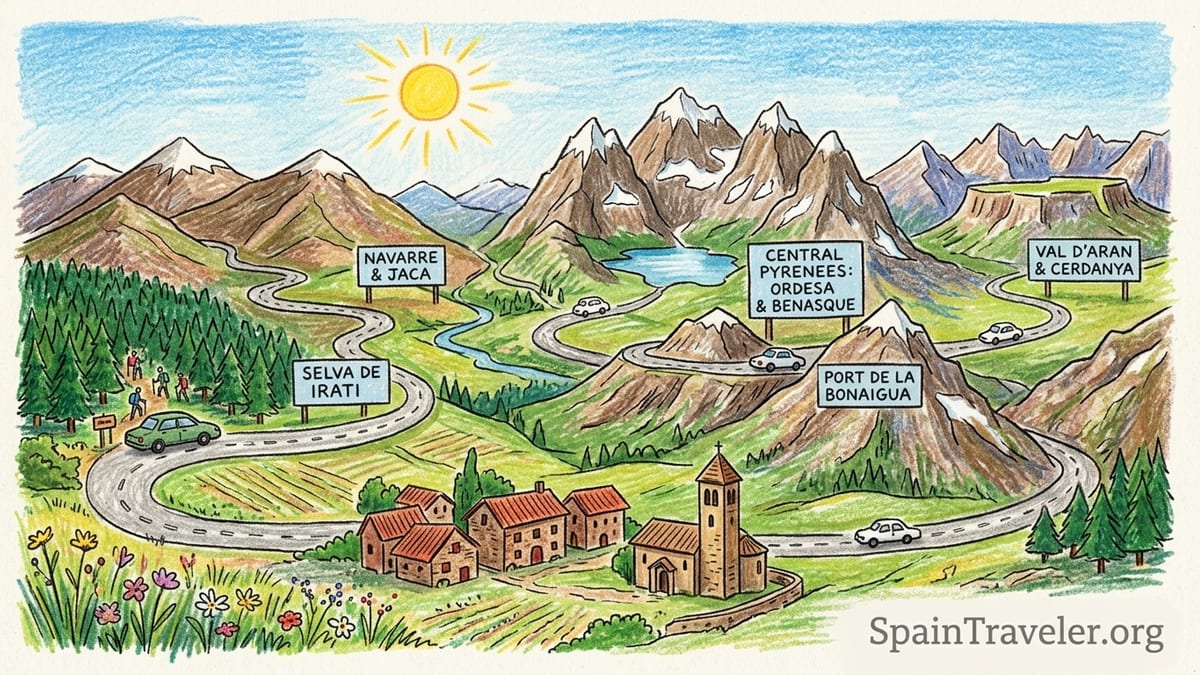
Instead of one long, exhausting traverse, this guide groups the Spanish Pyrenees into three logical blocks: Navarre and Jaca in the west; Tena, Ordesa, Aínsa and Benasque in the central section; and Val d’Aran, Aigüestortes and Cerdanya in the east. Each block works as a stand-alone four to six day trip. Link any two sections for a 10 to 12 day journey, or drive all three over two to three weeks. This modular structure also makes it easy to adapt if a mountain pass closes for snow or if you want to linger in one valley.
Driving distances between bases are manageable. For example, Zaragoza to Jaca is roughly two and a half hours on good main roads, Barcelona to Vielha in Val d’Aran is around four hours, and Girona to Puigcerdà in Cerdanya usually takes about two and a half hours. Within each valley, expect short but slower mountain drives, such as the sinuous A-136 from Sabiñánigo into the Tena Valley or the climb from Castejón de Sos to Benasque, where average speeds drop but views improve dramatically.
Car rental is straightforward in gateway cities such as Zaragoza, Barcelona, Girona and Lleida. A compact car with a reasonably strong engine is usually enough for summer trips, though travellers visiting in winter or early spring should prioritise models with good ground clearance and check that winter tyres or snow chains are available. In smaller towns like Jaca or Vielha, rental choice can be limited, so most visitors pick up their car in the lowlands and drive into the mountains.
Mountain-road Driving and Seasonal Passes: What to Expect
Mountain driving in the Spanish Pyrenees is scenic but rarely extreme if you stick to paved roads. Major routes such as the N-260, which cuts across the range, and the access roads into the Tena Valley, Ordesa, Benasque and Val d’Aran are asphalted and well signposted. Gradients can be steep and curves tight, especially on roads like the climb to Port de la Bonaigua between Val d’Aran and Pallars Sobirà, which tops out at just over 2,000 metres and is a true high pass. In summer the challenge is more about sharing the road with cyclists and motorbikes; in winter and early spring, snow and ice are the main considerations.
Several passes stay open year-round in principle but may close temporarily in bad weather. The Col du Pourtalet, which connects the Tena Valley with France at about 1,800 metres, is maintained in winter but can shut for a day or two after heavy snowfall, as recent seasons have shown when local authorities temporarily closed Portalet and neighbouring Bielsa to manage avalanche risk while keeping the Somport tunnel open as an alternative. The Port de la Bonaigua can also experience brief closures or require chains during strong storms. Travellers should check the Spanish traffic authority’s advisories, and the regional channels for Catalonia and Navarre, on the day of travel and build some flexibility into winter itineraries.
In practice this means planning extra time between valleys in winter and early spring, and being ready to reroute via lower roads if necessary. For instance, if Portalet is closed between Sallent de Gállego and France but you are staying within Spain, you can still drive comfortably between Jaca and the Tena Valley on the valley road without crossing the border. Similarly, if Bonaigua looks problematic, you can access Val d’Aran from the south through the Vielha tunnel instead of over the pass. Hotel bookings that allow for date changes are worth paying for in the snowy months.
Summer driving has its own rhythm. July and August bring more traffic around national park access points such as Torla-Ordesa or Espot, and parking fills up early. Heat can build up in the valleys during the day even if temperatures remain cooler than on the plains, so travellers should avoid overloading the car and keep fluids and brakes in mind on long descents. It pays to refuel when you pass through larger towns like Jaca, Sabiñánigo, Aínsa, Vielha or Puigcerdà, as some of the highest valleys have only one or two small filling stations with shorter opening hours.
Navarre and Jaca: Western Gateway from Zaragoza
For many travellers arriving by air, Zaragoza is the most convenient western gateway to the Pyrenees. Collect a car at Zaragoza Airport or the main station and head north towards Pamplona or Huesca depending on your plan. A classic three to four day module begins in the lush Navarrese Pyrenees before swinging east to Jaca, creating a gentle introduction to mountain driving and Basque-influenced culture. In Navarre, travellers often base themselves in villages such as Ochagavía for walks into the Irati Forest, or in Elizondo in the Baztan Valley where stone farmhouses and rolling hills feel a world away from the dry Ebro plain.
From Pamplona, the road to the Selva de Irati climbs through hairpins and pastures to car parks near trailheads. Spain’s national tourism material highlights this route as a showcase Pyrenean drive, with the Tapla pass in Navarre specifically cited as a scenic climb towards one of Europe’s best preserved beech and fir forests. Parking at popular access points can cost the equivalent of a few euros per day, often payable at machines or via local apps, and in high season spaces near the main trailheads fill by mid-morning. Many travellers therefore choose to stay two nights nearby to explore sections of the forest without constantly changing accommodation.
From the Navarre valleys, the drive to Jaca runs east along a mix of fast national roads and more winding stretches. Jaca itself is a lively small city with supermarkets, gear shops and a range of accommodation from simple hostales around the old town to mid-range hotels with parking on the ring road. Here travellers can park and explore on foot, visiting the 16th-century pentagonal citadel and Romanesque cathedral, or drive up to nearby viewpoints such as San Juan de la Peña, reached by a twisty road where parking is tightly controlled in summer weekends.
This western module works particularly well as a five-day loop from Zaragoza. For example, travellers might spend two nights around the Navarrese Pyrenees for forest walks and local cuisine, then drive about three hours to Jaca for another two nights, leaving a final day to return to Zaragoza. Those with a week could add a day trip north from Jaca into the high Aragón Valley towards Canfranc-Estación and the Somport tunnel, where the renovated historic station and easy walks provide a first taste of higher peaks without committing to long hikes.
Tena Valley, Ordesa, Aínsa and Benasque: Central Highlights
The central Pyrenees between Jaca and Benasque contain some of Spain’s most dramatic mountain scenery, including Ordesa y Monte Perdido National Park and a series of wide glacial valleys. This module can comfortably fill six to eight days and pairs well with either the Navarre and Jaca section to the west or Val d’Aran and Cerdanya to the east. Drivers usually approach from Zaragoza via Huesca and Sabiñánigo, or connect from Jaca in under an hour. From Sabiñánigo, the A-136 climbs into the Tena Valley, a broad trough dotted with reservoirs and villages such as Biescas, Sallent de Gállego and Panticosa.
Tena is a good place to acclimatise to higher elevations without committing to narrow roads. Many visitors base themselves in Biescas or Sallent de Gállego for two or three nights, taking half-day drives to the ski resorts of Formigal or Panticosa where summer lifts operate on selected dates. The road continues to the Portalet border pass, which reaches around 1,800 metres and typically remains open year-round, though authorities have recently closed it temporarily on snowy days to manage avalanche risk. Parking near the ski stations is generally free in summer, but in winter skiers pay for closer lots or resort garages, and snow chains may be required on peak days.
From Tena, drivers can swing east to Ordesa y Monte Perdido National Park, usually basing themselves in Torla or Broto along the Ara Valley. Access rules vary by season. In the peak summer weeks and busy autumn weekends, private cars are restricted on the upper road to the Pradera de Ordesa, and visitors park in Torla’s large lots and take shuttle buses to the meadow trailhead. Outside those periods, such as winter or quieter shoulder seasons, travellers can often drive their own car up to the Pradera parking, though carrying snow chains is prudent if snow is forecast. It is worth checking the park’s updated annual visitor information before arrival, as shuttle dates and parking conditions are confirmed each year.
South and east of Ordesa, the small town of Aínsa sits on a hill above the confluence of two rivers and functions as a hub between valleys. Its old quarter has several medium-sized hotels and guesthouses, and the newer lower town offers supermarkets and petrol stations. Many travellers stay in Aínsa two or three nights and make day trips: west to the Añisclo Canyon, north towards the Bielsa tunnel, or east along the N-260 towards Campo and Castejón de Sos. From there, a paved mountain road leads north to Benasque, one of the main gateways to the highest peaks of the Aragonese Pyrenees including Aneto.
Benasque itself is surrounded by 3,000-metre summits but reached by a single access road that threads through a narrow gorge before opening into a broad valley. The main town has a compact centre with hotels and apartment rentals, most of them with some on-site or underground parking, though spaces can be tight in August. The local tourism board notes that the valley is easiest to reach by car, as there is no rail connection and only limited bus services from Huesca or Zaragoza. That reality makes Benasque a textbook example of why a self-drive trip gives more freedom: with a car, visitors can drive up to trailheads at the Llanos del Hospital or Cerler resort early in the morning and return for dinner in town without worrying about infrequent buses.
Val d’Aran, Aigüestortes and Cerdanya: Eastern Section from Barcelona or Girona
The eastern Spanish Pyrenees offer a different flavour, with bilingual Catalan and Aranese culture, Romanesque churches and a strong focus on hiking and skiing. This module works well as a five to eight day trip from Barcelona or Girona, and can be combined with the central section via the Port de la Bonaigua or the Vielha tunnel. Many travellers arriving at Barcelona–El Prat Airport drive north on the A-2 and C-13 through Lleida and the Noguera Pallaresa valley, while those coming from Girona cross via the C-16 and Cadí Tunnel towards Cerdanya.
Val d’Aran, with its main town of Vielha and the ski resort area of Baqueira, is unique in Spain for its Atlantic climate and its own local language, Aranese. Drivers usually enter via the Vielha tunnel, a modern all-weather route, or over the Bonaigua pass on the C-28 if conditions allow. Bonaigua reaches just above 2,000 metres and provides a spectacular but more exposed drive between Val d’Aran and the southern valleys. In summer the roadside Clot Gran car park acts as a trailhead for hikes into the Gerber valley and lakes on the edge of Aigüestortes National Park. In winter, snowbanks line the road and closures or chain requirements are possible, so cautious drivers may prefer the tunnel.
Aigüestortes i Estany de Sant Maurici National Park, the only national park in Catalonia, is car-based in the sense that you drive to the park gateways but must then leave your vehicle and continue by shuttle or 4x4 taxi. Public information from Catalan authorities explains that private cars can reach various access villages such as Boí, Barruera or Espot, where dedicated car parks serve as staging points. Within the park itself, private vehicles are not allowed beyond these limits. Instead, licensed 4x4 taxis and, in peak season, shuttle services take visitors up rough tracks to iconic spots like the Aigüestortes plain or Sant Maurici lake. Many visitors therefore choose bases such as Boí or Espot for two or three nights, accepting that they will not move the car every day.
Further east, Cerdanya stretches across a high plateau valley shared between Spain and France, with Catalan towns such as Puigcerdà and La Molina on the southern side. From Barcelona or Girona, drivers reach Cerdanya via fast highways and then the Cadí Tunnel or Collada de Toses pass. The valley floor sits at around 1,000 to 1,200 metres, so roads are less steep than in Ordesa or Benasque, but winter snow and fog are still possible. Puigcerdà offers several mid-range hotels with on-site parking and a compact centre for evening strolls. Nearby ski resorts like La Molina and Masella open their car parks to hikers and mountain bikers in summer, making them practical day-trip targets for families who prefer short walks and cable car rides over long hikes.
Typical travellers might design an eastern module by spending three nights in Val d’Aran, using Vielha or Arties as a base, then driving over Bonaigua to spend two or three nights near Aigüestortes in Boí or Espot, and finally finishing with two nights in Cerdanya before returning to Barcelona or Girona. This pattern involves only two or three hotel changes over a week, but still samples a wide range of landscapes and driving conditions. It can also be reversed, starting with Cerdanya and ending in Val d’Aran, depending on flight schedules.
Combining Modules by Time and Starting Point
One of the strengths of a modular approach is that you can scale the journey to match the time you have. Travellers with only five or six days might focus on a single block, such as Navarre and Jaca, flying in and out of Zaragoza and limiting the drive to an easy loop. Those with eight to ten days could combine the central and eastern sections, entering from Barcelona, spending several nights each in the Tena Valley, Ordesa or Aínsa, Benasque and then Val d’Aran or Cerdanya, before looping back via the plains. With two full weeks available, it becomes realistic to drive the full west-to-east traverse from Navarre to Cerdanya, with time to pause in each main valley.
Starting points matter. From Zaragoza, the most logical first module is Jaca and the central valleys, with an optional extension west into Navarre if you have more time. For example, a ten day trip might spend two nights around the Selva de Irati, two in Jaca, then three split between Tena and Ordesa, and three in Aínsa and Benasque before returning via Huesca. From Barcelona, many travellers prefer to begin with the eastern module in Val d’Aran and Aigüestortes, then continue west to Benasque and Ordesa if time allows. Girona is particularly convenient for Cerdanya, with an easy half-day drive into Puigcerdà on the first afternoon.
Hotel changes are a key design decision. Because driving between main hubs rarely exceeds three and a half hours, it is usually better to spend at least two nights in each base, exploring nearby valleys on day trips. For instance, staying three nights in Aínsa allows a day in Ordesa, a day in the Sobrarbe canyons and a day driving up the Bielsa valley, without repacking every morning. In Val d’Aran, a two or three night stay in Arties or Salardú gives access to Baqueira’s lifts and short drives up side valleys like Aiguamòg and Valarties, where in summer a local shuttle may limit traffic and encourage visitors to park earlier and continue on foot.
Rental-car logistics also factor into how you combine modules. A classic pattern is to pick up and drop off the car in the same city to avoid high one-way fees, which are common in Spain. A Barcelona round-trip can easily include Val d’Aran, Aigüestortes, Cerdanya and even Benasque over 10 to 12 days without excessive backtracking. A Zaragoza round-trip can reach Navarre, Jaca, Tena, Ordesa and Aínsa in a similar timeframe. More ambitious travellers sometimes fly into Barcelona and out of Bilbao or vice versa, using the Pyrenees as a scenic bridge, but should budget for possibly higher rental costs in return for a more linear route.
Practicalities: Parking, Regulations and Local Services
Parking is generally straightforward in the Spanish Pyrenees as long as you respect local signs and seasonal regulations. Towns such as Jaca, Aínsa, Vielha and Puigcerdà have blue-zone street parking in central streets, often limited to one or two hours during the day with payment at curbside meters, and free or reduced fees in the evening. Most travellers opt for accommodation that includes parking, whether a spot in a private garage, a courtyard or a designated area outside the village. When booking, it is worth confirming whether parking is on-site, nearby public parking or street-based, especially in old villages with narrow lanes where access can be awkward.
At national park and high-valley access points, parking is more tightly managed. In Torla-Ordesa, large car parks on the edge of town serve visitors when shuttle buses replace private cars on the upper road. In Boí and Espot, designated lots act as interchange points for the 4x4 taxis into Aigüestortes i Estany de Sant Maurici National Park, and some of these car parks have seasonal closures or restricted hours, particularly in winter when snow makes higher areas inaccessible. Notices at the entrances and information from local tourist offices and park websites provide up-to-date details on which car parks are open and whether shuttle or taxi services are running.
Fuel and services concentrate in valley towns. For example, motorists will find multiple petrol stations in Jaca and Sabiñánigo, a cluster along the main road through Vielha and several in Puigcerdà. By contrast, small villages at the heads of side valleys, such as Torla, Sallent de Gállego or Benasque, may have only one small filling station or none at all, so topping up in the larger towns is prudent. Supermarkets and outdoor shops are also clustered in these hubs, making them good places to stock up on picnic supplies, gas canisters and last-minute gear such as trekking poles or rain jackets.
Local driving regulations follow national Spanish rules but with some regional wrinkles. Speed limits on open secondary roads are typically around 90 kilometres per hour, dropping to 50 or 30 kilometres per hour through villages and even lower near schools. Enforcement can be strict near tunnels, such as on the approaches to Vielha, or on sections of the N-260. In some Catalan valleys and Navarre, temporary traffic restrictions operate on especially busy summer weekends to manage congestion in fragile areas, sometimes replacing free access with timed entries or shuttle buses. Travellers should watch for signs indicating regulated access and respect no-parking zones in meadows and riverbanks, which are often monitored in peak season.
The Takeaway
A road trip through the Spanish Pyrenees rewards time, flexibility and a willingness to adapt plans to weather and landscape. The region is made for driving, with official Spanish tourism material explicitly endorsing fly-and-drive itineraries in the northern mountains and highlighting how a car connects dispersed valleys and villages that public transport barely touches. Yet the secret is not to attempt everything in one breathless sprint, but to treat the range as a series of interlocking modules that can be combined according to your starting point, your appetite for mountain roads and your available days.
By dividing the Pyrenees into the western Navarre and Jaca section, the central Tena, Ordesa, Aínsa and Benasque block, and the eastern Val d’Aran, Aigüestortes and Cerdanya area, travellers can build trips that feel rich yet unhurried. Whether you have five days or three weeks, you can string together valley bases, spend two or three nights in each, and still have time to linger over long lunches, detour to a viewpoint or wait out a passing storm without derailing the whole itinerary. The mountains will still be there tomorrow, and with a car and a modular plan, so will your options.
FAQ
Q1. How many days do I need for a Spanish Pyrenees road trip?
For a single module such as Navarre and Jaca or Val d’Aran and Cerdanya, five to six days is comfortable. To combine two modules, plan on 9 to 12 days. Driving the full west to east route with time to hike and explore usually takes at least two weeks.
Q2. What is the best time of year to drive the Spanish Pyrenees?
Late June to September offers the most reliable weather and open passes, with long days and accessible high trails. May and October can be beautiful but bring more risk of rain or early snow. In winter the roads remain open to major valleys, but mountain passes and national park access may be restricted by snow and ice.
Q3. Do I need a 4x4 or SUV for this road trip?
For most travellers in late spring, summer and early autumn, a standard two-wheel drive car is sufficient on paved roads. A 4x4 or SUV can provide extra confidence in winter, on minor roads after storms and for reaching some remote trailheads, but is not essential if you follow main routes and heed local traffic advisories.
Q4. How are parking and access managed in Ordesa and Aigüestortes national parks?
In Ordesa, private cars are often restricted on the upper access road in peak periods, with visitors parking in Torla and using shuttle buses to the Pradera. In Aigüestortes, you drive to gateway villages such as Boí or Espot, park in designated lots and then take licensed 4x4 taxis or shuttles into the park. Outside busy seasons, rules may be more flexible but private cars generally cannot continue into the core park areas.
Q5. Are mountain passes like Portalet and Bonaigua open all year?
Officially, passes such as Portalet and Bonaigua are maintained year-round, but heavy snowfall or avalanche risk can cause temporary closures or chain requirements in winter and early spring. When conditions are difficult, authorities sometimes keep lower tunnels such as Vielha open as the main all-weather route. Always check current traffic updates on the day you plan to cross a high pass.
Q6. Is it easy to rent a car in Zaragoza, Barcelona or Girona?
Yes. All three cities have multiple international and local rental agencies at airports and main train stations. Booking in advance is recommended in summer and around holidays. Travellers usually find compact or mid-size cars with unlimited mileage, and can request extras such as child seats, GPS units or snow chains where relevant.
Q7. How expensive are fuel and tolls in the Pyrenees region?
Fuel prices in the Pyrenean foothills are broadly similar to the rest of Spain, while tolls depend on your chosen routes. Many key access roads to valleys and passes are toll-free, although some approaches from Barcelona or Girona, such as the Cadí Tunnel towards Cerdanya, may involve tolls. To manage costs, travellers often refuel in larger towns and plan routes that minimise time on toll motorways once in the mountains.
Q8. Can I rely on public transport instead of a car?
Public transport reaches major hubs like Jaca, Aínsa, Vielha and Puigcerdà, mostly by bus, but services are often infrequent and rarely continue to high trailheads or side valleys. For example, reaching Benasque or Torla solely by bus can involve multiple changes and limited schedules. A rental car substantially increases flexibility, especially for early-morning hikes and one-way routes between valleys.
Q9. Are the roads suitable for nervous or inexperienced mountain drivers?
Many main roads in the Spanish Pyrenees are well engineered with good surfaces and guardrails, but they do include curves, gradients and occasional narrow sections. Nervous drivers may prefer to avoid high, exposed passes in poor weather and instead use tunnels or lower routes. Starting with easier valleys such as Cerdanya or the Tena Valley before tackling steeper roads can help build confidence.
Q10. How often should I change hotels during a Pyrenees road trip?
To avoid fatigue from constant packing and unpacking, it is sensible to stay at least two nights in each base and ideally three if you want full days of hiking. A ten day trip might therefore involve only three or four different bases, for example Jaca, Aínsa, Benasque and Val d’Aran, linked by scenic half-day drives rather than rushed daily relocations.