


The Spanish Pyrenees stretch from the Mediterranean to the Basque Country, a serrated wall of peaks hiding deep valleys, stone villages and some of Spain’s most characterful ski areas. To really join the dots between Catalonia, Aragón and Navarre, a rental car often makes the difference between seeing one resort and exploring several valleys in a single trip. This guide explains how to rent and drive in the Pyrenees from Barcelona, Girona, Zaragoza and Pamplona, when a car is almost essential, and when ski transfers make more sense.
Why a Rental Car Changes a Pyrenees Trip
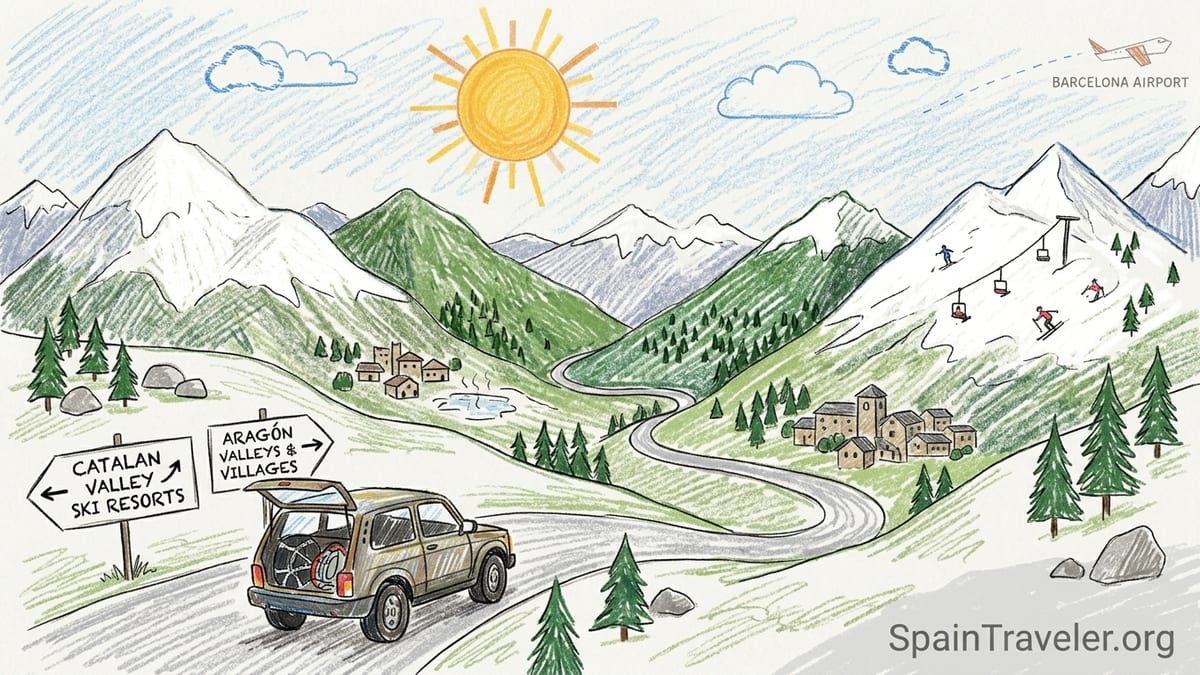
The geography of the Spanish Pyrenees is defined by long valleys that rarely link neatly with each other. Public transport tends to run up and down those valleys, not across them, which is why a rental car unlocks much more than just airport transfers. From Barcelona to La Molina, from Zaragoza to Formigal, or from Pamplona into the Roncal or Irati valleys, having your own wheels often turns a single-resort week into a multi-valley road trip.
Take the Catalan Pyrenees as an example. La Molina and Masella sit above the Cerdanya plain, while Vall de Núria is tucked into a separate valley further east, and Boí Taüll and Baqueira Beret spread across huge basins further west. Reaching all of them in one holiday by bus or train is technically possible but involves awkward connections and limited timetables, especially on weekdays in winter. With a car collected at Barcelona or Girona Airport, you can drive from La Molina to Vall de Núria in a morning and still catch the afternoon on the slopes.
In Aragón and Navarre the distances on a map look short, but valley roads are slow and curving. Zaragoza is the main gateway for Formigal, Panticosa and Cerler, while Pamplona is a launch pad for quieter corners such as the Belagua valley or the western approaches to the Ordesa area. A car means you can stay in one base, such as Jaca or Biescas, and day-trip to several ski areas or hiking trailheads instead of being locked into a single resort transfer.
There are exceptions. If you are flying for a simple week in Baqueira Beret with half-board in a big hotel, or to a self-contained resort like Formigal where you barely plan to move, pre-booked transfers can work just as well. But as soon as you talk about visiting more than one valley, chasing the best snow, or combining skiing with villages and hot springs, a rental car becomes far more practical and often cheaper per person.
Key Gateways: Barcelona and Girona for the Catalan Pyrenees
For the eastern and central Catalan Pyrenees, Barcelona’s Josep Tarradellas Barcelona-El Prat Airport and Girona-Costa Brava Airport are the two primary car rental gateways. Both are managed by Aena, which lists multiple on-site rental car facilities in each airport, so you can step off the plane and walk directly to the car hire desks inside the terminals without taking a shuttle bus.
Barcelona Airport offers the widest choice of providers and vehicles, from big international brands such as Hertz, Avis, Enterprise and Europcar to Spanish companies. That breadth is useful if you are looking for automatic transmission or compact SUVs, which tend to be scarce at smaller locations. Flight schedules are also denser, particularly from outside Europe, so many long-haul travelers will naturally start here, then drive two to three hours to reach ski resorts like La Molina in Cerdanya or Port del Comte on the Pre-Pyrenees edge.
Girona-Costa Brava Airport is smaller but very convenient if you find a good flight. Aena notes that the airport hosts rental brands including Hertz, Goldcar and Thrifty, among others, clustered in the arrivals area. In high season this can make for fast pick-ups, and the road links to the eastern Catalan Pyrenees are excellent. From Girona it is about 90 minutes to Vallter 2000 by road and roughly two hours to La Molina via the C-66 and C-17 or C-26, often with much less congestion than leaving Barcelona on a Friday evening.
Girona can also be a smart choice if you plan a mixed city-and-mountains trip. You could spend an opening night in Girona’s old town, then collect a car the next morning either at the airport or a downtown office and drive into the mountains in daylight. That avoids navigating unfamiliar highways right after a flight and gives you flexibility on pick-up and drop-off times.
Zaragoza and Pamplona for Aragón and Navarre
On the central and western side of the chain, Zaragoza and Pamplona are the logical entry points for Aragón and Navarre. Both airports are managed by Aena and listed among the network’s car rental facilities, so you will find on-airport desks with standard opening hours and common booking platforms. While flight options are more limited than Barcelona, these airports put you closer to the big Aragonese and Navarrese valleys.
From Zaragoza Airport, drivers usually follow the highway north toward Huesca before branching into different mountain valleys. The main ski areas of Formigal and Panticosa are roughly a three-hour drive in good conditions, with most of the journey on fast roads before the final climb up the Tena Valley. Cerler, the highest resort in the Aragonese Pyrenees, is reached via Barbastro and Benasque, a route often recommended by resort information because it keeps you on main roads for as long as possible before a scenic final stretch into the mountains.
Pamplona Airport sits just south of the city and is particularly well placed for Navarre’s western Pyrenees. Car rental counters here are smaller in scale, but the city is compact and you can reach the mountain valleys in under two hours. For example, the Roncal and Salazar valleys, gateways to cross-country tracks and snowshoe routes, are a comfortable drive, as is the road over the Ibañeta and Roncesvalles passes when conditions allow. For those combining city breaks with mountain time, it is easy to spend a night in Pamplona, then collect a car and head for the hills the next morning.
For Aragón and Navarre, a car is especially valuable outside peak winter. Shoulder-season bus services are thinner, and many attractive villages such as Hecho, Ansó or small hamlets near Ordesa have just one or two buses a day at best. With your own vehicle you can follow weather and snow patterns more flexibly, shifting between Formigal’s big lift network, Cerler’s quiet slopes and Navarre’s forested valleys as conditions change.
Airport vs City Pickup: What Works Best
Choosing between airport and city pick-up in Spain is about balancing convenience, cost and driving confidence. At Barcelona, Girona, Zaragoza and Pamplona, airport rentals are often the simplest option for most visitors: desks are inside or next to the terminal, many flights are timed to match opening hours, and the car parks connect directly to main roads heading toward the mountains. This is ideal if you land in the morning and want to be in the Pyrenees by late afternoon.
However, city pick-up can sometimes be cheaper and less stressful. In Barcelona, renting from a downtown office near Sants station or in the Eixample may shave a little off the daily rate and avoid airport surcharges. More importantly, you can take the airport train or airport bus into the city, spend a night to recover from jet lag, and pick up the car after a good sleep, when tackling the ring roads and mountain motorways feels easier. A similar strategy works in Girona, where you might stay in the old town, then collect your car at a city branch before driving to Vallter 2000 or La Molina.
In Zaragoza and Pamplona, city-centre branches are often just a short taxi or bus ride from the train stations. This can be useful if you are combining high-speed rail with a shorter rental. For instance, some travelers take a high-speed train from Barcelona to Zaragoza, then rent a car in the city to reach Formigal or Cerler, saving both time and rental days compared with keeping a car idle during a city stay.
A practical compromise is to compare airport and city quotes for your exact dates, including estimated fuel and parking. In many cases the difference might be small, so the convenience of walking from arrivals to the rental desk wins. But if you are nervous about driving out of Barcelona or landing late at night, collecting your car the next day from a city office can make the trip feel calmer and safer.
Cars, Gearboxes, SUVs and Winter Equipment
In Spain, most rental fleets are still dominated by manual transmission. If you want an automatic, you should reserve as early as possible, especially at smaller airports like Girona, Zaragoza or Pamplona where the number of automatic vehicles can be limited. Booking a named category that explicitly includes “automatic” is important; otherwise companies may interpret your request as a preference rather than a guarantee.
For winter in the Pyrenees, many travelers gravitate toward compact SUVs, partly for the feeling of extra security and partly for the increased ground clearance on snow-lined village streets or hotel access roads. Typical Pyrenees choices include small crossovers from mainstream brands. These do not automatically come with four-wheel drive, so you need to check if all-wheel drive is truly necessary for your itinerary or if a front-wheel-drive model with snow chains will suffice.
Unlike parts of central Europe, Spain does not generally require winter tyres nationwide, but in mountain regions local authorities can make snow chains or winter equipment obligatory when conditions demand. In practice this means you should ask about chains when booking and confirm at the desk whether your car includes them or if they can be added for an extra fee. On days of heavy snow, Catalan and Aragonese road authorities sometimes close high roads to vehicles without chains or winter tyres, and it is common to see signs near resorts stating that chains are mandatory for the final stretch.
Because winter weather in the Pyrenees is variable, you might drive from a sunny Barcelona or Zaragoza on bare tarmac, only encountering snow on the last 10 to 20 kilometres. Many visitors prefer a standard front-wheel-drive compact with chains in the boot, rather than paying a premium for a larger SUV, especially if they plan to park the car for several days while skiing and only drive to and from the resort.
Snow Chains, Mountain Roads and Safety
Driving mountain roads in winter requires a slightly different mindset than cruising Spanish motorways. The key is to stay flexible and respect local advice. When snow falls heavily, Catalonia and Aragón issue alerts and sometimes close secondary passes while keeping main valley roads open with snowploughs. In those moments, chains move from “good idea” to essential, especially for the last hairpins into high resorts or remote villages.
If you rent in Barcelona or Girona for the Catalan Pyrenees and plan to visit higher resorts such as Vallter 2000 or Boí Taüll, it is sensible to ensure your car either has winter tyres or that you carry chains sized correctly for your wheels. Rental companies typically charge a daily or per-rental fee to add chains, and staff may briefly explain how to fit them, but it is worth checking an online video or practising once in a car park on dry ground so that, if a roadside sign orders chains, you are not learning by torchlight in a snowstorm.
On the Aragonese side, routes from Zaragoza to Formigal or Cerler are mostly straightforward until the last climbs. Road surfaces are generally well maintained, and traffic includes local drivers accustomed to winter conditions. The main risks are sudden changes in grip where the sun has not reached the tarmac, or where meltwater refreezes in the evening. Keeping a steady speed, using engine braking instead of heavy pedal braking on descents, and leaving extra space from the car ahead all reduce stress.
It is also important to carry basic winter gear in the car: warm clothing that you can access easily, a charged phone, some water and snacks, and if possible a small shovel or brush to clear snow around the wheels. In Catalonia, authorities regularly remind drivers to travel with high-visibility vests and approved warning devices in case of breakdowns. Even though serious road closures are relatively rare, these simple preparations can turn an unexpected delay into a minor inconvenience rather than a serious problem.
One-way Rentals, Insurance and Parking
Many Pyrenees itineraries are linear rather than circular. You might land in Barcelona, ski in the Catalan Pyrenees, then cross to Formigal or Ordesa and fly home from Zaragoza or Pamplona. Most major rental brands in Spain do allow one-way rentals within the country, but they usually charge a drop-off fee that can range from modest to quite substantial depending on demand and the cities involved. When comparing prices, it is important to look for this fee in the quote breakdown rather than discovering it at the counter.
Insurance deserves careful reading. Standard Spanish rentals include mandatory third-party coverage and often a basic collision damage waiver with a relatively high excess. In mountain environments, where small scrapes, windscreen chips or wheel damage are more likely, it can be worth either paying for the company’s enhanced cover or buying an independent excess policy in advance. For example, if you are driving from Girona to Baqueira Beret and parking outdoors overnight, extra cover can make you more relaxed about minor cosmetic damage from ice or wayward skis in hotel car parks.
Parking varies by valley. In many ski resorts such as La Molina, Masella, Formigal or Panticosa, large open-air car parks next to the lifts are free or moderately priced, encouraging day-trippers. In small stone villages like Taüll or Benasque, streets can be narrow and signed resident-only, so it is common to park in designated lots at the village edge, then walk or take shuttle buses to the lifts. In busier hubs like Vielha or Jaca, underground car parks charge by the hour or day, which can add up over a week if you barely move the vehicle.
If you are planning a pure ski week where the car will sit unused for days, consider whether a private transfer plus local ski buses might be better value. For example, in Baqueira Beret many visitors book transfers from Lleida or Barcelona and rely on resort buses to move between slopes and accommodation. The daily cost of chain rental, parking and fuel for a car that hardly moves can easily exceed the comfort of being dropped at your hotel door.
Lleida and Alternative Gateways
Lleida, in western Catalonia, deserves mention as a secondary gateway to the central Pyrenees. While it does not have the same volume of international flights as Barcelona, the city sits on the high-speed rail line and hosts regional car rental branches. Many skiers heading to Baqueira Beret or Boí Taüll take a fast train from Barcelona or Madrid to Lleida-Pirineus station, then collect a rental car there, reducing driving time while still enjoying flexibility in the mountains.
From Lleida, the N-230 and associated roads head up toward the Val d’Aran and Baqueira Beret, while other routes lead to the Boí valley. Journey times to the resorts are still around two to three hours, but the road profiles are more direct than coming from the coast. For travelers who are nervous about driving through Barcelona’s ring roads or who arrive in Spain via Madrid, this train-plus-car combination can be particularly attractive.
Lleida is also useful for itineraries that blend Spanish and Andorran resorts. You might rent a car in Lleida, spend a few days in Boí Taüll, then cross to Andorra for Grandvalira or Pal-Arinsal before looping back to Barcelona or Zaragoza for your flight home. In such cases, always inform the rental company if you plan to cross borders, as not all contracts allow you to take the car into Andorra or France without prior authorization.
Even if you never see the inside of Lleida’s airport or train station, understanding its position on the map helps you evaluate routes and travel times. When comparing rental quotes, consider whether splitting your trip between rail and car, using Lleida as the junction, might shorten your time behind the wheel while keeping access to remote valleys.
When a Car Is Essential and When Transfers Win
A rental car is almost essential for certain styles of Pyrenees trip. If your goal is to sample multiple valleys in one visit, chasing sunshine or snow, public buses and resort shuttles rarely offer enough flexibility. For instance, a two-week itinerary combining La Molina and Masella, then shifting to Benasque for Cerler and finally a few days in the Val d’Aran is dramatically easier with your own vehicle, even in shoulder season when ski buses are not running frequently.
Summer and shoulder seasons amplify this difference. While winter brings dedicated ski buses to some resorts from Barcelona or Zaragoza, many of those services drop away in late March or April. If you plan to hike the Ordesa canyons in late spring, visit Romanesque churches in the Boí valley in early autumn, or explore the villages of Navarre’s Salazar valley outside peak times, a car hired in Barcelona, Zaragoza, Pamplona or Lleida will save hours of waiting and multiple connections.
On the other hand, for a pure ski week at a single, large resort, transfers can make more sense. Examples include a family flying into Barcelona and heading straight to La Molina for seven nights, or a group landing in Zaragoza and going directly to Formigal on a pre-booked shuttle. In these scenarios the car might not move for days because everything you need is within walking distance or served by resort buses. Eliminating the daily worry about parking, snow-clearing and potential minor damage can be liberating.
A middle option is to split the difference: take a shared transfer or bus from Barcelona to a well-connected resort such as La Molina, Masella or Baqueira Beret for the first part of your stay, then pick up a rental car in a nearby town for a few days of exploring cross-country trails, villages or hot springs. This approach keeps costs under control while still letting you experience the quieter corners of the Pyrenees that most package tourists never reach.
The Takeaway
Renting a car to explore the Spanish Pyrenees from Barcelona, Girona, Zaragoza or Pamplona multiplies your options in a landscape where valleys are long, public transport is limited and the best experiences often lie a few kilometres off the main road. Airport pick-up is usually the easiest choice, but city branches can make sense if you want to rest before driving or combine rail with road. Automatic cars and compact SUVs exist but remain limited, so advance booking is wise, and in winter it pays to think carefully about snow chains, insurance and where you will park.
The decision ultimately depends on your itinerary. If you are happy skiing one resort for a week, resort transfers and local buses can be efficient and relaxing. If you dream of linking Catalonia’s Cerdanya slopes with Aragón’s Tena Valley, or threading through Navarre’s forests and Romanesque villages, a rental car is close to essential. With sensible preparation and steady driving, the Pyrenean roads themselves become part of the adventure rather than an obstacle.
FAQ
Q1. Do I really need a rental car to ski in the Spanish Pyrenees?
A car is not strictly necessary for a week in a single big resort with good transfers, but it is very useful if you want to visit multiple valleys or smaller villages.
Q2. Is it better to pick up my car at Barcelona Airport or in the city?
Airport pick-up is usually more convenient and offers more choice, while a city branch can be calmer and occasionally cheaper if you stay in Barcelona first.
Q3. Are automatic rental cars easy to find in Barcelona, Girona, Zaragoza and Pamplona?
Automatics are available but limited, especially at smaller airports, so you should book early and choose a category that explicitly guarantees an automatic gearbox.
Q4. Do I need a 4x4 or SUV for winter driving in the Pyrenees?
A 4x4 or SUV is helpful on steep or snowy roads, but many visitors manage with a front-wheel-drive compact fitted with snow chains when conditions require them.
Q5. Are snow chains mandatory in the Spanish Pyrenees?
Spain does not impose a blanket national rule, but local authorities can require chains or winter equipment on specific mountain roads when snow and ice make conditions difficult.
Q6. Can I do a one-way rental between Barcelona and Zaragoza or Pamplona?
Most major rental companies allow one-way rentals within Spain, including between these cities, but they usually charge a drop-off fee that should be checked in advance.
Q7. How expensive is parking at Pyrenees ski resorts?
Many resorts offer free or low-cost open-air parking near the lifts, while busy towns and village centres may rely on paid underground or edge-of-village car parks.
Q8. Is it safer to drive from Barcelona to the mountains during the day?
Yes, daylight makes it easier to read signs and judge road conditions, so many travelers prefer an overnight in the city and a morning departure into the Pyrenees.
Q9. Can I cross into Andorra or France with a Spanish rental car?
Often yes, but only if the rental agreement allows it, so you must inform the company when booking and confirm that cross-border travel is permitted and insured.
Q10. When do airport transfers make more sense than renting a car?
Transfers are usually better for a simple week in one resort where you will not drive daily, especially if parking is limited or you are uncomfortable driving in snow.