


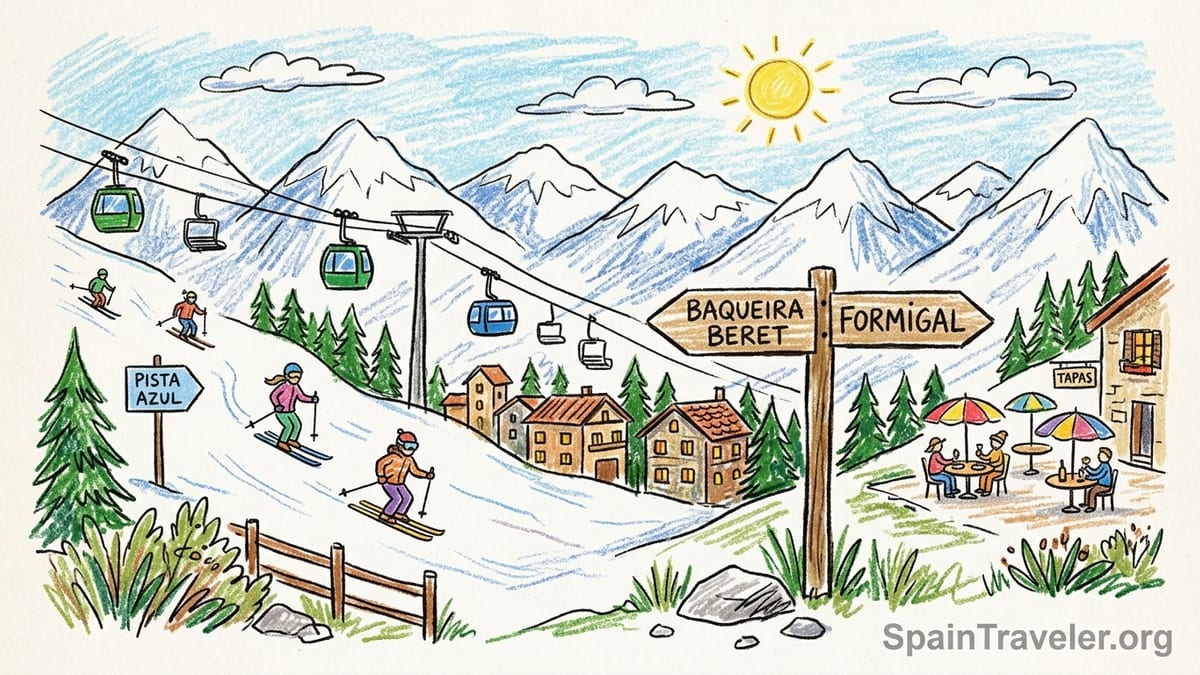
The Spanish Pyrenees have quietly evolved into one of Europe’s most compelling ski regions, blending high-altitude terrain with a relaxed southern European atmosphere. From Baqueira Beret in the Val d’Aran to the Catalan resorts above the Noguera Pallaresa valley, skiers can now choose between large integrated domains and compact family mountains, all within reasonable reach of Barcelona, Toulouse or Zaragoza. This guide compares the major players side by side so you can see which resort best fits your level, budget and travel plans.
The Spanish Pyrenees at a Glance
While the Alps still dominate European ski brochures, the Spanish Pyrenees now offer an impressive mix of large ski areas, reliable snowmaking and modern lift infrastructure. Spain’s tourism authorities consistently highlight Baqueira Beret in the Val d’Aran and Formigal-Panticosa in Aragón as the country’s best known and most complete ski areas, both backed by extensive grooming and lodging options. Around them, a cluster of smaller but high-altitude resorts such as Cerler and Boí Taüll offer quieter slopes and competitive prices, especially outside peak Spanish holiday periods.
For most international visitors, the first practical question is access. Barcelona-El Prat and Toulouse-Blagnac are the main gateways for the Catalan and Val d’Aran resorts, with winter driving times generally between 2.5 and 4 hours depending on traffic and weather. Zaragoza and, to a lesser extent, Pamplona and Huesca-Pirineos serve Formigal-Panticosa and Astún-Candanchú, usually in 2–3 hours by car. Rental cars are the norm, though some Spanish tour operators and local agencies run weekend buses from Barcelona and Zaragoza direct to the lifts.
Prices remain a key draw. Day passes in the Spanish Pyrenees often undercut those in many French and Swiss resorts, especially once you factor in on-mountain food and accommodation. For example, a mid-season adult day ticket at La Molina/Masella or Boí Taüll typically comes in below the cost of a comparable day in major Alpine destinations, while a coffee on the terrace above the slopes usually costs no more than it would in downtown Barcelona.
The overall character is more relaxed than in many big Alpine playgrounds. Long lunches on sunny terraces, late starts, and lively tapas-style après-ski in village bars are all part of the appeal. English is spoken in major hotels, rental shops and ski schools, but outside those settings you will hear mostly Spanish and Catalan, which adds to the sense of being in a genuine local mountain culture rather than a purpose-built international bubble.
Baqueira Beret: Big-Mountain Feel and Strong All-Rounder
Baqueira Beret is widely regarded as Spain’s flagship ski resort and one of the country’s largest, with around 165 to 170 kilometres of marked pistes spread across several linked sectors in the Val d’Aran. The lifts climb from roughly 1,500 metres at the valley base to about 2,600 metres at the highest points, giving a healthy vertical drop and a snow record that is often the envy of other Iberian resorts. A modern lift network and extensive snowmaking mean that core runs are usually well covered from early season through spring.
Beginner and early-intermediate terrain is concentrated on the wide, gentle plateau of Beret at about 1,850 metres, where broad green and blue runs allow cautious skiers to practice in a high, snow-sure environment. More confident intermediates can roam across long blue and red descents in the Baqueira and Bonaigua sectors, while advanced skiers gravitate toward steeper black runs and off-piste bowls above Orri and Baciver when conditions allow. Several snowparks, timed runs and fun zones keep freestyle skiers and teenagers busy between laps.
The village base at Baqueira 1500 and the nearby hub of Val de Ruda feel noticeably upmarket compared with many other Spanish resorts. Accommodation runs from high-end hotels and stylish apartment complexes with spa facilities to more modest pensions in the picturesque town of Vielha about 15–20 minutes down the valley by car or ski bus. Typical real-world examples include four-star hotels with half-board packages and access to wellness areas, often bundled with lift passes in January midweeks at prices that compare favourably to similar offerings in the French Alps.
Après-ski in Baqueira is more about quality than volume. Expect wine bars with good Rioja and Ribera del Duero by the glass, mountain restaurants serving slow-cooked stews and grilled meats, and a handful of lively spots where music continues into the small hours on winter weekends. Access is relatively straightforward: many international visitors fly into Toulouse, rent a car and drive around 2.5 hours over the border, while others come via Barcelona, Girona or even Bilbao for longer road trips that combine days on the slopes with urban sightseeing.
Formigal-Panticosa: Extensive Terrain and Youthful Vibe
Across the central Pyrenees in Aragón, Formigal-Panticosa is Spain’s other headline act. The combined ski area commonly promotes around 180 kilometres of pistes when fully open, linking the main Formigal slopes above the Tena Valley with the more compact Panticosa sector further downriver. The terrain ranges from approximately 1,100 metres in the village of Panticosa to more than 2,200 metres on the highest lifts, with extensive snowmaking armoury on the busiest runs.
Formigal’s layout spreads across several valleys, which creates a sense of exploration for strong intermediates and advanced skiers. Large open bowls, gladed sections and a selection of demanding black pistes give expert riders plenty to tackle, particularly when fresh snow arrives. Freestyle areas, bordercross tracks and timed runs are popular with a younger crowd that often drives up from Zaragoza for weekend parties, with live music and DJ sets in mid-mountain bars a regular feature during peak dates.
Panticosa, by contrast, feels more traditional and family oriented, with tree-lined blues and reds rising above a historic spa village. Families might choose to stay in Panticosa itself, where hotels and apartment complexes are generally quieter and often a touch cheaper than in Formigal, then use the combined lift pass to ski both sectors. A typical family scenario sees parents booking a three-night package that includes breakfast, lift passes and kids’ ski lessons, driving up from Madrid or Zaragoza in their own car, and rotating between Formigal’s wide open slopes and Panticosa’s sheltered runs according to weather.
Access is one of Formigal-Panticosa’s strong points for domestic travellers. From Zaragoza airport the drive typically takes a little over two hours on good roads, while from Madrid it is a longer but straightforward motorway and mountain highway journey. Rental shops, ski schools and childcare facilities are well developed, reflecting the area’s popularity with Spanish families and university groups. The resort’s scale, active nightlife and varied accommodation make it a good fit for mixed-ability groups who want both serious skiing and social energy.
Cerler and Astún-Candanchú: High Peaks and Classic Aragonese Character
Cerler, perched above the Benasque Valley in Aragón, is often described as one of Spain’s most scenic ski resorts, framed by 3,000 metre peaks of the central Pyrenees. The ski area currently offers roughly 81 kilometres of marked pistes, rising to about 2,630 metres at the Gallinero summit, one of the highest lift-served points in the Spanish Pyrenees. This altitude, combined with largely north-facing slopes, helps preserve snow quality well into spring and gives intermediates and experts long fall-line descents.
The piste map at Cerler is particularly friendly to progressing intermediates, with a number of long blue and red runs that drop all the way back to the village or to mid-station hubs. Advanced skiers will find steeper faces and freeride zones near the upper lifts when avalanche conditions allow, while beginners typically use the gentle nursery slopes close to the base. The village of Cerler retains a small-mountain feel: accommodation is mainly in mid-range hotels and apartment blocks, plus rural lodgings down the valley in Benasque, where prices for a week in a self-catering apartment in January often undercut equivalent stays in many large French or Austrian resorts.
Further west near the French border, Astún and Candanchú are two separate ski areas sharing a joint “100K” ski pass that effectively creates a combined domain of around 100 kilometres of pistes when fully connected by ski-bus. Astún alone offers roughly 40 to 50 kilometres of runs, while Candanchú contributes close to 60 kilometres, including some notoriously steep and technical slopes that are well known among Spanish experts. Candanchú’s terrain is varied, with everything from gentle beginner meadows to narrow gullies and challenging black runs.
Astún’s base is a purpose-built complex at about 1,700 metres, with slopes climbing to well above 2,000 metres. The layout concentrates most accommodation near the lifts in apartment-style buildings and a handful of hotels, which keeps prices competitive for groups willing to self cater. Candanchú’s older village has a more traditional atmosphere, with a mix of lodges, family hotels and long-established ski clubs. Many skiers choose to stay in the nearby town of Jaca, around 30 to 40 minutes’ drive away, where there is a wider choice of restaurants, historical sights and evening activities, then commute daily by car or bus to the slopes.
Boí Taüll, La Molina/Masella: Catalan Contrasts
In Catalonia, Boí Taüll stands out for its altitude and compact layout. The resort offers about 45 kilometres of pistes, with lifts reaching roughly 2,750 metres, making it one of the highest ski areas in the Pyrenees in terms of top elevation. The base area, with hotels and apartment-style buildings, sits higher than many rivals, which can translate into better snow conditions on the lower runs during mild spells. The piste network is weighted toward intermediate and advanced skiers, with numerous red runs and some demanding blacks, though there are beginner zones near the base for first timers.
Boí Taüll is particularly attractive to value-focused families and groups looking for an “all-in-one” resort. Package deals often bundle accommodation, half board and lift passes at prices that compare well with larger domains. A typical real-world example might be a three-night weekend stay in a family room with breakfast and dinner included, plus a two-day lift pass for each adult and discounted passes for children, booked through a Spanish tour operator or directly with the resort. Off the slopes, guests can visit the nearby Vall de Boí, famous for its Romanesque churches and UNESCO World Heritage status, which adds cultural depth to a ski trip.
La Molina and Masella, linked to form the Alp 2500 ski area, are Catalonia’s best established mass-market resorts. Together they usually promote around 140 to 145 kilometres of pistes served by a dense lift network, with La Molina offering roughly 70 kilometres and Masella around 70 to 75. The shared domain ranges from about 1,600 metres at the lowest points to over 2,500 metres at the highest ridges, with extensive snowmaking and night skiing on selected slopes in Masella during parts of the season.
La Molina is especially popular with beginners and school groups thanks to its wide learning areas, gentle greens and blues near the base, and well developed ski schools that offer classes in Spanish, Catalan, English and sometimes French. Masella, facing mainly north, tends to hold snow well and appeals strongly to intermediates and advanced skiers who like long, sustained descents through the forest. Accommodation is scattered between on-slope hotels, roadside lodges and the nearby towns of Alp and Puigcerdà. For Barcelona residents the main advantage is convenience: the drive typically takes just over two hours in normal winter conditions, making day trips and short midweek breaks entirely realistic.
Port Ainé and Espot: Family-Friendly Hidden Corners
Port Ainé, set in the Pallars Sobirà region of Catalonia, is a mid-sized ski area that markets roughly 25 to 30 kilometres of pistes, depending on how runs are counted, with a maximum altitude close to 2,400 metres. Much of the terrain fans out from a central hub near 2,000 metres, which houses a hotel, cafeteria and rental facilities. This compact design is a big plus for families, as parents can relax on the terrace while keeping an eye on children skiing the surrounding slopes without fearing they will end up in a distant valley.
The pistes at Port Ainé are well balanced across levels. Beginners have gentle greens and easy blues close to the main buildings, while intermediates can explore longer blues and reds that loop around the mountain. A modest snowpark and freeride zones provide variety for teenagers and boarders. Prices for lift passes and accommodation here are typically lower than at Baqueira Beret or Formigal-Panticosa, making Port Ainé a smart choice for travellers prioritising value and a calm environment over sheer size.
Espot Esquí lies a short drive away, above the village of Espot and on the doorstep of Aigüestortes i Estany de Sant Maurici National Park. Its ski area offers roughly 20 to 25 kilometres of pistes, rising from forested lower slopes up to panoramic ridges with views toward the park’s iconic lakes and peaks. The lower runs wind through woodland and suit learners well, while higher up there are steeper sections and race pistes that have hosted official competitions, making the resort a training base for Catalan ski clubs.
Many visitors to Port Ainé and Espot base themselves in nearby Sort, Rialp or in small rural hotels and guesthouses in the Pallars Sobirà valley. A realistic itinerary might see a family staying four nights in a rural hotel with breakfast included, skiing two days in Port Ainé and one in Espot, and reserving an extra day for snowshoeing or a scenic drive into the national park. Access from Barcelona typically takes around three hours by car, with the final approach on mountain roads that can require snow chains or winter tyres after heavy storms.
How the Resorts Compare: Terrain, Snow and Facilities
When comparing piste kilometres, Baqueira Beret and Formigal-Panticosa clearly lead the pack, each usually offering in the region of 160 to 180 kilometres of marked runs in a normal season when fully open. La Molina/Masella follows as the next largest domain in this group with around 140 to 145 kilometres, while the Astún-Candanchú “100K” pass opens up roughly 100 kilometres. Cerler’s 81 or so kilometres give it the feel of a medium-sized Alpine resort, and Boí Taüll, Port Ainé and Espot form a cluster of smaller, more intimate mountains in the 20 to 45 kilometre range.
Altitude matters for snow reliability. Boí Taüll and Cerler reach some of the highest lift-served points in Spain, with summits around or above 2,600 metres, while Baqueira Beret and Formigal-Panticosa also climb past 2,200 metres and rely on powerful snowmaking to reinforce natural snowfall on key routes. Port Ainé’s high central plateau helps maintain good coverage around the core runs, and Masella’s north-facing slopes often keep snow quality better than its relatively modest base altitude might suggest. In all resorts, early and late season conditions can vary from year to year, so travellers booking outside the core months of January and February should watch snow reports and consider flexible cancellation policies.
For beginners, La Molina, Panticosa, Beret (within Baqueira), and the bases of Port Ainé and Espot stand out thanks to their flat learning areas, easy lift access and beginner-friendly ski schools. Intermediates are spoiled for choice almost everywhere, but they will particularly appreciate the long cruising reds of Formigal, Cerler’s sweeping valley runs and the extended itineraries linking La Molina and Masella. Advanced skiers seeking challenging terrain and off-piste should look closely at Baqueira Beret’s upper bowls, the steep sectors in Candanchú, and Cerler’s high alpine descents, while also considering that snow and avalanche conditions in the Pyrenees can change rapidly.
Family facilities are fairly strong across the board, with dedicated kids’ zones, toboggan areas and ski schools in all the major resorts. Baqueira Beret and Formigal-Panticosa offer the broadest range of formal childcare, kids’ clubs and non-ski activities such as snowshoe outings or snowmobile rides. Smaller resorts like Port Ainé and Espot, though less equipped with structured entertainment, compensate with calmer slopes and bases where parents can give older children more freedom to roam. In terms of après-ski, Formigal and Baqueira Beret lead for nightlife and gastronomic variety, while La Molina/Masella and Jaca (near Astún-Candanchú) provide a good mix of low-key bars and restaurants geared toward families and weekenders.
Access, Airports and Sample Trip Ideas
Most international visitors will combine a Spanish Pyrenees ski holiday with a city break in Barcelona, Toulouse, Zaragoza or Madrid. For Baqueira Beret and the Pallars Sobirà resorts of Port Ainé and Espot, Barcelona-El Prat is typically the most convenient hub, with car rental desks in all terminals and a driving time that, in normal winter conditions, ranges from about three hours to Val d’Aran to slightly less than that for Sort and the surrounding valleys. Toulouse is an attractive alternative for Baqueira, with many package operators in France offering transport to the resort. The drive over the border, depending on route and weather, can be as short as 2.5 hours.
Formigal-Panticosa, Cerler and Astún-Candanchú are usually accessed via Zaragoza, which has both rail connections and an airport served by domestic and some international flights. From Zaragoza, well-maintained highways lead toward Huesca and then into the mountains, though snowstorms can require overnight stays in intermediate towns during severe weather events. Travellers from farther afield sometimes fly into Madrid, rent a car and drive four to five hours north to reach the Aragonese valleys, turning the journey into a mini-road trip with stops in historic towns like Ainsa or Jaca.
Real-world examples help illustrate how these logistics play out. A long weekend at La Molina/Masella for Barcelona residents might involve renting an SUV on Friday afternoon, checking into a mid-range hotel in Alp by evening, skiing Saturday and Sunday with a single Alp 2500 lift pass, then returning to the city after an early dinner on Sunday night. By contrast, a week in Baqueira Beret for a couple flying in from London or Dublin might start with a Friday flight to Toulouse, a scenic drive through the Garonne valley and over the border, then six days of skiing with one rest day spent exploring Vielha’s old quarter and thermal spa.
Whichever resort you choose, planning ahead around Spanish bank holiday periods is critical. Christmas to Epiphany, late January race events and February Carnival weeks can see accommodation fill up and lift queues grow, particularly in Baqueira Beret and Formigal-Panticosa. Travellers with flexibility often find better value and quieter slopes in mid-January or early March, when sun angles are higher yet snow coverage in the high Pyrenees usually remains solid.
The Takeaway
No single resort in the Spanish Pyrenees suits everyone, which is precisely what makes the region so appealing. Baqueira Beret stands out as the most polished all-rounder, with extensive terrain, reliable snow and an upmarket atmosphere. Formigal-Panticosa balances large-scale skiing with lively après-ski and convenient access from central Spain, while Cerler offers spectacular high-mountain scenery and excellent intermediate terrain in a quieter setting.
Astún-Candanchú appeals to strong skiers who value traditional character and challenging slopes, especially when using the joint pass to explore both areas. In Catalonia, Boí Taüll and La Molina/Masella cover different ends of the spectrum: one high, compact and good value, the other extensive and extremely convenient for Barcelona-based skiers. Port Ainé and Espot, finally, reward those willing to travel a little further with uncrowded slopes, family-friendly layouts and proximity to pristine national park landscapes.
For travellers planning a first trip, a useful rule of thumb is to match resort size and style to your group. Mixed-ability groups and strong skiers who want variety will be happiest in Baqueira Beret, Formigal-Panticosa, La Molina/Masella or the Astún-Candanchú combo. Families seeking manageable terrain and gentle prices might gravitate toward Boí Taüll, Port Ainé or Espot. With more low-cost flights into Barcelona and Zaragoza, and continued investment in snowmaking and lifts, the Spanish Pyrenees are rapidly becoming a realistic alternative to many classic Alpine destinations.
FAQ
Q1. Which Spanish Pyrenees resort is best for beginners? La Molina, Panticosa, the Beret sector of Baqueira Beret, and the base areas at Port Ainé and Espot all have wide, gentle slopes, modern beginner lifts and well regarded ski schools that make starting out more comfortable.
Q2. Where will advanced skiers find the most challenging terrain? Advanced skiers should look closely at Baqueira Beret’s upper bowls, the steeper sectors in Candanchú, Cerler’s high alpine descents, and some of Formigal’s black runs, which together offer a good mix of steep pistes, moguls and off-piste routes when conditions are safe.
Q3. Which resort has the largest ski area in this comparison? Baqueira Beret and Formigal-Panticosa are generally the largest, each often offering around 160 to 180 kilometres of marked runs in a typical season when fully open, followed by La Molina/Masella with about 140 to 145 kilometres.
Q4. What is the most convenient resort from Barcelona? La Molina and Masella are usually the easiest from Barcelona, with a drive of just over two hours in normal winter conditions, while Port Ainé, Espot and Boí Taüll are also realistic for long weekends but require a longer drive on mountain roads.
Q5. Are the Spanish Pyrenees cheaper than the Alps? In many cases yes, especially for lift passes, accommodation and on-mountain food, though exact savings vary by resort and travel dates; midweek stays outside peak Spanish holidays often provide the best value.
Q6. Which resort is best for families with small children? Family-friendly setups are strong in Baqueira Beret, Formigal-Panticosa, La Molina and Port Ainé, all of which offer kid-specific learning areas, equipment rental, ski schools and a choice of accommodation close to the lifts.
Q7. How important is a rental car for these resorts? A rental car is highly practical for reaching most Spanish Pyrenees resorts and moving between villages, especially in Aragón and Pallars Sobirà, although some areas, such as La Molina/Masella, also have bus and rail connections supplemented by local taxis.
Q8. When is the best time to ski the Spanish Pyrenees? Snow conditions are usually most reliable from early January through late February, with March offering a good blend of longer days and, in high resorts like Baqueira Beret, Cerler and Boí Taüll, often excellent spring skiing.
Q9. Do the resorts have English-speaking ski instructors? Yes, most larger resorts, including Baqueira Beret, Formigal-Panticosa, La Molina/Masella and Boí Taüll, have instructors who teach in English, though it is advisable to request this specifically when booking lessons.
Q10. Can I combine skiing with cultural sightseeing? Absolutely, many travellers pair several ski days with visits to Barcelona, Zaragoza or Toulouse, while mountain areas such as the Val d’Aran and Vall de Boí also offer historic villages, Romanesque churches and regional gastronomy worth exploring off the slopes.