

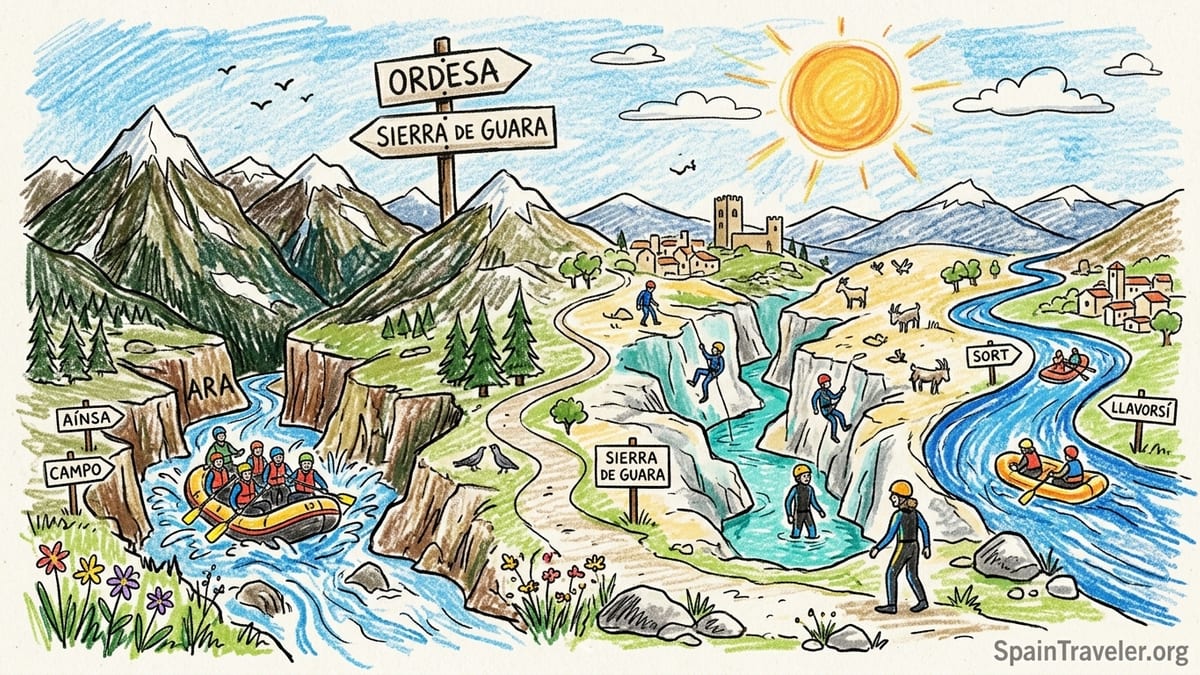
The Spanish Pyrenees are one of Europe’s most exciting playgrounds for white-water rafting and canyoning, and a handful of valleys concentrate much of the best action. Around Aínsa and Ordesa you can combine big-mountain scenery with accessible canyons and family rafting. In the Sierra de Guara you enter a limestone world famous for technical descents. Campo on the Ésera river has become a white-water hub in Aragón, while Sort and nearby Llavorsí on the Noguera Pallaresa are a benchmark for rafting in Catalonia. This guide compares these hotspots side by side so you can choose the right river, canyon and trip format for your group, budget and experience level.
Where to Go: Aínsa, Ordesa, Sierra de Guara, Campo and Sort Compared
Most travelers planning an adventure holiday in the Spanish Pyrenees end up choosing between two broad zones. In Aragón, Aínsa and Ordesa sit at the gateway to alpine-style canyons and the rafting runs on the Ésera near Campo. A little further south, the Sierra de Guara is a semi‑arid limestone massif carved by turquoise gorges that has become one of Europe’s classic canyoning destinations. Cross into Catalonia and the Noguera Pallaresa river, running past Llavorsí, Rialp and Sort, is widely regarded as one of the best white-water rivers in Spain, with more than 50 kilometers of navigable rapids between mountain reservoirs and the Collegats gorge.
For canyoning, Aínsa and the Ordesa area are ideal if you want something that feels wild and vertical, often with snowmelt‑fed flows early in the season. Routes near Escuaín or in side valleys off the Cañón de Añisclo tend to be fresher and more alpine in character. Sierra de Guara, by contrast, offers dry, sunny conditions and warmer water on rivers like the Vero, Formiga or Oscuros de Balced, which makes it popular with beginners, mixed‑ability groups and anyone who prefers long aquatic hikes over big drops.
For rafting, Campo on the Ésera and Sort or Llavorsí on the Noguera Pallaresa are the two main bases. At Campo, operators run half‑day descents on the Ésera that often appear in regional tourism brochures with prices starting around 50 euros per person for a standard section. In Catalonia, companies in Sort and Llavorsí offer a menu of Noguera Pallaresa runs, from short family floats to classic Llavorsí–Sort or Llavorsí–Rialp stretches, typically priced between roughly 35 and 60 euros depending on distance and difficulty.
In practice, many visitors combine zones in a single trip. A common itinerary might be two or three days of canyoning in Sierra de Guara, then a move north to Aínsa or Bielsa for a more vertical canyon and a rafting day in Campo, finishing with one or two days of big‑volume rafting on the Noguera Pallaresa around Sort. The driving times between these valleys are usually two to three hours, so you can easily build a loop without backtracking too much.
Canyoning in Aínsa, Ordesa and Sierra de Guara
Canyoning around Aínsa and Ordesa appeals to travelers who want to feel close to the high Pyrenees. Professional guides based in Aínsa or Torla typically offer introductory barrancos with plenty of pools and short slides, as well as more advanced descents with higher abseils and stronger currents. Entry‑level trips are often advertised from about 55 euros per person, which matches current regional tourism listings, and include guiding, technical equipment and basic insurance. Expect to spend a full half‑day in the canyon plus time for approach and return hikes.
In Sierra de Guara, the range of canyoning products is broader. Local companies based in villages like Alquézar, Bierge and Rodellar run everything from short family descents on sections of the Vero or Peonera Inferior to demanding routes with long swims, siphons and technical rope work. Prices for guided trips are usually in the same bracket as Ordesa, starting around the mid‑50 euro mark per person for a shared group outing, with private guiding costing more. Because Guara is lower and drier than the main Pyrenean crest, the canyoning season here is long, often running from spring into early autumn, with summer offering reliably warm water.
For beginners, Sierra de Guara is more forgiving. Approaches are generally shorter, water levels more predictable, and exits less committing. Families might choose a half‑day in the Vero or a similar grade canyon that avoids high abseils but delivers jumps, slides and narrow limestone corridors. Around Aínsa and Ordesa, beginner canyons exist, but conditions can change quickly with snowmelt or thunderstorms, and some classics are better suited to confident swimmers and active adults, especially in early summer.
Advanced canyoners often reverse these preferences. The Ordesa area and nearby valleys north of Aínsa can offer steeper, more vertical canyons that feel distinctly alpine, particularly when accessed early in the season. Technical itineraries with higher waterfalls and colder water appeal to experienced groups or those hiring a guide for a full technical day. Sierra de Guara has a number of serious routes as well, but many repeat visitors use it as a base for a week mixing moderate and demanding descents rather than seeking only the most committing lines.
Rafting on the Ésera around Campo and Aínsa
The Ésera river near Campo is Aragón’s rafting showcase. Spanish national tourism material often promotes three‑hour rafting descents here with starting prices around 50 euros per person, and current local tariffs for standard Ésera trips hover in the 50 to 60 euro range for adults, with slightly reduced rates for children on family sections. Outfitters based in Campo and Aínsa typically offer at least two formats: a family‑friendly stretch on gentler water and a sportier section that includes the well‑known “Pirámides” rapid sequence for teenagers and adults.
On family trips, rafts usually put in above Campo and run a shorter section with mostly class II and easy class III rapids. Many companies set a minimum age of around 5 to 7 years for this float, provided children can swim and are comfortable in water. The whole outing lasts about two to three hours door to door, including transport, safety briefing, time on the river and a simple snack or drink at the end in some cases. These departures are popular with road‑trip families staying in campgrounds or rural guesthouses around Aínsa, as they can fit into a single morning or afternoon.
The sportier Ésera sections, often marketed toward active adults and teens from roughly 12 or 14 years upwards, tackle stronger rapids and a longer distance. Some operators split children and adults, having younger kids run the family section while adults continue downstream through the bigger waves. In higher water conditions, guides may raise the minimum age or adjust which section of river they use. Spring and early summer snowmelt can push the Ésera into solid class III or IV conditions, while late summer flows tend to be friendlier.
In terms of logistics, most Ésera rafting days follow a similar pattern. You meet at the operator’s base or office in Campo or Aínsa, complete waivers and medical questions, get kitted out with helmet, neoprene, buoyancy aid and possibly neoprene booties, then transfer in a minibus to the put‑in. After a safety talk on the riverbank, you spend around one and a half to two hours on the water before getting shuttled back to base. Almost all reputable providers include mandatory accident and liability insurance in the advertised price, though it is still worth confirming exactly what is covered and ensuring your own travel insurance allows white‑water rafting.
White-Water Rafting on the Noguera Pallaresa: Sort and Llavorsí
The Noguera Pallaresa, which flows through the Catalan Pyrenees past Llavorsí and Sort, is widely recognized as one of the finest white-water rivers in Spain. Regional adventure tourism guides highlight around 50 kilometers of navigable river here, with commercial rafting concentrated on classic stretches like Llavorsí–Sort or Llavorsí–Rialp. Multiple companies offer departures throughout the day in high season, and current prices for standard trips typically range from around 35 euros for shorter family runs to about 60 euros for longer or more technical sections.
A typical introductory trip might run from Llavorsí down to a point just above Sort or Rialp, covering 14 to 18 kilometers of mainly class II and III water with a few livelier rapids. One well‑known operator prices a Llavorsí–Sort run at roughly 45 to 50 euros per adult, with children under 12 sometimes paying closer to 35 euros for the same descent. These outings are usually labeled “initiation” or “medium” difficulty, and many companies accept children from about 8 years of age in spring or as young as 6 in late summer once flows have dropped and warmed.
For families, there are shorter Noguera Pallaresa options branded specifically as “family rafting,” often running for just over two hours on the water in the afternoon. The minimum age here depends on flow levels and is sometimes described as variable according to the river’s conditions, but it is common to find operators who take children from around 6 to 8 years as long as they can swim 25 meters and are comfortable with splashes and small waves. Prices tend to be in the same band as other half‑day trips, with the family label referring more to the chosen section and pace than to a big discount.
Advanced rafters and groups of friends looking for more challenge can book longer, higher‑intensity runs that extend downstream beyond Sort toward Baro or even into the Collegats gorge, where the river narrows dramatically between limestone walls. These trips often last a full half‑day on the river plus transfers and may push into solid class III and IV rapids at peak flows in late spring. Prices climb toward the upper end of the Noguera Pallaresa range, around 55 to 60 euros per person, and outfitters sometimes recommend prior rafting experience or at least good fitness for these routes.
Beginner vs Advanced Trips, Minimum Ages and Seasons
Across Aínsa, Ordesa, Sierra de Guara, Campo and Sort, operators grade their products carefully, but labels like “family,” “initiation” or “advanced” can mean slightly different things in each valley. As a rule, beginner canyoning in both Ordesa and Sierra de Guara avoids long abseils, ceiling‑low siphons and sustained exposure, focusing instead on natural slides, small jumps and swims. In rafting, beginner or family trips on the Ésera and Noguera Pallaresa stick to class II and easy class III rapids where the likelihood of big flips is low and rescue from the bank is straightforward.
Advanced canyoning near Aínsa or in the more remote corners of Sierra de Guara introduces higher vertical drops, more continuous sections with strong flow, and longer approach or exit hikes. These routes may be advertised for people who are already comfortable abseiling and spending a full day in a wet canyon environment. Advanced rafting sections on the Ésera and Noguera Pallaresa, particularly at peak snowmelt in late spring, can feel pushy, with bigger waves and holes. Guides are usually frank about whether conditions are suitable for first‑timers or better kept for guests who have rafted before.
Minimum ages vary by company and water level, but a few patterns are clear. Family canyoning in Sierra de Guara is often open to children from about 7 or 8 years upwards, while alpine‑style canyons in the Ordesa area may carry higher age recommendations, especially in colder conditions. On the Ésera, family rafting commonly starts from roughly 5 to 7 years, with more dynamic sections reserved for older children and adults. On the Noguera Pallaresa, standard initiation runs generally accept children from around 8 years and sometimes younger in summer once the river has dropped.
Seasonally, canyoning in Sierra de Guara can start as early as spring and run reliably into September or October, with midsummer the peak. In Ordesa and the Aínsa region, snowmelt is a bigger factor, so late spring and early summer bring fuller flows but also colder water, while late summer offers warmer, sometimes lower water levels that are friendlier for families. Rafting on the Ésera around Campo tends to run from roughly April to September, tracking the melt and reservoir releases. On the Noguera Pallaresa, commercial rafting often begins in March or April and runs into October, with May and June usually giving the most powerful white water and July to September providing a warmer, more forgiving experience.
Equipment, Safety, Insurance and What to Expect on the Day
Whichever valley you choose, reputable canyoning and rafting providers in the Spanish Pyrenees include the specialized equipment you need. For canyoning, this normally means a full neoprene wetsuit suitable for the water temperature, neoprene socks or booties in some areas, a helmet, harness, descender and all ropes and group gear. For rafting, companies provide a neoprene wetsuit, buoyancy aid, helmet, paddle and often neoprene boots. Participants are usually asked to bring a swimsuit, towel, closed‑toe shoes that can get wet if booties are not supplied, and dry clothes for after the activity.
Safety standards have risen over the last decade, and most established operators now emphasize certified guides, regular equipment checks and clear safety briefings in multiple languages. Before starting, you can expect a briefing on paddling commands in the raft, what to do if you fall in the water, how to help teammates and how guides manage risk in the canyon. Serious incidents are rare, but providers typically require you to be able to swim and to declare any medical issues that might be relevant, such as heart conditions or recent injuries.
Insurance is an important detail that many travelers overlook. Adventure companies in Aragón and Catalonia generally include mandatory accident and civil liability insurance in the trip price in order to comply with regional regulations. This coverage usually applies during the activity itself and may include basic rescue and medical expenses within Spain. It is still wise to carry general travel insurance from your home country that covers white‑water sports or canyoning at the grade you intend to do, especially if you plan to travel onward or are booking a package that combines multiple providers.
A typical half‑day outing, whether canyoning or rafting, takes between three and four hours from arrival to departure. Check‑in at the base is followed by equipment fitting, a short drive to the start point, the activity itself and a shuttle back. Full‑day formats might involve two separate sections with a lunch break or one long route with a longer approach and exit hike, as is common on advanced canyoning days in Sierra de Guara. Booking ahead is essential in July and August, particularly for morning departures, while shoulder‑season trips are more flexible but can be affected by sudden weather changes.
Half-Day vs Full-Day: How to Choose and What You Pay
Across the Spanish Pyrenees, half‑day trips dominate the commercial offering, especially for first‑time visitors. They fit neatly around other sightseeing or hiking plans and keep costs manageable. In the Ordesa area and Sierra de Guara, entry‑level canyoning products priced from about 55 euros per person are almost always half‑day outings. On the Ésera near Campo, a standard rafting session in the 50 euro range is typically marketed as a half‑day experience, even if actual time on the water is around two hours. On the Noguera Pallaresa, the common Llavorsí–Sort or Llavorsí–Rialp runs in the 35 to 50 euro bracket are also half‑day products.
Full‑day canyoning in Sierra de Guara or the alpine valleys north of Aínsa is where experienced visitors often feel they are getting something more distinctive. These routes might require longer approaches, carry a higher technical grade or take you through particularly scenic and remote gorges. Prices rise accordingly, often into the upper double digits or more if private guiding is involved, and groups are smaller. Full‑day rafting is less common but does exist in the form of extended Noguera Pallaresa runs that combine multiple sections or incorporate riverboard or kayak segments for experienced guests.
From a value perspective, the headline difference between half‑ and full‑day formats is not only the number of hours but also the level of physical effort and technical commitment expected. Families with younger children are usually better off choosing a half‑day, both to avoid fatigue and to keep an easy exit option if someone gets cold or overwhelmed. Fit adults who already enjoy outdoor sports and want a highlight experience might choose a full‑day canyon or an advanced Noguera Pallaresa descent once they have done at least one introductory trip.
Remember that quoted prices rarely include extras such as professional photo packages, which many companies now offer, or optional picnic lunches. Transport to the activity base is also your responsibility, although shuttles to and from the river or canyon access points are almost always included once you have checked in. When comparing offers around Aínsa, Campo and Sort, look for what is bundled into the base price, such as snack, towel rental or hot showers, rather than focusing only on small differences in the advertised tariff.
The Takeaway
If your priority is canyoning with warm water and a huge menu of routes, Sierra de Guara makes an excellent base. Entry‑level descents here are accessible to active beginners and families, while more technical canyons challenge experienced teams. For a wilder, more alpine atmosphere with big limestone cliffs and glacier‑fed rivers, the Aínsa and Ordesa area adds dramatic scenery and more vertical canyon options, ideally suited to late spring and early summer when flows are at their peak.
For rafting, the choice is between the Ésera at Campo and the Noguera Pallaresa around Sort and Llavorsí. Campo offers straightforward logistics and dependable half‑day descents that pair well with a stay in Aínsa or the Benasque valley. The Noguera Pallaresa delivers the broadest range of routes and operators, from gently graded family floats to full‑throttle white water in May and June, at prices roughly between 35 and 60 euros depending on distance and difficulty.
In the end, there is no single “best” Pyrenean river or canyon, only the one that matches your group’s experience, appetite for adventure and travel dates. Beginners and families will feel comfortable booking half‑day canyoning in Sierra de Guara and family rafting on the Ésera or Noguera Pallaresa. Experienced paddlers and canyoners can aim for a full‑day alpine descent near Ordesa or an extended Noguera Pallaresa run at peak flow. Whichever you choose, the Spanish Pyrenees combine world‑class adventure with small‑town hospitality, mountain food and the simple joy of ending a big day in cold water under a warm evening sky.
FAQ
Q1. What is the best time of year for rafting in the Spanish Pyrenees?
The most reliable months for rafting on the Ésera and Noguera Pallaresa are roughly April to September, with May and June offering the strongest white water and July and August giving warmer, gentler conditions that are ideal for first‑timers and families.
Q2. How much should I budget for a half-day rafting trip?
Current prices for half‑day rafting are typically from about 50 euros per person on the Ésera near Campo and between roughly 35 and 60 euros on the Noguera Pallaresa, depending on the section, distance and whether you join a standard group or opt for a more technical run.
Q3. Is canyoning in Sierra de Guara suitable for children?
Yes, many guides in Sierra de Guara offer family‑friendly canyoning routes suitable for children from about 7 or 8 years old, focusing on short slides, small jumps and swims in warm water, but minimum ages vary by company and daily conditions.
Q4. Do I need previous experience for rafting around Sort and Llavorsí?
No previous experience is required for beginner or family rafting sections around Sort and Llavorsí, as trips are guided and start with a full safety briefing, though you must be able to swim and should be comfortable in moving water.
Q5. What is included in the price of a typical rafting or canyoning trip?
Standard prices usually include certified guides, technical equipment such as wetsuit, helmet and buoyancy aid, transport between the base and the river or canyon access, and compulsory accident and liability insurance, but you should bring your own swimsuit, towel and sometimes water shoes.
Q6. How do I choose between Aínsa–Ordesa and Sierra de Guara for canyoning?
Choose Aínsa–Ordesa if you want cooler, more alpine‑style canyons with dramatic cliffs and snowmelt‑fed flows, especially in late spring, and choose Sierra de Guara if you prefer warmer water, a longer season and a wide range of routes that suit beginners, families and mixed‑ability groups.
Q7. What are the typical minimum ages for rafting on the Ésera and Noguera Pallaresa?
On family sections of the Ésera near Campo, children can often join from around 5 to 7 years old, while on the Noguera Pallaresa many operators accept children from about 6 to 8 years on family or initiation routes, always subject to water level and the child’s swimming ability.
Q8. Are full-day canyoning trips much harder than half-day options?
Full‑day canyoning trips generally involve longer approaches or exits, more sustained water flow and higher abseils, so they are better suited to fit, water‑confident adults or groups with some prior experience, whereas half‑day routes are designed with beginners and families in mind.
Q9. Do I need to book rafting and canyoning in advance?
Advance booking is strongly recommended in July and August, weekends and public holidays, especially for morning departures, while in shoulder seasons you may have more flexibility but should still reserve at least a day or two ahead to allow operators to group participants and monitor conditions.
Q10. Is personal travel insurance necessary if the operator includes basic coverage?
Operators in Aragón and Catalonia usually include activity‑specific accident and liability insurance in the trip price, but it is still sensible to carry your own travel insurance that explicitly covers rafting or canyoning so that you are protected for cancellations, extended medical care and onward travel.