


The Spanish Pyrenees stretch from the Atlantic to the Mediterranean in a serrated wall of limestone peaks, deep valleys and stone villages that still feel stubbornly local. While ski resorts have made names like Baqueira Beret and Formigal familiar in winter, this is first and foremost a mountain landscape of national parks, glacial lakes and old trading towns. This selective guide focuses on the central and western Pyrenees, where Ordesa y Monte Perdido and Aigüestortes i Estany de Sant Maurici stand at the heart of a network of gateways such as Torla, Benasque, Jaca, the Tena Valley, Val d’Aran, Espot, Aínsa and the Roncal Valley.
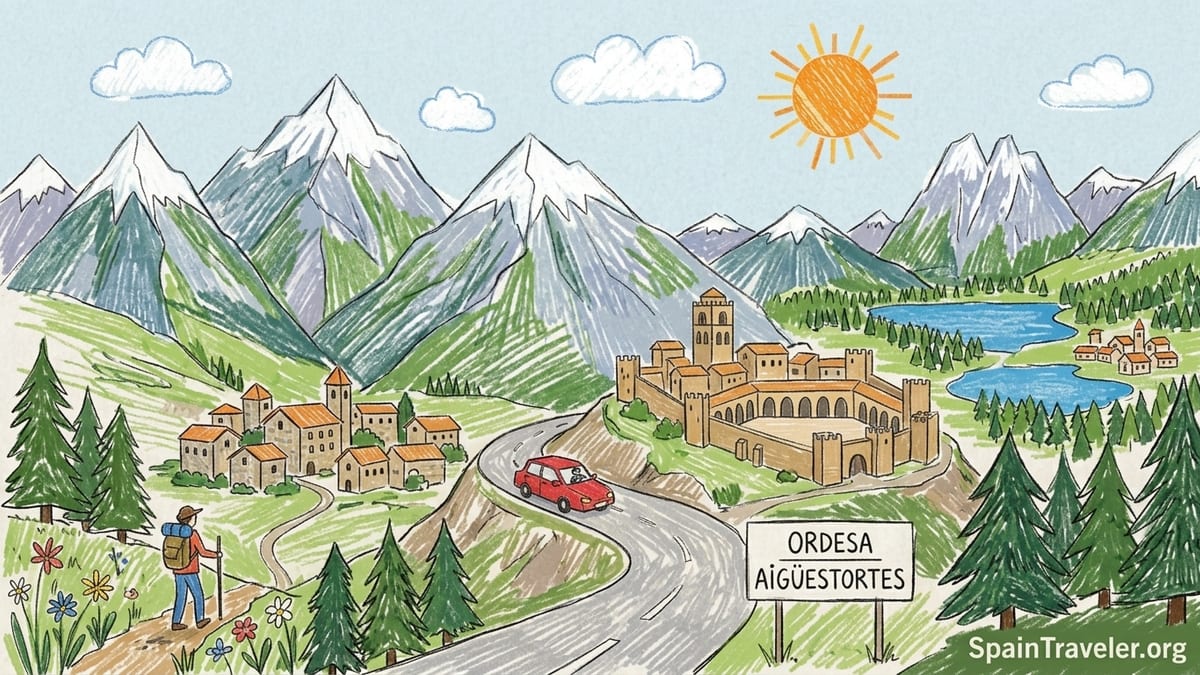
How to structure a trip to the Spanish Pyrenees
Think of the Spanish Pyrenees less as one destination and more as a chain of distinct mountain basins. Ordesa y Monte Perdido and Aigüestortes i Estany de Sant Maurici are the two flagship national parks, each ringed by villages that work as natural bases. Around Ordesa, those hubs are Torla and Aínsa, with satellite villages in nearby valleys. Around Aigüestortes, Espot and the Vall de Boí sit closest to the core, while Vielha in Val d’Aran offers more services and year round life.
Most trips work best as a loop in a hire car. A common one week circuit from Barcelona in summer might run Barcelona to Aínsa to Torla for Ordesa, then across to Benasque, up to Val d’Aran and Vielha, with a final night in the Roncal Valley or Jaca before returning. Drivers should budget for mountain roads: distances are short on the map but progress is slow. A two hour hop from Aínsa to Benasque, for example, can easily turn into three with photo stops and a lunch break at a roadside asador.
Season matters. July to early September brings long, stable days for hiking and high refuges, but also fuller car parks and higher room rates. Late May, June and late September are attractive shoulder months, when valley meadows are green, trails quieter and prices in smaller hotels can drop compared to August. Winter transforms several of these bases, especially Benasque, Tena and Val d’Aran, into ski and snowshoe hubs while Ordesa and high Aigüestortes remain serious mountaineering terrain.
To get the best of the region in one trip, plan at least one night in a true national park gateway such as Torla or Espot, one or two in a historic town like Aínsa or Jaca, and two or three in an adventure centre or ski base such as Benasque or Vielha, where outfitters, guides and rental shops cluster.
Ordesa y Monte Perdido and its gateways: Torla, Aínsa and the surrounding valleys
Ordesa y Monte Perdido National Park protects a limestone massif cut by four spectacular valleys: Ordesa itself, plus Añisclo, Escuaín and Pineta. The park is famous for balcony paths like the Faja de las Flores and for classic day hikes from the Pradera de Ordesa meadow to the Cola de Caballo waterfall, where families, trail runners and alpinists share the same wide track. In high season private cars are barred from the core Ordesa valley and hikers ride shuttle buses from Torla, a system that keeps traffic out but requires a little planning.
Torla is the quintessential national park gateway and absolutely merits at least one overnight stay. The village has a compact stone centre, a visitor information centre, several family run hotels and a handful of restaurants that pivot between hearty mountain stews in spring and set menus built around grilled lamb and trout in summer. Room prices in July typically range from modest guesthouses to small boutique hotels, and it pays to reserve ahead for long weekends, when Spanish visitors flood in from Zaragoza and Barcelona.
Aínsa, about an hour south of Torla by road, feels very different. Perched on a hill above the confluence of the Ara and Cinca rivers, it is a fortified medieval town rather than a park village, with a large arcaded plaza and castle walls. While it sits outside the national park, it makes an excellent base for visitors who want a broader mix of experiences: mountain bike routes fan out from town, the turquoise reservoirs of the Sobrarbe area invite paddleboarding and canyoning, and day trips reach Ordesa, the Añisclo canyon and lesser known natural parks in under ninety minutes.
Other nearby valleys offer quieter alternatives. Broto, downstream from Torla along the Ara river, has easy access walks to waterfalls such as the Cascada de Sorrosal and a growing range of rural apartments. Fanlo and Escalona give access to the Añisclo gorge, where narrow roads and one way traffic rules in peak season make it sensible to check local information before driving in. All of these villages work best with at least one night, especially if you want to catch early morning light in the canyons or stay out for sunset photography over Monte Perdido.
Aigüestortes i Estany de Sant Maurici: lakes, valleys and the bases of Espot and Val d’Aran
Aigüestortes i Estany de Sant Maurici National Park in Catalonia is a high mountain maze of granite peaks, hanging valleys and over 200 glacial lakes. It has a dense network of signed walking routes, with dozens of day hikes marked from key trailheads. The park is split between two main sectors: the western Aigüestortes plateau above the Vall de Boí, and the eastern Sant Maurici lake basin above Espot and the Àneu valleys. Access for private vehicles is restricted near the core zones; visitors typically ride local 4x4 taxis from Espot or Boí to lakes and trailheads, paying a per person fare that turns long dirt roads into quick ascents.
Espot is the classic national park gateway on the eastern side and rewards at least two nights if you want to explore more than a single viewpoint. A small mountain village with stone houses and a river running through its centre, it offers a surprisingly full range of services: several hotels and apartments, a couple of gear shops renting trekking poles or snowshoes in shoulder seasons, and guiding outfits that lead hikes to lakes such as Ratera or Amitges. The nearby Espot Esquí ski area gives the village a winter role, but in summer its identity is firmly hiking and nature focused.
To the west, the Vall de Boí forms another gateway zone, with the villages of Boí and Taüll known as much for their Romanesque churches as for park access. Here too, local 4x4 taxis climb up to the Planell d’Aigüestortes and beyond, saving visitors a long walk in on service tracks. Multi day hikers often string together mountain refuges through circuits like the Carros de Foc, while day hikers choose signed loops around lakes such as Llong or Redó. Even a single night in Boí or Taüll lets you combine a half day lakeside walk with an evening visit to a UNESCO listed church lit dramatically after dark.
Val d’Aran, centred on Vielha, sits just north of the park and functions more as a broad alpine valley than a single gateway. In winter it is dominated by Spain’s best known ski area, Baqueira Beret, but in the green season Vielha becomes an all purpose base for road cyclists tackling high passes, trail runners on the long distance Camins de l’Aneto route and families driving over the Bonaigua pass for day trips to the lakes and forests around Sant Maurici. Vielha makes sense for travellers who want urban comforts and nightlife alongside relatively easy access to Aigüestortes and the neighbouring Alt Pirineu Natural Park.
Benasque and the high summits of Posets Maladeta
East of Ordesa, the Benasque Valley cuts deep into the central Pyrenees, framed by some of the highest peaks in the range, including Aneto and the Maladeta massif inside the Posets Maladeta Natural Park. The town of Benasque is an archetypal adventure centre: its main street is lined with gear shops selling everything from climbing hardware to trail running shoes, guiding offices advertising ascents of Aneto or glacier walks, and cafes used to serving early breakfasts to hikers catching sunrise on north facing ridges.
Just above town, the Aramón Cerler ski resort climbs to over 2600 metres, giving Benasque a second life as a ski base in winter. In summer, many ski lifts close but mountain roads open up long, often steep day hikes. The GR 11 long distance trail passes through the valley and there are signposted routes ranging from family friendly strolls along the Ésera river to strenuous climbs to glacial cirques. Because of its altitude and concentration of infrastructure, Benasque rewards a stay of at least three nights for keen walkers or climbers, or two nights for visitors who want a taste of high mountains without technical objectives.
Practically, Benasque is also a good place to organise more complex activities. Local guiding companies often bundle two day Aneto ascents with an overnight in the Renclusa refuge, and rental shops can supply kit like crampons and helmets. In winter, ski travellers find package deals that combine Cerler lift passes with hotel stays. Prices fluctuate significantly between midweek and peak holidays, so it is worth checking Spanish school calendars when planning.
For a quieter feel, villages higher in the valley such as Cerler itself or smaller hamlets like Anciles offer stone built accommodation with sweeping views and easy access to evening walks. These work especially well for couples and families looking for a peaceful base that still sits within a fifteen minute drive of Benasque’s supermarkets and services.
Historic hubs and winter gateways: Jaca, the Tena Valley and Vielha
Jaca, south of the main ridge, is one of the oldest urban centres in the Spanish Pyrenees and functions as both a year round town and a convenient staging post for trips further into the mountains. Its star shaped citadel, Romanesque cathedral and busy tapas streets give it more of a small city feel than a village atmosphere. Jaca is not a national park gateway in itself, but it is a strategic stopover between the plains of Aragón and high valleys like Tena or the western approaches to Ordesa. Many travellers break their journey here, spending a night to adjust to mountain driving, stock up on supplies and enjoy a more varied restaurant scene.
North of Jaca, the Tena Valley rises through the villages of Biescas, Sallent de Gállego, Panticosa and smaller hamlets such as Hoz de Jaca and Tramacastilla de Tena. This is one of the most intensively developed winter sports areas in the Spanish Pyrenees, with the linked Formigal and Panticosa ski areas drawing domestic visitors with large bed capacity and family focused services. In winter, shuttle buses run between slopes and valley villages, and ski passes can be bundled with accommodation, turning the entire valley into a ski base.
Yet the Tena Valley is far from a one season destination. In summer and early autumn, its reservoirs and high cirques become playgrounds for hikers and adventure seekers. Waymarked trails lead to viewpoints over Ibón de Piedrafita or into quieter side valleys; adventure operators in towns like Panticosa and Sallent de Gállego run via ferrata courses, canyoning descents and zip line rides above reservoirs. The density of services makes the valley particularly suitable for families who want a mix of easy walks, water based activities and short drives, and two or three nights here can be folded neatly into a broader Pyrenees itinerary that also visits Ordesa or Aigüestortes.
Vielha in Val d’Aran plays a similar role on the western side of Aigüestortes. It is the main service centre for the valley, with supermarkets, ski rental shops, an indoor ice rink and an increasingly sophisticated hotel scene. In winter, it is primarily a ski base for Baqueira Beret, but from late spring to autumn it serves hikers, cyclists and road trippers who want a town like feel with alpine scenery. For travellers arriving from France via the Vielha tunnel, it makes sense to spend at least a night here before continuing to more remote bases like Espot or the Vall de Boí.
Quieter corners: Aínsa, Torla, Espot and the Roncal Valley as overnight bases
While the big ski bases dominate capacity, some of the most rewarding overnight stays are in smaller historic towns and park villages. Aínsa, as noted, is one of the most atmospheric, its upper old town largely pedestrianised and lined with small hotels, casa rurales and restaurants. An overnight stay here allows you to wander the medieval streets once day trippers have gone, with the added advantage that parking is easier and restaurant reservations less pressured than in peak evening hours. Many visitors choose to stay in Aínsa for three or four nights, using it as a central base for day excursions in all directions.
Torla, perched above the Ara river, demands at least one night and ideally two if your focus is Ordesa. Staying in the village gives you first pick of early morning shuttle buses into the national park and the option to linger in the meadows long after most day visitors have turned for home. Practical touches underline its gateway role: a National Park information centre sits by the main car park, and several hotels offer early breakfasts or packed lunches timed around bus departures. In low season, when the shuttle is not running and private cars can drive closer to the Pradera, Torla is still the natural base for accessing balcony paths and high routes.
Espot, on the eastern fringe of Aigüestortes, is smaller but plays a similar role. Many of its accommodation options market themselves explicitly as park bases, offering storage for hiking boots, early morning coffee and information on local weather conditions. Because access into the park relies on 4x4 taxis and on foot travel, staying overnight in Espot gives you an edge in catching the first vehicles up to Sant Maurici lake, when light is soft and crowds are thin. It also allows flexibility to respond to changing conditions; if afternoon storms are forecast, for example, you can swap a longer high route for a shorter signed loop closer to the valley.
The Roncal Valley in western Navarre, reached via winding roads through beech and fir forests, feels far from the better known resorts. The main village, Roncal, along with neighbouring Isaba, offers stone houses, small inns and a slow rhythm more focused on traditional transhumance routes and local cheese production than on lift served skiing. In winter, nearby cross country ski areas and snowshoe circuits come into their own, while summer and autumn bring excellent marked hiking routes through high pastures, often with relatively few walkers compared with Ordesa or Aigüestortes. At least two nights here allow time for both a high level hike and a day visiting local producers or exploring smaller hamlets.
Planning hikes, activities and practical costs
Both Ordesa and Aigüestortes have dense networks of marked paths, but their character is different. Ordesa is dominated by deep canyons and balcony routes that can involve airy traverses and significant exposure; many classic paths are full day undertakings, where hikers start at first light from Torla or the Pradera and return late afternoon. Aigüestortes is more of a lake landscape, with many routes linking tarns and high basins on gentler gradients, especially from main trailheads above Espot and Boí. Families with mixed abilities often find it easier to choose appropriate circuits in Aigüestortes, thanks to the combination of 4x4 access and signed loops of varying length.
Guided activities and rentals are widely available. In Torla and Aínsa, local companies offer guided hikes into the park, canyoning descents in nearby gorges and via ferrata routes. Day trips typically include small group sizes, transport, helmets and wetsuits where needed. In Benasque, guides lead glacier walks and ascents of Aneto, usually over two days with a night in a refuge. In Tena and Val d’Aran, winter visitors can sign up on the spot for snowshoe hikes, ski touring introductions or dog sled outings, often booked through hotel desks or directly at valley adventure centres.
Costs vary by valley and season, but travellers can use a few benchmarks when budgeting. Rural guesthouses and small hotels in less famous villages often offer doubles with breakfast at prices that are noticeably lower in June or late September than in August or over Spanish public holidays. Larger ski base towns like Vielha or Formigal see sharper price spikes on winter weekends. Guided day hikes and canyoning trips are priced in line with other European mountain areas, and hiring a private guide for a summit attempt is a significant but usually worthwhile investment for less experienced mountaineers.
Transport logistics deserve attention. Public transport into the heart of these valleys is limited, especially outside peak summer or winter periods, so most travellers will find a rental car from Barcelona, Zaragoza or Toulouse the most practical option. Within the parks, shuttle buses in Ordesa and 4x4 taxis in Aigüestortes are the norm; these run to timetables that can change between seasons, so it is important to check current schedules with local tourist offices or at village noticeboards the day before your hike.
The Takeaway
Seen on a map, the Spanish Pyrenees can look daunting, a tangle of ridges and valleys with unfamiliar names. On the ground, the region resolves into a series of memorable hubs, each with a clear identity. Ordesa y Monte Perdido, accessed through Torla and framed by Monte Perdido’s limestone walls, offers some of Europe’s most dramatic canyon hiking. Aigüestortes, approached from Espot, the Vall de Boí or even Val d’Aran, reveals its character through hundreds of lakes and a carefully managed network of routes. Benasque, Jaca, the Tena Valley, Val d’Aran and the Roncal Valley then provide the supporting cast of bases, from bustling adventure towns to quiet stone villages.
Designing a trip around these places is less about ticking sights and more about choosing rhythms. A few days in a national park gateway, early bus rides and long days on the trail; a night or two in a historic town with good restaurants; a spell in a ski base repurposed as a summer adventure hub. With realistic driving plans, some flexibility around the weather and a willingness to stay overnight in the villages that sit closest to the mountains, travellers can experience the Spanish Pyrenees as a connected landscape rather than a collection of isolated valleys.
FAQ
Q1. How many days do I need to visit both Ordesa and Aigüestortes?
Most travellers should allow at least six to seven full days to visit both parks without rushing, with two or three nights near Ordesa and two or three around Aigüestortes.
Q2. Which village is the best base for Ordesa y Monte Perdido?
Torla is the classic gateway, with shuttle buses into the Ordesa valley, a park information centre, several hotels and restaurants, and easy access to nearby valleys.
Q3. Is Aigüestortes suitable for families with children?
Yes, especially from Espot or the Vall de Boí, where 4x4 taxis shorten approaches and there are many signed routes of moderate length linking lakes and viewpoints.
Q4. Do I need a car to explore these parts of the Spanish Pyrenees?
A car is strongly recommended, as public transport is limited and often seasonal. Once in the main bases, you can use park shuttles and local taxi services to reach trailheads.
Q5. When is the best time of year for hiking in Ordesa and Aigüestortes?
Late June to late September usually offers the most reliable conditions for high level hiking, with June and September providing fewer crowds than peak August.
Q6. Which places are mainly ski bases rather than year round towns?
Resort focused areas include Formigal and Panticosa in the Tena Valley and Baqueira Beret in Val d’Aran, although nearby villages like Panticosa and Vielha have growing summer scenes.
Q7. Are the Roncal Valley and Aínsa good alternatives to busier resorts?
Yes. The Roncal Valley offers quiet villages and uncrowded trails, while Aínsa combines a historic centre with access to multiple valleys and fewer large resort style developments.
Q8. Can I visit the Pyrenees without serious mountaineering experience?
Absolutely. There are many well marked day walks of varying difficulty, and hiring a local guide for more demanding routes adds both safety and local insight.
Q9. How far in advance should I book accommodation in summer?
For stays in July and August, it is wise to book popular bases like Torla, Espot, Benasque or Vielha at least a few months ahead, especially over weekends and holidays.
Q10. Are there restrictions on driving into the national parks?
Yes. In high season, private cars are usually restricted from the core Ordesa valley, and access to key areas of Aigüestortes relies on regulated 4x4 taxis instead of private vehicles.