


Spain’s Pyrenees have quietly grown into one of Europe’s most compelling alternatives to the Alps, and three names dominate any serious shortlist: Baqueira Beret in the Val d’Aran, Aramón Formigal-Panticosa in the Tena Valley, and Aramón Cerler above the Benasque Valley. All three offer big-mountain terrain, modern lifts and reliable snow, but they deliver very different experiences in terms of price, atmosphere and practicality. This guide is written for skiers who already know they want the Spanish Pyrenees and now have to choose between the country’s three headline resorts.
Overview: Three Heavyweights of the Spanish Pyrenees
Baqueira Beret is Spain’s most famous resort and its closest equivalent to a small Alpine “mega-resort.” Its 160 to 170 kilometres of groomed pistes spread across the linked areas of Baqueira, Beret, Bonaigua and Baciver, with just over 1,100 metres of lift-served vertical. The resort sits in the Val d’Aran on the Atlantic, north-facing side of the ridge, which tends to favour snowfall. It has long been a favourite of the Spanish royal family and Madrid’s ski set, which has pushed the accommodation stock solidly into the premium bracket.
Formigal-Panticosa belongs to the Aramón group and is Spain’s largest single ski domain by piste length. Formigal itself offers around 140 kilometres of runs and Panticosa adds roughly 35 to 40 kilometres, for a combined total close to 180 kilometres in a good snow year. The two are a short drive apart in the upper Tena Valley. This is the resort most commonly sold in international package deals from the UK and elsewhere, with an emphasis on accessible prices, simple logistics and lively nightlife in Formigal village and nearby Sallent de Gállego.
Cerler, also operated by Aramón, is smaller on paper with about 81 kilometres of marked pistes, but it punches above its weight thanks to high altitude and a continuous vertical drop of around 1,130 metres from its highest lifts to the valley. The resort overlooks the dramatic Benasque Valley, ringed by some of the highest peaks of the Pyrenees, including Aneto. Cerler sees fewer foreign visitors, prices are generally lower than Baqueira, and the whole experience feels closer to a traditional mountain valley with skiing rather than a ski factory with a village attached.
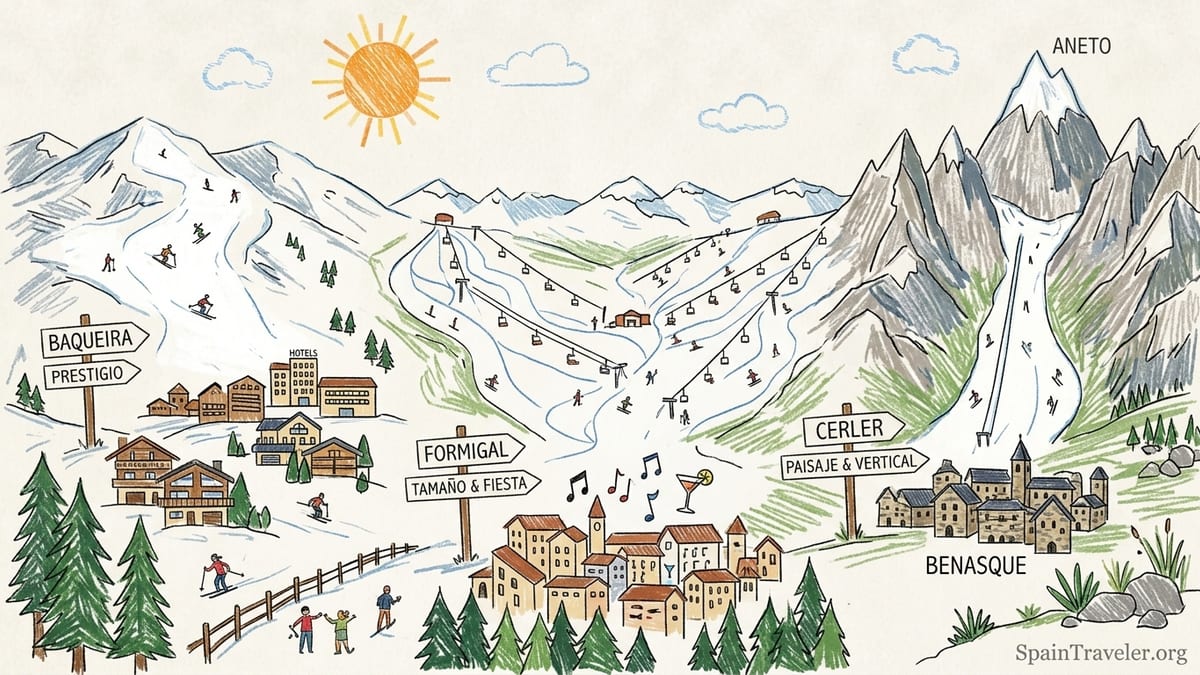
All three share some fundamentals. Lift infrastructure is modernising steadily, snowmaking is extensive and all three are family-friendly in different ways. The real choice comes down to what you value most: Baqueira for atmosphere and prestige, Formigal-Panticosa for size plus nightlife and easy packages, and Cerler for scenery, vertical and a more relaxed, authentic feel in Benasque.
Terrain & Snow: How the Slopes Really Compare
On pure ski mileage, Formigal-Panticosa wins. In a typical mid-season week, you can expect around 170 to 180 kilometres of groomed piste to be open if conditions are good, spread across multiple valleys and aspects. That gives intermediates and mileage-hungry skiers endless cruising, with a strong mix of blues and reds. The terrain layout feels expansive rather than compact, so it is possible to spend whole days exploring new corners, particularly if you split time between Formigal’s main sectors and Panticosa’s quieter bowls.
Baqueira Beret is slightly smaller in official kilometres but feels comparably big in practice. The four linked sectors are arranged in a broad, high valley and side valleys, with long lifts dropping you onto ridges from which multiple lines fan out. Important here is the quality of the terrain: Baqueira’s upper slopes above Beret and Baciver offer wide, treeless faces and playful undulations that advanced skiers rave about after fresh snow. Tree skiing off runs like Dera Reina when conditions allow can be excellent. With good coverage, Baqueira’s off-piste and sidecountry options are arguably the best of the three.
Cerler’s 81 kilometres are concentrated in a single, steep-sided valley. This is where the continuous 1,130 metre vertical shows: you can ski long, leg-burning top-to-bottom runs that feel more like parts of the French Alps than a mid-sized Spanish resort. Because many slopes face north and sit relatively high for the Pyrenees, snow quality often holds up well into March. Above the Ampriu area there is a sense of being in genuinely big mountains, with wide views across 3,000-metre peaks and long fall lines that appeal to stronger skiers.
In terms of snow reliability, none of the three is completely immune to the dry spells that occasionally affect the range, but Baqueira’s north-facing orientation means it sometimes gets heavy storms when southern slopes are much drier. Formigal-Panticosa and Cerler compensate with dense snowmaking over their core pistes. For a February or early March trip, all three usually operate at or near full domain, but if your dates are very early or late in the season, Baqueira and Cerler’s higher, shadier slopes have a slight edge.
Lift Passes, Packages & On-Mountain Costs
Lift-pass pricing in Spain remains lower than in many big-name Alpine resorts, but the gap has narrowed, and Baqueira in particular now prices itself as a premium product. For the 2025 to 2026 season, a typical one-day adult lift pass in Baqueira Beret is around 69 euros at the ticket window, with children paying in the mid-40s. Season passes for adults list in the mid four figures, although early-bird promotions can shave around 100 euros off the final price. Frequent visitors often use the BaqueiraPASS or Baqueira Ticket reloadable cards to secure modest day-rate discounts and skip queues at the tills.
Formigal-Panticosa and Cerler share the Aramón lift-pass system, which simplifies things if you want to ski more than one of their resorts in the same winter. Dynamic pricing is increasingly common, so day rates flex with demand, but as a rule of thumb, expect adult one-day passes in the mid-50 to low-60 euro range outside peak holiday weekends, with child and youth passes notably cheaper. Aramón also markets “Aramón 294 km” multi-resort passes and various early-booking discounts for season passes that undercut Baqueira’s season pricing by a visible margin.
Package deals are where the differences become sharpest for most skiers. Formigal-Panticosa is heavily featured in international tour operator brochures, especially out of the UK and Portugal. It is quite normal to see one-week packages combining flights to Zaragoza or Toulouse, transfers to the Tena Valley, seven nights in a three-star hotel and a six-day lift pass from roughly 900 to 1,200 euros per person outside of the busiest weeks. Cerler shares some of this package infrastructure through the Aramón travel arm, but availability is more limited and tends to attract Spanish families driving up from Zaragoza, Valencia or Madrid rather than a large international crowd.
Baqueira has its own official reservation centre for tailor-made packages, but overall pricing is higher. It is common for a family of four to see quotes around 4,000 to 5,000 euros for a mid-range hotel plus six-day lift passes in February, excluding flights or long-haul travel to Spain. That is still often cheaper than a fully catered week in a top-tier French resort but feels significantly pricier than Formigal or Cerler once you factor in restaurants, ski school and equipment hire, which also track at the upper end of Spanish rates.
Beginners, Intermediates, Experts & Families
All three resorts work for mixed-ability groups, but each has a distinct profile. Baqueira Beret arguably offers the most balanced terrain spread. Complete beginners are best based around Beret, where gentle, open slopes with excellent snowmaking make first turns less intimidating. Progressing intermediates can roam widely, linking long blues and easy reds from Baqueira 1,800 up towards Orri, Dossau and the top of Bonaigua. Experts benefit from steep black runs such as Escornacrabes in the Bonaigua sector and numerous unmarked routes when conditions are safe.
Formigal-Panticosa is an intermediate paradise. Most of its terrain is blue and red, with long cruising runs dropping from ridges like Izas and Tres Hombres back to the valley stations. There are beginners’ zones at resort base level, but the lifts and pistes can feel busy in peak weeks because of the strong package market and day trippers from Zaragoza. Confident intermediates and advanced skiers will appreciate the ability to spend a full day on laps such as the long reds off Pico Tres Hombres or explore Panticosa’s quieter slopes, which often have fewer people and a more relaxed rhythm.
Cerler stands out for its sustained vertical and challenging terrain choices, which advanced skiers love. The classic top-to-bottom routes from Gallinero or Cogulla down to the village offer long, uninterrupted descents that reward good fitness. There is a dedicated beginners’ area near the base and plenty of manageable blues higher up, but families with very young or nervous skiers may find the layout slightly less forgiving than Beret’s wide nursery spaces. On the flip side, strong teens and parents who want to ski together on meaningful, varied runs often find Cerler exceptional value.
For families, the question is as much about resort environment as slope maps. Baqueira’s accommodation is clustered close to the main lifts, with efficient shuttle buses linking satellite villages like Tanau and Nin de Beret. Many four-star hotels offer in-house kids’ clubs, ski storage at the lift and half-board dining. Formigal’s village layout is more spread out, with accommodation on both sides of the valley road, but most package hotels run their own shuttles to the gondola. In Cerler, families often choose to stay in Benasque, a short drive down the valley, where self-catering apartments and small hotels provide a quieter, more local atmosphere, and parents drive or use resort buses up to the lifts each morning.
Après-Ski, Atmosphere & Off-Slope Life
Après-ski in the Spanish Pyrenees revolves around long lunches, late dinners and sociable bars rather than the full-throttle beer-funnel culture you might find in some Austrian resorts. Even so, there are clear differences. Baqueira Beret cultivates an understated, upmarket feel. Think hotel lounges with good wine lists, pintxos bars in nearby Arties, and reservations at well-regarded restaurants in Vielha or Baqueira village itself. On-mountain eateries range from self-service cafeterias to stylish restaurants serving Catalan and Aranese cuisine; prices are higher than elsewhere in the Pyrenees, closer to mid-range Alpine levels for a main course and a drink.
Formigal-Panticosa has the liveliest nightlife of the three. The village of Formigal is lined with pubs, cocktail bars and late-night venues popular with Spanish students and young professionals, particularly on weekends. Happy-hour deals on drinks and themed nights are common, and it is one of the few Spanish resorts where you can ski hard all day and then find a packed dance floor until the small hours. Panticosa village is quieter and more family-oriented, with the historic spa complex offering a contrasting, more relaxed evening option.
Cerler and the Benasque Valley offer a different sort of atmosphere altogether. Benasque itself is a charming, stone-built mountain town with tapas bars, bakeries and gear shops along its narrow streets. Evening life is convivial but low-key: people linger over wine and raciones rather than shots, and many visitors are mountaineers or ski tourers who are up early for long days in the surrounding peaks. For travellers who enjoy a blend of ski holiday and mountain-town culture, this can be more appealing than a pure resort bubble.
Off-slope activities reflect these personalities. In Baqueira, non-skiers can explore the Romanesque churches of the Val d’Aran, visit small spas and stroll through boutique-filled villages like Vielha. In Formigal-Panticosa, snowshoe excursions, dog sledding and visits to the Panticosa spa complex are popular day or evening diversions. Around Cerler and Benasque, winter hiking, cross-country skiing at Llanos del Hospital and scenic drives up to viewpoints provide plenty to do for non-skiers or rest days, all against a backdrop of some of the wildest scenery in the Pyrenees.
Getting There, Driving & Accommodation Costs
Driving is the most common way to reach all three resorts, whether you are arriving from within Spain or via airports in Toulouse, Barcelona, Zaragoza or Pau. Road access to Baqueira Beret runs up the N-230 and then into the Val d’Aran; the final stretch climbs steadily but is well maintained, as this is a major route for both tourists and freight. Winter tyres or chains are strongly recommended from December to March. Parking in Baqueira is a mix of covered paid garages near the main lifts and free outdoor areas further away, with shuttle buses to bring you in each morning.
Formigal-Panticosa sits above the A-136 in the Tena Valley, reached from the main Zaragoza to Huesca motorway. The drive from Zaragoza airport is typically around two and a half to three hours in normal winter conditions. Roads are generally slightly less exposed than the final climb into Baqueira, and there are large car parks at both Formigal and Panticosa base stations. Many package guests arrive by coach from Madrid or coastal cities, which removes the stress of winter driving entirely but ties you to fixed departure days.
For Cerler, the access road climbs up from Benasque on a series of bends, but the overall journey is straightforward from Huesca via the A-139. Benasque itself feels more remote than either the Val d’Aran or the Tena Valley, partly because there is no quick cross-border highway and the valley ends at the French frontier in a wall of mountains. That remoteness is part of the appeal for many visitors, but it does mean slightly longer transfer times. On the plus side, traffic jams are rare compared with busier Alpine valleys during high season.
Accommodation costs largely follow resort prestige and demand. Baqueira Beret commands the highest prices: four-star hotels at or near the lifts often charge from roughly 250 to 400 euros per night for a double room in February, with upscale apartments in the core village achieving similar effective rates once cleaning and booking fees are included. In comparison, Formigal-Panticosa offers a broad spread from simple hostales and older apartments under 150 euros per night through to smart four stars that, even in high season, tend to undercut Baqueira’s equivalents by a noticeable margin. Cerler and Benasque are generally the most economical of the three, particularly for self-catering apartments where weekly rates can come in significantly below both Baqueira and Formigal, making Cerler attractive for cost-conscious families willing to drive to the lifts.
Which Resort Is Best For You?
Choosing between Baqueira Beret, Formigal-Panticosa and Cerler is less about finding an objective “winner” and more about matching the resort personality to your travel style and budget. For skiers who value atmosphere, on-snow quality and a sense of being somewhere special, Baqueira is hard to beat. Its Val d’Aran setting, polished accommodation stock and extensive, varied terrain justify the higher prices for many repeat visitors. If you enjoy lingering over good food, staying in comfortable hotels and riding fast lifts to snowy, open bowls, and you are prepared to pay a premium inside Spain, Baqueira is likely your best fit.
Formigal-Panticosa will appeal if you want a big ski area, a sociable scene and straightforward package options. The combined domain is vast for Spain, the pistes cater superbly to intermediates, and the nightlife in Formigal village can rival some Alpine party resorts on busy weekends. Pricing for lift passes, rentals and mid-range hotels is usually lower than Baqueira, and major tour operators make it easy to book everything together, which is a strong plus for first-time visitors to the Pyrenees or groups trying to coordinate flights, transfers and accommodation.
Cerler is the connoisseur’s choice among Spain’s big three: slightly harder to reach, smaller in kilometres, but with standout vertical and scenery. If you dream of long, continuous descents with high-mountain views, prefer a quieter base, and like the idea of staying in a real mountain town rather than a purpose-built resort, Cerler and the Benasque Valley deserve serious consideration. The relatively modest lift-pass costs and lower accommodation prices also make it attractive for longer stays or for skiers who want to combine on-piste days with ski touring or other mountain sports.
For many travellers, the decision can also hinge on timing. If you are limited to peak school-holiday weeks and want to control costs, Formigal-Panticosa or Cerler will stretch your budget further than Baqueira. If you are travelling outside the busiest periods and are willing to trade a little extra cost for ambience and snow quality, Baqueira’s combination of terrain and Val d’Aran charm is compelling. In all cases, booking early, watching for early-bird pass deals and being flexible on exact accommodation location within each valley can make a substantial difference to the final bill.
FAQ
Q1. Which resort has the biggest ski area overall?
Formigal-Panticosa has the largest combined ski area, with around 170 to 180 kilometres of pistes in a typical season, edging out Baqueira Beret in total marked runs.
Q2. Where will I find the best snow reliability in the Spanish Pyrenees?
Baqueira Beret benefits from its north-facing Val d’Aran location, which often receives generous Atlantic snowfall, while Cerler’s high, shady slopes also hold snow well into late season.
Q3. Which of the three is best for beginners and nervous skiers?
Baqueira’s Beret sector is particularly friendly for beginners thanks to its wide, gentle slopes and efficient lifts, although both Formigal and Cerler have dedicated learner areas at their bases.
Q4. I am an advanced skier. Which resort offers the most challenging terrain?
Advanced skiers will find excellent options in all three, but Baqueira’s off-piste and steep blacks, together with Cerler’s long, steep top-to-bottom runs, provide the most sustained challenge.
Q5. Which resort is best for nightlife and après-ski?
Formigal is the clear leader for lively après-ski and nightlife, with numerous bars, clubs and themed parties, while Baqueira offers a more refined, upmarket evening scene and Cerler remains quieter.
Q6. How do lift-pass prices compare between the resorts?
Baqueira Beret has the highest day rates, typically around the high 60-euro mark for adults, while Formigal-Panticosa and Cerler usually come in a little cheaper with dynamic pricing and Aramón passes.
Q7. Which resort is most suitable for families on a budget?
Cerler and the Benasque Valley generally offer the lowest accommodation and package prices, followed by Formigal-Panticosa, while Baqueira tends to be significantly more expensive overall.
Q8. Is it easy to reach these resorts without renting a car?
Dedicated ski buses and tour-operator transfers serve Baqueira and Formigal-Panticosa from major cities, but having a car greatly increases flexibility, especially for Cerler and Benasque.
Q9. Can I combine more than one resort in a single trip?
Combining Formigal-Panticosa with Cerler is straightforward using the Aramón pass and a rental car, while adding Baqueira is possible but involves longer drives between the Val d’Aran and Aragon.
Q10. What is the main takeaway when choosing between Baqueira, Formigal and Cerler?
Choose Baqueira for premium atmosphere and terrain quality, Formigal-Panticosa for size, nightlife and easy packages, and Cerler for scenery, long vertical runs and better value.