


The Spanish Pyrenees stretch from the Atlantic to the Mediterranean in a sweep of jagged peaks, Romanesque churches and deep, green valleys. This is one of Europe’s great year-round mountain playgrounds, with serious skiing in winter and high-mountain hiking from late spring to autumn. It is also exceptionally well served with places to stay. Vielha alone currently has around 130 to 140 listed hotels, apartments and guesthouses, which gives an idea of how rich and varied the accommodation scene is in the bigger valleys. Choosing the right base matters: some villages are made for ski-in, ski-out convenience, others for spa downtime, history-steeped streets or direct trailhead access. This guide focuses on five of the most practical regions for visitors and highlights specific properties that deliver on mountain luxury, ski access, family comfort, heritage charm and hiking convenience.
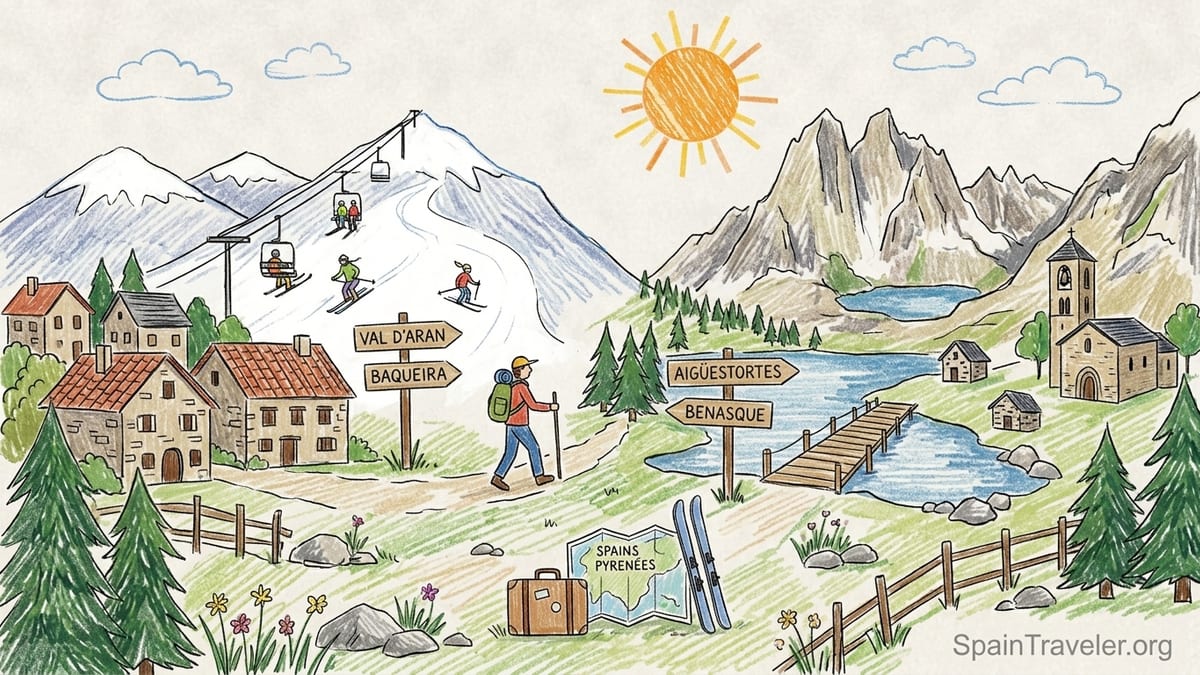
How to Choose Your Base in the Spanish Pyrenees
Unlike purpose-built Alpine resorts, the Spanish Pyrenees are a patchwork of historic valleys and small towns, each with its own character. Val d’Aran and Vielha in Catalonia, Benasque and the Tena Valley in Aragon, Aínsa and Boltaña on the edge of Ordesa, and the villages around Aigüestortes National Park all offer strong hotel choices. The best base for you will depend less on star ratings and more on how you plan to spend your days.
In winter, the main question is distance to the lifts. If you are skiing Baqueira Beret, Cerler or Formigal-Panticosa, staying in villages with direct bus links and on-site ski storage can save you an hour every morning. In summer, easy trail access and parking become more important, especially if you are driving to trailheads such as Llanos del Hospital near Benasque or car parks at Aigüestortes.
Across the region, modern mid-range hotels commonly offer private or public parking nearby, buffet breakfasts geared to hikers and skiers, and dedicated ski or bike storage rooms. Spas and pools are concentrated in a handful of mountain-luxury properties and historic conversions, particularly around Vielha, Benasque and Boltaña. Families will find many hotels offering quad rooms or small apartments, and the larger resorts usually have kids’ playrooms and family-friendly pools.
Val d’Aran & Vielha: Mountain Luxury and Ski Bases for Baqueira Beret
Val d’Aran is Spain’s flagship ski valley and a strong all-round destination, with winter sports from roughly December to April and excellent hiking once the snow retreats. Vielha, the valley’s main town, is a practical base if you want a broad choice of restaurants and shops along with competitive hotel pricing. Higher up the valley, Baqueira and small villages like Arties and Salardú put you closer to the lifts, but with a quieter atmosphere outside ski season.
For a polished mountain-luxury experience with spa access in Vielha, Hotel Vielha Val d’Aran, Affiliated by Meliá, is a reliable benchmark. Recent rate searches for winter weekends often show standard rooms in the mid to upper three-figure range per night for two people, depending on dates. The property offers an indoor pool and spa area, buffet breakfast, and a mix of rooms and family options. It sits about 20 minutes by car from Baqueira Beret’s main lifts, and it combines on-site paid underground parking with a large free public car park directly outside, handy if you are arriving with ski gear and prefer to avoid narrow historic streets.
Travelers looking for more local character often opt for smaller hotels like Aran La Abuela in the center of Vielha. While more modest in category, it illustrates the kind of practical features skiers and hikers should look for: covered parking a short walk from the building, individual lockers for skis and boots, plus separate storage for bikes. Its location a few steps from Vielha’s riverfront and main bars makes it a good option if you want to be able to walk everywhere after a day on the slopes or trails.
If budget is less of a constraint and you value being closer to the lifts than Vielha, Baqueira itself and nearby Arties and Salardú have several upscale spa hotels and chalet-style properties. These usually come with heated ski lockers next to the lifts, underground parking to avoid snow-clearing in the mornings, and generous breakfasts suitable for full ski days. However, prices in peak February can run significantly higher than in Vielha or lower in the valley, and dining options may be more limited once you step away from the main resort core.
Benasque & Cerler: Spa Hotels and High-Mountain Hiking Access
The Benasque valley in Aragon has a different feel from Val d’Aran. It is more compact, with the town of Benasque serving as the year-round hub and Cerler, a short drive uphill, operating as the main ski station. In summer, Benasque is one of Spain’s premier hiking bases, giving access to the Posets-Maladeta Natural Park, including popular day hikes such as the routes around Llanos del Hospital and the Aneto area.
Within Benasque town, SOMMOS Hotel Benasque Spa is a good example of the mid to upper-range properties that combine wellness with practicality. Rooms are simple but comfortable, and the on-site spa usually includes an indoor pool, hot tub and sauna. Hotels in this category typically include buffet breakfasts from early morning, parking options either on site or within a short stroll, and views onto the surrounding peaks from many rooms and the garden or terrace. The Cerler ski resort lies roughly six kilometers up the road, so having an on-site ski storage room and easy driveable access is key in winter.
Closer to the high-mountain trailheads, Hotel Hospital de Benasque regularly stands out for hikers and cross-country skiers. Located near the Llanos del Hospital Nordic ski area, it offers direct access to trails that start almost at the hotel door during much of the winter and shoulder seasons, removing the need to drive to a car park each morning. It is more of a mountain lodge than a town hotel, so evening dining is usually on site and spa facilities are narrower in scale, but the trade-off is immediate immersion in the landscape and less time in the car.
Benasque also has a scattering of smaller two and three-star hotels and hostales. While they may not offer full spas or pools, many provide private parking, secure bike storage and drying rooms that are particularly useful on wet hiking days. Families might consider apartment-style accommodations, which often come with kitchenettes and washing machines, and still keep you within a short walk of Benasque’s main restaurants and outdoor-gear shops.
Aínsa & Boltaña: Historic Stays on the Edge of Ordesa
If you prefer stone villages and river views to ski-lift proximity, Aínsa and neighboring Boltaña in the Sobrarbe region offer some of the most atmospheric accommodation in the Spanish Pyrenees. They sit just southeast of Ordesa y Monte Perdido National Park and within driving range of the valleys of Añisclo and Pineta, making them excellent year-round bases for sightseeing and low to mid-altitude hiking.
The standout historic-luxury option here is Hotel & Spa Monasterio de Boltaña. Housed in a converted 16th or 17th-century monastery above the Ara River, it functions as a five-star spa hotel while preserving thick stone walls, cloisters and landscaped gardens. Facilities usually include an extensive spa with hydrotherapy pool, saunas, hot tubs and treatment cabins, complemented by an outdoor pool for the warmer months. The hotel has its own parking, which is useful given its slightly elevated position, and many rooms look across to the surrounding hills. It is not a ski hotel in the strict sense, but it is a strong choice for couples seeking a quiet, indulgent mountain break with day trips into Ordesa and to villages like Torla or Broto.
Just a few minutes away by road, Hotel & Spa Peña Montañesa outside Aínsa combines resort-style facilities with a more informal, family-friendly vibe. The complex generally offers both standard hotel rooms and bungalows or small apartments, an indoor spa pool and outdoor pools, and large gardens where children can play. Parking is straightforward and free, and the location on the main road makes it an efficient base if you want to day-trip to different sectors of Ordesa or drive north toward the French border. Breakfasts are typically hearty, with a mix of hot and cold items aimed at hikers and cyclists heading out early.
Inside Aínsa’s medieval core, small boutique hotels and restored townhouses tend to focus more on charm and location than on large spa areas. Expect stone staircases, beamed ceilings and views over the confluence of the Ara and Cinca rivers. Parking can be more complicated in the old town, sometimes involving a short walk from public car parks. However, you gain instant access to evening strolls through the historic plaza and to local bars and restaurants serving river fish, game stews and regional wines.
Tena Valley & Jaca: Ski Hotels for Formigal and Panticosa
West of Ordesa, the Tena Valley and the historic city of Jaca form one of Aragon’s main mountain tourism axes. The Tena Valley runs north from Biescas through villages such as Sallent de Gállego, Lanuza, Escarrilla and Panticosa to high reservoirs and peaks over 3,000 meters. It is home to two major alpine ski areas, Formigal and Panticosa, along with a dense network of trails and mountain-bike routes, so accommodation here is strongly geared toward outdoor travelers.
In the upper valley, Sallent de Gállego and Formigal host most of the ski-oriented hotels and apartments. Properties like Hotel Snö Villa de Sallent illustrate the standard offering: warm rooms in modern-alpine style, ski lockers for each room, hearty buffet breakfasts and small wellness areas with saunas or hot tubs. Many hotels cluster near shuttle bus stops for the Formigal lifts or within walking distance of the base area, enabling car-free ski days. Underground or outdoor parking is widely available but may incur a nightly charge in peak season, especially on weekends and Spanish holiday periods.
Panticosa, with its own ski area and historic spa heritage, offers a different atmosphere. The older balneario complex higher up the valley has been reimagined as a mountain-spa enclave, while hotels in the modern village below focus more on family skiing and summer lake activities. Travelers prioritizing spa downtime might split a trip between Formigal and Panticosa, using the latter for rest days. Here, mountain views are almost guaranteed, and several properties allow you to walk to the gondola rather than drive.
Further south, Jaca is not a ski resort in itself but a lively small city with a full range of amenities and a strategic location on the road network. Many visitors choose to stay in Jaca if they prefer urban comforts, cathedral squares and a choice of tapas bars, then drive roughly 30 to 40 minutes to either Formigal or Panticosa. Hotels in Jaca usually provide straightforward underground or street-level parking, good Wi-Fi and varied room types, but spa and pool facilities are less consistent than in the purpose-built mountain resorts.
Aigüestortes & Sant Maurici: Trailhead Hotels and Quiet Bases
Aigüestortes i Estany de Sant Maurici National Park is one of the jewels of the Catalan Pyrenees, famous for its glacier-carved lakes, wooden walkways and granite peaks. Unlike ski-focused valleys, this area is shaped almost entirely around hiking, snowshoeing and alpine photography, with a season running from late spring through early autumn for most high routes.
The main access villages on the western side are Boí and Taüll, which also anchor the Vall de Boí’s route of Romanesque churches. Accommodation here ranges from unassuming two-star hotels above bars to higher-end mountain hotels with small spas and strong views. Travelers who value wellness facilities alongside trail access should look for properties with hot tubs or small indoor pools, which are increasingly common in the upper mid-range segment. Parking is usually straightforward, either on site or in adjacent public lots, and hotels often sell or provide information on shuttle buses that run to the park entrances during the main season.
On the eastern side, Espot serves as the primary gateway to Estany de Sant Maurici. Hotels here are typically geared toward hikers and families rather than luxury travelers and may not offer extensive spa facilities, though a few have outdoor pools and gardens for summer stays. Breakfast buffets tend to start early and emphasize local cheeses, cold cuts and baked goods to fuel long days in the hills. Skiers also use Espot as a base for the small Espot Esquí resort during winter, so several properties do provide ski lockers and covered parking.
Across both sides of Aigüestortes, the biggest advantage is proximity to trailheads. Many routes begin either in or a short shuttle ride from these villages, allowing you to minimize driving and maximize time on the paths. If you are traveling with children, choosing a hotel that is within a short walk of the central plaza and park shuttle stop can make logistics much simpler, especially in high season when parking near trailheads is restricted.
Comparing Facilities: Spas, Parking, Views and Trail Access
Across the Spanish Pyrenees, the difference between a satisfactory hotel and an excellent base often comes down to practical details. Spa facilities, for instance, range from simple hot tubs and saunas attached to mid-range hotels to full hydrotherapy circuits at properties like Monasterio de Boltaña or some of the larger hotels in Vielha and the Tena Valley. If you are planning a week of hard skiing or hiking, investing in a hotel with a proper spa circuit can make a significant difference to how you feel on day three or four.
Parking is another key consideration in mountain towns where streets are narrow and snowfall is common in winter. Multilevel hotels in Vielha and Benasque often combine paid underground parking with nearby free municipal lots. In small historic centers such as Aínsa’s old town, you may need to park in designated areas a few minutes’ walk from the hotel, which can be a factor if you arrive with lots of luggage or ski bags. Ski villages like Formigal and Cerler tend to have better integrated parking, but spots can fill quickly on peak weekends, so checking whether your booking includes a guaranteed space is worthwhile.
For skiers, dedicated ski storage near the lifts is a significant advantage. Many hotels in Val d’Aran, the Tena Valley and Cerler maintain heated lockers in-house, and some upscale properties operate ski rooms directly at the lift base, allowing you to leave your equipment overnight and walk back in regular shoes. Hikers should look instead for secure storage for boots and poles, plus washers and dryers or at least drying rooms, which can be critical on multi-day trips in changeable mountain weather.
Lastly, it is worth considering not just whether a hotel has “mountain views” but what those views mean in practice. In towns like Vielha and Jaca, a room facing the river or valley can feel much more open than one overlooking a side street. In high locations such as Cerler, Boí or Panticosa, balconies often deliver direct peaks-and-forest panoramas that become part of the experience. When comparing options, photo galleries can give a realistic sense of orientation and how much natural light each room receives.
The Takeaway
There is no single “best” hotel in the Spanish Pyrenees for every traveler. Instead, the region offers a dense network of options that cater to different priorities: spa-focused retreats in converted monasteries, practical ski bases with heated lockers and underground parking, family complexes with pools and playgrounds, and simple hiking inns within minutes of national park trailheads.
If you plan to ski Baqueira Beret, consider whether you prefer the broader amenities and often better value of Vielha, with its deep accommodation inventory and easy road access, or the convenience of staying higher in the valley. For Cerler and Benasque, decide between a town base with more restaurants or a mountain lodge near the trails. Around Ordesa, Aínsa and Boltaña balance historic charm with resort-style facilities, while the Tena Valley and Jaca link vibrant ski domains with lively villages. Near Aigüestortes, small hotels in Boí, Taüll and Espot put you minutes from some of Spain’s finest high-mountain scenery.
Whatever combination you choose, pay close attention to the details: spa hours, parking arrangements, ski or bike storage, the timing and style of breakfast, and how easy it is to walk to lifts, shuttle stops or trailheads. In a region where even a modest drive can involve mountain roads and winter weather, those seemingly small factors often define how relaxed your Pyrenees escape will feel.
FAQ
Q1. What is the best time of year to visit the Spanish Pyrenees for hiking?
The main hiking season typically runs from late June to late September, when most high passes are free of snow and mountain huts are open. Lower-elevation walks around Aínsa, Boltaña, Jaca and the lower Val d’Aran can often be enjoyed from spring into late autumn, but conditions vary year by year.
Q2. When is the ski season in Val d’Aran, Benasque and the Tena Valley?
In a normal year, ski resorts such as Baqueira Beret, Cerler, Formigal and Panticosa aim to operate from early December to late March or early April. Exact opening and closing dates depend on snowfall and temperatures, so it is always wise to check resort announcements for the specific winter you plan to travel.
Q3. Do I need a car to enjoy the Spanish Pyrenees?
A car is very helpful, especially for reaching trailheads in Benasque, Aigüestortes or the side valleys of Ordesa. However, it is possible to visit without driving by combining intercity buses to hubs like Vielha, Jaca or Benasque with local taxis and resort shuttle services. Travelers without a car should prioritize staying in larger towns or directly in ski villages.
Q4. Are spa facilities common in Pyrenean hotels?
Full spa circuits with pools and hydrotherapy are concentrated in higher-end hotels, particularly in Vielha, Benasque, Boltaña and some Tena Valley resorts. Many three-star properties offer at least a small sauna or hot tub, but simple rural hotels and guesthouses may have no wellness facilities beyond a communal lounge and terrace.
Q5. How does parking usually work at mountain hotels?
Most modern hotels offer some combination of on-site parking, underground garages and nearby free public lots. In winter, it is worth paying for covered parking if you want to avoid clearing snow from your car each morning. In historic centers like Aínsa’s medieval old town, expect to park a short walk away due to narrow streets and restrictions on traffic.
Q6. Are the Spanish Pyrenees suitable for families with children?
Yes. Many ski-area hotels in Baqueira, Formigal, Panticosa and Cerler provide family rooms, kids’ clubs and shallow sections in their pools. Around Ordesa and Aigüestortes, hotels often have gardens, playgrounds or easy riverside walks nearby, making these areas suitable for families who enjoy the outdoors but do not want only ski-focused activities.
Q7. How expensive are hotels compared with the Alps?
Prices vary widely by resort and season, but in general, mid-range hotels in the Spanish Pyrenees are often more affordable than comparable properties in top-tier Alpine destinations. Weekends during Spanish school holidays and Easter can still be costly, especially in Baqueira and Formigal, so midweek stays and shoulder-season visits usually offer better value.
Q8. What should I look for in a good ski hotel in the Pyrenees?
Key features include proximity to the lifts or shuttle stops, dedicated ski storage (ideally heated), early and substantial breakfasts, and convenient parking. For extra comfort, a small spa area to unwind in the evenings and rooms with mountain views can significantly enhance the experience, especially on longer stays.
Q9. How can I find accommodation near trailheads in Aigüestortes or Ordesa?
Look for hotels and guesthouses in villages such as Boí, Taüll, Espot, Torla or Broto. Many of these properties advertise their distance to park shuttle stops or main car parks. When booking, it is useful to confirm how early breakfast is served and whether takeaway picnic lunches are available for long hiking days.
Q10. Is it necessary to book hotels far in advance?
For peak ski weeks, Easter, and August in the most popular valleys, booking several months ahead is sensible, especially if you want specific room types or spa hotels. Outside these periods, you can often find good last-minute options, particularly in larger bases like Vielha, Jaca and Benasque, where the accommodation inventory is substantial.