


The Spanish Pyrenees are one of Europe’s great walking holiday regions, with deep glacial valleys, limestone canyons and high granite peaks stretching from Navarra to Catalonia. For 2026 and 2027, a mature market of tour operators is offering both guided and self-guided, week-long packages in hotspots like Ordesa, the Tena Valley, Benasque in the Posets–Maladeta area and the Catalan Pyrenees. Prices for fully guided weeks typically start around €1,899 per person, including accommodation, most meals, daily transport and guiding, while flexible self-guided trips with luggage transfer are often a few hundred euros less. This guide explains how the main regions compare and helps you choose between guided and independent multi-day walking holidays.
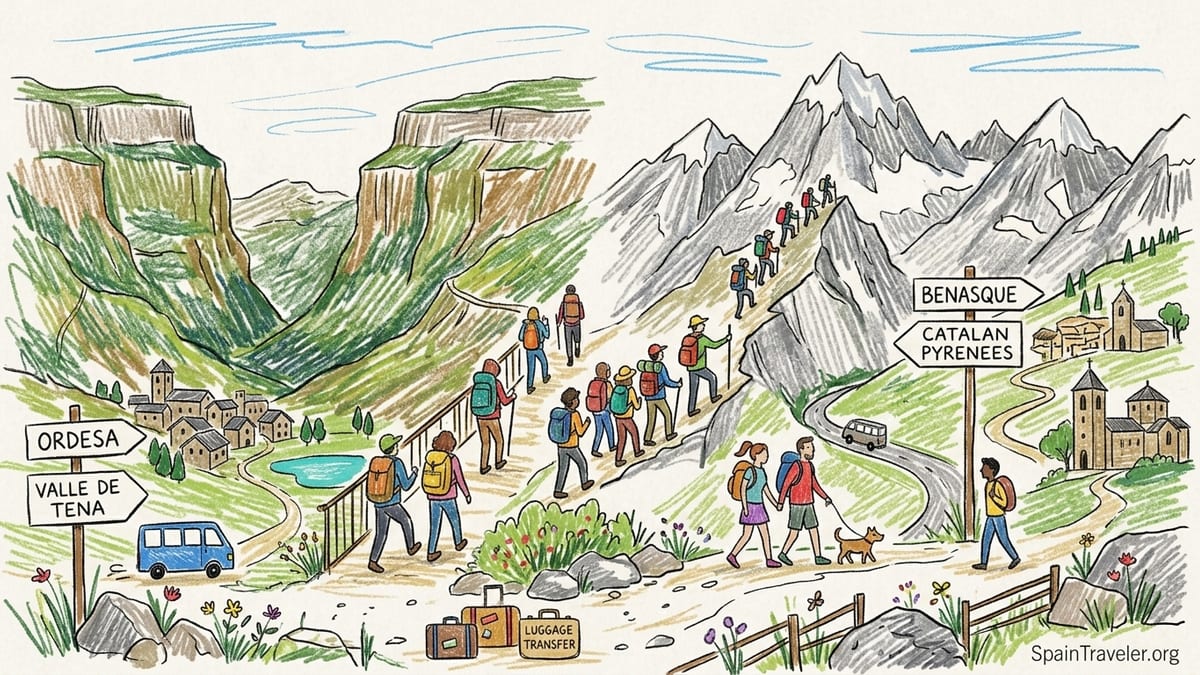
Key Regions: Ordesa, Tena Valley, Benasque and the Catalan Pyrenees
Most commercial walking holidays in the Spanish Pyrenees cluster around a few core regions. In the central Aragonese Pyrenees, Ordesa y Monte Perdido National Park is famous for its vast U-shaped valley, big day walks like the Cola de Caballo and balcony routes such as the Faja de Pelay. A number of Spanish and British operators base their Ordesa holidays out of Torla and nearby villages, using short vehicle transfers to trailheads inside or just outside the park boundaries.
South and slightly east, the Tena Valley is a classic base for week-long itineraries. Operators such as Hike Pyrenees run both guided Valle de Tena Explorer weeks and hotel-to-hotel self-guided “village to village” routes, connecting resort villages like Panticosa and Sallent de Gállego with high balcony paths, reservoirs and lakes. The valley offers a dense network of waymarked trails, which makes it attractive for both guided groups and confident independent walkers.
Further east again, Benasque sits at the heart of the Posets–Maladeta massif, home to some of the highest summits in the Pyrenees, including Aneto and Posets. Commercial walking holidays here typically blend moderate valley hikes with optional more serious summit days run by local guiding outfits. Compared with Tena, Benasque and the surrounding Posets–Maladeta area feel more alpine, with a stronger emphasis on granite ridges, high lakes and routes that may hold snow patches into early summer.
On the Catalan side, self-guided packages often focus on softer but still dramatic landscapes such as the Cerdanya valley, the foothills around la Seu d’Urgell or the national park of Aigüestortes i Estany de Sant Maurici. Operators like Hike Pyrenees and Catalan-based specialists sell week-long self-guided walks that link traditional stone villages, Romanesque churches and high meadows, typically at slightly lower elevations and with more options for easier days than in Benasque or central Aragon.
Difficulty Levels and Who Each Region Suits
In Ordesa, the most popular commercial itineraries are built around classic day walks from a fixed base. The well-known Cola de Caballo path, for instance, is a long but technically straightforward valley hike of around 17–20 kilometres and 600–800 metres of ascent, taking 5 to 7 hours at a steady pace. More exposed balcony routes like the Faja de Pelay or the Senda de los Cazadores are steeper and more serious, and good operators will only schedule them in safe conditions and with clear briefings for clients who are comfortable with heights.
The Tena Valley offers perhaps the broadest menu of difficulty levels in one place. Guided “dual level” holidays there often split groups each morning into an easier and a harder walk, with gentler options following balcony paths above reservoirs and tougher options climbing to passes over 2,000 metres. Self-guided hotel-to-hotel routes in Tena are usually graded moderate: regular hillwalkers carrying just a daypack should cope well with daily ascents of 600–900 metres over 5 to 7 hours. Guests can usually shorten a day using local buses or pre-arranged taxi transfers if needed.
Benasque and the Posets–Maladeta area suit more mountain-experienced walkers. While commercial week-long holidays do include moderate valley and forest walks, the headline days often aim for high glacial cirques or lakes beneath peaks like Posets and Maladeta. Ascents of summits such as Posets are typically offered as optional add-ons with a local high-mountain guide, involve over 1,000 metres of ascent and may require an early start, good fitness and a tolerance for rough, sometimes loose terrain.
The Catalan Pyrenees, especially Cerdanya and the lower valleys around Aigüestortes, appeal to mixed-ability groups. Self-guided packages frequently offer flexible route notes with easier valley rambles of 3 to 4 hours alongside more demanding 6 to 7 hour circuits to high viewpoints or lakes. The climate here is often slightly milder and the profiles a little softer than in the central Aragonese ranges, making it a good choice for first-time Pyrenees walkers or couples where one partner prefers gentler days.
What Guided Week-Long Holidays Typically Include
For 2026 and 2027, guided week-long walking holidays in the Tena Valley and Benasque commonly price in the region of €1,899 per person for seven nights, based on two people sharing. A typical guided package from a specialist operator will include accommodation in one or more small hotels, most meals, daily transport to and from trailheads, and the services of qualified guides. Prices vary with season and room type, but €1,800 to €2,100 is a realistic range for peak summer departures.
Inclusions usually start with airport transfers from Barcelona or Zaragoza to the mountains on set arrival days, although some land-only packages expect you to reach a designated meeting point independently. Once in the valley, daily logistics are handled for you: the minibus drops you at trailheads, collects you at end points, and the guide adjusts routes on the fly according to weather and group ability. Many guided weeks also include one rest or sightseeing day to visit local villages, Romanesque churches or thermal spas.
Meal arrangements on guided holidays are generally generous. Breakfasts are taken at the hotel, packed lunches are either provided by the operator or arranged each morning, and evening meals are commonly served in-house or at a nearby restaurant on a fixed menu basis. In the Tena Valley, for example, guided groups might dine each night in the same family-run hotel, while in Benasque some itineraries split the week between two bases to reduce transfer times to different walking areas.
Guided groups are usually small, often between 6 and 12 walkers, which allows the guide to manage pacing and safety effectively. Many operators now advertise dual-grade days, where an easier and a harder walk are offered from the same base, giving flexibility for couples or friends with different fitness levels. For nervous or less experienced hikers, the reassurance of a professional guide, clear daily briefings and structured risk management is often a decisive factor.
Self-Guided Packages and Luggage Transfer
Self-guided walking holidays in these regions are built around detailed route notes, GPS tracks and luggage transfers between accommodations. In the Tena Valley, for example, hotel-to-hotel “village to village” weeks allow you to walk from one mountain village to the next while your main suitcase or duffel is moved by vehicle each day. You carry only a daypack with water, layers and lunch, which opens up longer days for a wider range of walkers.
In Ordesa, self-guided trips often use Torla or nearby villages as a fixed base. Operators provide a portfolio of routes inside and around the national park, along with maps, local information and sometimes a briefing on arrival. Because overnight options inside the park are limited to refuges, most commercial self-guided holidays position you just outside the park boundary and build in short transfers to the main car parks.
The Catalan Pyrenees have seen strong growth in self-guided, luggage-supported walking over the past decade. Specialists based in Catalonia and international adventure companies sell itineraries that run from the mountains down towards the Costa Brava, or stay entirely in the high valleys, combining quiet farmhouses, small hotels and village inns. Daily luggage transfer is standard on most of these trips, with bags collected after breakfast and waiting at your next stop by mid-afternoon, subject to weight limits and one bag per person policies.
In practice, the difference between guided and self-guided in terms of luggage and basic logistics is now quite small. Both styles usually include baggage transfer, pre-booked accommodation and road transfers where needed. What changes is that, on a self-guided trip, you are responsible for navigating using maps, notes and waymarks, and for deciding when to shorten or lengthen a day. Most reputable operators maintain a 24-hour support number for route advice or to arrange a taxi if weather closes in or you need to cut a stage short.
Airport and Train Transfers to Each Region
Reaching the Spanish Pyrenees for a walking holiday typically involves flying into Barcelona, Zaragoza, Girona or occasionally Toulouse, then continuing by pre-booked transfer, hire car or a combination of train and bus. Guided group holidays at the €1,899 level often include set-time transfers from a nominated airport, especially for Saturday or Sunday arrivals aligned with scheduled departures.
For Ordesa and the Tena Valley, Zaragoza is a practical gateway, with road journeys of roughly three hours to Torla or the central Tena villages. Some operators offer direct minibus pick-ups from Zaragoza airport or train station on fixed schedules. Others, particularly those selling land-only packages, provide guidance on taking a train to Huesca or Sabiñánigo and a regional bus or taxi onward to your hotel.
Benasque in the Posets–Maladeta area is usually accessed from Barcelona or Zaragoza. Road transfer times are often around four hours from Barcelona and slightly less from Zaragoza, depending on traffic and stops. Many commercial holidays bundle this as a group transfer on the first and last day, which removes the need to navigate rural bus timetables or arrange a one-way car hire.
The Catalan Pyrenees offer the greatest flexibility for independent arrival, thanks to better public transport links. Cerdanya and nearby valleys can be reached by train from Barcelona to Puigcerdà or La Seu d’Urgell, followed by a short taxi or bus. Some self-guided operators in Catalonia make airport transfers optional, selling their holidays on a “land only” basis so that guests can mix flights, trains and even a few days in Barcelona or Girona before or after the walk.
Accommodation, Meals and Single Supplements
Accommodation on Pyrenean walking holidays is generally in small, locally run hotels, rural guesthouses and family pensions, with the occasional night in a staffed mountain refuge on more alpine-style itineraries. In Tena and Ordesa, for example, three-star family hotels with simple, comfortable rooms and hearty breakfasts are standard. In Benasque, the higher mountain focus often coincides with a slightly more “alpine” hotel style, with gear rooms, drying facilities and a more international walking and climbing clientele.
Meal plans differ between guided and self-guided holidays. Guided trips at around €1,899 typically include breakfast, packed lunch and a three-course evening meal on most nights, leaving perhaps one evening free for independent dining. Self-guided holidays in the Catalan Pyrenees more often include breakfast and luggage transfer as standard, with dinners either pre-booked on a half-board basis or left open so guests can explore local restaurants in villages such as Bellver de Cerdanya or Llívia.
Single supplements are a key consideration for solo walkers. On guided weeks, supplements of several hundred euros are common for a private room, reflecting the fixed per-room costs in small mountain hotels. Some operators offer “willing to share” options, matching solo travellers of the same gender to avoid or reduce supplements, although this can never be guaranteed. On self-guided trips, single supplements are often proportionally higher, since the base price assumes at least two people sharing luggage transfers and route materials.
Standards are generally reliable but not luxurious. Rooms may be simply furnished, with tiled floors and functional bathrooms rather than boutique styling. The trade-off is that you are staying in the heart of the walking areas, often with views of the mountains from your balcony and immediate access to evening strolls through stone-built villages. Breakfasts tend to be continental with added local touches such as cured meats, cheeses and home-baked cakes, while dinners lean towards traditional mountain dishes like stews, grilled meats and trout.
Choosing Between Guided and Independent Walking
Deciding between a guided and a self-guided multi-day walking holiday in the Spanish Pyrenees comes down to your confidence in the mountains, your appetite for route-finding and the kind of holiday atmosphere you prefer. Guided weeks in the Tena Valley or Benasque are ideal if you value expert local knowledge, structured safety management and the social element of walking with a small group of like-minded travellers. They suit those who want to focus on the walking itself, without having to plan routes, check weather windows in detail or manage daily logistics.
Self-guided trips in the Catalan Pyrenees or on hotel-based Ordesa holidays appeal to walkers who enjoy a measure of independence and are comfortable reading maps, following waymarks and making decisions on the ground. These packages work particularly well for couples or small groups of friends who prefer to walk at their own pace, take long photo stops or café breaks, and adjust their days spontaneously without having to consider a wider group.
From a cost perspective, self-guided holidays with luggage transfer are usually cheaper than equivalent guided weeks, sometimes by several hundred euros per person once guiding fees are factored in. However, when you add the value of professional guiding, safety oversight and local interpretation of weather, flora, fauna and culture, many travellers feel that the price premium for a guided week in a place like Benasque or the Tena Valley is justified, especially for a once-a-year main holiday.
One compromise option is to book a self-guided week in a relatively gentle area such as the Catalan Pyrenees, then add a single-day private guide for a more complex or ambitious route, such as a high pass or a classic ridge walk. This allows you to keep overall costs down while ensuring expert support on the days when it matters most. Some operators can arrange this as an add-on at the time of booking, particularly in areas with an established guiding presence.
The Takeaway
The Spanish Pyrenees offer a remarkably mature and flexible walking holiday market for 2026 and 2027. Whether you choose the dramatic canyons of Ordesa, the varied landscapes of the Tena Valley, the high alpine atmosphere of Benasque and Posets–Maladeta, or the softer contours and cultural richness of the Catalan Pyrenees, you will find both guided and self-guided options designed for week-long stays.
Guided group holidays around €1,899 per person deliver a high level of support and simplicity: airport transfers, daily transport, experienced guides, most meals and carefully chosen routes are bundled into a single price. Self-guided packages, often with the same style of accommodation and full luggage transfer, reduce costs and increase flexibility in return for a greater responsibility for navigation and day-to-day decision-making.
For first-time visitors or those aiming for more demanding routes in areas like Benasque, a guided week can be a smart investment in safety and enjoyment. Confident independent walkers, especially in the gentler Catalan valleys or on well-travelled routes in the Tena Valley, may find that self-guided weeks offer the best balance of value, autonomy and comfort. Either way, the key is to match the region, trip style and itinerary to your own experience level and expectations for the holiday.
Above all, the Spanish Pyrenees reward time on foot. With a carefully chosen operator and trip style, you can move lightly between villages and valleys, sleep each night in a comfortable bed, and wake each morning to a new corner of one of Europe’s most compelling mountain ranges.
FAQ
Q1. How much should I budget for a week-long guided walking holiday in the Spanish Pyrenees?
For 2026 and 2027, many specialist operators price guided week-long holidays in areas like the Tena Valley or Benasque at around €1,899 per person, based on two sharing. This typically includes seven nights of accommodation, most meals, daily transport to and from trailheads and the services of a professional guide. You should budget extra for flights, travel insurance, drinks, tips and any optional activities or single supplements.
Q2. Are self-guided walking holidays in the Pyrenees suitable for first-time hikers?
Self-guided holidays can work for fit first-time hikers in gentler regions such as the Catalan Pyrenees or on moderate routes in the Tena Valley, provided you are comfortable following waymarked paths and using route notes or GPS tracks. If you are completely new to mountain walking or nervous about navigation, a guided holiday in your first year is often a better choice, especially in more rugged areas like Benasque or on balcony paths in Ordesa.
Q3. What level of fitness do I need for a typical Pyrenean walking holiday?
Most week-long itineraries assume you can walk for 5 to 7 hours a day with steady ascents and descents of 600 to 900 metres, carrying just a daypack. Guided holidays often offer easier and harder options on the same day so you can choose according to how you feel. For more demanding routes, such as summit attempts in the Posets–Maladeta area, you will need a higher level of fitness and previous mountain experience.
Q4. Is luggage transfer normally included in walking holiday packages?
Luggage transfer between accommodations is standard on most commercial walking holidays in the Spanish Pyrenees, both guided and self-guided. On hotel-to-hotel routes, your main bag is usually collected after breakfast and delivered to your next hotel by mid-afternoon, subject to weight and size limits set by the operator. You then walk with a lighter daypack, which makes longer or hillier days accessible to a wider range of walkers.
Q5. Which airport is best for reaching Ordesa, Tena Valley and Benasque?
For Ordesa and the Tena Valley, Zaragoza is often the most convenient gateway, with transfers of roughly three hours to the main walking bases. Benasque can be reached from either Barcelona or Zaragoza, with typical road transfer times of around four hours from Barcelona and a little less from Zaragoza. Many guided holidays include group transfers from a designated airport, while self-guided trips may offer optional pick-ups or provide detailed instructions for using public transport and taxis.
Q6. What kind of accommodation can I expect on these trips?
Most packages use small, family-run hotels, rural guesthouses and occasionally staffed mountain refuges. Rooms are usually simple but comfortable, often with en-suite bathrooms and mountain views. In valleys like Tena and Benasque, hotels may have extra facilities such as drying rooms, lounges and small bar areas. While standards are generally good, these are mountain accommodations rather than luxury resorts, and the focus is on location, warmth and hearty food.
Q7. How are meals handled on guided versus self-guided holidays?
Guided holidays commonly include breakfast, packed lunches and three-course evening meals on most nights, leaving perhaps one evening free to dine independently. Self-guided packages more often include breakfast and luggage transfer as standard, with dinners either added as a half-board option or left open so you can choose local restaurants. It is worth checking exactly which meals are included when comparing prices between operators and trip styles.
Q8. Do I have to pay a single supplement if I travel alone?
Solo travellers usually pay a single supplement for a private room, which can add several hundred euros to a week-long holiday. Some guided operators offer “willing to share” arrangements where they match solo walkers of the same gender to twin rooms to reduce or avoid supplements, but this is not guaranteed. On self-guided trips, the supplement can feel proportionally higher because fixed costs like luggage transfer and route materials are spread over one person instead of two.
Q9. When is the best time of year for a walking holiday in the Spanish Pyrenees?
The main walking season runs from late June to late September, when most higher passes are snow-free and refuges and mountain facilities are fully open. July and August offer the warmest weather but also the busiest trails, particularly in Ordesa. June and September can provide a good balance of quieter paths and stable conditions, although early or late snow can affect higher routes, especially in areas like Posets–Maladeta.
Q10. How do I choose between Ordesa, Tena Valley, Benasque and the Catalan Pyrenees?
Ordesa is ideal if you want dramatic canyons and classic national park day walks, often from a single base. The Tena Valley offers a varied mix of lakes, ridges and balcony paths with both guided and self-guided options. Benasque and the Posets–Maladeta area suit more experienced walkers who are drawn to higher, more alpine-style terrain. The Catalan Pyrenees work well for mixed-ability parties and first-time visitors who prefer slightly gentler profiles, cultural interest and strong public transport links.