


The Spanish Pyrenees stretch for hundreds of kilometres, but trip planning usually comes down to a simple, practical question: where should you sleep. Whether you are chasing big hiking days, road trips between medieval villages or easy ski access in winter, choosing the right base can save you hours of driving and parking stress. This guide compares the main hubs on the Spanish side of the range and helps you decide between staying in one place or moving between valleys.
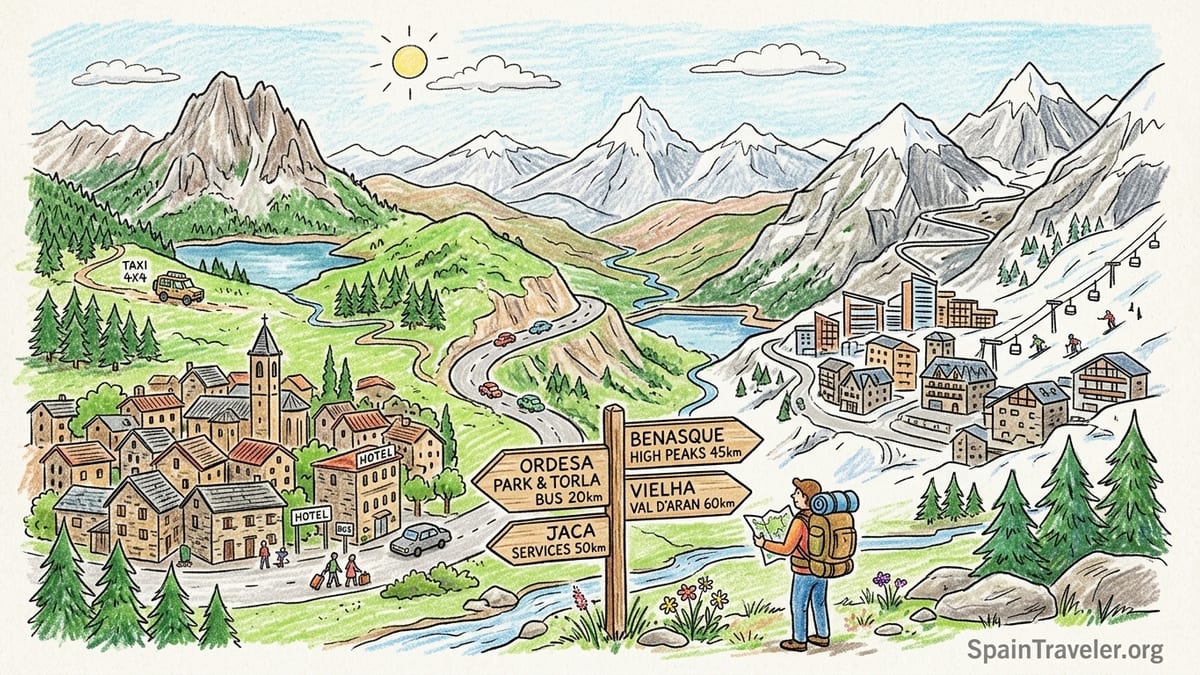
One Base or Several Valleys: How to Plan Your Trip
Before you choose a town, decide how you want to travel. If you have 3 to 4 days and your priority is a single area, such as Ordesa or Val d’Aran, it usually makes sense to pick one hub and minimise packing and unpacking. For example, a long weekend focused on the famous Circo de Soaso hike works best with three nights in Torla, leaving the car parked and relying on the park shuttle in high season. In contrast, a 10 to 14 day summer road trip that mixes Ordesa, Aínsa, Benasque and Val d’Aran is more enjoyable if you move your base every 2 or 3 nights to avoid repeating long drives over the same passes.
Driving distances between valleys can be longer than they look on a map. In good conditions, Jaca to Torla takes about 1 hour, Aínsa to Benasque about 1 hour, and Vielha to Espot via the Bonaigua pass around 1 hour 15 minutes. In summer this is fine for a transfer day, but it is tiring if you try to bolt long drives onto big hiking days. In winter, snow and traffic around ski resorts can easily double these times, so it is usually better to stay as close as practicable to the lifts or shuttle departure points.
Think about parking and access rules as well as scenery. Several of the most popular valleys, including Ordesa, Benasque and Aigüestortes, now regulate summer traffic with shuttle buses, parking quotas or timed access in peak weeks. A base with easy walking access to the shuttle stop, such as Espot for Aigüestortes or Torla for Ordesa, can be worth more than a remote cottage with mountain views but a stressful daily battle for space in a full car park.
Jaca: Services Hub and Gateway to the Western Pyrenees
Jaca is the natural capital of the western Aragonese Pyrenees and the most practical base if you want big-town services with quick road access to multiple valleys. The town has large supermarkets, outdoor shops, several pharmacies and a busy restaurant scene around Calle Mayor and the streets near the cathedral. In summer, terraces serving tapas and raciones fill up from early evening, and you can usually find everything from simple menus del día at family-run bars to more formal dining with tasting menus within a few blocks of each other.
Parking is relatively straightforward by Pyrenean standards. Several central hotels include underground or courtyard parking and there are sizeable public car parks on the edge of the old town, which are convenient if you are arriving with bikes, skis or camping gear. From Jaca you can drive in under an hour to the ski resorts of Astún and Candanchú, to the entrance of the Ordesa valley via Biescas and Torla, or to the French side through the Somport tunnel. This makes it a good choice for travellers who prefer to return to the same hotel each night while exploring different directions by car.
Jaca is less ideal if you want to step out of your door directly onto high-mountain trails. Classic ridge and high-lake routes usually start at trailheads at least 30 to 45 minutes away by car. For example, a day on the Ibón de Ip or a traverse above Candanchú means a pre-breakfast drive up to the pass. For many visitors this trade-off is acceptable because Jaca’s nightlife, range of accommodation and the possibility of a relaxed rest day visiting the citadel or the nearby Monastery of San Juan de la Peña compensate for the extra time behind the wheel.
Sallent de Gállego and Formigal: Best for the Tena Valley
The Tena Valley is one of the most dramatic corners of the central Pyrenees, with big reservoirs, sharp peaks and classic hikes such as the Ibones de Anayet and the loops around the Panticosa cirque. For this valley, most travellers choose between Sallent de Gállego, a traditional stone village on the reservoir, and Formigal, the purpose-built ski resort a few minutes uphill. Sallent offers more village atmosphere, with stone houses, a small central square and several restaurants that stay open year-round, from simple grills offering chuletón to wine bars serving local Somontano bottles.
Formigal, on the other hand, sits right at the base of the ski lifts and is designed around winter access. In ski season, apartment blocks and hotels fill the hillside, and the advantage is obvious: you can usually walk from your accommodation to the lifts without needing the car, or use the internal shuttle to move between sectors. This saves time compared with staying lower down and having to drive and park every morning. However, in shoulder seasons some bars and restaurants in Formigal close, while Sallent tends to feel more lived-in and is a better year-round base for hiking.
Parking for hiking and skiing in the Tena Valley is generally good but can be crowded on peak winter weekends. The large car parks at Formigal and Panticosa ski areas fill progressively from early morning after fresh snow. In summer, popular trailheads such as La Sarra reservoir near Sallent still have space if you arrive before mid-morning, but later arrivals may find cars already lining the access track. If you want to minimise parking stress, consider booking accommodation in Sallent or Formigal that allows you to walk to at least one or two of your planned activities.
Torla: The Classic Base for Ordesa
For Ordesa y Monte Perdido National Park, Torla is the obvious choice and feels purpose-built for hikers. The stone village sits right at the vehicle gate of the Ordesa valley. In the main season, private cars are stopped at Torla and visitors park in the large car park by the river. From there, frequent shuttle buses run up the narrow road into the heart of the valley, dropping you at the Ordesa meadow, the starting point for routes like the Cola de Caballo waterfall, Faja de Pelay balcony path and higher ascents for experienced mountaineers.
Staying in Torla means you can leave the car in your hotel’s small lot or in the village car park and walk a few minutes to the bus terminal each morning. This is a big advantage over basing in more distant villages like Broto or Biescas, where you must factor in extra driving and the possibility of queues to enter Torla’s main parking area on crowded days in August or during long weekends. It also makes it easier to adapt plans to changing weather: if storms threaten, you can delay your start and still catch a later bus without worrying about a long return drive.
The village has a surprisingly wide choice of accommodation and restaurants considering its size. Most options are small family hotels, guesthouses and apartment rentals, many with their own restaurant serving hearty mountain dishes, grilled meats and local cheeses in the evening. Prices fluctuate with park demand; in high summer, a simple double room can cost as much as a more upmarket hotel in a less famous valley, so booking ahead is wise. For drivers, note that hotel parking is often tight and streets are narrow. If you travel in a campervan, you will most likely need to use the regulated daytime parking near the river and move on at night according to local by-laws.
Aínsa: Crossroads for Road Trips and Adventure Activities
Aínsa, lower in altitude at the junction of the Cinca and Ara rivers, is one of the best bases for a multi-activity holiday and a logical stop on a road trip that links Ordesa, the Sierra de Guara and the central Pyrenees. The walled old town sits above a newer quarter where you will find supermarkets, petrol stations and outdoor businesses offering canyoning, rafting and guided via ferrata. In summer it is common to see groups meeting outside gear shops at 8 a.m. to drive to the canyons of the Añisclo or Escuaín sectors, then returning for late dinners on the medieval plaza.
Because Aínsa is not a high-mountain village, summer days are warmer, but that also means easier driving and less risk of being blocked by storms or late snow. From here, you can reach Bielsa and the French border tunnel in around 40 minutes, the entrance to Ordesa’s Añisclo side in well under an hour and the lost-world landscapes of the Sierra de Guara in about an hour and a half. Mountain bikers use Aínsa as their gateway to Zona Zero, an extensive network of enduro and cross-country trails that start near the village and extend through abandoned hamlets and pine forests.
Parking in Aínsa is comparatively generous. The lower town has large, mostly free surface car parks near supermarkets and the river, which makes it easy to stock up on supplies even in high season. The old town itself has more limited space and is better visited on foot from lower parking, especially in the evenings when people come up for dinner or for views of the sunset over the Peña Montañesa ridge. For accommodation, many travellers choose modern apartments in the lower town because they come with dedicated parking spaces and air conditioning, while those seeking atmosphere base themselves in restored stone houses in the historic centre and accept a slightly longer walk to their car.
Benasque and Cerler: High-Mountain Hiking and Winter Ski Base
The Benasque valley is a favourite base for serious walkers because it provides road access to the Posets-Maladeta Natural Park and the southern side of Aneto, the highest summit in the Pyrenees. The village of Benasque, sitting in the valley floor, combines a compact historic centre with modern services: several supermarkets, bakeries, gear rental shops and a dense strip of bars and restaurants along the main pedestrian street. In summer, it is normal to see hikers having early breakfasts on café terraces before driving up to trailheads like La Besurta, the Vallibierna track or the Eriste waterfalls.
From Benasque, the Cerler ski resort is just a short drive uphill. The resort, known as Aramón Cerler, is one of the highest in the Aragonese Pyrenees, with slopes reaching over 2,600 metres. It has large parking areas at the base sectors, and the local council has been improving these car parks and pushing ahead with a planned gondola link from Benasque, which will further reduce the need for winter driving up the mountain road. For now, most skiers either stay in Benasque and commute to the lifts in around 10 to 15 minutes, or sleep in Cerler village itself, where some apartment blocks and hotels are within walking distance of the base chairlifts.
For hiking, Benasque has the advantage of sitting roughly in the middle of the main access roads. On a three or four day stay you can hike the classic Portillón de Benasque route on one day, explore the ibones near Cerler on another, and visit the waterfalls near Eriste or the forests around Anciles without changing accommodation. In high season, access to some upper car parks such as La Besurta may be regulated, with shuttle buses running from lower down the valley, so staying in Benasque town helps you reach these early. Trailheads usually have basic but sufficient parking if you arrive before mid-morning, and many popular routes end at refuges where you can buy hot food or drinks before heading back.
Restaurant choice in Benasque is broader than in most high-mountain villages. Along a few streets you can find everything from simple menú del día options and pizzerias to restaurants specialising in local beef, wild mushrooms in autumn and Aragonese wines. Many mid-range apartment rentals include access to underground parking, which is convenient for travellers arriving with roof boxes or bikes. If you prioritise ski access above all, consider splitting your stay between a few nights in Benasque to explore the valley and a couple of nights in a hotel or apartment next to the lifts in Cerler to enjoy car-free ski days.
Vielha: Val d’Aran Capital and Access to Baqueira
Vielha is the main town of the Val d’Aran and the most practical year-round base for combining skiing at Baqueira Beret with a wider exploration of the valley. The town sits at the northern end of the long tunnel that links it with the rest of Spain, which means access is reliable even in bad weather. In the centre you will find supermarkets, sports shops, medical services and a wide variety of hotels and apartments. The restaurant scene is lively, with traditional Aranese dishes such as olla aranesa served alongside more contemporary Catalan cuisine, pintxos bars and burger joints that cater to younger visitors and ski workers.
From Vielha it is around 20 to 30 minutes by road to the main Baqueira 1500 base area, depending on traffic and snow conditions. During the ski season, bus services and private shuttles link the town with the slopes, allowing some visitors to leave their car parked all week. This arrangement suits travellers who want to ski for a few days but also spend time visiting Romanesque churches in Arties and Salardú, walking along the Garonne river or driving up to smaller villages in the side valleys. In summer, Vielha becomes a hub for cycling events and trail races as well as hiking, and hotels can be busy on those weekends.
For motorists, Vielha offers more structured parking than smaller villages higher up the valley, including dedicated camper van areas and long-stay car parks near the river. Central hotels often charge for on-site parking, but this can be worthwhile in winter when street parking gets tight after fresh snow. One practical consideration in recent hotter summers is air conditioning: many mid-range hotels and guesthouses were built for a traditionally cool mountain climate and some still lack full air conditioning in standard rooms, which is usually fine outside of heatwaves but may matter to travellers visiting in July or August.
If your main goal is to ski as much as possible with ski-in ski-out convenience, staying in Baqueira itself or in nearby villages like Arties may still be preferable. However, for mixed groups where some people want to ski and others prefer walks, shopping or spa days, Vielha’s wider choice of services makes it a strong compromise. Over a week you might ski three days in Baqueira, take a rest day exploring the town and nearby villages, then drive one day over the Bonaigua pass towards Espot and Aigüestortes to see a different landscape.
Espot: Gateway to Aigüestortes and Local Skiing
Espot is one of the principal gateways to Aigüestortes i Estany de Sant Maurici National Park and also has its own ski resort, Espot Esquí, on the slopes above the village. This dual identity makes it an excellent base for travellers who want to combine national park hiking with moderate downhill skiing or snowshoeing in winter. The small village has a clutch of hotels, guesthouses and rural apartments clustered along the main street and near the river, as well as a handful of restaurants and bars that cater mainly to walkers and families.
In the main hiking season, private cars cannot drive all the way to the Sant Maurici lake. Instead, 4x4 taxis and minibuses run from Espot up the narrow track, dropping visitors at the lakeside or at intermediate stops. Staying in the village means you can walk to the taxi departure point in a few minutes, saving time and avoiding parking headaches. Typical itineraries include a day walking around Estany de Sant Maurici and the nearby viewpoints, a loop through other lakes in the park such as Ratera or Amitges, and a quieter day on foot or by car visiting nearby villages like Son and Esterri d’Àneu.
Espot Esquí, reached by a short road above the village, offers a compact ski area that is particularly attractive for families and intermediates. The resort has its own parking area at the base, which generally suffices except on the busiest holiday weekends, when arriving early is advisable. Because the village is so close, some visitors walk or take short transfers to the lifts, allowing them to leave their car at their accommodation. For non-skiers, winter walks along the river and snowshoe routes in the park provide alternatives without needing long drives.
Dining options in Espot are more limited than in bigger hubs like Vielha or Benasque, but you can still expect to find a mixture of rustic Catalan mountain cooking, pizza and simple set menus. In exchange for this smaller choice you get a quieter atmosphere and the satisfaction of being right next to one of Spain’s most beautiful national parks. If you plan to explore more of the Catalan Pyrenees on the same trip, consider combining Espot with a stay in Cerdanya or in Val d’Aran so that you are not backtracking over the same high passes each day.
Cerdanya: Broad Valleys and the Eastern Catalan Pyrenees
Cerdanya occupies a wide, high valley that straddles Spain and France, with the Spanish side centred on towns such as Puigcerdà, Alp and Bellver de Cerdanya. It is the best base for the eastern Catalan Pyrenees, including ski resorts like La Molina and Masella, and for families or cyclists who prefer gentler gradients and more open landscapes than the steeper central valleys. The climate here is often sunnier and less storm-prone in summer, which appeals to visitors planning road cycling or long-distance walking on routes such as the GR11.
For skiing, the twin resorts of La Molina and Masella are linked to create a large combined ski area known as Alp 2500. Many skiers choose to stay in or around the village of Alp or in small developments near the base lifts, where several hotels and apartments allow you to walk to the gondola or chairlifts. Others base in Puigcerdà, the region’s main town, and drive 20 to 30 minutes to the slopes. Puigcerdà offers the widest range of restaurants, shops and medical services, as well as a pleasant lake and park where you can stroll on rest days.
Parking around La Molina and Masella is generally straightforward on weekdays but can be busy on winter weekends when visitors arrive from Barcelona. Large tarmac car parks receive an early-morning wave of vehicles, and arriving by 9 a.m. usually makes finding a spot much easier. In summer, those same parking areas serve as trailheads for walks into surrounding forests and ridges. Cerdanya is also dotted with smaller villages such as Bellver, which offer quieter rural stays with easy access to both the main valley road and the foothills of the Cadí-Moixeró Natural Park.
If you are trying to decide between staying in Cerdanya or further west for a week-long trip, think about your priorities. Cerdanya is ideal for a less alpine, more pastoral landscape with easy road cycling, accessible family skiing and a broad choice of accommodation tied to year-round local life rather than purely to high-mountain tourism. For a route-based holiday, one practical strategy is to start or finish your Pyrenees trip here, especially if you are driving to or from Barcelona, and spend the middle of your itinerary in more rugged valleys such as Benasque or Val d’Aran.
How to Combine Valleys in One Itinerary
For travellers with 10 to 14 days, the most satisfying Spanish Pyrenees itineraries usually connect two or three of these bases rather than trying to see them all. A classic loop for hikers might start in Jaca for two nights to explore the western valleys and settle into the rhythm of mountain driving, then move to Torla for three nights focused on Ordesa. From there, a transfer via Aínsa to Benasque for another three or four nights opens up high-mountain routes under Aneto and across the Posets-Maladeta range. If you have extra time, finishing with three nights in Vielha lets you experience the different culture and architecture of Val d’Aran before driving back through the tunnel.
In winter, skiers might instead link Tena Valley and Val d’Aran or combine Benasque with Cerdanya. For example, four nights at a hotel in Formigal or Sallent de Gállego allow you to ski the full Tena Valley network and sample nearby Astún and Candanchú, followed by a transfer day to Vielha for another four or five nights skiing Baqueira Beret. Alternatively, you could spend a long weekend in Benasque, splitting time between Cerler and cross-country skiing at Llanos del Hospital, then drive to the eastern Pyrenees for four nights in Cerdanya skiing La Molina and Masella.
However you combine valleys, it pays to keep driving days separate from your biggest hikes or ski sessions. Booking accommodation that includes breakfast or offers early coffee and pastries can make dawn starts easier on transfer days. In small villages like Espot or Torla, some restaurants close one night a week or in shoulder seasons, so it is worth asking your host on arrival which evenings you might need to reserve ahead. With a little planning, using a sequence of well-chosen bases allows you to experience the full variety of the Spanish Pyrenees without spending your holiday constantly unpacking in new places.
FAQ
Q1. Is it better to stay in one base or move between valleys in the Spanish Pyrenees
For trips of 3 to 4 days focused on one area, staying in a single base such as Torla for Ordesa or Benasque for high-mountain hiking works best. For longer trips of 10 days or more, moving every 2 to 3 nights between valleys like Jaca, Benasque and Vielha reduces repetitive driving and lets you experience more varied landscapes.
Q2. Which town is the best all-round base if I want services and flexibility
Jaca and Vielha are the strongest choices for services and road connections. Jaca works well for the western Aragonese Pyrenees, with easy access to multiple valleys and ski areas, while Vielha serves Val d’Aran and Baqueira and has a wide range of restaurants, shops and accommodation.
Q3. Where should I stay for the best access to Ordesa y Monte Perdido National Park
Torla is the most practical base for Ordesa because the park shuttle buses leave from the large car park at the edge of the village in high season. Staying there means you can walk to the bus stop and avoid daily parking queues or extra driving from villages further down the valley.
Q4. What is the best base for serious high-mountain hiking in the Spanish Pyrenees
Benasque is an excellent base for high-mountain hiking thanks to its access to the Posets-Maladeta Natural Park and routes around Aneto. From the village you can quickly reach trailheads such as La Besurta, Vallibierna or Eriste and return in the evening to a good choice of restaurants and services.
Q5. Where should I stay if I want to ski Baqueira Beret but also have non-ski options
Vielha is usually the best compromise. It is around 20 to 30 minutes by road from the main Baqueira base and has regular transport links during the ski season, yet it also offers shops, historic churches, riverside walks and easy drives to other villages in Val d’Aran for non-skiers.
Q6. Is Espot a good base for visiting Aigüestortes i Estany de Sant Maurici National Park
Yes. Espot is one of the main gateways to the park, with 4x4 taxis and minibuses that take visitors up to the lakes. Staying in the village lets you walk to the departure point in a few minutes and also gives you access to the small Espot Esquí ski resort in winter.
Q7. How does Cerdanya compare to the central Pyrenees for a family holiday
Cerdanya offers broader, sunnier valleys, easier road access and family-friendly ski resorts such as La Molina and Masella. It is a good choice for families or cyclists who prefer gentler gradients and a mix of year-round local life and mountain activities, rather than the more rugged high-mountain feel of places like Benasque or Torla.
Q8. Which base is best for combining hiking with adventure sports like canyoning and rafting
Aínsa is ideal for combining hiking with adventure activities. It sits at a crossroads between the Pyrenees and Sierra de Guara, with local operators offering canyoning, rafting and via ferrata, while classic hikes in surrounding valleys are within a short drive.
Q9. Where can I stay to minimise daily driving to ski lifts
If minimising driving is your priority, stay in resort villages such as Formigal for the Tena Valley, Cerler for the Benasque area, Baqueira for Val d’Aran or near La Molina and Masella in Cerdanya. These allow you to walk to the lifts or use short shuttles instead of commuting by car each morning.
Q10. Do I need to book accommodation far in advance in the Spanish Pyrenees
In peak periods such as August, Christmas, New Year and winter weekends during good snow years, booking several months in advance is advisable in hotspots like Torla, Benasque, Vielha, Espot and the Tena Valley. Outside those times, you can often find options with shorter notice, especially in larger towns like Jaca or Puigcerdà.