


Spain’s Mediterranean coast has quietly become one of Europe’s most interesting yacht charter playgrounds. From the rugged coves of the Costa Brava to the big-boat glamour of Marbella and Puerto Banús, mainland bases now offer a credible alternative to the Balearics, often at slightly softer prices and with simpler logistics. Whether you want a bareboat week from Barcelona, a family catamaran out of Alicante or a fully crewed motor yacht for the day on the Costa del Sol, understanding how the Spanish charter market works will help you get much better value on the water.
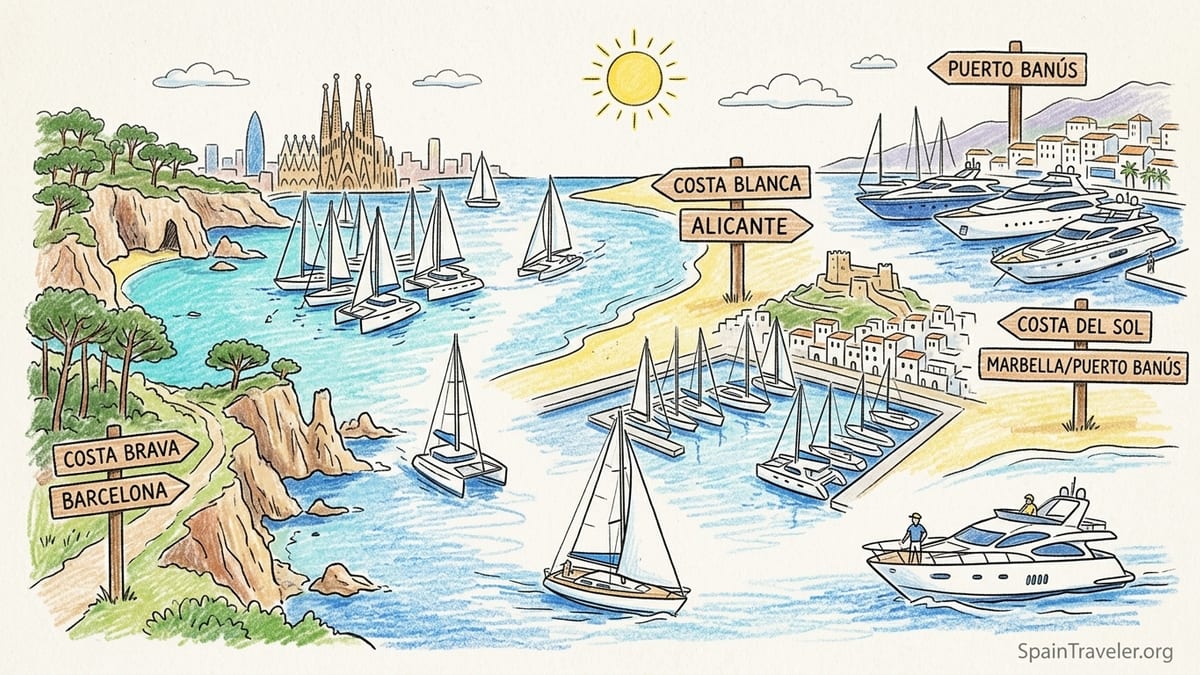
Costa Brava & Barcelona: Rugged Coastline, Strong Bareboat Market
The Costa Brava, running from Blanes up to the French border, offers a mix of dramatic cliffs, pine-backed calas and pretty fishing towns such as Cadaqués and Palamós. For yacht charters, the practical hubs sit slightly to the south: Barcelona and nearby ports such as Badalona and Mataró have become major bases for modern monohull and catamaran fleets. From here, it is a straightforward overnight or long day sail to Tossa de Mar, Sant Feliu de Guíxols and the heart of the Costa Brava, while still enjoying the flight connections and services of a major city.
Most of the larger international operators, along with a cluster of Spanish independents, base their bareboat and skippered fleets in Barcelona. Typical examples in the 2025–2026 season include 38–45 foot sailing yachts from well-known builders, plus 40–46 foot cruising catamarans. In high summer, a recent 40 foot monohull might start around a few thousand euros for a week bareboat, while a 40–42 foot catamaran can cost noticeably more, reflecting high demand from families and groups. Shoulder months such as May, June and late September often see discounts that bring the overall cost closer to the Balearic Islands or south of France, but with easier embarkation and slightly lower marina costs in the Costa Brava ports.
Once under way, skippers can mix traditional ports with small anchorages. Ports like Palamós, L’Estartit and Roses usually provide a good balance of infrastructure and character, and you can still anchor for free in many calas outside buoyed-off swimming zones. Fuel consumption for a sailing yacht on this coast is relatively modest because you can often motor-sail short legs between coves. Budget a couple of hundred euros for fuel for a normal week’s itinerary on a midsize sailing boat, and be prepared for higher marina fees only in the most in-demand harbours and August weekends.
The Costa Brava and Barcelona area works especially well for crews who want an active, exploratory charter: sail for a few hours, swim in a cala, then overnight in a marina with restaurants and provisioning within walking distance. It also suits mixed groups where some want city nights out in Barcelona before or after the cruise, while others prefer quiet anchorages and snorkelling.
Costa Blanca & Alicante: Reliable Weather and All-round Flexibility
Further south, the Costa Blanca around Alicante, Dénia and Torrevieja has become a reliable all-round charter destination. Alicante in particular combines a busy commercial airport with a sheltered, south-facing bay and a solid marina infrastructure, including fleets of modern sailing yachts, catamarans and small motorboats set up for day charter and week-long holidays. The area’s reputation for mild winters and generally moderate summer winds makes it appealing for less experienced crews or families with children.
Typical offers from Alicante and nearby marinas include 3–4 cabin monohulls in the 35–45 foot range and 38–45 foot catamarans that can comfortably host 8–10 people. On current price lists, a family-sized catamaran for a summer week can run into the mid four-figures in euros, while an equivalent monohull is often noticeably cheaper. For a simple private day charter, operators around Alicante marina and San Juan beach advertise 10–13 metre sailing boats and small motor yachts for roughly the cost of a nice dinner out per person if you are eight to ten guests, especially outside the very peak weeks of late July and August.
Unlike the dramatic Costa Brava, the Costa Blanca’s appeal lies in wide sandy beaches, straightforward navigation and predictable sea breezes. That makes it ideal for training holidays and first-time bareboat charters. Several English-speaking sailing schools in the region run five-day liveaboard courses that double as short coastal cruises, teaching practical skills while hopping between marinas like Villajoyosa, Calpe and Altea. This education presence spills over into the charter market, where many fleets are used both for courses and for standard holiday charters, so boats are usually well maintained and equipped with safety gear.
Alicante also functions as a launchpad toward the Balearics. Ambitious crews sometimes plan an overnight passage to Ibiza or Formentera, but for most holiday sailors the better value is to stay coastal and explore bays like Jávea’s Cala Granadella or the island of Tabarca near Santa Pola. Fuel usage for these itineraries remains relatively low on sailing yachts; on motor yachts and power catamarans, you should plan for a more substantial fuel line in your budget, especially if you intend to cruise fast or cover long distances in a day.
Costa del Sol & Marbella: Premium Day-Charter and Crewed Yachts
The Costa del Sol, and particularly Marbella and Puerto Banús, occupies a different niche from Costa Brava and Alicante. Here the dominant product is not the week-long bareboat sailing yacht but the premium private yacht day charter. Puerto Banús in particular hosts a dense concentration of 20–35 metre motor yachts, many privately owned and then offered on the day-charter market in July and August. As a result, the region’s per-day charter prices sit at the top end of the western Mediterranean mid-market, with a noticeable glamour premium driven by demand from Spanish, British and Middle Eastern guests.
Real-world examples from current local operators show how this plays out. A classic 19 metre sailing yacht or a 12–15 metre motor yacht running short 2–4 hour trips from Puerto Banús might start around several hundred to a little over one thousand euros for the boat, often including skipper and fuel for a short coastal cruise, with capacity for up to 10–12 guests. Full-day charters on modern 20–24 metre motor yachts commonly start from around the mid four-figures in euros and climb steeply with size and brand. High-end 26–30 metre yachts can cost several thousand euros more again for a typical eight-hour day, especially in August and during weekends around major events.
Marbella’s coastline itself is not as varied as the Costa Brava’s, but the appeal lies in combining a day at sea with the town’s beach clubs, restaurants and nightlife. Many charters include coastal runs toward Estepona or east toward Cabopino, with swim stops off quieter beaches, paddleboards in the water and drinks served on board. In most cases, these are fully crewed experiences where guests are not expected to handle lines or navigate. Yacht charter companies in Puerto Banús and Marbella marina typically package skipper, crew, basic drinks and fuel for a standard itinerary into a fixed price; only extra fuel for detours, special catering or extended hours significantly alters the bill.
Because of the premium positioning and the dominance of motor yachts, Marbella and the wider Costa del Sol are less suitable for budget bareboat sailors and more interesting for groups who want a turnkey, hosted yacht day as part of a luxury holiday. If your primary aim is a week of sailing and anchoring in coves, you will find more choice and better value north in Barcelona or Alicante. If you want to combine La Concha’s backdrop, Puerto Banús’s supercar-lined quays and a glossy day on a 20-plus metre yacht, Marbella is where the mainland market is strongest.
Bareboat, Skippered, Catamaran and Crewed: What To Choose
On Spain’s Mediterranean mainland you will find several distinct charter formats, each with its own cost structure and level of independence. Bareboat charter is the classic option for qualified skippers: you rent the boat without crew, take responsibility for navigation, mooring and safety, and pay extra for fuel, final cleaning and marinas. In Barcelona and along the Costa Brava and Costa Blanca, bareboat sailing yachts from roughly 32 to 50 feet are common, with a noticeable step up in price for catamarans. If you already hold an accepted qualification and are comfortable handling a yacht in unfamiliar harbours, this usually offers the most economical price per person.
A skippered sailing yacht sits in the middle ground. You still charter a normal yacht or catamaran, but the operator provides a professional skipper who remains on board for the whole trip. In practical terms, you plan the route together, but the skipper handles docking, anchoring and most of the sailing. On the Spanish coast, skippers typically cost a fixed daily fee plus meals and a cabin on board. While exact numbers vary by region and yacht size, it is reasonable to expect to add a moderate daily amount to your budget, which divided among eight or more guests is often excellent value for the reduced stress and increased safety.
Catamarans have become especially popular in Barcelona and Alicante for family and friends’ trips. Their wide decks and stable platforms make them ideal for groups with children or mixed sea legs. However, their size can increase marina bills, and their base charter rates are consistently higher than monohulls. If your group will spend most nights at anchor or on a buoy and values space over top-end sailing performance, a catamaran, whether bareboat or skippered, is often worth the premium.
At the top of the spectrum is the fully crewed yacht. This is the standard in Marbella and common for larger yachts in Barcelona and along the Costa Blanca. Here the boat comes with skipper, deckhand and sometimes a hostess or chef. You pay a charter fee and then, depending on size and type, either an all-inclusive package or an additional allowance to cover fuel, food and berthing. The experience is closer to a small floating villa than a sailing trip. For a simple taster or celebration, many operators in all three regions also run private day charters on smaller boats, sometimes only 7–10 metres, which can be driven bareboat with the right licence or rented with a skipper if you prefer to sit back entirely.
Licences, Skippers and Insurance: What You Really Need
Spain regulates recreational boating through a series of national licences for residents, and it recognises equivalent foreign qualifications for visiting skippers. For foreign guests, the key point is that you generally need a certificate that matches or exceeds the level your own country requires for similar coastal cruising. In practice, charter companies on the Costa Brava, in Barcelona and around Alicante are familiar with common credentials such as the International Certificate of Competence, RYA Day Skipper, ASA 104 Bareboat Cruising or equivalent national coastal licences. They will normally ask to see proof of both your qualification and your practical experience, often via a sailing CV, before confirming a bareboat booking.
Spanish rules allow small boats below certain length and power limits to be driven without a formal licence, close to shore and only by day. A few Marbella and Alicante operators exploit this by offering compact motorboats under the threshold that local clients can rent without paperwork. For international visitors, charter companies often take a more cautious stance and still expect a recognised certificate or will steer you toward hiring a skipper for insurance reasons. The safest assumption is that if you want a sailboat or catamaran of more than about 10 metres, or a motor yacht of similar size, you will need an accepted licence on paper to go bareboat.
Hiring a skipper removes most of the regulatory burden. In Spain, professional charter skippers hold commercial endorsements on top of their recreational licences. When you book a skippered or crewed charter, the operator’s insurance covers the skipper’s activities, and you are treated as passengers. You will still be liable for damage caused by negligence, but any manoeuvres under the skipper’s direction fall primarily under the company’s policy. This is one reason skipper-inclusive charters are so common in Marbella and Puerto Banús, where many guests simply want to enjoy the boat without the responsibility of command.
Before sending a deposit, ask your chosen operator to confirm in writing which licences they accept, whether a second crew member with basic skills is required for bareboat, and how their insurance treats guest helming and night passages. On the Costa Brava and in Alicante in particular, some fleets insist on a second crew member with at least basic experience or may restrict night sailing for bareboats. Having this in writing avoids disputes later if weather or itinerary tempt you into longer hops.
Real-world Costs: Skippers, Fuel, Marinas and Deposits
Understanding the full cost picture is essential, because the headline weekly rate only tells part of the story. For bareboat and skippered sailing yachts on the Costa Brava, around Barcelona and on the Costa Blanca, skippers usually charge a daily fee, which guests also top up with meals on board and a dedicated cabin. Over a seven-day charter this can add a meaningful sum, but when divided across a full boat of eight to ten people it often represents only a small percentage increase compared with going bareboat, while delivering far more comfort for less experienced crews.
Fuel is the next major variable. On a typical 40 foot sailing yacht used conservatively along the Costa Brava or Costa Blanca, you might burn only a small amount of diesel per day, mostly for entering and leaving harbours and motoring during light winds. On settlement, that might translate into a modest bill at the fuel dock. By contrast, a 20 metre motor yacht running a full eight-hour day charter from Puerto Banús, cruising at planing speeds, can burn hundreds of litres, which is why high-end Marbella charters either quote rates that already include a standard itinerary’s fuel or list fuel as a major additional item. For example, some Puerto Banús operators advertise all-inclusive packages where skipper, crew and fuel for a defined coastal route are built into a single figure, with extra hours or long detours charged separately.
Marina fees vary widely along the coast. Smaller ports on the Costa Brava and Costa Blanca can still offer reasonable overnight rates for yachts in the 10–15 metre range, but prime marinas in peak season, especially in Barcelona city and in Puerto Banús, command a premium. While precise nightly prices depend on boat length, beam and booking conditions, it is sensible for week-long bareboat trips to allow a few hundred euros for berths if you plan a mix of marinas and anchoring. Crewed yachts in Marbella normally have a home berth included in their pricing, but if you request a night in a different port, that extra marina bill may be passed through to you or deducted from any onboard expense allowance.
Finally, deposits and insurance. Almost all Spanish charter companies take a security deposit for bareboat and sometimes for skippered charters, often held on a credit card. The amount scales with yacht size: a small 32 foot sailing boat might carry a significantly lower deposit than a large catamaran. Some fleets now offer damage-waiver insurance that reduces the deposit in exchange for a non-refundable fee. For fully crewed day charters, especially in Marbella, deposits are often lower or even waived in favour of clear rules on behaviour onboard, strict no-smoking policies in interiors and signed acceptance of liability for damage caused by guests. It is worth reading these conditions carefully before boarding, as they govern everything from red wine in saloons to shoes on teak decks.
Where Spain’s Mainland Charter Market Is Strongest
Each stretch of Spain’s Mediterranean coast has carved out its own niche in the charter economy. The Costa Brava and Barcelona lead on variety and depth of sailing fleets. If you want a wide choice of modern monohulls and catamarans, including last-minute options and off-season deals, this is where supply is densest on the mainland. You also benefit from Barcelona’s flight connections and city infrastructure, together with the Costa Brava’s rugged coastline and countless calas within a day’s sail.
The Costa Blanca and Alicante stand out for accessible, weather-friendly cruising and a strong mid-market offering. Here, reliable sea breezes, mostly benign seas and the presence of well-regarded sailing schools combine to make the region attractive for training, first-time charters and family trips. The charter market is genuinely strong in the 35–45 foot sailing yacht and 38–45 foot catamaran segment, with enough competition to keep prices competitive outside peak school-holiday weeks. The area also benefits from being a convenient hop for domestic travellers from Madrid and northern Spain, which helps support fleets year-round.
The Costa del Sol, on the other hand, dominates the premium private-yacht and day-charter sector rather than the bareboat scene. Puerto Banús, Marbella marina, Estepona and Sotogrande collectively host a concentration of 20–35 metre crewed motor yachts that is unusual on the Spanish mainland. This creates a market where you can choose between multiple similar yachts for a one-day celebration or corporate event, with professional crews, polished service and all-inclusive pricing. The flip side is a relative shortage of mainstream bareboat sailing options directly from Marbella compared with Barcelona or Alicante, and higher per-day prices that reflect both operating costs and the destination’s status.
For travellers, the practical conclusion is straightforward. If your priority is hands-on sailing with maximum choice of yachts and the ability to shop around on price, look to Barcelona and the Costa Brava or to Alicante and the Costa Blanca. If, instead, you want a showpiece day on a crewed motor yacht as part of a luxury holiday, Marbella and Puerto Banús are where the Spanish mainland market truly excels.
The Takeaway
Chartering along Spain’s Mediterranean coast has become more sophisticated and diversified over the past decade. Today you can book everything from a modest bareboat monohull in Barcelona to a high-spec, fully crewed motor yacht in Puerto Banús, with many shades in between. Costa Brava and Barcelona provide depth of fleet and adventurous coastlines for sailors; Alicante and the Costa Blanca offer friendly conditions and solid mid-market pricing; Marbella and the Costa del Sol focus on premium, skipper-inclusive day charters.
Whatever format you choose, the basics remain the same. Check your licence is accepted, clarify what is and is not included in the rate, budget sensibly for fuel, marinas and incidentals, and read the deposit and insurance terms before you pay. When you match the right region to the right boat and crew profile, Spain’s mainland delivers some of the Mediterranean’s most rewarding and good-value yacht holidays, whether you are tacking into a Costa Brava cala or sipping a sunset drink off Puerto Banús.
FAQ
Q1. Do I need a boat licence to charter in Spain’s Mediterranean ports?
In most cases yes, if you want a bareboat sailing yacht or larger motorboat. Recognised certificates such as the International Certificate of Competence, RYA Day Skipper or ASA 104 are widely accepted in Costa Brava, Barcelona and Alicante. For crewed and skippered charters, guests do not need a licence, and some very small motorboats near the coast may be hired licence-free under Spanish rules.
Q2. How much does a skipper cost per day in Spain?
Exact figures vary by region and boat size, but on Spain’s Mediterranean coast you should expect a fixed daily fee for a professional skipper, plus meals and a cabin on board on week-long trips. Split between eight to ten people, the added cost is often modest compared with the peace of mind and extra local knowledge you gain.
Q3. Is bareboat or skippered charter better around Costa Brava and Alicante?
For experienced sailors who enjoy handling the boat, bareboat offers more freedom and usually a lower price per person. Around Costa Brava and Alicante, conditions are generally friendly, but harbour entries and summer crowds can be demanding. Many mixed-ability groups compromise with a skippered charter, which keeps everyone relaxed while still allowing keen sailors to learn and take the helm under supervision.
Q4. Why are Marbella and Puerto Banús known for day charters rather than bareboats?
Marbella and Puerto Banús have developed a strong market in 20–35 metre crewed motor yachts aimed at day and half-day experiences for holidaymakers. The local clientele often prioritises convenience and luxury over hands-on sailing, so operators focus on skipper-inclusive, all-in-one packages rather than classic bareboat fleets. There are far more choices for week-long bareboat sailing from Barcelona or Alicante than directly from Marbella.
Q5. What extra costs should I expect beyond the charter fee?
In addition to the base rate, factor in fuel, end-of-charter cleaning if not included, marina fees away from the home port, possible outboard and water-toy rentals, and any onboard catering. For bareboat charters, budget a realistic fuel allowance and a few hundred euros for moorings over a week. For Marbella day charters, fuel and drinks are often included for a standard route, with supplements for longer runs or premium catering.
Q6. Are catamarans worth the extra cost in Spain?
Catamarans are usually more expensive to charter and berth than similar-length monohulls, but they offer far more living space and stability. On the Costa Brava and in Alicante, they are particularly popular with families and groups who prioritise comfort, large outdoor areas and shallow-draft access to coves. If you fill most of the berths, the per-person cost can still be attractive despite the premium.
Q7. Can I sail from Alicante or Barcelona to the Balearic Islands on a one-week charter?
It is technically possible, and some experienced crews do plan overnight passages from Alicante or Barcelona to Ibiza or Mallorca. However, the distances mean you spend a significant proportion of your week at sea rather than relaxing in bays. For most holidaymakers, a coastal itinerary along the Costa Brava or Costa Blanca, or a separate Balearic charter, provides a more relaxed experience.
Q8. How far in advance should I book a yacht charter in Spain?
For July and August, it is wise to book several months ahead, especially for popular catamarans and larger crewed yachts in Marbella and Puerto Banús. Shoulder seasons such as May, June, September and early October often offer more flexibility and better prices, though last-minute deals on the most desirable boats are never guaranteed.
Q9. What is a realistic budget for a simple private day charter?
On the Costa Blanca and Costa Brava, a modest sailing boat or small motor yacht for a half or full day, with skipper, can work out at roughly the same or a little more than a good restaurant meal per person if you are eight to ten people. In Marbella and Puerto Banús, day-charter prices tend to be higher because the boats are larger and fully crewed, so groups should expect a noticeably larger total, even when shared among several guests.
Q10. Is Spain’s mainland a good alternative to the Balearic Islands for yacht holidays?
Yes, particularly if you value easier access and competitive pricing. Barcelona and Alicante are well served by flights and high-speed trains, and you avoid the extra ferry or domestic flight to reach island bases. While the Balearics still win on concentration of anchorages, mainland coasts such as Costa Brava and Costa Blanca now offer a strong mix of scenery, marinas and charter options that suit many travellers just as well.