


Spain’s Mediterranean costas have quietly become one of Europe’s most competitive villa markets, especially for 2026. From pine-backed coves on the Costa Brava to the palm-framed beaches of the Costa del Sol, thousands of private-pool, sea-view and walk-to-beach villas are now bookable either as standalone rentals or full holiday packages. The choice is excellent for families and groups, but the options and extra fees can feel confusing. This guide focuses on the four heavyweight coasts where current villa inventory is strongest: Costa Brava, Costa Blanca, Costa Cálida and Costa del Sol.
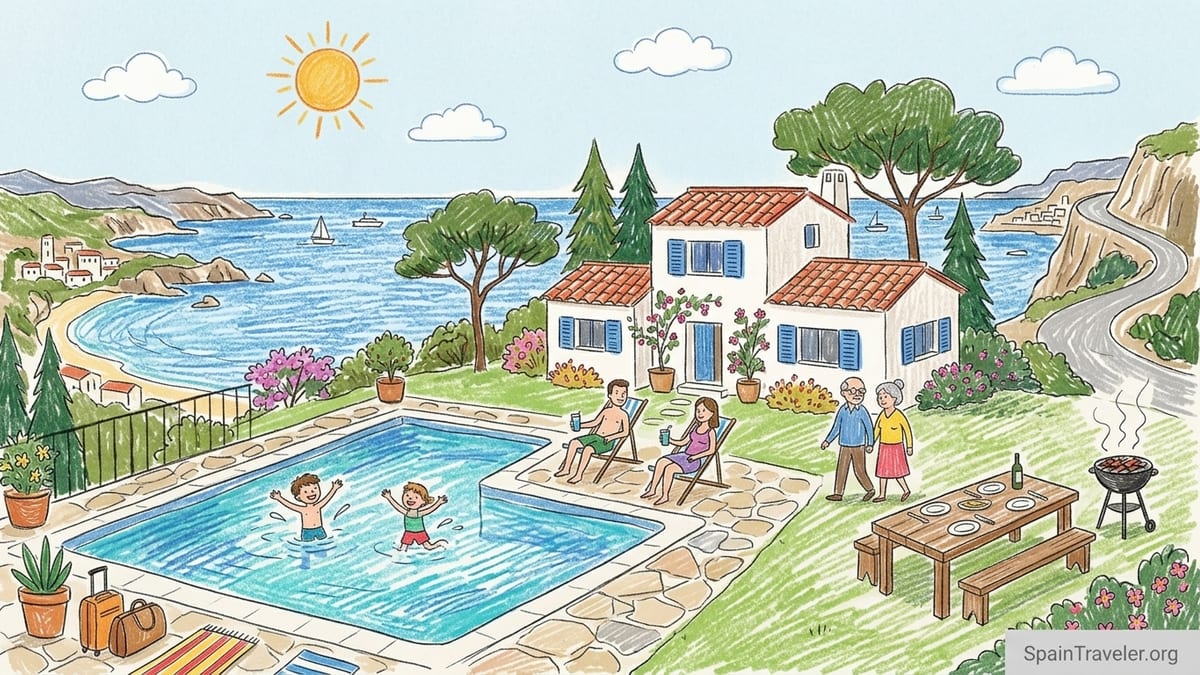
Why Villas Make Sense on Spain’s Mediterranean Coast
For families and groups, a villa on the Spanish Mediterranean often delivers more value and freedom than a hotel. A three or four bedroom house with its own pool around Lloret de Mar or Begur on the Costa Brava can start from roughly 150 to 250 euros per night in shoulder season when shared between two families. Similar properties near Javea or Moraira on the Costa Blanca or around Mijas and Estepona on the Costa del Sol are often in the same range, especially if you book outside peak August. Everyone gets separate bedrooms, a living area, a full kitchen and outdoor space, which would otherwise require multiple hotel rooms.
Villas also match how people actually want to use the costas. Many travellers now prefer long, lazy days by a private pool and evening barbecues over strict meal times in hotel restaurants. Families with small children appreciate being able to put kids to bed while adults stay up on the terrace. Multigenerational groups like grandparents joining in often find single-level villas around the Costa Blanca or Costa Cálida easier than hotels with long corridors and lifts.
The four costas in this guide also have strong support services for villa guests. Towns such as Lloret de Mar and Roses on the Costa Brava list hundreds of villas with private pools and air conditioning, while booking portals show well over 400 private-pool villas available across the region on any summer week. On the Costa Blanca and Costa del Sol, dedicated agencies manage everything from key handover to mid-stay cleaning, while larger tour operators package villas with flights and rental cars, making logistics straightforward even for first-time villa users.
Finally, villa stays offer privacy that is increasingly valued. Couples and groups can swim without sharing a pool with strangers, choose quieter residential neighbourhoods set back from the busiest strips and keep noise or late-night conversations within their own space without worrying about hotel corridor etiquette.
Understanding the Four Key Costas
The Costa Brava runs north from Blanes towards the French border. It is known for rocky coves, pine-fringed cliffs and pretty resort towns like Tossa de Mar, Begur and Calella de Palafrugell. Villas here often sit on hillside plots with partial or full sea views. Many have private pools and terraces designed to catch breezes rather than relying solely on air conditioning, although modern villas near the beach increasingly include full climate control.
Costa Blanca stretches roughly from Denia past Javea, Calpe, Altea and Benidorm to Torrevieja and Orihuela Costa. This is one of Spain’s most dynamic villa markets, with dense clusters of detached houses and new-build villas offering private pools, roof terraces and off-street parking. Towns such as La Nucía, Ciudad Quesada and Finestrat back the coastline and provide extensive inventory, from modest three bedroom homes rented from around 900 to 1200 euros per week in June to luxury properties well into five figures in peak summer.
The Costa Cálida, in the Murcia region, is quieter but increasingly marketed by package operators for villa holidays. Resorts like Mazarrón Country Club, La Manga Club and the bays around Águilas and Bolnuevo provide a mix of townhouses and villas with access to communal or private pools. Prices here are often a little lower than the Costa Blanca or Costa del Sol for equivalent space, which appeals to value-conscious extended families. Beaches tend to be gently shelving and less crowded outside Spanish school holidays.
Further west, the Costa del Sol between Nerja and Estepona remains one of Europe’s classic villa destinations. Sea-view houses around Mijas Costa, Marbella, Benahavís and Estepona often come with mature gardens, private pools and shaded terraces. At the premium end, newly built villas in areas such as La Cala Golf Resort or the foothills above Marbella combine design-forward architecture with panoramic views, underfloor cooling and heating, and advanced insulation for year-round comfort.
Private-Pool, Sea-View, Beach-Walk and Large-Group Villas Compared
Private-pool villas dominate search results on Costa Brava, Costa Blanca and Costa del Sol. In Costa Brava, a typical example is a three bedroom villa above a bay like Canyelles or near Lloret de Mar, with a private pool, barbecue area and partial sea view, often starting from around 1500 to 2500 euros per week in July depending on exact location and finish. In Costa Blanca, detached houses with small private pools in suburbs like La Nucía or Ciudad Quesada can be significantly cheaper in June, around 900 to 1200 euros for ten days if booked well ahead.
Sea-view villas usually attract a premium. Around the Costa del Sol, a three or four bedroom villa in Mijas Costa or Calahonda with direct views of the Mediterranean, a private pool and landscaped garden can easily cost from 2500 to 4000 euros per week in high summer, more for high-spec contemporary builds. On Costa Brava, front-line or near-front-line villas around Sa Riera or Tamariu with unobstructed views are limited in number, so prices tend to stay firm, especially in August.
Walk-to-beach homes appeal to travellers who prefer not to drive every day. On the Costa Blanca, single-storey houses near Javea’s Arenal beach or within ten to fifteen minutes on foot of the sea in Torrevieja or Orihuela Costa may trade some privacy or plot size for convenience. Expect smaller pools or shared communal pools in gated developments rather than large private gardens. On the Costa Cálida, townhouses within short walking distance of the Mar Menor or Mazarrón’s beaches are often marketed through package operators that include transfers, making them attractive to families who do not want to rent a car.
For large groups, such as three generations or a mix of families, look at villas with five or more bedrooms or neighbouring properties on the same street. On the Costa Brava, big hillside houses around Begur or Platja d’Aro often sleep ten to twelve guests and can come with features such as table tennis, games rooms and large infinity pools. On the Costa del Sol, substantial villas in Estepona or Benahavís might offer six or seven bedrooms, staff accommodation and extensive outdoor kitchens, but booking early is essential because capacity at this size is limited, especially in school holidays.
How Package Villa Holidays Work in 2026
Package operators now explicitly market villa holidays on all four Mediterranean costas, often bundling flights from major European cities, a car rental and a villa with either a private or shared pool. This can be particularly useful for Costa Cálida, where direct villa bookings are a little less visible but major tour brands package properties at developments like La Manga Club or coastal resorts near Cartagena, allowing travellers to pay one bundled price with financial protection under package travel regulations.
On the Costa Blanca and Costa del Sol, packages might include a detached villa with private pool near Javea or a sea-view home around Mijas Costa, plus mid-size rental car and basic insurance. Prices vary significantly by origin country and travel dates, but a family of four travelling in June might see week-long packages starting from around 1500 to 2500 euros total when departing from northern Europe, sometimes less outside school holidays.
The main advantages of packages are cost transparency and support. You pay a deposit to the tour operator rather than to an individual owner, the balance is due on a clear schedule, and if a flight is delayed or cancelled the operator is responsible for rebooking. Customer service lines handle issues such as broken air-conditioning or pool problems, rather than guests negotiating in another language with a private host.
Direct bookings, however, often offer greater choice and flexibility. Dedicated villa agencies based on the Costa del Sol or Costa Brava may have deep local portfolios, including unique houses that never appear in large package brochures. Direct sites for individual villas on the Costa Blanca, such as long-established family-run properties in La Nucía or Rojales, sometimes publish detailed availability calendars and transparent seasonal price tables, allowing repeat guests to lock in their preferred weeks year after year.
Rental Cars, Driving and Access
On most of the Spanish Mediterranean coast, a rental car is highly recommended for villa stays, especially if you choose hillside or rural properties. On the Costa Brava, many villas sit above coves reached by winding roads. A house with panoramic sea views near Tossa de Mar or Begur might be only a five minute drive from the beach, but walking back uphill in summer heat is unrealistic for many guests. Having a car makes supermarket runs, day trips to Girona and visits to multiple beaches much easier.
The Costa Blanca’s residential zones are often spread out, with local supermarkets, bakeries and restaurants a few minutes’ drive inland from the main resort strips. For example, a villa in La Nucía with its own pool might be in a quiet urbanisation ten minutes by car from Benidorm’s beaches. Public transport exists but is not geared to villa neighbourhoods, so a car makes sense unless you choose a walk-to-beach property in a more urban location like Javea or Altea.
On the Costa Cálida, a car gives access to a string of lesser-known bays, hilltop villages and interior wineries. Many villa developments are built a little inland, prioritising space and value over immediate beach access. Similarly, on the Costa del Sol, using a car allows you to enjoy both coastal towns such as Fuengirola or Estepona and inland white villages like Mijas Pueblo or Frigiliana. Even villas marketed as walkable to the beach often involve a ten to twenty minute walk along roads that may not have continuous pavements, so consider mobility and heat when deciding whether to rely on walking alone.
Parking is usually straightforward because most villas include at least a driveway or on-street parking in residential areas, but check listing details. In some older Costa Brava villages or steep streets on the Costa del Sol, smaller cars are more convenient. If your package includes a very large vehicle or nine-seat van for a big group, verify that the villa driveway or access road is suitable.
Costs Beyond the Nightly Rate: Fees, Deposits and Utilities
Villa pricing on the Spanish costas can look simple at first glance, but extra charges make a real difference to your final bill. Standard cleaning fees are very common. A typical three or four bedroom villa might charge 80 to 200 euros for end-of-stay cleaning, either as a separate fee or bundled into the weekly price. Some Costa Brava and Costa Blanca agencies roll cleaning into the advertised rate for week-long stays but levy a surcharge for shorter bookings or additional mid-stay cleans.
Security deposits are another key element. Expect to pre-authorise or pay between 300 and 1000 euros for regular family villas, more for high-end properties with designer furniture or advanced technology. This may be held on a credit card or transferred by bank and is usually refunded a few days after departure once the property has been inspected. Guests should document any existing damage on arrival and take time-stamped photos of fragile items, particularly in luxury Costa del Sol villas or architect-designed Costa Brava homes.
Utilities can also come with conditions, especially air conditioning and pool heating. Some Costa Blanca and Costa Cálida villas include a reasonable electricity allowance per week and then charge extra if you exceed it. In practice, this means you should not leave air conditioning running when you are out. Meter readings may be taken at check-in and check-out. In a few cases, especially rural properties, gas for heating or hot water may be billed separately outside summer.
Local tourist taxes are another small but important factor. In parts of Catalonia, including the Costa Brava, per-person nightly tourism levies can appear on your invoice and are collected in cash on arrival or added to the booking total. While the amounts are relatively low, they are worth accounting for in multi-week stays or for large groups where every guest over a certain age is charged.
Air Conditioning, Pool Heating and Seasonal Comfort
Not every villa on the Spanish Mediterranean has full air conditioning, especially older houses on the Costa Brava or traditional fincas inland on the Costa del Sol. Many rely on thick walls, shutters and ceiling fans. For stays in July and August, especially with young children or older travellers, it is sensible to filter for properties with air conditioning in at least the bedrooms, and ideally in main living areas as well. Newly built villas on the Costa Blanca and Costa del Sol almost always include modern systems, while mid-range properties on the Costa Cálida often specify split units in key rooms.
Pool heating is less common but increasingly available, particularly on the Costa del Sol where shoulder-season demand is strong. Heated pools can extend comfortable swimming into April, May and October. There is usually a daily or weekly supplement, sometimes around 150 to 300 euros for a week, and systems may need to be requested several days before arrival. In the peak of summer, pool heating is usually unnecessary and may even be disabled to keep water temperatures comfortable.
Seasonality matters. On the Costa Brava, evenings in May or late September can feel cool, so villas with terraces that catch afternoon sun or with sheltered courtyards are valuable. In contrast, inland Costa Blanca or Costa Cálida locations can be very hot in July, which makes shaded pergolas, covered outdoor dining areas and decent indoor cooling systems almost essential. Consider how you plan to spend your time. If you expect to work remotely, check for both air conditioning and good natural light near a table, rather than relying on a dark corner of a traditional living room.
Noise and insulation are another comfort factor. Newer villas near Costa Blanca’s urbanisations or Costa del Sol’s golf developments often feature double glazing and better soundproofing than older holiday homes. If you are sensitive to noise, favour modern builds or houses at the end of quiet cul de sacs rather than hillside properties close to main coast roads.
Choosing the Right Villa Type for Your Trip
For families with small children, practical features often matter more than spectacular design. Look for villas where the pool can be gated or is easily overseen from the main terrace or living room. Single-level villas on the Costa Blanca or Costa Cálida with a flat garden and minimal steps are convenient for pushchairs and grandparents. Proximity to a supermarket and a sandy, gently shelving beach such as those around Javea, Torrevieja or Mazarrón can ease daily routines.
Groups of friends might prioritise views and social spaces. Sea-view villas on the Costa Brava or Costa del Sol with multiple terraces, outdoor bars or barbecue kitchens create natural gathering spots. Check that there is enough comfortable seating both inside and outside for everyone and that bedrooms are reasonably equal so that no one is stuck with a tiny room. Properties around Mijas, Estepona or Begur often balance traditional architecture with modern fittings, giving atmosphere without sacrificing hot showers or good kitchens.
Active travellers using the villa as a base for hiking, cycling or watersports should pay attention to storage and access. Some houses on the Costa Brava market themselves to triathletes or cyclists, offering long lap pools, secure garages for bikes and easy access to coastal roads. On the Costa Blanca, villas near mountainous inland areas such as the Marina Alta can provide quick access to trailheads while still being less than half an hour’s drive from the sea.
For digital nomads or guests combining work and holiday, check internet speeds and workspace photos. Many newer Costa del Sol and Costa Blanca villas promote fibre connections, but not all older properties have upgraded. If a strong connection is essential, confirm with the agency before paying a deposit, especially in rural Costa Cálida locations or smaller Costa Brava villages.
The Takeaway
In 2026, the Spanish Mediterranean offers one of Europe’s richest selections of villa holidays, especially across the Costa Brava, Costa Blanca, Costa Cálida and Costa del Sol. Private-pool villas are strongly represented on Costa Brava, Costa Blanca and Costa del Sol, while package operators now connect all four coasts with flight and car-inclusive villa deals. Whether you prefer pine-scented coves, family-friendly sandy beaches or chic sea-view terraces, there is likely a villa style and price point to match.
Maximising value means reading beyond the nightly rate. Pay attention to cleaning fees, deposits, air-conditioning arrangements and potential extra costs for utilities or pool heating. Think realistically about driving needs, especially for hillside properties or quieter developments set back from the shore. Above all, align the villa choice with the shape of your trip: space and safety for young families, equal bedrooms and social terraces for groups of friends, or calm neighbourhoods and reliable internet for workations.
With a bit of planning and a focus on the details that matter to your party, a Spanish Mediterranean villa can deliver an experience that standard hotels struggle to match. Shared meals by the pool, unhurried mornings and the freedom to shape each day at your own pace are exactly what keep travellers returning to these four costas year after year.
FAQ
Q1. Do I really need a rental car for a villa holiday on the Spanish Mediterranean?
In most cases a rental car is highly recommended, especially for hillside Costa Brava villas, inland Costa Blanca urbanisations and quieter Costa Cálida or Costa del Sol developments. You may do without a car only if you choose a walk-to-beach villa within an established resort town and are comfortable using taxis for supermarket trips.
Q2. How far in advance should I book a villa for July or August?
For peak summer on popular stretches such as Begur on the Costa Brava, Javea on the Costa Blanca or Marbella and Mijas on the Costa del Sol, booking six to nine months ahead gives the best choice, particularly for large villas sleeping eight or more people and properties with outstanding sea views.
Q3. What is a typical security deposit for a family villa?
Most standard three or four bedroom villas require a security deposit of around 300 to 1000 euros, depending on value and furnishings. Luxury properties with designer interiors can ask for higher deposits, so always check terms before confirming.
Q4. Are cleaning fees usually included in the price?
Practices vary. Some agencies include end-of-stay cleaning within the weekly rate, while others show a separate cleaning fee that can range from roughly 80 to 200 euros or more. Always read the cost breakdown and ask whether mid-stay cleaning is available and at what price.
Q5. Is air conditioning standard in Spanish coastal villas?
Many newer villas on the Costa Blanca, Costa Cálida and Costa del Sol have full air conditioning, but older houses, especially on the Costa Brava, may rely on fans and natural ventilation. If cool bedrooms are important in July and August, filter for properties with air conditioning in the listing details and confirm room coverage.
Q6. How common is pool heating, and when do I need it?
Pool heating is less common than standard pools but is increasingly offered in mid to high-end villas, particularly on the Costa del Sol. It is most useful in spring and autumn. There is usually an extra weekly charge and it often has to be requested in advance.
Q7. Are villas suitable for families with toddlers or non-swimmers?
Yes, but you should choose carefully. Look for villas where the pool is either fenced, can be closed off with gates or is easily supervised from the main terrace. Single-level layouts and minimal steps are better for young children and older relatives. Do not assume pool safety features are present unless clearly stated.
Q8. How do package villa holidays differ from booking direct?
Package villa holidays bundle flights, villa and often a rental car into one protected booking, giving clear pricing and strong customer support. Booking direct may offer more unique properties, flexible dates and closer contact with local managers, but requires you to arrange flights and car hire separately.
Q9. Are there extra local taxes on villa stays?
Some regions, such as Catalonia which includes the Costa Brava, levy local tourist taxes per person per night. These are usually modest but can add up for large groups or longer stays. Elsewhere on the costas, taxes may be built into the advertised rate. Check booking conditions or ask the agency directly.
Q10. What should I check in the villa contract before paying a deposit?
Review cancellation terms, payment schedule, security deposit amount, included utilities, rules on air conditioning or pool heating, maximum occupancy and any restrictions on events or parties. Clarify check-in and check-out times, key collection procedures and contact details for on-the-ground support in case of issues.