


The Mediterranean shore of Spain stretches for hundreds of kilometers from the French border down to Gibraltar, changing character several times along the way. For a first-time visitor, names like Costa Brava, Costa Blanca or Costa del Sol can blur together into “somewhere sunny with beaches,” yet in reality each section has a distinct mood, landscape and level of development. This guide walks you coast by coast from northeast to southwest, helping you choose where to base yourself, how to move between regions, and what kind of Mediterranean experience to expect.
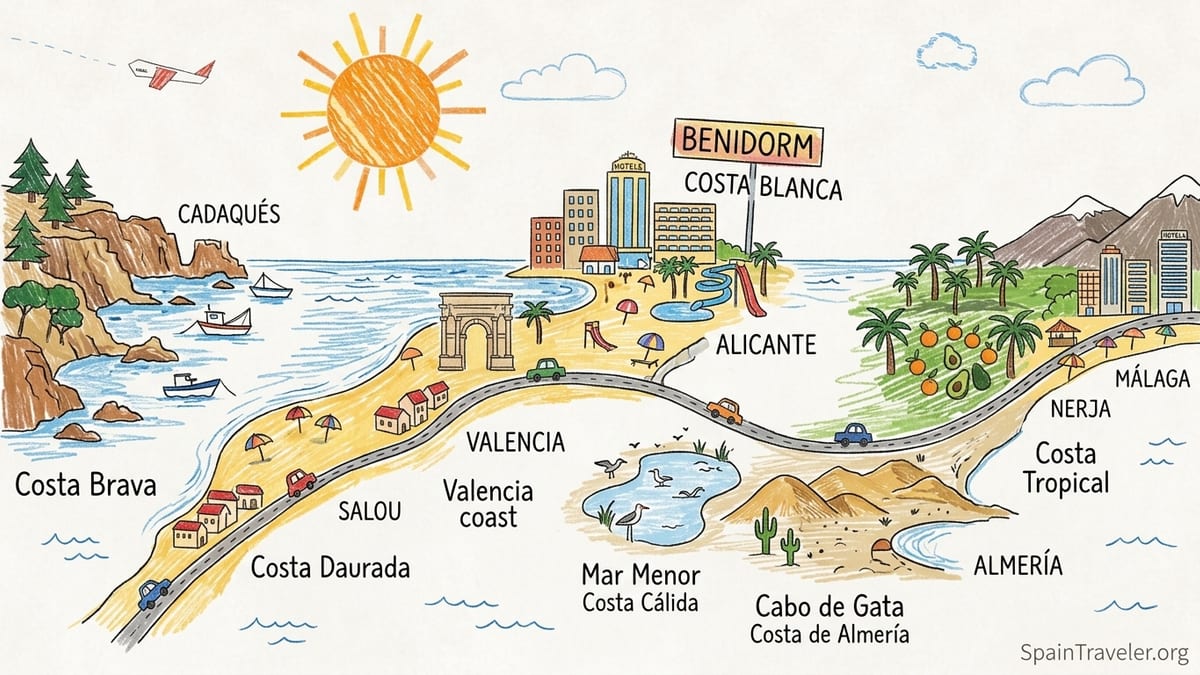
How the Spanish Mediterranean Coast Fits Together
Spain’s official tourism portal divides the Mediterranean shore into several key holiday coasts, notably the Costa Brava, Costa Daurada, Costa Blanca, Costa Cálida and Costa del Sol, with additional stretches such as the Castellón and Valencia coasts, Costa de Almería and Costa Tropical filling in the gaps. In practice, travelers often experience this as one long arc from the rugged coves of northern Catalonia down to the subtropical beaches of Málaga province. The entire run is drivable in about 12 to 14 hours of pure driving time, but most visitors sensibly break it up into two or three bases or treat one region as a standalone trip.
Major cities play an important role as gateways. Barcelona sits just south of the Costa Brava and north of the Costa Daurada, Valencia anchors the central section that includes Castellón and the northern Costa Blanca, Alicante serves as the main entry point for the rest of the Costa Blanca, and Málaga is the obvious hub for the Costa del Sol while also giving access to the Costa Tropical and eastern Costa de Almería. All four cities have busy international airports with regular low-cost flights from across Europe and frequent rail connections from Madrid, so most itineraries will begin and end in at least one of these urban centers.
Despite this connectivity, the feel on the ground varies dramatically from coast to coast. Some areas, such as parts of the Costa Blanca and Costa del Sol, have long stretches of high-rise resorts, large British-style pubs and all-inclusive hotels. Others, especially the Costa Brava, sections of the Castellón coast, Costa Cálida outside the Mar Menor and key pockets of the Costa de Almería and Costa Tropical, still preserve a more traditional Mediterranean atmosphere with small fishing towns, low-rise whitewashed houses and natural coves. Understanding these regional personalities is the key to planning a trip that matches your expectations.
Climate is another big differentiator. The northern Mediterranean coast around the Costa Brava is a little cooler and windier in winter, while the southern end around Málaga and Almería is known for very mild winters and long swimming seasons. Summer sea temperatures along the whole coast now commonly reach the mid-20s Celsius, with some recent reports of the Costa Brava hitting 20 degrees earlier than usual in late spring, but shoulder-season swimming is still generally more reliable the further south you go. When choosing where to stay, consider not just the brochure promise of “over 300 days of sunshine” but also whether you prefer cooler nights and more dramatic geology or almost guaranteed heat and softer, wider beaches.
Costa Brava: Rugged Coves and Characterful Towns
The Costa Brava, in Girona province, runs from the French border down to roughly Blanes. It is the most dramatic stretch of Spain’s Mediterranean shore, with pine-topped cliffs, rocky headlands and dozens of small coves that are ideal for snorkelling and kayaking. Towns like Cadaqués, Calella de Palafrugell, Llafranc and Begur are favorites for travelers who want atmosphere first and nightlife second. Small beaches such as Tamariu or Sa Tuna often mix coarse sand and pebbles, backed by low white houses, restaurants serving grilled fish and walking trails along the cliffs known as caminos de ronda.
Access is usually via Barcelona’s main airport or Girona–Costa Brava Airport, which sees a seasonal influx of low-cost flights. Many first-time visitors pick up a rental car in Barcelona and reach Tossa de Mar in about 90 minutes, or the Begur area in around two hours, following the AP-7 and then narrower coast roads. Driving here is perfectly feasible but requires patience, as some of the most scenic stretches twist and climb steeply. The reward is flexibility: you can start a morning with a coffee in the medieval town of Pals, swim at Platja de Castell, then detour inland to a vineyard tasting in Empordà before returning to your base.
Development varies considerably. The southern end around Lloret de Mar and Platja d’Aro has larger package resorts, nightlife strips and apartment blocks, similar in feel to more built-up parts of the Costa Blanca, while the central section between Palamós and L’Escala is more low-rise and village-based, with boutique hotels, small campsites and rental apartments. Prices in high season reflect the coast’s popularity with French, Dutch and Catalan holidaymakers: a simple seafront hotel in Llafranc in August can easily run to mid-range city prices, while a rural masia guesthouse a 15-minute drive inland may cost significantly less.
Beach style here tends to favor smaller, enclosed coves rather than long boulevards. Many beaches shelve quite quickly into deeper water, which is excellent for confident swimmers and snorkelers but less ideal for toddlers. Water clarity is typically very good, with rocky bottoms that attract marine life. For a first-timer, basing in a town like Tossa de Mar or Calella de Palafrugell offers a good compromise between charm, services and access to nearby coves by boat or on foot.
Costa Daurada & The Castellón / Valencia Coasts: Wide Sands and Family Resorts
South of Barcelona, the Costa Daurada in Tarragona province is known for long, gently shelving golden beaches backed by pine forests or promenades. Resorts such as Salou, Cambrils and La Pineda cater heavily to families, with apartment hotels, beachfront playgrounds and easy access to the PortAventura World theme park. Sand here is typically fine and soft, and the sea usually stays shallow for a long way out, making this one of the most child-friendly sections of the Spanish Mediterranean.
Road-trip practicality is high. Reus Airport sits just inland from the main resort area, and the AP-7 and A-7 motorways run parallel to the coast. You can easily combine beach time with visits to Tarragona’s Roman ruins or day trips to Priorat wine country. Compared with the Costa Brava, the driving is simpler, the coast road flatter and the resort layout more regular, with long strands like Platja de la Pineda lined with hotels ranging from budget to four-star all-inclusive properties.
Continuing south, the less internationally known coasts of Castellón and Valencia offer an interesting middle ground between classic resort development and traditional towns. Castellón province markets itself as the Costa de Castellón or Costa del Azahar, with around 120 kilometers of coastline and 16 or so coastal municipalities. Places like Peñíscola, with its castle-topped old town jutting into the sea, and Oropesa del Mar, with its combo of older areas and modern family complexes, are examples of relatively developed but still distinctly Spanish resorts. The recently expanded Castellón–Costa Azahar Airport provides some seasonal connections, but many visitors still arrive via Valencia.
The Valencian coast around the city of Valencia showcases long beaches such as Malvarrosa and El Saler, backed by a mix of city skyline and protected dune systems. Further south, you reach smaller resort towns like Gandia and Oliva, where Spanish families rent apartments for the month of August. Development here is mostly mid-rise apartment blocks and hotels rather than dense high-rise clusters. For a first-time visitor who wants wide sand, a more local flavor and easy rail or bus links, this central section of the Mediterranean is a strong but often overlooked option.
Costa Blanca: Classic Sunshine Coast With Busy Resorts
The Costa Blanca, in Alicante province, is one of Spain’s best-known holiday coasts, stretching for over 200 kilometers. Its name “White Coast” refers to its light-colored sandy beaches and bright limestone backdrops. Tourism is extremely well developed, particularly around Benidorm, Torrevieja and the Orihuela Costa, where you find extensive hotel zones, British and Irish pubs, themed bars, water parks and large urbanizations of holiday homes. Benidorm’s skyline of high-rise towers and busy Levante and Poniente beaches is the most visible symbol of this style of development.
For first-time visitors, the Costa Blanca’s advantages are straightforward: excellent flight connections into Alicante–Elche airport, a good network of dual carriageways and toll-free motorways, and a tremendous range of accommodation. In summer, it is quite possible to book a week-long package including flights, transfers and a three-star hotel in Benidorm or nearby resorts at prices that often undercut more boutique-oriented areas further north. Supermarkets stock many imported brands, menus feature English and German translations as standard, and many bars advertise full English breakfasts and Sunday roasts alongside tapas.
However, the Costa Blanca also has more quietly appealing towns, especially along the northern half. Altea’s white old town on a hill, the port town of Dénia with its ferry connections to the Balearic Islands, and Jávea (Xàbia) with its mix of rocky coves and sandy Arenal beach all draw a blend of foreign residents and Spanish holidaymakers. Here the built environment is more low-rise, with villas and small apartment blocks spread along the hills and coves, and walking paths around headlands like Cabo de San Antonio. If you prefer a softer version of the Costa Blanca, basing in Altea or Jávea while visiting Benidorm as a day trip can work well.
Beach style on the Costa Blanca is varied but generally more oriented to wide sand and urban promenades than to small coves. Calpe has twin sandy bays beside its dramatic rock, the Peñón de Ifach, while Guardamar del Segura and La Mata, near Torrevieja, offer long dune-backed beaches where you can still find relatively quiet sections even in high season. The climate here is among the driest and sunniest on the Spanish Mediterranean, with very long shoulder seasons that suit golfers, walkers and winter sun seekers, although mid-summer heat can be intense away from the sea breeze.
Costa Cálida & Costa de Almería: Quieter Corners and Wild Spaces
South of the Costa Blanca lies the Costa Cálida in Murcia, where the key coastal feature is the Mar Menor, a large coastal lagoon separated from the open Mediterranean by a narrow sandbar known as La Manga. On the lagoon side, beaches are extremely sheltered and shallow, which appeals to families and learners of sailing and windsurfing. On the open-sea side, La Manga’s skyline is a striking ribbon of apartment blocks and hotels, illustrating a period of intense development. Elsewhere along the Costa Cálida, however, you still find lower-key fishing towns and resort villages such as Águilas, Mazarrón and smaller coves backed by arid hills.
The Region of Murcia’s new international airport near Corvera has improved direct access, though many visitors still arrive via Alicante due to the greater range of flights and then drive south along the AP-7 in under two hours. Road conditions are generally good, and traffic outside peak summer weekends is light compared with the Costa del Sol or the central Costa Blanca. Prices for accommodation and restaurant meals can be noticeably lower than in the more high-profile costas, especially outside La Manga’s most desirable seafront stretches.
Continuing southwest, the Costa de Almería features some of the most strikingly undeveloped scenery on Spain’s Mediterranean shore, particularly in and around the Cabo de Gata–Níjar Natural Park. Here volcanic headlands, semi-desert landscapes and protected coves such as Playa de los Genoveses or Playa de Mónsul attract travelers looking for hiking, photography and quieter beaches. Development within the park is strictly limited, and many beaches are accessed via dirt tracks or seasonal shuttle buses from designated parking areas. Towns like San José, Las Negras and Agua Amarga offer a small-scale mix of guesthouses, boutique hotels and simple chiringuito beach bars.
Outside the park, however, there are also more conventionally developed resort areas such as Roquetas de Mar and Mojácar Playa, where beachfront apartment blocks, hotels and golf resorts line long sandy bays. Almería Airport sits roughly between these zones and Cabo de Gata, making this coast manageable by rental car for a first-timer. The climate in both the Costa Cálida and Costa de Almería is notably dry, with sparse vegetation and strong summer sun, which can feel more desert-like compared with the greener Costa Brava. Sea temperatures in summer are warm but can be slightly cooler near Cabo de Gata due to currents, which helps moderate the heat on land.
Costa Tropical & Costa del Sol: Subtropical Gardens and Urban Beaches
The Costa Tropical in Granada province is a relatively short but distinctive stretch between roughly Motril and Almuñécar. Taking its name from its mild microclimate, it has long been used for growing crops such as avocados and mangos, and you will see terraces of subtropical fruit trees climbing the hillsides above the sea. The coastline blends shingle and sand beaches with steep cliffs and headlands, so some beaches are narrow and backed by road cuttings, while others open into wider bays like Playa de Velilla in Almuñécar. Development is moderate, with a mix of Spanish second homes, small hotels and campsite-style complexes, and far fewer high-rise towers than the Costa Blanca or central Costa del Sol.
Granada–Jaén Airport offers some flights, but for most international visitors Málaga is the practical gateway, with a drive of about an hour to Almuñécar along the A-7 motorway. This makes it feasible to combine a few nights on the Costa Tropical with a cultural visit to Granada and the Alhambra. Road-trip travelers appreciate the dramatic inland detours into the Alpujarra mountains, where white villages like Pampaneira and Capileira cling to the slopes of the Sierra Nevada. Compared with the Costa del Sol, resort amenities are slightly more limited and nightlife is generally quieter, but the scenery and relative lack of high-rise development are strong draws.
Further west, the Costa del Sol in Málaga province is Spain’s archetypal Mediterranean holiday coast, heavily publicized for its “over 300 days of sunshine” and easy access via Málaga–Costa del Sol Airport, one of the country’s busiest. The coast runs from Nerja in the east through Torremolinos, Benalmádena, Fuengirola, Marbella and Estepona to the border with Cádiz province. Much of this strip is intensely developed, particularly around Torremolinos and Benalmádena, where high-rise hotels and apartment blocks back long, fully serviced beaches. In places like Marbella’s Puerto Banús, luxury yachts, designer boutiques and beach clubs give the area an upscale party atmosphere.
At the same time, the Costa del Sol is not monolithic. Nerja retains a more small-town feel, with its Balcón de Europa viewpoint and coves such as Burriana Beach, while Estepona has undergone a careful facelift of its old town and promenade, emphasizing flowers, murals and family-friendly spaces. Inland, the “pueblo blanco” of Mijas and the historic center of Málaga itself provide a more traditional Andalusian backdrop. For first-time visitors, the combination of a major airport, frequent local trains between Málaga, Torremolinos, Benalmádena and Fuengirola, and an extensive bus network makes it easy to explore without a car, though driving is helpful if you want to reach hill towns like Ronda or the less developed western fringes.
Beach style on the Costa del Sol is predominantly long urban strands of dark sand or fine gravel, divided by breakwaters and equipped with sunbed rentals, showers and a dense chain of chiringuitos serving grilled sardines on skewers. Water temperatures in peak summer are very warm for the Mediterranean, and winter daytime highs are often comfortable enough for outdoor café life even when swimming is reserved for the hardy. Compared with the Costa Brava or Cabo de Gata, however, the coastal scenery feels more urban and less wild, which is precisely what many visitors want: an easy, sociable beach holiday with extensive services and nightlife on tap.
Choosing Your Coast: Practical Comparisons and Trip Ideas
For a first-time visitor deciding where to start, it is helpful to think in terms of your preferred balance between scenery, development and convenience. If you value dramatic landscapes, small coves and characterful towns, with a willingness to drive curvy roads and pay a little more for boutique lodging, the Costa Brava and the wilder pockets of the Costa de Almería or Costa Tropical are strong candidates. If you prioritize very easy logistics, wide sandy beaches, abundant package deals and nightlife, the central Costa Blanca around Benidorm or parts of the Costa del Sol will likely suit you better.
Climate and timing also matter. For trips in late May or early October, southern stretches such as the Costa del Sol, Costa Tropical, Costa de Almería and much of the Costa Blanca offer the best chance of comfortably warm sea and beach days, while the Costa Brava and Costa Daurada can have pleasantly mild days but cooler water, especially at the start of the season. For high summer, the entire coast is beachworthy, but you may appreciate the slightly fresher nights on the Costa Brava or the sea breezes on cliff-backed coasts more than the urban heat of inland plains.
In terms of airports and gateways, Barcelona and Valencia are logical choices if you want to include more cultural sightseeing and perhaps travel partly by train, using regional rail to reach coastal towns and reserving car rental for a few days in the middle of the trip. Alicante and Málaga, by contrast, work well if you are focusing mainly on beach time and short local excursions, possibly without ever needing a car if you stay in well-connected resorts. For example, a one-week trip could involve flying into Málaga, staying in Nerja for a quieter base, visiting the caves and Málaga’s museums by bus, and capping things off with a day in Granada.
For a longer journey, a classic road-trip idea is to fly into Barcelona, spend two or three nights in the city, then pick up a car and drive the Costa Brava for a few days, hop down via the Costa Daurada and Castellón coast, and drop the car in Valencia. Another possibility is to focus on the central and southern section: land in Alicante, base yourself in Dénia or Jávea, then continue by car to the Costa Cálida and Cabo de Gata, ending in Málaga for city sightseeing. In both cases, booking a mix of coastal apartments, rural guesthouses just inland and perhaps one larger seaside hotel gives you a good cross-section of how different the Spanish Mediterranean can feel in just a few hundred kilometers.
FAQ
Q1. Which part of the Spanish Mediterranean coast is best for a first-time visitor?
For an all-round first trip, the central Costa Blanca or eastern Costa del Sol work well because they combine easy airport access, a wide choice of accommodation and straightforward public transport, but travelers who prioritize scenery over nightlife often prefer the Costa Brava or Cabo de Gata area on the Costa de Almería.
Q2. Is it practical to drive the whole coast from Costa Brava to Costa del Sol in one holiday?
It is physically possible to drive the full length in a couple of long days, but for a vacation it is more enjoyable to focus on one or two adjacent coasts over 7 to 10 days, such as Costa Brava plus Costa Daurada, or Costa Blanca plus Costa Cálida and eastern Costa de Almería.
Q3. Where will I find the least developed and most natural beaches?
The most natural-feeling stretches are generally in the Cabo de Gata–Níjar Natural Park on the Costa de Almería, in smaller coves of the Costa Brava away from the main resort towns, and in some pockets of the Costa Tropical and southern Costa Cálida that are outside major resort clusters.
Q4. Which coasts are best for families with small children?
The Costa Daurada, much of the Castellón and Valencia coasts, and many parts of the Costa Blanca and Costa del Sol have long, gently shelving sandy beaches and plentiful family facilities, making them especially suitable for young children who need shallow water and nearby services.
Q5. Do I need a car to enjoy the Spanish Mediterranean coast?
You can manage without a car in well-connected areas like the core Costa del Sol between Málaga and Fuengirola, or in larger towns on the Costa Blanca and Costa Brava, but having a car gives you far more freedom to reach small coves, natural parks and hill villages just inland.
Q6. How expensive are the main coastal regions compared with each other?
Prices vary more by season and exact location than by coast, but in general intensely touristic hubs like central Benidorm or prime Costa del Sol marinas can be expensive in high summer, while smaller towns on the Costa Cálida, Costa de Almería or inland from the Costa Brava often offer better value.
Q7. When is the best time to visit for warm sea temperatures and fewer crowds?
Late June and September usually offer warm water and long beach days with fewer crowds than peak August, particularly in the Costa Blanca, Costa Cálida, Costa de Almería, Costa Tropical and Costa del Sol, though local festivals and school holidays can still make some weekends busy.
Q8. Are there good cultural or city stops along the coast besides the beaches?
Yes, major cities such as Barcelona, Valencia, Alicante and Málaga offer museums, historic quarters and food scenes, while smaller places like Tarragona, Peñíscola, Altea, Granada near the Costa Tropical and Málaga’s own old town add significant cultural depth to a coastal itinerary.
Q9. How does nightlife differ between the various coasts?
Resorts like Lloret de Mar on the Costa Brava, Salou on the Costa Daurada, Benidorm on the Costa Blanca and parts of the central Costa del Sol have concentrated nightlife strips, while areas such as the Costa Tropical, Cabo de Gata and many smaller Costa Brava villages lean more toward relaxed bars and restaurant terraces rather than large clubs.
Q10. Is the Spanish Mediterranean suitable for travelers relying on public transport?
Yes, intercity buses and trains connect major cities and many resort towns, and on the Costa del Sol there is a convenient suburban train line along part of the coast, but reaching more remote coves, natural parks or hill villages may still require a rental car, taxi or organized excursion.