


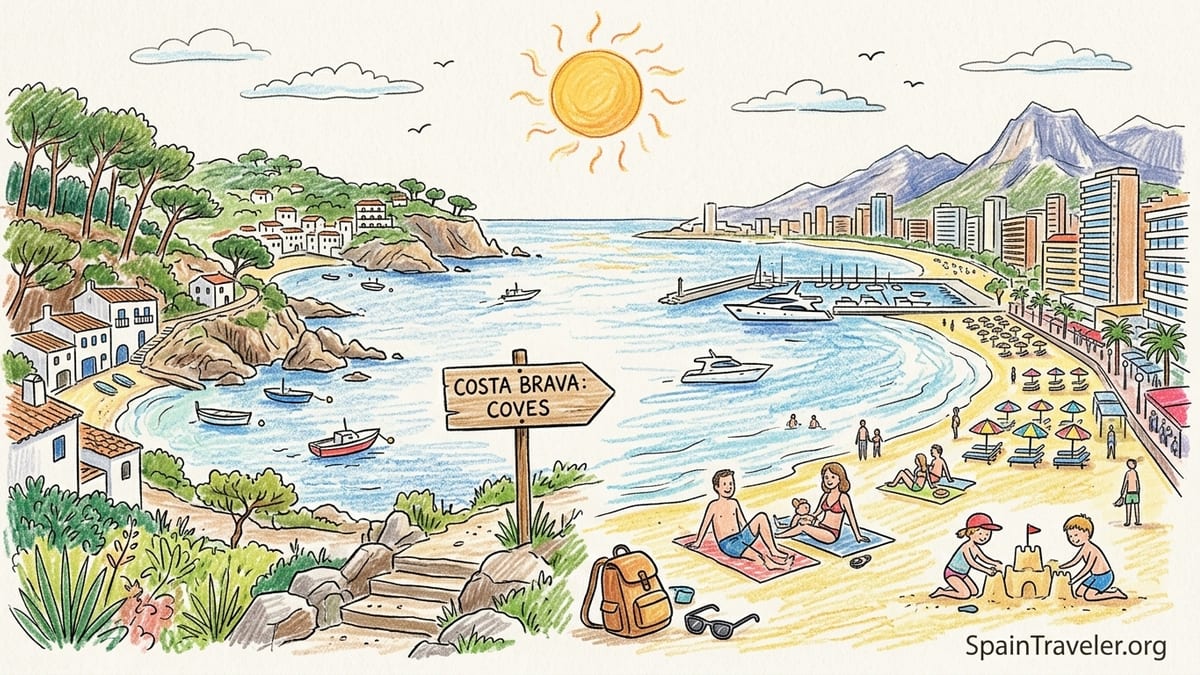
Spain’s Mediterranean coastline is not one long, interchangeable strip of sand. From the rugged coves of the Costa Brava to the high-rise skyline of Benidorm and the wild volcanic shores of Cabo de Gata, each stretch offers a distinct mix of beaches, resort infrastructure, transport links and atmosphere. Choosing the right coast before you book a hotel can make the difference between the Spanish holiday you imagined and one that never quite fits.
How to Choose Your Ideal Spanish Mediterranean Coast
Before you start comparing specific hotels, it helps to think at the scale of the coastline. Spain’s Mediterranean shore breaks into several distinct regions, each with its own character and typical visitor. A couple seeking cliff-backed coves and pretty fishing villages will usually be happier in Calella de Palafrugell on the Costa Brava than in a glass-fronted tower in Benidorm, while a family that wants a big theme park, all-inclusive resorts and easy rail access might find Salou on the Costa Daurada fits far better.
Practicalities also vary. Girona and Barcelona airports give relatively quick access to the Costa Brava, while Alicante serves much of the Costa Blanca and Murcia and Almería airports are gateways to the quieter Costa Cálida and Cabo de Gata. Some coasts are integrated with major cities, such as Valencia, where you can sleep in a historic district and be on Malvarrosa or Cabanyal beach within about 15 minutes by tram or bike. Others, like parts of Cabo de Gata-Níjar Natural Park, require hiring a car and accepting longer drives in return for emptier beaches.
Prices follow the same logic. An August seafront apartment in a Costa Brava village like Llafranc or a boutique hotel on Marbella’s Golden Mile can command premium nightly rates, while a comparable self-catering place in a Costa Cálida town such as Águilas or Mazarrón often comes in noticeably cheaper outside peak Spanish holiday weeks. With that in mind, the sections below compare the main coasts on atmosphere, beach style and infrastructure, then suggest specific bases that suit different types of trip.
Costa Brava: Coves, Fishing Villages and Boutique Bases
Running north from just above Barcelona to the French border, the Costa Brava is known for its rocky headlands, pine-fringed coves and a string of whitewashed former fishing villages. Official tourism material notes nearly 200 beaches and coves along roughly 220 kilometers of coastline, many of them tucked between cliffs and reached by footpaths or short boat trips. This is a coast for people who do not mind a bit of walking in return for smaller, more scenic swimming spots and villages that still feel like communities outside summer.
If you want the classic Costa Brava mix of coves and village life, the cluster around Calella de Palafrugell, Llafranc and Tamariu is a strong base. In Calella de Palafrugell, simple pensions and small boutique hotels sit one or two streets back from the arc of sandy coves, with evening promenades along the seafront and local restaurants serving rice dishes on open terraces. Llafranc, a short coastal walk away, has a slightly smarter feel, with a small marina and a couple of higher-end hotels overlooking the bay. From either, you can follow the coastal path to smaller coves such as Cala El Golfet or drive inland to medieval Pals and Peratallada for day trips.
Travelers who prefer a bigger resort backed by a long main beach might look to Tossa de Mar or Platja d’Aro. Tossa de Mar combines a broad town beach with a rare walled medieval old town rising directly above the sand, plus quick boat access to nearby coves like Cala Pola and Cala Giverola. Platja d’Aro adds shopping streets and nightlife typical of a modern resort, with a wide open beach suitable for families that like easy access and plenty of promenade space. In the far north, Roses and Cadaqués offer another contrast: Roses functions as a larger, more practical hub with family-friendly beaches and apartments, while Cadaqués appeals to those willing to trade convenience for a tight, whitewashed village wrapped around a small horseshoe bay.
Choose the Costa Brava if your ideal days involve walking coastal paths between coves, lingering over long lunches in village squares and dipping into culture in Girona or Figueres rather than relying on a dense strip of nightlife. It suits couples, food-focused travelers and families that value scenery and atmosphere over all-inclusive packages or large-scale water parks.
Costa Daurada & Valencia Coast: Families, PortAventura and City-plus-Beach
South of Barcelona, the Costa Daurada flattens into long sandy stretches backed by pine trees and low-rise resorts. The flagship base here is Salou, a family-focused town with several urban beaches, a long seafront promenade and a concentration of mid-range hotels and apartments. Just inland, PortAventura World near Vila-seca and Salou includes major theme and water parks, making this one of the best choices on the Mediterranean coast for families who want roller coasters and slides within a short transfer of their hotel. Nearby resorts like La Pineda and Cambrils offer slightly quieter alternatives within easy driving distance of the parks.
If you prefer a more historic atmosphere, Tarragona combines Roman amphitheatre remains and a compact old town with its own urban beaches down the hill. It works well for travelers who want cultural sightseeing in the mornings and simple afternoons on a local beach without moving base. In practice, this means you can stay in a characterful guesthouse inside the old walls yet still walk or bus down to Platja del Miracle or Arrabassada for a swim.
Further south, the Valencian coast around the city of Valencia offers a different proposition again: a genuine large city with miles of urban and semi-natural beaches attached. Malvarrosa and Cabanyal beaches form the main city sands, broad and sandy with promenades, beach volleyball courts, seasonal chiringuito bars and rows of rice restaurants serving paella-style dishes. City tourism information highlights that these beaches lie roughly 15 minutes from the historic centre by public transport, so you can sleep in a boutique hotel near the cathedral or the futuristic City of Arts and Sciences and still spend long afternoons on the sand.
Beyond the city limits, El Saler and the Albufera lagoon area present a more natural side of the Valencian coast, with dunes and pine forest behind the beach and simple seafood restaurants in nearby villages. Bases such as El Perellonet or even a farmhouse stay near the rice paddies suit visitors who want quieter sands while remaining within a short drive of central Valencia for museums, nightlife and restaurants. Choose the Costa Daurada if theme parks and family-ready resorts are priorities; pick the Valencia coast if you want a proper city break that happens to come with wide city beaches and easy transport rather than a pure resort feel.
Costa Blanca: Wide Choice, From Benidorm Towers to Calpe Cliffs
Costa Blanca, centered on Alicante, is the classic mass-market Mediterranean coast for many travelers, with an airport that receives flights from across Europe and a huge range of resorts. The beaches here tend to be longer and broader than on the Costa Brava, with most main towns offering level promenades, accessible entrances and plenty of sunbed and parasol rental. It is the right choice if you want options at every budget level and you prefer to compare different styles of resort rather than hunt for a single perfect village.
Benidorm is the best-known base on this coast and has one of the densest concentrations of hotels in Spain, from large all-inclusive complexes on the edges of town to high-rise beachfront properties on Levante or Poniente beaches. Many travelers come here for value package deals and a social, nightlife-heavy environment, but the town has also added more diverse offerings in recent years, including upgraded seafront promenades and more family-oriented activities. For a more laid-back interpretation of the Costa Blanca, nearby Altea offers a whitewashed old town on a hill above a pebble beach, while Albir provides a quieter, more residential feel with plenty of apartments popular for longer winter stays.
Further north, Calpe stands out for its wide beaches overlooked by the Peñón de Ifach, a dramatic limestone rock that gives the town a distinctive profile and offers a well-known hiking trail for active visitors. Here you will find a mix of mid- to high-rise apartments and hotels along Arenal-Bol and La Fossa beaches, with seafood restaurants at the old fishing port. Jávea (Xàbia) and Dénia, at the northern end of the Costa Blanca, appeal to travelers who want a blend of beaches, marinas and old town quarters with a more local feel. In both, you can combine relaxed days on family beaches such as Jávea’s Arenal with trips out to rocky coves or boat excursions.
Pick the Costa Blanca if you value ease of access via Alicante airport, want a broad choice of accommodation types and prefer towns that function year-round with supermarkets, health services and frequent public transport. This coast suits families, retirees escaping winter and anyone who prefers a straightforward resort setup over more delicate scenery.
Costa Cálida & Murcia: Quieter, Better-Value Resorts and the Mar Menor
South of the Costa Blanca, the Costa Cálida runs along the Region of Murcia, with a reputation for lower prices and a quieter atmosphere than its better-known neighbors. Here, the coastline mixes open Mediterranean beaches with the distinctive Mar Menor, a large coastal lagoon separated from the sea by the La Manga strip. The lagoon’s generally shallow waters can be calmer and slightly warmer in season, which appeals to families with small children and older swimmers, though environmental issues and water quality should be checked against the latest local information when planning a trip.
Bases such as Los Alcázares on the Mar Menor offer a down-to-earth mix of apartments, small hotels and promenade walks, with plenty of tapas bars and beach cafés but less intense nightlife than Costa Blanca hubs. Inland golf and resort complexes in this area often market themselves as value alternatives to the Costa del Sol, with townhouses and apartments available for weekly rental at prices that can undercut equivalent properties around Marbella in peak season. For example, a two-bedroom apartment with shared pool in a gated resort near Torre Pacheco might, in typical summer pricing, cost less per night than a similar property close to the beach in Alicante province.
On the open Mediterranean side, Águilas and Mazarrón give access to more natural-feeling beaches backed by low hills and scrub. Águilas combines a compact town, a small castle on a headland and several sandy coves within a short drive, while Puerto de Mazarrón has grown into a modest resort with a marina, seafront restaurants and a mix of villas and low-rise apartments. These towns appeal to travelers who want to swim and walk rather than party, and who do not mind hiring a car to reach supermarkets, hiking areas and more distant coves.
Choose the Costa Cálida if you are looking for a quieter base, especially outside Spanish school holidays, and you are happy to trade some of the Costa Blanca’s polished infrastructure for more local-feeling towns and better-value accommodation. It works well for long-stay visitors, budget-conscious families and those seeking winter sun in an environment that is less dominated by foreign tourism.
Cabo de Gata & Almería: Less-Developed, Wild Mediterranean Landscapes
East of Almería city, Cabo de Gata-Níjar Natural Park protects one of the most distinctive stretches of coastline in Spain. Official descriptions highlight its volcanic cliffs, semi-desert environment and protected status, noting that it forms one of Europe’s driest coastal areas and includes tens of thousands of hectares of land and sea within its boundaries. This combination has so far kept large-scale development in check compared with the major resort coasts, though recent local reporting has also raised concerns about construction pressure near some edges of the park.
The result for travelers is a coast of long, almost empty beaches such as Playa de los Genoveses and Mónsul, backed by arid hills and limited facilities, alongside small former fishing villages that now host simple guesthouses, apartments and a scattering of boutique stays. Bases like San José offer the best compromise between access and atmosphere, with a small seafront, a range of restaurants, kayak rental and boat trips to otherwise hard-to-reach coves. Further along the coast, Las Negras and Agua Amarga provide even quieter, compact villages that effectively shut down outside the main season, rewarding those who value silence and starry skies over constant services.
Almería city itself, just west of the park, gives another option: a working Andalusian port city with an Alcazaba fortress, an urban beach and a train and bus hub. Staying here makes sense if you prefer more city amenities while still making day trips into the park by car. In this area, a typical visitor day might involve driving early to a beach reached via a rough track, swimming and picnicking with little shade, then returning to the village for a leisurely dinner on a terrace as the heat fades. Infrastructure in terms of public transport and medical services is more limited than on the Costa del Sol or Costa Blanca, so independent travelers and those comfortable driving on narrow roads tend to be happiest.
Cabo de Gata and the Almería coast suit visitors who rank landscape and tranquility above nightlife and entertainment. Think hikers, photographers, independent couples and repeat Spain travelers who have already experienced the bigger resort coasts and now want something wilder without leaving the mainland.
Costa del Sol: Spain’s Largest International Resort Corridor
Between roughly Nerja and Marbella, with Málaga city in the middle, the Costa del Sol remains Spain’s best-known international resort strip. Development here is intense, with continuous or near-continuous urbanization along many sections of the coast and a density of hotels, apartment complexes, golf courses and marinas that far exceeds other regions. Málaga airport and a coastal rail line link key hubs like Torremolinos, Benalmádena and Fuengirola, making this one of the most accessible and infrastructure-rich parts of the Mediterranean for foreign visitors.
Each town along this coast offers a slightly different spin on the same basic idea: wide, well-serviced beaches with paved promenades, plentiful English-friendly services and a deep stock of holiday rentals. Torremolinos and Benalmádena offer classic package-holiday setups with water parks, family attractions and nightlife. Fuengirola mixes a long seafront with a compact centre that stays lively year-round, attracting winter residents as well as summer holidaymakers. Further west, Marbella and Puerto Banús add luxury boutiques, beach clubs and upscale hotels along the so-called Golden Mile, appealing to travelers who prioritize high-end dining and nightlife.
On the quieter end of the Costa del Sol spectrum, Nerja stands out for its clifftop old town and smaller coves like Burriana and Calahonda, plus easier day-trip access to Granada’s Alhambra. Estepona, beyond Marbella, has invested in upgrading its old town streets and promenade, becoming a favorite among visitors who want a more Spanish-feeling base while keeping the benefits of the coast’s infrastructure. Throughout the Costa del Sol, you can expect a heavy presence of international supermarkets, English-language medical clinics and property services, which can be reassuring for some travelers but feel overly generic to others.
Choose the Costa del Sol if you want the broadest range of flights, the most extensive choice of hotels and apartments, nightlife at all levels and a good chance of speaking your own language in restaurants and bars. It is less suitable for those seeking low-rise landscapes or a strong sense of being far from international tourism, but it excels for convenience, winter sun and multi-generational trips where different family members have very different needs.
The Takeaway
The Spanish Mediterranean is not a single product. At one end of the spectrum, Costa Brava and Cabo de Gata reward those who prioritize scenery and village or wild-coast atmosphere, accepting more steps, steep paths and car journeys in return. In the middle, the Costa Daurada, Valencia coast and Costa Cálida offer a mix of family-friendly beaches, lower-rise resorts and, in Valencia’s case, serious city life alongside the sea. At the other end, Costa Blanca and especially the Costa del Sol lean into accessibility, choice and infrastructure, with wide beaches, efficient transport and a dense layer of international tourism services.
For most travelers, the first decision should be which of these broad personalities matches their trip: boutique coves and medieval towns, city-plus-beach, family theme parks, quieter good-value resorts or full-scale international holiday corridors. Once you have picked the coastline that feels right for your budget, energy level and taste, choosing a specific base like Llafranc, Salou, Valencia city, Calpe, Águilas, San José or Nerja becomes much easier. Think of the coast as the frame and the resort as the picture inside it; get the frame right and the rest of your planning will fall into place.
FAQ
Q1. Which Spanish Mediterranean coast is best for a first-time visitor?
For a first trip, many travelers do well with the Costa Blanca or Costa del Sol, because they offer frequent flights, a wide choice of resorts and straightforward logistics, though those who prefer a more local feel might start with the Costa Brava or Valencia coast instead.
Q2. Where should I stay if I want both city life and beach time?
The Valencia coast is ideal for combining a genuine city with easy beach access, since you can stay in central Valencia and reach Malvarrosa or Cabanyal beaches in about 15 minutes by public transport, while Málaga city on the Costa del Sol offers a similar, slightly more urban alternative.
Q3. Which coast is best for families with young children?
The Costa Daurada around Salou and PortAventura is particularly strong for families who want theme parks and long, gently shelving beaches, while the Costa Blanca offers many family-oriented resorts with playgrounds, calm waters and short airport transfers.
Q4. I am looking for quieter, better-value places away from big resorts. Where should I focus?
Costa Cálida in Murcia and parts of the Almería coast, including towns like Águilas, Mazarrón and villages in and around Cabo de Gata-Níjar Natural Park, typically feel quieter and can offer lower accommodation prices than the main resort corridors in peak season.
Q5. Which areas are best for dramatic coastal scenery and coves?
The Costa Brava is the standout for pine-fringed coves and cliff-backed bays, especially around Calella de Palafrugell, Llafranc, Tamariu and Tossa de Mar, while Cabo de Gata adds a wilder, volcanic version of scenic coastline with long, undeveloped beaches and arid hills.
Q6. Do I need a car on these coasts, or can I rely on public transport?
On the Costa Blanca and Costa del Sol, many resorts and day trips are feasible by train and bus, but on the Costa Brava, Costa Cálida and especially in Cabo de Gata, having a car greatly increases your ability to reach smaller coves, natural parks and less-developed beaches.
Q7. Where can I find the most developed international resort infrastructure?
The Costa del Sol wins on sheer density of hotels, apartment complexes, golf courses, English-speaking services and year-round amenities, particularly between Torremolinos and Marbella, while Benidorm on the Costa Blanca offers a similarly concentrated resort environment on a smaller scale.
Q8. Which coast is best outside the main summer season?
The Costa del Sol and Costa Blanca work particularly well in spring and autumn due to their mild climate and year-round infrastructure, while quieter areas like Cabo de Gata and small Costa Brava villages can feel very peaceful but have reduced services outside high season.
Q9. Are there still less-developed beach areas on the Spanish Mediterranean?
Yes, stretches of Cabo de Gata-Níjar Natural Park, sections of the Costa Cálida around Águilas and some coves on the Costa Brava remain comparatively low-rise and natural, although access can be more difficult and facilities are limited compared with the big resort areas.
Q10. How should I decide between Costa Brava and Costa Blanca?
Choose the Costa Brava if you prefer smaller coves, picturesque villages and a more boutique, sometimes steeper coastline; choose the Costa Blanca if you want broad, easily accessible beaches, a huge choice of accommodation and convenient package options at a range of prices.