


The Spanish Mediterranean coast is heading into a busy 2026/27 season, with major operators already loading separate package inventories for Costa Brava, Costa Blanca and the Costa del Sol, and strong demand building across Costa Daurada and Costa de Almería. For travelers, that means more choice but also more decisions: flight plus hotel or all inclusive, apartment or villa, family resort or adults only, and whether to book a ready-made package or build your own trip from scratch. This guide breaks down the main package types, looks at what is typically included, and shows when a package holiday can beat going it alone.
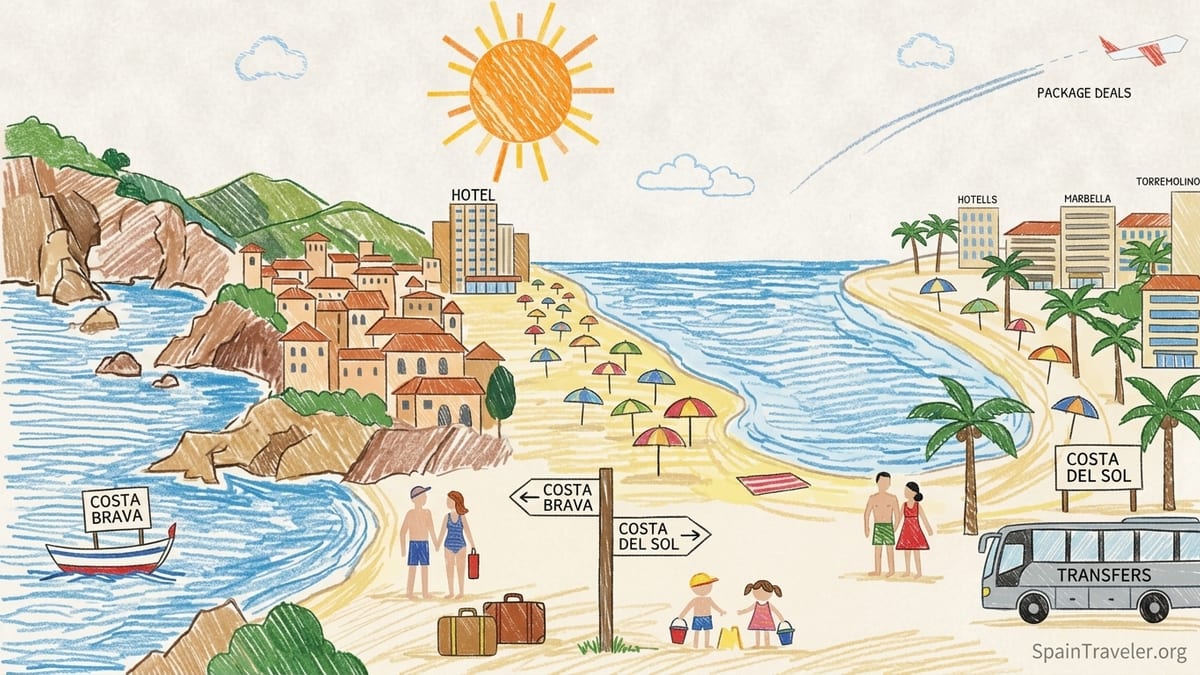
Where the Deals Are on the Spanish Mediterranean Coast
If you are looking specifically at 2026 and early 2027, the most active package markets on Spain’s Mediterranean side are Costa Brava, Costa Blanca and Costa del Sol. British and European operators such as easyJet holidays, Jet2holidays, TUI, Thomas Cook and First Choice are all selling flight plus hotel bundles into these coasts, often with seasonal offers when new dates are released. For example, easyJet holidays lists seven-night Costa Brava packages from around the low to mid-£300s per person in late summer shoulder weeks, including return flights and hotel, with higher prices in school holidays.
Costa Brava and Costa Daurada remain the classic Catalan beach choices. Costa Brava’s Lloret de Mar, Blanes and Santa Susanna have dense stocks of package-friendly three and four star hotels, many offering full board or all inclusive options. Transfers from Girona-Costa Brava Airport to these resorts tend to be in the 30 to 60 minute range, so a bundled coach transfer can be attractive. Costa Daurada, anchored by Salou and Cambrils, draws families who combine the beach with a day at PortAventura World.
Further south, Costa Blanca and the Costa del Sol are established year-round markets. On the Costa Blanca, Benidorm, Albir and Calpe see strong flight plus hotel traffic into Alicante, while Torremolinos, Benalmádena, Fuengirola and Marbella are the key Costa del Sol hubs from Málaga. Jet2holidays, for instance, packages Benidorm with return flights to Alicante, 22 kg checked baggage, hand luggage and coach transfers as standard, allowing travelers to compare only the hotel and board type rather than every separate component.
Costa de Almería is a slightly quieter, more seasonal coast but still well served on a package basis, especially around Roquetas de Mar and Mojácar, often appealing to value-focused couples and off-peak travelers. Here, availability may be thinner than on the bigger coasts, so packages can sell out earlier for school holiday weeks, even though prices may start competitively outside peak dates.
Understanding Flight + Hotel Packages
Flight plus hotel is the baseline package format on the Spanish Med. In its simplest form, you pick dates, departure airport, destination coast and hotel, then the operator combines return flights and accommodation under one booking. With UK and EU-based tour operators, these packages are generally covered by financial protection schemes such as ATOL in the United Kingdom, which protect your money and help with repatriation if the airline or operator fails.
A typical example for 2026 might be a seven-night bed and breakfast package to Costa Blanca: return flights from a regional UK airport to Alicante, a mid-range hotel in Benidorm or Albir, and shared coach transfers to and from the hotel. Prices for basic shoulder-season flight plus hotel deals have been marketed from under £300 per person at the lowest end for two-star or simple three-star properties, with more comfortable three-star plus or four-star options commonly sitting in the £400–£700 range per person depending on school dates and departure airport.
One of the main attractions of flight plus hotel deals on the Spanish coast is that they make decision-making simple. You see a single per-person or per-booking price that already includes flights, luggage allowance and the hotel. Instead of juggling multiple airline sites, different room categories and separate transfer providers, you can compare similar length stays side by side. This can be especially helpful if you are flexible on destination; you might weigh a week in Costa Brava against a week in Costa del Sol by total package price rather than attempting to cost each element manually.
However, these packages are built around contracted room allocations and specific flight blocks. You sometimes pay more for the most popular dates because demand is concentrated into set charter or scheduled flights. Conversely, if you are willing to travel slightly outside peak weeks or midweek rather than weekend, operators can discount flight plus hotel bundles heavily to fill remaining seats and beds, which can make them notably cheaper than booking independently.
All Inclusive vs Half Board vs Self Catering
Meal plan is one of the biggest levers on price when you compare Spanish Mediterranean packages. On Costa Brava, for instance, it is common to see the same three-star hotel in Lloret de Mar offered across different board bases: room only, bed and breakfast, half board, full board and all inclusive. A seven-night all inclusive stay in a four-star hotel has been advertised for late-summer 2026 from just under £300 per person in lower-demand weeks with early-booking discounts, while higher profile beachfront properties and peak August dates sit much higher.
All inclusive typically means buffet breakfast, lunch and dinner, plus a selection of local alcoholic drinks and soft drinks within defined hours. Some Costa Blanca and Costa del Sol hotels add on extras such as daytime snacks, ice creams for children, and evening entertainment. For example, a Benidorm all inclusive family resort might bundle kids’ clubs, pool activities and nightly shows into the package, creating a scenario where your on-the-ground spending can be very low beyond occasional excursions.
Half board (breakfast and dinner) and full board (all three meals but usually not drinks) remain popular on the Spanish Med coasts where resort strips are lined with tapas bars, chiringuitos and international restaurants. In a Costa Daurada or Costa de Almería resort where you want to explore local food, half board can offer a good compromise: breakfast and one main meal included, leaving one meal a day to eat out. Prices often sit between bed and breakfast and all inclusive, and the saving compared with all inclusive might make sense if you know you will be off exploring during the day.
Self catering and room only are especially common in apartment complexes in areas like Salou, Benidorm or Torremolinos, and in many villa packages. Here, your kitchen gives you flexibility and can be economical for longer stays or families who are happy to cook simple meals from local supermarkets. With flight plus apartment packages, the savings versus full board or all inclusive can be significant, but you should factor in the cost of groceries and meals out when comparing headline prices.
Family, Luxury and Villa Packages: What to Expect
Family-focused packages dominate parts of Costa Brava, Costa Daurada, Costa Blanca and the Costa del Sol. Typical features include family rooms or interconnecting rooms, kids’ clubs, splash pools or small water parks, play areas and early buffet sittings. Large international brands and specialist operators often market “family holidays” to the Costa del Sol or Costa Blanca where board bases range from bed and breakfast to all inclusive, and coach transfers and 20–23 kg checked baggage are usually included as standard.
In practice, a family of four flying from northern Europe to Málaga for a week in a three or four star Costa del Sol resort in May or June 2026 might see package prices in the approximate range of £1,800 to £3,000 total depending on hotel, board basis and departure airport. Many parents choose all inclusive or full board in these resorts because it simplifies budgeting with children, even when the headline price is higher than a room only alternative.
Luxury packages sit at the upper end of the market across all coasts, from high-end spa hotels in Costa Brava’s quieter bays to upscale resorts around Marbella or boutique properties on Costa Blanca’s smaller coves. These might include private transfers instead of shared coaches, upgraded room categories with sea views, dine-around or a la carte dinner options and late check-out on request. While the per-night cost is higher, luxury packages can still offer value relative to booking each element of a five-star trip separately, especially once you factor in flexible booking conditions and package protection.
Villa packages remain a niche but growing segment. In practice they combine flights with a pre-selected villa or townhouse, most often on Costa Blanca, Costa Daurada and parts of Costa del Sol’s hinterland. These can work well for multi-generational groups who want private space, a pool and kitchen. A typical villa package might include flights into Alicante or Málaga, car hire instead of coach transfers, and a seven or 14 night villa rental. You still benefit from financial protection, but you need to be comfortable driving and shopping locally, and you will not have on-site buffet restaurants or entertainment that you might get in a hotel.
What Baggage, Transfers and Protection Usually Include
Baggage and transfers are two of the main inclusions that differentiate Mediterranean package holidays from DIY trips. Operators such as Jet2holidays, for example, usually include a cabin bag and up to around 22 kg of checked baggage per person in their standard package price to Spain, alongside airport-to-resort transfers on arrival and departure. This means that when you compare the price with a flight-only fare from a low-cost airline, you must add equivalent baggage and transfer costs to make a fair comparison.
On Costa Brava, shared coach transfers from Girona-Costa Brava Airport to southern resorts like Lloret de Mar or Blanes typically take between 30 and 60 minutes depending on traffic and hotel drop-off order. Similar transfer durations apply from Alicante to much of the central Costa Blanca, and from Málaga to the core Costa del Sol strip. When transfers are bundled into a package, they are usually shared coaches, though higher-priced or luxury packages may include private transfers. Some dynamic online agents give you the option to remove transfers and book your own taxi or car hire instead, which can lower the price if you are comfortable arranging this separately.
Most flight plus hotel packages sold in the UK and many EU markets come with statutory financial protection. ATOL protection in the UK, for instance, applies to most package holidays that include a flight sold by a UK company. It means that if the operator or airline ceases trading, you should receive a refund before travel or be repatriated if you are already abroad. Separate travel insurance is still essential to cover medical issues, cancellations for personal reasons and baggage, but built-in package protection provides a safety net that DIY flight and hotel combinations booked directly may not match unless you take extra steps.
Some operators also offer additional package protection or low-deposit schemes. For example, it is common to see flexible booking policies where you can change dates for a fee, or pay the balance closer to departure, especially on longer-lead 2026 and 2027 holidays. These policies vary, so reading the booking conditions is important, but they can be valuable if you are committing a year or more in advance for peak dates on the Costa del Sol or Costa Blanca.
When a Package Beats DIY Flights and Hotels
Whether a package beats booking flights and accommodation independently on the Spanish Mediterranean depends on timing, flexibility and the type of trip. Packages often deliver better value in peak holiday periods, such as late July and August school vacations, when flights into Girona, Barcelona, Alicante, Almería and Málaga are heavily in demand. Tour operators pre-purchase seats and hotel allocations, so even though package prices rise in peak dates, they can still undercut the combined cost of buying the same flights and a comparable hotel at last-minute retail rates.
For family holidays, the advantages of package deals often go beyond headline price. Bundled checked baggage, transfers, board basis and entertainment can simplify planning and reduce stress in-resort. Instead of worrying about sourcing airport taxis after a late flight into Málaga or finding family rooms in an already busy Benidorm hotel, you arrive knowing these components are coordinated. Many families report that peace of mind and financial protection are the main reasons they favor packages over assembling elements themselves, particularly when traveling with younger children.
There are scenarios where DIY can be cheaper or more flexible. For example, if you are traveling outside of peak periods, have very specific hotel preferences, or spot an exceptional sale airfare into Barcelona or Málaga, building your own trip can work in your favor. Travelers who want to split their time between city and coast, such as a few nights in Barcelona followed by independent stays along the Costa Brava, sometimes find that online hotel deals and rail tickets booked directly are better suited to their itinerary than a standard one-resort package.
In general, the more straightforward your plans are, the more likely a package will be competitive. A simple one-week beach holiday to Costa Blanca, Costa del Sol, Costa Brava, Costa Daurada or Costa de Almería, especially from a regional airport and during busy dates, is exactly the sort of trip operators are optimizing their 2026 and 2027 inventories around. Complex, multi-stop itineraries or ultra-budget, bare-bones trips booked at very short notice may still favor the DIY approach if you are comfortable handling all the logistics yourself.
How to Compare Packages Across the Five Coasts
Comparing packages across Costa Brava, Costa Daurada, Costa Blanca, Costa de Almería and Costa del Sol starts with clarifying your priorities. Costa Brava offers dramatic coves, relatively short transfers from Girona or Barcelona and a mix of quiet resorts and lively nightlife hubs such as Lloret de Mar. Costa Daurada, with Salou and La Pineda, adds theme park access and flat, family-friendly beaches. Costa Blanca leans heavily on long sandy stretches and high-rise convenience in Benidorm, along with more low-key towns. Costa de Almería tends to be quieter and can feel more traditional in segments, while the Costa del Sol balances busy strips with historic cities like Málaga and resort towns from Torremolinos to Estepona.
From a package perspective, you will usually find the broadest hotel choice and most frequent flights into Costa Brava, Costa Blanca and Costa del Sol. That means more room to shop around for specific board types, children’s facilities, and upgrades such as sea views. Costa Daurada and Costa de Almería have slightly fewer charter-style flights and large hotels, but they are still well covered, particularly with family and value-focused packages in high season. Checking several operators for the same dates can reveal notable differences in price depending on their individual contracts with particular hotels.
When evaluating offers, pay close attention to what each package includes. One Costa Blanca deal might headline a lower per-person price but charge extra for checked baggage and transfers, while another looks higher initially but quietly folds 20–23 kg baggage and shared transfers into the total. Similarly, some Costa del Sol all inclusive resorts limit certain drinks or entertainment to specific hours or venues, so reading inclusions and exclusions is essential. Two packages that look similar on paper can deliver very different experiences once you arrive.
It can also be helpful to visualize the opportunity cost of time. A pre-packaged week in Roquetas de Mar on the Costa de Almería, for instance, might be slightly more expensive than separately buying a sale airfare, a budget hotel and local bus transfers. But if putting those pieces together requires hours of research, multiple bookings and a higher risk that something does not align, many travelers feel the incremental cost of the package is worthwhile, particularly for a once-a-year main holiday.
The Takeaway
The Spanish Mediterranean coasts are well-positioned for the 2026/27 seasons, with major operators devoting dedicated inventory and marketing to Costa Brava, Costa Blanca and the Costa del Sol and sustained interest in Costa Daurada and Costa de Almería. For travelers, that translates into a wide choice of flight plus hotel, all inclusive, family, luxury and villa packages that can match most budgets and travel styles.
Choosing the right option comes down to understanding what is included in each package and how it compares with booking flights and accommodation independently. In many common scenarios, such as family holidays in peak season or straightforward one-week beach breaks, packages that bundle flights, baggage, hotel, transfers, meals and financial protection offer a compelling combination of value and convenience. In more complex or highly flexible trips, especially off-peak, a well-researched DIY approach can still be attractive.
Whichever coast you choose, taking the time to compare real-world examples, read the small print on baggage, transfers, meal plans and package protection, and match the product to the way you like to travel will help you get the most out of Spain’s Mediterranean shoreline in 2026 and beyond.
FAQ
Q1. What is typically included in a Spanish Mediterranean flight plus hotel package? Most packages include return flights, a set baggage allowance, accommodation for the number of nights chosen and shared airport transfers, with optional extras such as checked baggage upgrades, private transfers or specific board bases like all inclusive or half board depending on the operator.
Q2. When does a package holiday usually work out cheaper than booking independently? Packages are often better value for simple seven or fourteen night beach breaks, particularly in school holidays and other peak periods when contracted flights and hotel allocations can undercut buying last-minute flights and rooms separately.
Q3. Are all inclusive packages on the Spanish Mediterranean coast worth the extra cost? All inclusive can be good value if you plan to spend most of your time in the resort, have children who snack frequently, or want to keep on-the-ground spending predictable, but travelers who expect to eat out or explore daily may prefer half board or bed and breakfast instead.
Q4. How much checked baggage is normally included in a package? Many mainstream operators include at least one piece of checked baggage per person, often around 20 to 23 kilograms, plus a cabin bag, but the exact allowance depends on the airline and fare type bundled into the package.
Q5. Do all packages include airport transfers in Spain? Not all do, but many traditional tour operators automatically include shared coach transfers between the airport and your coastal resort, while some dynamic online agents treat transfers as an optional extra that you can add or remove at the time of booking.
Q6. Which coast is best for a first-time family package holiday? Costa Blanca and Costa del Sol are particularly popular for first-time family packages because they offer frequent flights, a wide range of family-oriented hotels with pools and kids’ clubs, and relatively straightforward transfers from Alicante and Málaga airports.
Q7. Are villa packages financially protected like regular package holidays? In many cases, yes, as long as the villa, flights and any included car hire or transfers are sold as a single package by a licensed operator, they are typically covered by the same financial protection frameworks as hotel-based packages.
Q8. Can I mix coasts or cities within one package booking? Some operators offer multi-centre packages that combine, for example, a few nights in Barcelona with a week on the Costa Brava or Costa Daurada, but more complex itineraries may require either a specialist tailor-made package company or a DIY approach.
Q9. Is travel insurance still necessary if my package is financially protected? Yes, financial protection covers operator failure and certain structural issues with the holiday, but you still need separate travel insurance for medical cover, personal liability, theft, and cancellations for personal reasons such as illness.
Q10. How far in advance should I book a 2026 or 2027 Spanish Mediterranean package? For peak summer or popular school holiday weeks, many travelers aim to book at least six to twelve months ahead to secure preferred coasts, resorts and room types, while shoulder-season trips often offer more flexibility and occasional late deals closer to departure.