


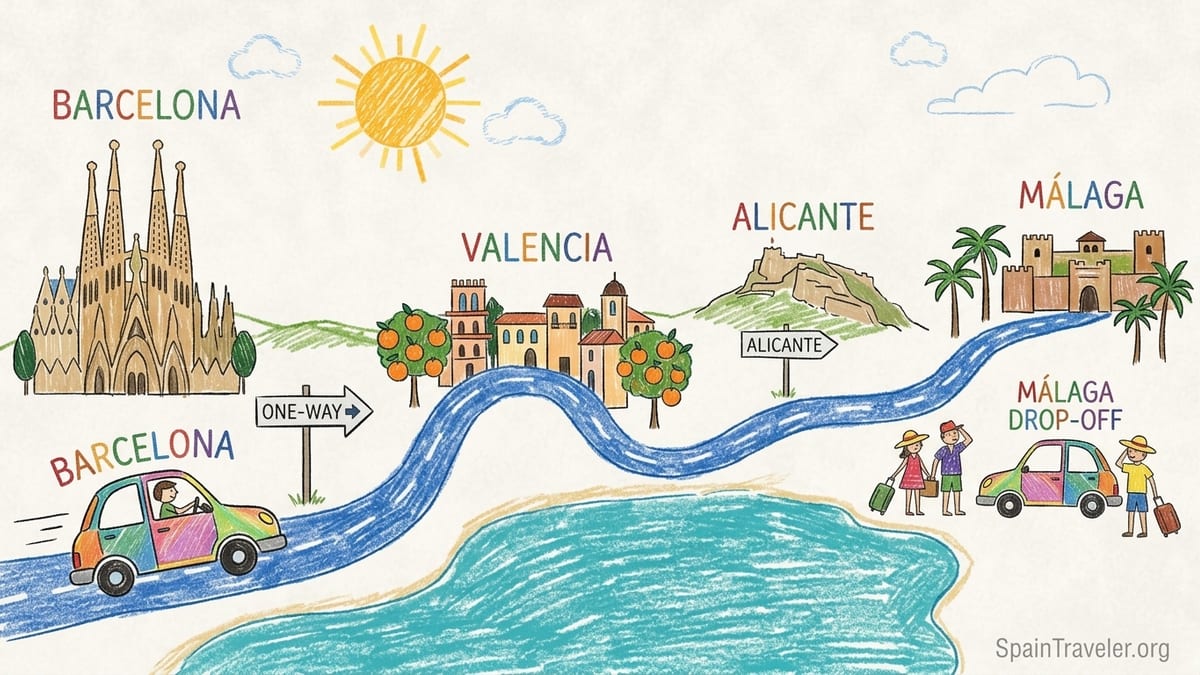
Driving the Spanish Mediterranean coast from Barcelona through Valencia and Alicante to Málaga is one of Europe’s great road trips. One-way car rentals now make it realistic to trace the shoreline without looping back, but the details can be confusing: where to start, which airport is best, how one-way fees work, and when you no longer need a car in busy cities. This guide distils current on-the-ground information so you can plan a smooth, good-value coastal drive.
How One-Way Coastal Rentals Work in Practice
The Spanish Mediterranean corridor between Barcelona, Valencia, Castellón, Alicante and Málaga is now well served by rental companies that explicitly support one-way trips. Major brands such as Enterprise, Hertz, Europcar, Sixt, Goldcar, Centauro and regional operator Malco let you collect in one hub and return in another, provided both offices are on their network along the coast. For example, Malco actively markets one-way rentals between Barcelona, Valencia, Castellón, Alicante and Málaga, while Centauro’s terms list one-way routes linking Alicante Airport, Valencia Airport, Málaga Airport and Barcelona stations. In day-to-day terms, you can start in Barcelona and drop in Málaga, or do a shorter Alicante to Málaga run, without needing to double back.
Prices vary by season and supplier, but recent tariff examples give a realistic sense of cost. A compact automatic collected in Barcelona and dropped in Valencia with a mainstream brand in shoulder season often runs around 35 to 55 euros per day before extras, plus a corridor one-way fee in the region of 40 to 80 euros. Routes between Alicante and Málaga are well established and typically see one-way surcharges of roughly 50 to 80 euros with full-service companies. Low-cost outfits sometimes advertise very cheap daily rates then offset them with high one-way and insurance fees, so you need to compare the full basket of costs rather than just the headline daily price.
Within Spain, one-way rentals are usually allowed as long as you keep the car inside the country and between standard offices. Cross-border drops into Portugal or France, or between mainland and islands, either are not permitted or carry steep surcharges that make them poor value for a coastal road trip. The sweet spot for most travellers is a one-way itinerary of 3 to 10 days along the Mediterranean, which balances the one-way fee against the freedom to stop in smaller towns like Altea, Jávea, Denia, Nerja or Salobreña along the way.
When you shop around, use the rental company’s own search tools to test different pick-up and drop-off combinations on your exact dates. Changing your return from airport to city office, shifting one day forward or back, or dropping the car in Valencia instead of Barcelona can meaningfully change the one-way fee. The Spanish market is genuinely dynamic, so it is better to confirm by doing a live quote than to rely on broad averages.
Choosing Your Starting Hub: Barcelona, Valencia, Alicante or Málaga
Where you start along the coast shapes your trip more than many visitors expect. Barcelona El Prat Airport is Spain’s second-busiest airport and the largest on the Mediterranean, and it anchors a dense rental market. If you want to combine a major city break with a coastal drive south, Barcelona is a logical starting point: you might spend three days car-free in the city, then pick up a car to explore the Costa Daurada, Ebro Delta, Peñíscola, Valencia and beyond. One-way rentals from Barcelona down to Valencia, Alicante or all the way to Málaga are widely offered and can be relatively affordable if booked in advance for at least a few days.
Valencia offers a more relaxed urban experience and easier navigation for first-time drivers in Spain. The ring road is usually less hectic than Barcelona’s, and the city is compact enough that you can cross from centre to beach in about ten minutes by car. Rental offices are split between Valencia Airport and several city locations. Travellers doing an inland high-speed train from Madrid often pick up the car at a central office near Estación del Norte or Joaquín Sorolla station, then drive south via the Albufera wetlands, Cullera and Gandia. For northbound itineraries, Valencia also works well as a drop-off point, letting you continue by train to Barcelona.
Alicante is the natural entry point for the Costa Blanca. Alicante-Elche Airport handles more passengers than Valencia Airport and hosts a large lineup of rental brands, from big names to ultra-budget firms. If your focus is on beach towns like Altea, Calpe, Benidorm, Jávea and Denia, starting in Alicante and driving either north to Valencia or south towards Murcia and Almería keeps daily distances short. Alicante is also an efficient middle start for a one-way coastal drive in either direction, such as Alicante to Málaga along the A-7 or AP-7, with overnight stops in Águilas, Mojácar or Almuñécar.
Málaga is the hub for the Costa del Sol and often the best starting point if you plan more time in Andalusia than in Catalonia or Valencia. Málaga-Costa del Sol Airport has a very high density of rental suppliers and strong competition on rates. From here, you can drive east along the coast via Nerja and Almuñécar towards Almería and eventually Alicante, or you can focus west on Marbella, Estepona and Cádiz before dropping the car elsewhere in Andalusia. For trips that only touch the eastern Costa del Sol and Costa Tropical, Málaga to Alicante is a popular one-way leg that avoids backtracking while keeping daily stages manageable.
Airport vs City-Centre Pick-Up Along the Coast
Airport rentals along the Spanish Mediterranean are convenient, but they often cost more than city-centre equivalents once you factor in surcharges and queues. Price lists from major brands show supplements on airport rentals in Barcelona, Valencia, Alicante and Málaga, typically in the range of 10 to 20 percent over downtown rates for the same car on the same dates. In practice, that might translate into paying 45 euros a day for a compact automatic from an airport desk compared with 38 euros from the same brand’s city office a few kilometres away. The airport surcharge buys you immediate pickup after landing but also places you in the busiest, most pressured rental environment.
City-centre offices are usually calmer and can be better aligned with the point at which a car is genuinely useful. In Valencia, for instance, local guidance often suggests collecting from an in-town branch if you are spending several days in the centre first. A one-week rental that starts two days into your stay from a central office can be 25 to 50 euros cheaper overall than taking the same car from the airport for the full period, and you avoid paying for days when the car would sit idle in a garage. In Barcelona, many visitors choose Sants train station or offices just outside the core low-emission zone as a compromise between convenience and easier driving.
Alicante illustrates the trade-off clearly. Airport pick-up is almost always the fastest route to the Costa Blanca resorts because the airport sits directly on the main A-70 ring road, and shuttle buses from the terminal deliver you to off-airport rental compounds in minutes. Yet an article comparing Alicante Airport and city-centre pickup noted that in-town rentals tend to be slightly cheaper, and you can avoid crowded airport halls by taking the airport bus into the city and collecting your car later. The decision comes down to how soon you intend to leave the city and whether the extra 10 to 30 euros in airport surcharges matters more than the saved time.
In Málaga, the calculus is similar but the airport’s dominance is stronger. Most tourists land at Málaga-Costa del Sol and drive straight out along the A-7 coastal highway to Nerja, Marbella or Estepona. City-centre branches exist and sometimes beat airport quotes by a modest margin, but that saving has to be balanced against the cost and time of getting into the city first on the commuter train or bus. For travellers whose itinerary begins with several car-free nights in Málaga’s old town, it can make sense to arrive by public transport, then collect a car from a central branch on the day you leave for the coast or the interior.
Understanding One-Way Fees, Automatics and Insurance Excess
One-way fees within mainland Spain are not standardised, but recent guides make the current ranges fairly clear. For popular intercity routes such as Barcelona to Valencia or Valencia to Alicante, full-service companies like Enterprise, Hertz and Sixt often charge a fixed corridor drop fee somewhere between 40 and 90 euros, depending on distance and season. Example tables show Valencia to Alicante one-way surcharges as low as about 40 euros on certain tariffs, while longer routes like Málaga to Alicante appear in the 50 to 80 euro band with mainstream brands. Budget-focused firms may show higher, more variable one-way charges, sometimes exceeding 150 euros, particularly on less common route combinations or in peak summer.
Transmission also affects pricing. Automatics remain less common in Spain than in North America or northern Europe, though availability has improved. On live quotes for Barcelona, Valencia, Alicante and Málaga, a compact or small SUV with automatic transmission tends to be about 20 to 40 percent more expensive than a manual equivalent on the same dates. For example, a manual compact in October might price at around 30 euros per day, while the same category in automatic shows around 40 to 45 euros per day. In high summer, the difference can widen, and automatics sell out earlier. If you must have an automatic for a June to August trip, it is sensible to book several months ahead and avoid very last-minute searches.
The bigger financial variable is insurance excess. Standard collision and theft cover from Spanish rental brands usually carries an excess in the range of roughly 900 to 1,500 euros, which is the amount you are liable for if the car is damaged or stolen. That excess is often matched by a deposit hold of similar size on your credit card at pick-up. Many companies then offer a “super” or “premium” cover that reduces the excess to a small amount or zero in exchange for an extra daily fee, frequently 15 to 25 euros per day on the Mediterranean corridor. Travellers who accept full cover at the desk often see their total rental cost double compared with the base rate, but they gain peace of mind and avoid a large hold on their card.
For cost control, some experienced visitors book the basic cover from the rental company and purchase separate excess insurance from a standalone travel insurer or credit card benefit. That can reduce the daily charge, but it means you may need to pay the rental company for any damage up front and reclaim from your third-party insurer later, which not everyone is comfortable with. Whichever route you pick, reading the contract matters: pay attention to what is excluded from the super cover, such as underbody damage, tyre damage or misfuelling, and check whether roadside assistance is included or sold as an extra. In Spain, many frustrations arise from misunderstandings at the counter rather than from the driving itself.
Parking, City Driving and When a Car Becomes a Burden
Along this stretch of coast, the best experiences tend to come from combining car days with car-free days. In Barcelona and Valencia in particular, you seldom need or want a rental car while staying in the central districts. Both cities have extensive metro, tram and bus networks, and both have low-emission or restricted driving zones that complicate access for visitors. Street parking in neighbourhoods close to main sights is heavily regulated, and secure garages can easily cost 20 to 30 euros per night. For a three-night Barcelona stay, it often makes financial sense to delay picking up the car until the morning you leave the city, even if it means returning to the airport or a station office.
Valencia is more forgiving behind the wheel but still not an ideal place to pay to park an unused car. Many visitors stay near the old town or the City of Arts and Sciences, both of which are easy to reach by taxi or tram from the station or airport. If your plan includes day trips to the Albufera wetlands, Sagunto, Xàtiva or the Costa de Azahar beaches, you could time your rental to cover only those days and keep the car in secure parking when not in use. Overnight parking near the beach districts of Malvarrosa and Cabanyal is more feasible than in the medieval core, but planning ahead for a hotel with a garage or nearby parking saves stress.
Alicante and Málaga present a similar pattern. Their historic centres are walkable and increasingly prioritise pedestrians and public transport. In Alicante, the tram network and buses link the city centre with San Juan Beach and nearby towns along the Costa Blanca, so a car becomes useful only when heading out to smaller coves and inland villages. In Málaga, you can comfortably explore the cathedral quarter, Picasso Museum area and waterfront on foot while using the commuter train and buses to reach the airport or nearby beaches. For many travellers, collecting the car only on the day they leave the city centre, then driving along the coast to Nerja, Marbella, Frigiliana or Ronda, gives the best balance of convenience and cost.
Outside the big four hubs, parking is usually simpler. Towns like Peñíscola, Altea, Jávea, Nerja and Salobreña have paid zones close to the waterfront but also free parking further back. Hotels and apartments often provide or can recommend nearby car parks where you can leave the car while you wander on foot. In these smaller places, the car returns to being the asset you imagined when you booked it: a way to hop between coves, hill villages and viewpoints without worrying about timetables. The trick is to avoid carrying the cost and hassle of a car on days when it adds little beyond the anxiety of finding a space.
Practical Scenarios: Example Coastal Itineraries
To understand how all these variables play out, it helps to look at concrete itineraries. Imagine a 9-day trip starting in Barcelona and ending in Alicante. One common pattern is to spend three nights car-free in Barcelona, using the metro and buses in the central area, then pick up a compact automatic from a city office on day four. You might then drive south to Tarragona and the Costa Daurada for a night, continue to the Ebro Delta or Peñíscola, overnight again, and then head on to Valencia for a final night before dropping the car there. A high-speed train connects Valencia to Alicante in about two hours, allowing you to enjoy the Costa Blanca later without paying a one-way car fee for the last leg if you do not need the flexibility.
Another scenario focuses on a shorter one-way rental. Suppose you fly into Valencia for four nights, stay car-free in the city for two days, and then collect a car from a central branch on day three. You could drive down the coast to Gandia and Denia, spend a night near Jávea or Altea, and then return the car in Alicante Airport before flying home. On recent tariffs, the Valencia to Alicante one-way surcharge is modest compared with the cost of fuel and accommodation, especially if you share the car between two or more people. Because you avoid driving in Barcelona altogether, this itinerary suits travellers nervous about big-city traffic but keen to see several sections of the coast.
For those with more time, a 12-day loop from Málaga to Barcelona or the reverse can be appealing. Flying into Málaga, you might spend two nights car-free in the old town, then collect a car from a central or airport office and drive east to Nerja for one or two nights, continue to Almuñécar or Motril, then on to Almería, the Cabo de Gata natural park, and up through Águilas and Mojácar to the Costa Blanca. After stops around Alicante and Altea, you could either drop the car in Alicante and continue to Barcelona by train, or push on via Valencia and Castellón, dropping the car in Barcelona at the end with a one-way fee. In this pattern, the car earns its keep almost every day because you are constantly moving between towns.
Travellers on tighter budgets sometimes flip the model and use trains for the big hops while reserving a car only for a focused few days. For instance, you could take a fast train from Barcelona to Valencia or Alicante, then book a three-day car rental from a city office specifically to explore the Costa Blanca villages and inland sierras. That way you avoid the higher one-way fees on long distances and pay for the car only when it provides clear added value. The Mediterranean coast is well served by rail and intercity buses between major nodes, so the decision to rent a car is about where you want to detour and how intensively you plan to move around.
The Takeaway
Planning a one-way road trip along Spain’s Mediterranean coast is mostly about matching the car to the parts of the journey where it genuinely improves your experience. On this corridor, one-way rentals between Barcelona, Valencia, Castellón, Alicante and Málaga are common and workable, but the specific costs vary by route, season and supplier. Airport pickups are convenient if you are leaving a city straight away, while city-centre offices often suit travellers who want several car-free days first. Automatics command a premium and book out early in summer, and insurance excesses can dwarf the base rental cost if you upgrade to full cover at the counter without planning.
If you treat Barcelona, Valencia, Alicante and Málaga as hubs connected by fast trains and use the car for the in-between places that public transport skips, you can keep costs under control while still enjoying the freedom of a coastal road trip. Think in terms of segments rather than a single long rental: a car for the Costa Daurada and Ebro Delta, a break on the train, another car for the Costa Blanca villages, then perhaps a final stretch along the Costa del Sol. With a bit of forward planning on pick-up locations, one-way fees and parking, your Spanish Mediterranean drive can feel like a relaxed sequence of scenic days rather than a logistical puzzle.
FAQ
Q1. Is it worth paying a one-way fee for a Barcelona to Málaga coastal road trip?
For most travellers the one-way fee is worthwhile if you plan to stop in several coastal towns and do not want to spend a full day driving back. The fee for Barcelona to Málaga often falls in a band of roughly 70 to 120 euros with mainstream brands, which becomes easier to justify on an 8 to 12 day itinerary shared by two or more people.
Q2. Are automatic cars easy to find on the Spanish Mediterranean coast?
Automatics are widely available in Barcelona, Valencia, Alicante and Málaga but still form a minority of fleets. They usually cost 20 to 40 percent more than manual cars and sell out faster in summer, so booking well ahead is recommended if you are not comfortable driving a manual.
Q3. When should I avoid having a rental car in Barcelona or Valencia?
In both cities, a car is usually unnecessary if you are staying in the central districts for sightseeing. Public transport is extensive, central parking is expensive, and low-emission zones add complexity. Many visitors delay car pick-up until the day they leave town to start their coastal drive.
Q4. Is it cheaper to pick up my car at the airport or in the city centre?
Airport pick-up is more convenient but often comes with a surcharge of around 10 to 20 percent over downtown rates. In-city branches in Valencia, Alicante and Barcelona can be cheaper for longer rentals, especially if you only need the car after spending a couple of car-free days in the city.
Q5. How big are typical insurance excesses on rentals in Spain?
Standard collision and theft cover commonly carries an excess of roughly 900 to 1,500 euros, backed by a similar-sized deposit hold on your card. You can reduce or eliminate that excess by paying extra for super cover with the rental company or by using third-party excess insurance, though the latter may require you to claim back later.
Q6. Can I drive my Spanish rental car into France or Portugal on a one-way trip?
Driving across borders is often allowed with prior permission, but returning the car in a different country usually triggers very high drop-off fees or is not permitted at all. For a Spanish Mediterranean coastal trip it is generally more practical and economical to keep the rental and the drop-off inside Spain.
Q7. Do I need a car for the Costa Blanca if I stay in Alicante city?
You can enjoy Alicante city, its main beach and nearby tram-linked resorts without a car. A rental becomes most useful if you want to explore smaller coves, hill villages like Guadalest or spread-out areas where public transport is infrequent.
Q8. How much should I budget for parking in big coastal cities?
In central Barcelona, Valencia, Alicante and Málaga, secure garages typically cost around 20 to 30 euros per night, sometimes more near key attractions or in peak season. Hotels with included or discounted parking can noticeably reduce this cost, so it is worth factoring parking into your accommodation choice.
Q9. Are young driver surcharges high in Spain?
Drivers under about 25 often pay a young driver fee that can range from roughly 15 to 30 euros per day, sometimes capped for longer rentals. In addition, younger drivers may face higher excesses or deposits. Checking the age policy of your chosen supplier before booking is important if anyone in your party is under 25.
Q10. What is the best season to drive the Mediterranean coast by rental car?
Late spring and early autumn are usually ideal. Traffic is lighter than in July and August, parking is easier in popular towns, and rental prices tend to be lower. Winter offers quieter roads and good value but shorter days and more variable weather, especially on the more exposed stretches between Almería and Alicante.