


Spain’s Mediterranean coast is not one uniform strip of sand. From the rocky coves of the Costa Brava to the volcanic cliffs of Cabo de Gata and the urban buzz of Valencia and Málaga, each stretch of shoreline feels like a different country. The challenge is not finding a good beach, but deciding which kind of coast suits the trip you have in mind: quiet fishing town, resort skyline, historic port city or protected natural park.
Costa Brava Classics: Cadaqués, Begur and Tossa de Mar
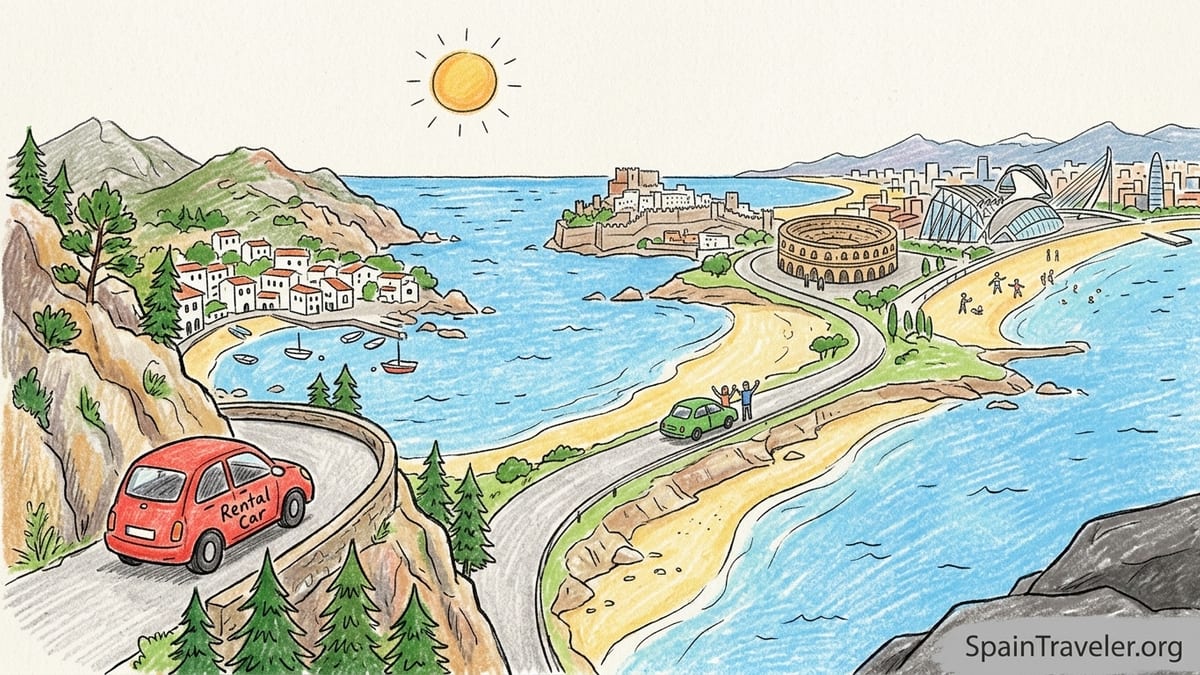
The Costa Brava, in northern Catalonia, is the most rugged and romantic section of Spain’s Mediterranean coast. Towns like Cadaqués, Begur and Tossa de Mar combine traditional whitewashed streets with rocky headlands, pine forests and small coves instead of long resort beaches. Driving north from Barcelona, you feel the landscape tighten into cliffs and twists, which is why many travelers choose a compact rental car rather than a larger SUV for these roads.
Cadaqués, set near the Cap de Creus headland, suits slow travelers who like art and atmosphere more than big beaches. The town was a favorite of Salvador Dalí, and today many visitors combine a night or two here with a visit to his house museum in nearby Portlligat. Expect steep alleys, pebble beaches and waterfront restaurants serving grilled sardines and suquet de peix, a Catalan fish stew. Summer room rates in a small seafront guesthouse often start around mid-range hotel prices in Barcelona, so book early if you are visiting in July or August.
Begur, further south, works well for travelers who want stylish bases with access to several different coves. The medieval hilltop town sits slightly inland, while its beaches, such as Sa Tuna, Aiguablava and Sa Riera, lie in protected inlets a short drive away. Many visitors base themselves in a restored stone townhouse or small boutique hotel in Begur and then spend the day walking coastal paths or driving down to different calas, a good option if you have five to seven days on the Costa Brava and prefer variety over staying in just one bay.
Tossa de Mar offers a more conventional beach-town feel with an outstanding historic twist. Its walled old town, Vila Vella, rises above a crescent of sand, giving you both a classic seaside promenade and a genuine medieval landmark in one place. Spain’s official Mediterranean road-trip guide even suggests taking the scenic GI-682 from Tossa towards Sant Feliu de Guíxols, stopping at viewpoints along the cliffs for wide views of the coast. In practice, that means building an extra hour or two into your driving day so you can park at roadside miradores instead of rushing between hotel check-out times.
Roman Coastlines and Family Friendly Shores: Tarragona and Peñíscola
South of the Costa Brava, the coastline flattens out around Tarragona and Peñíscola, making this section easier for nervous drivers and families towing luggage and beach toys. Tarragona is a medium-sized city with a walkable historic center, Roman amphitheater and seaside promenade. It appeals to travelers who like to mix culture and beach time in equal measure: you can walk through Roman ruins in the morning and be on a city beach like Platja del Miracle in the afternoon, then finish the day with a seafood rice dish in the marina district.
Accommodation in Tarragona ranges from simple guesthouses near the station to modern chain hotels on the outskirts. Because the city has a working port and a large local population, prices stay more stable year-round than in small resort villages. That makes Tarragona a practical base if you are traveling outside high summer or if you are combining the coast with budget-conscious rail travel between Barcelona and Valencia.
Peñíscola, further south on the Castellón coast, is built around a striking headland crowned by a Templar castle that appears in many tourism campaigns. The old town sits on a rocky outcrop while long, flat beaches stretch north and south, backed by modern apartment blocks and mid-range hotels. This split personality makes Peñíscola suitable for mixed groups: one person can spend hours in the castle and old streets, while others head for sun loungers and shallow water. Families often appreciate the shallow gradient and wide sands for young children, as well as the straightforward parking and stroller-friendly promenade.
A practical way to use this region on a road trip is to treat Tarragona as an overnight stop for culture and restaurants, then continue to Peñíscola for one or two beach-heavy days. Distances are manageable, and main roads are simpler here than in the Costa Brava, so you can plan slightly longer driving days without feeling exhausted.
Urban Mediterranean: Valencia as a Cultural and Foodie Hub
Valencia is the largest city on this itinerary and the right choice if you want a proper urban experience combined with easy access to the sea. The historic center has Gothic and Baroque landmarks, while the City of Arts and Sciences complex showcases daring contemporary architecture. Unlike resort towns that quieten outside summer, Valencia feels lively year-round thanks to its universities, port and residents. That means more restaurant choice and nightlife even in shoulder seasons like April, May, October and November.
For beach time, most visitors head to Playa de la Malvarrosa or nearby Patacona, broad city beaches with long promenades, bike rentals and casual chiringuitos for drinks and tapas. The sand here is wider and flatter than in the Costa Brava coves, so it is better for ball games, jogging and families with pushchairs. The trade-off is atmosphere: you get an urban skyline and container ships on the horizon instead of remote coves, but public transport from the center to the sea is straightforward and you can manage easily without a car.
Valencia also makes sense for travelers focused on food. This is the birthplace of paella in its classic form, originally a rice dish cooked with rabbit, chicken and snails. Today, many seafront restaurants specialize in seafood rice dishes, so it is worth researching a couple of well-reviewed arrocerías and reserving for lunch, when locals typically eat their main rice meal. Prices vary by location, but a quality paella for two with a shared starter and a bottle of local wine can cost similar to a mid-range meal out in major European cities.
As a road-trip hub, Valencia connects easily with both the Costa Blanca to the south and the Roman and castle towns to the north. Some travelers choose to leave the car in a secure underground car park for two or three nights and explore the city on foot and by tram, then pick up the coastal drive again once they are ready for smaller places.
Costa Blanca Variety: Dénia, Jávea, Altea, Benidorm, Villajoyosa and Alicante
South of Valencia, the Costa Blanca offers one of the most diverse stretches of Spain’s Mediterranean shore. Spain’s official east coast road-trip route highlights Dénia, Jávea, Calpe, Altea, Benidorm, Villajoyosa and Alicante as logical stops because you can experience very different atmospheres within relatively short driving distances. The inland mountains come close to the sea here, creating headlands, cliffs and sheltered bays that contrast with the long sand of the main resort strips.
Dénia works well as a first stop coming from Valencia. It has a working port with ferries to the Balearic Islands, an old town and a castle on a hill, plus several kilometers of beaches. North of town, long sandy stretches appeal to families and kite-surfers, while to the south you find rockier coves at the base of the Montgó massif. Nearby Jávea, split between a historic inland quarter and a seaside strip, attracts many Northern European visitors and offers a mix of pebble and sand beaches, coastal walking paths and a busy bar and restaurant scene in high season.
Altea and Calpe are good options if you like strong visual contrasts. Altea’s whitewashed old town sits on a hill above a pebble shoreline, with blue-domed churches and narrow streets that photographers love. Calpe is dominated by the Peñón de Ifach, a huge limestone rock rising out of the sea that you can hike for wide views when conditions permit. Both towns offer a combination of holiday apartments and small hotels, so they are suitable for travelers who prefer self-catering and longer stays.
Benidorm and Villajoyosa demonstrate two very different approaches to resort life. Benidorm is one of Spain’s most famous resort cities, with high-rise hotels, nightlife aimed at international visitors and long sandy beaches. It suits travelers who want all services in one place, plenty of entertainment and do not mind crowds or neon signs. Villajoyosa, just down the coast, feels more traditional, with a small old quarter of brightly painted fishermen’s houses and a quieter seafront. Many road trippers stop here for a few hours or a night if they want a softer contrast to Benidorm’s energy while still enjoying beach time and seafood dinners.
Alicante anchors the southern end of this section as a medium-sized city with a castle, museums and a broad urban beach. Spain’s road-trip guide specifically lists it as a key stop because you can climb up to Santa Bárbara Castle for views, visit the archaeological museum to understand the region’s Iberian and Roman heritage, then head down to Playa del Postiguet or the longer San Juan beach for a late afternoon swim. For visitors flying in or out, Alicante’s airport is a practical start or end point for a coastal road trip, with car rental desks and frequent connections to other European hubs.
History-Rich Harbours: Cartagena and the Murcian Coast
Continuing south from Alicante, the province of Murcia and its main coastal city Cartagena offer another shift in tone. Cartagena is smaller than Valencia or Alicante but has an important naval and Roman history. The city center wraps around a natural harbour, and visitors can tour a Roman theatre, civil war shelters carved into the rock and a hilltop castle with views over defensive batteries and the port. It feels more low-key and local than major resort cities, which appeals to travelers interested in history and Spanish daily life rather than all-inclusive resorts.
The surrounding Murcian coast is a patchwork of small towns, agricultural plains and stretches of protected shoreline. Some travelers visit the Mar Menor, an inland lagoon, but many recent visitors prefer the open Mediterranean side for clearer water and a more natural feel. If you are driving, you can use Cartagena as a one- or two-night base, then explore nearby coves and viewpoints by car during the day before returning to the city’s restaurants and accommodation at night.
Prices in Cartagena for meals and accommodation are often slightly lower than in the Costa Blanca’s most famous resorts, especially outside Spanish school holidays. That makes it a useful stop if you are trying to keep an extended road trip on a reasonable budget without giving up museum visits, waterfront walks and good seafood. Parking is easier here than in some older coastal towns; look for underground car parks close to the historic center so you can leave the car for 24 hours and move around on foot.
This section of the coast is less internationally known than the Costa Brava or Costa del Sol, so expect fewer English-language menus and a more Spanish atmosphere. For many travelers, that is a positive: an evening around Cartagena’s main pedestrian streets with locals out for an evening paseo can feel like a welcome break from more tourist-saturated resorts.
Wild Shores and White Villages: Cabo de Gata Natural Park
South of Cartagena, the coastline becomes increasingly arid as you approach Cabo de Gata-Níjar Natural Park in the province of Almería. This protected area is often described by Spanish and international outlets as one of Europe’s last relatively undeveloped Mediterranean coasts, with volcanic cliffs, small fishing villages and dirt tracks leading to remote coves. Because it is a natural park, large-scale hotel development has been limited and accommodation is concentrated in small villages such as San José, Las Negras and Agua Amarga.
Each village has a distinct character. San José is the largest and most established base, with more services, cafés and a busy summer atmosphere. From here, visitors can reach well-known beaches like Playa de los Genoveses and Playa de Mónsul along signposted tracks, sometimes with seasonal controls on vehicle access to protect dunes and limit overcrowding. Las Negras, smaller and more bohemian, appeals to walkers and snorkellers; a popular coastal path connects it with the remote Cala de San Pedro, where you need to hike in or arrive by boat. Agua Amarga, near the northern end of the park, feels more refined, with a compact sandy town beach and a handful of boutique-style accommodations and restaurants.
Cabo de Gata is ideal for travelers who prioritize scenery and hiking over nightlife. Expect black lava headlands, cactus-dotted hillsides and clear water in sheltered coves. Many of the best beaches, such as La Playa de los Muertos near Carboneras or hidden coves between Agua Amarga and Las Negras, require either a walk down from clifftop car parks or a section along a dirt track. That means packing proper footwear, plenty of water and sun protection, especially in June, July and August when daytime temperatures often climb well above comfortable hiking levels by midday.
Accommodation here tends to be simpler than in the Costa Blanca or Costa del Sol: small guesthouses, apartments and rural properties rather than high-rise hotels. Nightly rates can be similar to more developed areas in peak season because supply is limited, but outside school holidays you may find better value and quieter beaches. For a balanced road trip, many travelers spend three or four nights in Cabo de Gata between urban stops like Valencia or Málaga, giving themselves time to adjust to the slower rhythm and unlit rural roads at night.
Eastern Costa del Sol: Nerja and the Cliffs of Málaga Province
As you drive west into Málaga province, the landscape gradually shifts again. The eastern Costa del Sol around Nerja has a more dramatic, mountainous backdrop than the main resort corridor between Torremolinos and Marbella. Nerja itself sits above small coves and includes viewpoints like the Balcón de Europa, a broad terrace that juts out above the sea. The town center mixes narrow Andalusian streets with international bars and restaurants aimed at long-stay visitors, especially from northern Europe.
Nerja is particularly popular with travelers who want clearer water and more character than the larger urban beaches closer to Málaga city. Nearby, the cliffs of Maro and Cerro Gordo form a protected coastal area with small coves accessible by steep paths and, in some cases, kayaks or paddleboards. That combination of resort services, dramatic views and accessible nature makes Nerja a good choice for couples and families who want something more relaxed than the largest Costa del Sol resorts but still appreciate a wide choice of accommodation.
Practical examples help illustrate the difference. In high season, a self-catering apartment in Nerja with a shared pool may cost roughly the same as a sea-view hotel room along Málaga’s main city beaches, but in Nerja you are walking distance from cliffside viewpoints and small bays, whereas in the city you gain easier museum access and transport. Parking in Nerja’s center can be tight in summer, so many visitors look for accommodation with dedicated parking or choose to leave the car in one of the municipal underground car parks while they explore on foot.
For active travelers, this region works well as a base for mixed itineraries. A typical day might involve an early morning swim at a town beach, a midday visit to the Nerja Caves, then a late afternoon drive up into the nearby white village of Frigiliana for hillside views and dinner. Building at least two full days here into a road trip allows you to see both the coast and the interior without constant packing and unpacking.
City by the Sea: Málaga as a Cultural Finale
Málaga, at the western end of this itinerary, is more than an airport hub. In the past decade it has developed into a cultural city break destination, with major museums, a revitalized port area and a growing reputation for restaurants and rooftop bars. The compact historic center sits just behind the waterfront, with landmarks such as the Alcazaba fortress, Gibralfaro Castle and the cathedral all within walking distance of each other and the port.
The city beaches, such as La Malagueta and the more local-oriented Pedregalejo and El Palo areas, stretch east along the bay. They may not be as visually dramatic as Cabo de Gata’s volcanic coves, but they are practical: you can leave a museum, walk 15 minutes and be at a chiringuito with grilled sardines cooked on open boats known as espeteros. For travelers ending a long coastal drive, this ease counts for a lot. You can return the rental car, then rely on buses, taxis and walking for the final days, turning the focus away from driving and towards food and culture.
Accommodation in Málaga covers everything from simple pensiones in old buildings to design hotels overlooking the port. Outside the peak summer weeks and major festivals, prices can be reasonable compared with other Mediterranean cities of similar size, which makes Málaga a solid base for four or five nights if you want both beach hours and day trips inland to places such as Ronda or up the coast to Nerja. The city’s transport connections, including high-speed trains to Madrid and other parts of Andalusia, also simplify multi-region itineraries.
For many travelers, finishing the road trip in Málaga feels logical. After days or weeks of moving between small towns and beaches, arriving in a city with broad promenades, galleries and a busy local scene offers a satisfying shift in mood. You still have the Mediterranean in front of you, but the focus changes from choosing the next cove to selecting which tapas bar to try or which museum to visit before your flight home.
The Takeaway
Planning a trip along Spain’s Mediterranean coast is less about finding the single best beach and more about combining different types of destinations that suit your travel style. The Costa Brava with towns like Cadaqués, Begur and Tossa de Mar delivers dramatic coves and stone villages; Tarragona and Peñíscola mix Roman and medieval history with more open family beaches; Valencia and Alicante bring urban energy, culture and city sands into the mix.
Further south, Dénia, Jávea, Altea and Villajoyosa on the Costa Blanca offer a ladder of stops from working ports to whitewashed hill towns and quiet fishing quarters, while Cartagena and the Murcian coast introduce a lower-key, history-focused interlude. Cabo de Gata stands out as the wild card, with protected landscapes and small villages that suit hikers and nature lovers, before the itinerary ends on the eastern Costa del Sol around Nerja and Málaga, where cliffs, coves and a dynamic city round off the journey.
If you enjoy art and rugged scenery, give more time to the Costa Brava and Cabo de Gata. If food, nightlife and museums matter most, weight your days towards Valencia, Alicante and Málaga. Families often appreciate flatter, longer beaches and easier driving, which points towards the Costa Blanca and stretches around Tarragona and Peñíscola. There is no single right answer, only the combination that best fits the balance you want between small fishing towns, resort destinations, historic cities and natural coast.
Using Spain’s official Mediterranean road-trip recommendations as a backbone and adding your own priorities on top, you can shape a coastal route that feels varied rather than repetitive. With thoughtful planning and a realistic driving schedule, the journey from the coves of the Costa Brava to the city beaches of Málaga becomes less a long transfer along one coast and more a sequence of distinct Mediterranean worlds connected by a single ribbon of road.
FAQ
Q1. How many days do I need for a Spanish Mediterranean road trip covering these stops?
For a balanced itinerary from the Costa Brava down to Málaga, many travelers allow at least 14 to 16 days, with two or three nights in major hubs such as Valencia, the Costa Blanca, Cabo de Gata and Málaga, and single nights or short stays in smaller places like Peñíscola, Cartagena or Nerja.
Q2. Is it better to visit in summer or in the shoulder seasons?
July and August offer the warmest sea temperatures and longest days but also the largest crowds, highest prices and heaviest traffic. Late May, June, September and early October usually give pleasant swimming conditions with fewer visitors, making them ideal for this type of multi-stop coastal route.
Q3. Do I need a car, or can I rely on trains and buses?
Major cities such as Tarragona, Valencia, Alicante, Cartagena and Málaga are well connected by train and bus, but small coves in the Costa Brava, Cabo de Gata and certain Costa Blanca headlands are much easier to reach with a car. For the varied mix of fishing villages, nature and cities described here, renting a car for at least part of the trip is the most flexible option.
Q4. How difficult is driving and parking along this route?
Main highways are modern and straightforward, but some coastal roads, especially on the Costa Brava and within Cabo de Gata, are narrow and winding. Parking in historic centers and popular beach towns can be tight in high season, so it is wise to book accommodation with parking included or budget for paid underground car parks in busier cities.
Q5. What kind of budget should I expect compared with other European coasts?
While exact costs vary by season and travel style, Spain’s Mediterranean coast is often more affordable than parts of the French Riviera or Italy’s Amalfi region. City restaurants in Valencia or Málaga and family-run spots in towns such as Dénia or Villajoyosa can offer good value, although boutique stays in popular places like Cadaqués or Agua Amarga may be priced at a premium in peak periods.
Q6. Which areas are best for travelers who prioritize nature and hiking?
Cabo de Gata is the standout natural destination, with coastal trails between villages such as Las Negras and Agua Amarga and paths to remote coves. Sections of the Costa Brava around Begur and the Cap de Creus near Cadaqués also offer excellent cliff-top walks and coastal paths with frequent viewpoints over small bays and headlands.
Q7. Are these destinations suitable for families with young children?
Yes, though some areas work better than others. Long, flat beaches around Tarragona, Peñíscola, parts of the Costa Blanca and Málaga city are convenient for strollers and beach games. Steeper coves on the Costa Brava and certain paths in Cabo de Gata may be less practical with very young children or anyone with limited mobility.
Q8. How far in advance should I book accommodation in popular coastal towns?
For high summer and major Spanish holidays, it is sensible to book key stops such as Cadaqués, Begur, Jávea, Nerja and villages within Cabo de Gata several months in advance, especially if you want specific room types or parking. In shoulder seasons, you often have more flexibility, though weekends and local festivals can still fill up quickly.
Q9. Can I swim everywhere along this route, or are there restricted areas?
In general, swimming is possible along most of the coast, but some natural areas like parts of Cabo de Gata have protected zones, signposted access points and seasonal rules on vehicle entry to certain beaches. It is important to respect local signage, lifeguard flags and any posted information about currents, jellyfish alerts or temporary closures.
Q10. How should I decide which places to prioritize if I have limited time?
Start by choosing your focus: for historic cities and food, prioritize Valencia, Alicante and Málaga; for wild scenery, give more time to the Costa Brava and Cabo de Gata; for classic resort convenience and family-friendly beaches, look towards the Costa Blanca, Tarragona and Peñíscola. Then connect two or three of those themes into a realistic route rather than trying to stop everywhere in a single trip.