


Spain has two very different faces on the Atlantic: the cool, wild green shores of Galicia, Asturias, Cantabria and the Basque Country, and the bright, wind-brushed sands of the Costa de la Luz in Cádiz and Huelva. For first-time visitors, choosing between them is less about ticking off every region and more about matching your climate, water, food and vibe preferences to the right stretch of coast. This guide breaks down the key differences so you can decide which Atlantic Spain best fits your trip.
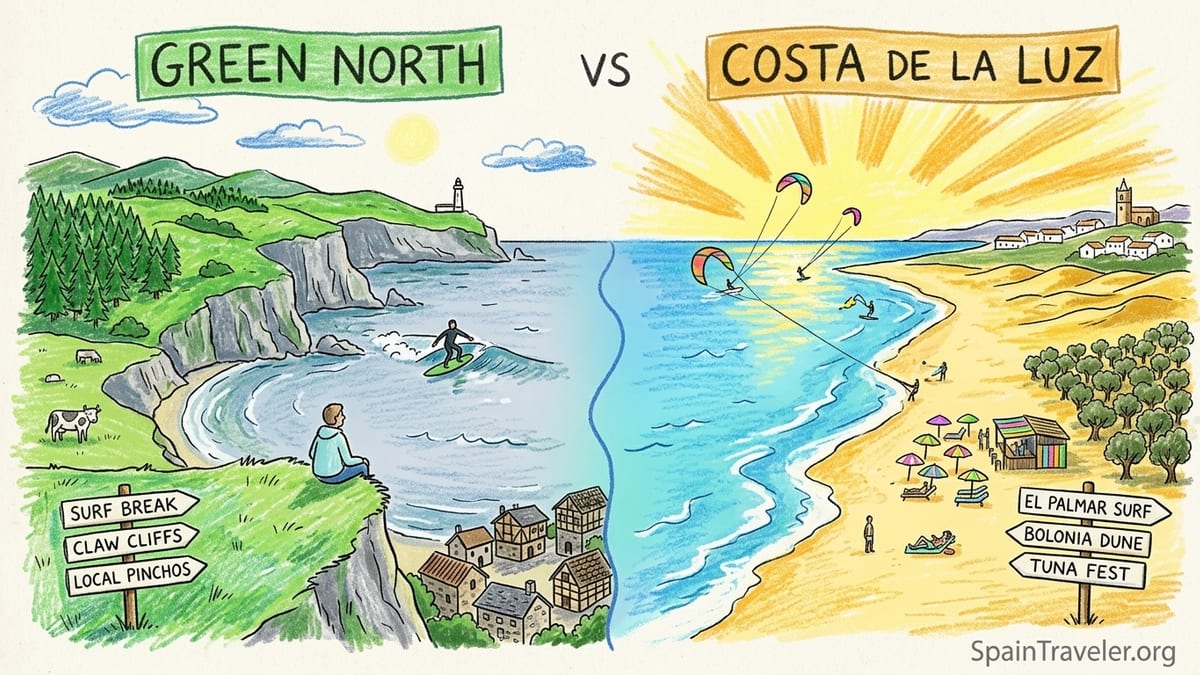
Understanding Atlantic Spain: Green North vs Costa de la Luz
The official Spanish coastal tourism branding groups the northern Atlantic and Cantabrian shore as Costa da Morte in Galicia, Costa Verde in Asturias and Cantabria, and Costa Vasca in the Basque Country. This long arc is often marketed together as “Green Spain” because of its lush Atlantic climate, sea cliffs and forests that run almost to the sand. Further south, a separate coastal brand, Costa de la Luz, covers the Atlantic coastline of Cádiz and Huelva in Andalusia, facing directly toward the Atlantic and, across the strait, Morocco.
In practical terms, you could drive between these worlds in a day, but the experience on the ground is very different. In late July a beach day in San Sebastián might mean 22 degrees Celsius air, sea mist and 21 degree water, while the same date in Zahara de los Atunes on the Costa de la Luz can push into the low 30s with water around 23 to 24 degrees. Accommodation styles, food culture, airport access and even the way people use the beach vary just as sharply, which is why most first-time visitors are better off choosing one “base coast” rather than trying to join them into a single itinerary.
Think of the northern coast as the cooler, more rugged and more traditionally Spanish option, where you visit for dramatic scenery, hiking and authentic small towns with tapas bars full of locals. The Costa de la Luz, in contrast, feels airy, open and summery, with huge sandy beaches, strong light and a big presence of wind and watersports. The north fits travelers who like mild weather and do not mind colder water, while the south suits those chasing heat, long swims and that late-afternoon glow over shifting dunes.
Climate and Water: What It Really Feels Like
Along the Green Spain coastline, the Atlantic and Cantabrian climate is mild and humid year-round. Summer daytime temperatures in coastal cities such as A Coruña, Gijón or Santander often sit around 20 to 24 degrees, with cooler nights and a fair chance of cloudy mornings even in July and August. Rain is still possible in midsummer, though showers tend to be short. This is the part of Spain where locals sometimes bring a light jacket to the beach and many visitors are surprised by how fresh the evenings feel compared with the Mediterranean.
Sea temperatures in the north are cooler too. In August the water off Galicia, Asturias and Cantabria usually ranges around 19 to 22 degrees, dropping to the mid-teens by late spring and autumn. Most local swimmers are comfortable without a wetsuit in high summer, but many visitors from warmer climates appreciate a shorty or a 3/2 wetsuit outside of July and August. Surfers in Somo, Zarautz or Rodiles will usually wear at least a 3/2 full suit even in August and step up to a 4/3 with booties in the shoulder seasons.
The Costa de la Luz has a noticeably warmer and sunnier climate. Cádiz province is among the sunniest parts of mainland Spain, and summer highs in beach towns like Conil de la Frontera or El Puerto de Santa María often sit in the high 20s to low 30s. However, the constant Atlantic influence and breezes usually keep it feeling less oppressive than inland Andalusian cities such as Seville. Water temperatures on this stretch frequently reach around 22 to 24 degrees in late summer, so long, comfortable swims without any neoprene are standard from roughly late June to early October.
Wind is a key factor in the south. The Levante and Poniente winds that blow through the Strait of Gibraltar can make Tarifa almost too windy for a relaxed beach day but perfect for kitesurfing, while an otherwise hot day in Zahara de los Atunes or Bolonia feels cooler because of the constant breeze. If you are sensitive to wind-chill on the beach, the north’s calmer coves and headland-sheltered bays such as those around Llanes in Asturias might actually feel more comfortable, despite the cooler air and water.
Beaches and Scenery: Wild Coves vs Endless Sands
The northern Atlantic coast is all about variety packed into relatively short distances. In Galicia’s Costa da Morte you find dramatic headlands and small coves like Nemiña or Soesto, where pine forests and granite boulders frame pale sand and the nearest village might be a few minutes inland. Asturias reworks this formula into a sequence of green cliffs and pocket beaches such as Playa de Torimbia or Cuevas del Mar, where short walks from clifftop parking lots lead you to shell-shaped bays backed by pastures and stone farmhouses.
Cantabria and the Basque Country add long sweeps of sand mixed with mountainside backdrops. Somo, near Santander, is a classic: a multi-kilometre arc of beach backed by dunes and surf schools, with the skyline of Santander across the bay. Further east, Zarautz in the Basque Country offers nearly 2.5 kilometres of beach right in front of town, hemmed in by hills and overlooked by a busy promenade. Even the more urban beaches, such as San Sebastián’s La Zurriola or Gijón’s San Lorenzo, keep their Atlantic character, with visible tides, changing sandbanks and waves that shape daily life in the city.
The Costa de la Luz is defined by space. Beaches here are generally wider and more open than in the north, with long, straight or gently curving stretches of sand that seem to run for miles. El Palmar, near Vejer de la Frontera, is a good example: a long village strung along the back of a sand beach where the low, white houses never overpower the landscape. Bolonia combines a sweeping bay with an enormous dune that creeps inland and Roman ruins a short walk away. Around Huelva, wide strands like Punta Umbría or Matalascañas run parallel to pine forests and low-slung holiday developments.
If your dream is to walk for an hour along relatively undeveloped sand at sunset, the Costa de la Luz delivers that more reliably. If you prefer smaller coves, sea-sculpted rock formations and quick changes of scenery every few kilometres, Green Spain is better suited. Families with young children might prefer the gentler, often more sheltered estuary beaches of the north, such as those inside the Rías Baixas in southern Galicia, or the calmer morning conditions inside the Bay of Santander.
Surf and Sea Sports: Where the Waves Work for You
The north is Spain’s traditional surf heartland. The Cantabrian Sea and open Atlantic send in swells year-round, and beach breaks like Somo in Cantabria, Rodiles in Asturias and Pantín in Galicia have become fixtures on the European surf map. In practice, for a first-time visitor, that means you can base yourself in a small town and almost always find a rideable wave within a 30-minute drive, especially between September and November when the first autumn storms arrive but water has not yet cooled dramatically.
For beginners, long sandy beaches with multiple peaks and surf schools are ideal. Somo, Zarautz and San Vicente de la Barquera are good examples, with several schools offering two-hour group lessons that in recent seasons often cost in the range of 35 to 45 euros including board and wetsuit. Intermediate surfers can look for more powerful sandbars or river-mouth setups such as Rodiles in Asturias or the famous left-hander at Mundaka in the Basque Country, though those advanced spots come with heavier crowds and stronger local etiquette.
On the Costa de la Luz, the surf is more seasonal and largely focused on autumn, winter and early spring, when Atlantic lows send solid swell into southern Spain. El Palmar, with its sand-bottom peaks along the length of the village, is the go-to choice for many first-time visitors to the area. In winter it can deliver powerful waves suitable for experienced surfers, but in late spring and early autumn it often has friendly conditions that work for intermediates and keen beginners. Several surf camps cluster around El Palmar and Conil, typically offering week-long packages with shared accommodation, breakfast and daily lessons for a price that is often competitive with similar camps in Portugal.
If your main priority is consistent surf in summer, the north is safer. You may still encounter flat spells, but the exposed orientation of many beaches catches more swell than the south, and even a knee-high day can be enough for longboard practice. If you are more interested in learning kitesurfing or windsurfing, or simply like watching colorful kites dance over the sea as you sunbathe, then the windy corridor from Tarifa up through Valdevaqueros and Bolonia on the Costa de la Luz is unmatched in mainland Spain.
Towns, Food and Everyday Atmosphere
The character of the towns is one of the clearest differences between Green Spain and the Costa de la Luz. In Galicia, Asturias and Cantabria, most coastal towns remain working communities with fishing, small industry or regional services underpinning daily life. Think of places like Ribadeo in Galicia, Llanes in Asturias or Castro Urdiales in Cantabria, where historic centers of stone houses and arcaded squares host year-round markets, local bars and family-run bakeries. Tourism is important, especially in August, but it rarely dominates everything.
This translates into a more local-feeling nightlife and dining scene. In Gijón, Santander or Bilbao you might spend an evening hopping between cider bars or pintxos counters, trying small plates of grilled squid, tortilla and local cheeses for a couple of euros each. In smaller villages, it is common to find a lunchtime “menú del día” in the 12 to 18 euro range that covers three courses, bread and a drink. The culinary focus leans heavily on seafood, hearty stews and grilled meats, with regional specialties such as Asturian fabada, Galician octopus or Basque-style cod appearing on menus from simple taverns to upscale restaurants.
On the Costa de la Luz, tourism and second-home culture play a larger role in many coastal settlements, especially around Conil, Chiclana or Islantilla. Whitewashed old towns like Vejer de la Frontera or Cádiz city itself have strong year-round communities, but many lower-lying beach areas fill noticeably with visitors between June and September. The result is a more holiday-oriented feel, with sunset beach bars, ice-cream stands and a dense cluster of seafood terraces fronting the promenade. In popular areas, expect a simple fried fish platter for two with drinks to land somewhere around 25 to 40 euros depending on the setting.
Food-wise, the Costa de la Luz shines when it comes to Atlantic tuna, fried fish and shellfish. Barbate is known for almadraba tuna, and many restaurants advertise seasonal tuna tastings in late spring. Beach towns like Sanlúcar de Barrameda serve chilled manzanilla sherry alongside plates of prawns or tiny fried fish eaten whole. If you enjoy leisurely dinners that start late, outdoor tables that hum well past midnight and a general sense of summer buzz, the Costa de la Luz fits that picture better. The north, while far from sleepy, often keeps a more restrained, neighborhood rhythm outside of the major cities and peak August weeks.
Airports, Transport and Getting Around
Access to the northern Atlantic coast is relatively straightforward, thanks to a string of mid-sized airports spaced along the shore. A Coruña and Santiago de Compostela serve Galicia’s Atlantic coast, Asturias Airport sits between Avilés and Gijón, Santander covers central Cantabria and Bilbao is the main international gateway for the Basque Country. For a first-time visitor, this means you can fly into one airport, choose a 60 to 90-minute driving radius and still have a wide mix of beaches, towns and scenery without needing to cross long distances.
Public transport in the north is workable for patient travelers. Regional trains and buses link major cities and many coastal towns, so you could, for example, travel from Bilbao to San Sebastián by train, then on to Zarautz or Getaria by bus. However, to reach more remote coves or move freely between surf spots, hiring a car is a strong advantage. Parking at beaches can be tight on the busiest August weekends, but outside of that peak the system of small lots, roadside spaces and clifftop pull-outs generally functions smoothly.
The Costa de la Luz, by contrast, is primarily served by two main airports: Jerez de la Frontera for Cádiz province and Seville slightly inland, plus Faro across the border in Portugal for some of the western Huelva coast. There is also a smaller airport near Huelva used mainly for domestic or seasonal flights. For visitors from northern Europe, flights to Seville tend to be more frequent and competitively priced, and many people then rent a car and drive roughly 1.5 to 2 hours to reach towns like Conil, Zahara de los Atunes or El Rompido.
Once on the Costa de la Luz, public transport options narrow outside the main cities. Local buses do exist between larger towns, but services can be infrequent and may not run late into the evening, especially outside peak summer. If your plan involves spontaneous beach-hopping, chasing good surf conditions or exploring inland white villages such as Vejer or Medina Sidonia, a rental car makes the experience much smoother. The main roads are modern, and driving is generally relaxed, but in August allow extra time for traffic around Cádiz and the popular resort zones.
Accommodation Styles and Trip Budget
In Green Spain, accommodation skews toward small hotels, traditional guesthouses and rural “casas rurales” converted from farmhouses and manor houses. It is common to find two or three-star family-run hotels a short walk from the beach for nightly rates that, outside August and major festivals, can feel modest compared with Mediterranean hotspots. Inland, a 15 to 20-minute drive from the coast often unlocks historic stone houses with gardens rented as whole properties, which work well for families or small groups traveling together.
Camping and campervan culture are also strong in the north. Many bays and estuaries, such as those around Liencres in Cantabria or Ribadesella in Asturias, have established campgrounds with direct or near-direct access to the sand. In summer, a simple pitch for a small tent might be one of the more affordable ways to stay near sought-after beaches, though popular spots do book up in advance. Surf camps in places like Somo, Loredo and San Vicente de la Barquera typically offer shared dorm-style rooms or basic bungalows plus daily surf lessons and board rental, which can be cost-effective for solo travelers focused on learning to surf.
On the Costa de la Luz, the accommodation picture is more mixed. Around Cádiz and Huelva there are resort-style hotels, golf complexes, clusters of modern holiday apartments and rising numbers of stylish boutique guesthouses in re-purposed townhouses. Beachfront hotels in places like Chiclana’s Novo Sancti Petri, Punta Umbría or Isla Canela can be priced in line with popular Mediterranean resorts during high season, especially for rooms with direct sea views or half-board packages. Slightly inland, villages such as Vejer or Conil’s old town offer small hotels and guesthouses that balance character with access to the coast.
If you are traveling on a tighter budget, self-catering apartments in residential blocks a few streets back from the sea in towns like Conil, Rota or Islantilla can offer better value than full-service hotels, especially for stays of a week or more. Surf camps in El Palmar and surrounding villages have grown in recent years, but they often operate more seasonally than their northern counterparts, focusing on the main surf months outside the hottest part of summer. As in the north, booking well ahead for August or holiday weeks is wise, with shoulder seasons in May, June, September and October offering more availability and softer prices.
Which Coast Fits Your Trip?
If you imagine yourself in a light sweater on an evening paseo, ducking into a traditional bar for cider or wine and grilled fish while waves crash at the end of the street, the northern Atlantic probably matches your style. Galicia, Asturias, Cantabria and the Basque Country suit travelers who like cooler summer temperatures, dramatic landscapes and towns where Spanish remains the dominant language on the street even in peak season. They are a natural fit if you are combining the coast with walking routes like the Camino de Santiago, inland mountain hikes or visits to cities such as Oviedo, Burgos or Bilbao.
Within the north, Galicia’s Costa da Morte and Rías Baixas feel wild and remote, with scattered fishing villages and small port towns. Asturias and Cantabria offer perhaps the best blend of cliffs, beaches and easy town-to-town travel, making them excellent for road trips. The Basque coast is more compact and more built-up in parts, but it compensates with a strong food culture, stylish cities like San Sebastián and quick access from Bilbao Airport. Surfers, hikers and food-focused travelers are especially well served by this part of the Atlantic Spain.
The Costa de la Luz fits a different mental image: long, bright days where beach time stretches from late morning to sunset, followed by drinks in a chiringuito, a late dinner and perhaps a midnight walk back along warm streets. It suits visitors who actively enjoy heat and sun, who want to swim for long sessions in relatively warm water and who appreciate beachfront infrastructure such as showers, loungers and casual bars. It also works very well for mixed-ability groups: some members of the group can surf or kite while others simply relax with a book on the sand or explore nearby historic towns like Cádiz or Jerez.
For families seeking reliable sunshine during school holidays, the Costa de la Luz can feel like a lower-key alternative to the Costa del Sol, with more space on the beaches and a slightly more Spanish ambiance. For couples or solo travelers keen on shoulder-season trips, the north’s milder May or September air may be more comfortable. Ultimately, both coasts reward slow travel. Rather than trying to do both in one week, pick the coastline whose climate and rhythm seem closest to how you already like to spend your days, then plan a future trip for the other side of Atlantic Spain.
The Takeaway
Atlantic Spain is not one destination but two distinct coastal worlds. The northern arc of Galicia, Asturias, Cantabria and the Basque Country offers cool summers, rugged coves, surf-rich beaches and lived-in towns where daily life continues even when the tourists go home. The Costa de la Luz brings broad, sunny sands, warmer water, wind-driven watersports and a more overtly holiday-oriented rhythm, especially in July and August.
For a first-time visitor, the choice comes down to your personal tolerance for heat, your interest in surfing or kitesurfing, how much you value wild scenery versus refined beachfront promenades, and whether you prefer your evenings buzzing and late or relaxed and neighborhood-focused. Both coasts share Spain’s strengths in food, hospitality and culture, but they express them through different landscapes and lifestyles.
If you can, allow at least five to seven nights focused on one of these regions rather than rushing between them. That way, you get beyond the postcard views and into a rhythm that makes sense with the tides, the light and the local timetable. Green or golden, misty or sun-bleached, Atlantic Spain will reward the time you give it.
FAQ
Q1. Is the water really cold on the northern Spanish Atlantic coast in summer?
The water in Galicia, Asturias, Cantabria and the Basque Country is cooler than in southern Spain but generally manageable in summer, often around the high teens to low twenties in degrees Celsius. Many locals swim comfortably without a wetsuit in July and August, though visitors from warmer climates sometimes prefer a short wetsuit or quick dips rather than hour-long sessions.
Q2. When is the best time to visit the Costa de la Luz for beach weather?
For classic hot, sunny beach conditions with warm water, the period from mid-June to late September usually works well on the Costa de la Luz. July and August are the hottest and busiest months, while June and September often combine good swimming temperatures with slightly fewer crowds and easier restaurant and parking availability.
Q3. Can I learn to surf as a beginner in both regions?
Yes, beginners will find surf schools in both Green Spain and the Costa de la Luz. In the north, beaches like Somo, Zarautz and San Vicente de la Barquera have multiple surf schools geared toward first-timers. In the south, El Palmar and some neighbouring beaches offer lessons, especially outside the peak heat of midsummer. Consistency of waves tends to be higher in the north in summer, while the south often has better learning conditions in spring and autumn.
Q4. Which area is better if I do not want to rent a car?
If you prefer to rely on public transport and walking, basing yourself in or near cities like San Sebastián, Santander, Gijón, A Coruña or Cádiz can work well. Among these, the northern cities generally offer shorter transfers from the airport to the beach areas and more frequent local trains and buses to nearby towns. The Costa de la Luz has public transport along the main corridors, but many of the most appealing beach villages are easier to reach and explore with a car.
Q5. How expensive is eating out on the Atlantic coasts of Spain?
Costs vary by town and season, but in many northern towns a daily fixed-price lunch menu with three courses and a drink can often be found in a range that feels moderate by Western European standards. On the Costa de la Luz, simple fried fish, salads and drinks in beach bars or casual restaurants are generally affordable, though sea-view terraces in highly touristed spots naturally cost more. Self-catering in an apartment and mixing home-cooked meals with restaurant visits can keep overall food budgets reasonable in both regions.
Q6. Are there many English speakers in these areas?
In major cities and well-known resort towns you will usually find some English spoken in hotels, larger restaurants and surf schools. However, many smaller towns along both the northern coast and the Costa de la Luz remain primarily Spanish-speaking in daily life. Knowing a few basic phrases in Spanish, or having them handy on your phone, makes interactions smoother and often appreciated.
Q7. What kind of clothing should I pack for summer in northern Atlantic Spain?
For the north, even in July and August, it is sensible to bring layers: T-shirts and shorts for the day, plus a light sweater or jacket and long trousers for cooler evenings or cloudy, breezy days. A compact rain jacket can be useful, as showers are possible even in midsummer. Beach footwear, a hat and sunscreen are still essential, as the sun can be strong whenever the clouds clear.
Q8. Is the Costa de la Luz suitable for families with small children?
Yes, many families choose the Costa de la Luz for its wide sandy beaches, generally gentle slopes into the sea on calmer days and family-friendly accommodation. Consider choosing a base in or near towns with good facilities, such as Conil, Chiclana or Punta Umbría, where you will find supermarkets, pharmacies, playgrounds and pedestrian promenades alongside the beach. Always pay attention to local lifeguard flags and currents, as with any Atlantic coast.
Q9. How many days do I need for a first visit to either region?
A stay of at least five to seven nights is advisable for a first trip, whether you choose the northern coast or the Costa de la Luz. That allows time for a mix of beach days, exploring a couple of nearby towns, enjoying local food and, if you wish, trying an activity like surfing or a boat trip. Shorter stays are possible but often feel rushed, especially if you are flying in and out rather than arriving by car from elsewhere in Spain.
Q10. Is it realistic to combine the northern coast and Costa de la Luz in one trip?
It is physically possible to drive between, for example, Santander and Cádiz in a long day, but for most first-time visitors it is not ideal in a single short holiday. The two coasts offer different climates and styles of travel, so trying to cover both in a week can leave you spending more time in transit than on the beach or in town. Many travelers find it more satisfying to focus on one coast in depth and then plan a second trip for the other.