


The Spanish Atlantic coast is really two very different beach worlds. To the north, Galicia, Asturias, Cantabria and the Basque coast are all about wild green headlands, small coves and intimate sea‑view hotels. Far to the south, on the Costa de la Luz in Andalusia, you enter a landscape of wide sand beaches, dunes and sprawling resort complexes purpose built for pool time, kids’ clubs and all‑inclusive lounging. Treating these as the same product leads to disappointing trips. This guide looks coast by coast at real hotels and resort areas, and compares what you actually get in terms of direct beach access, pools, spas, parking, family facilities and food, so you can book the right stretch of Atlantic for your style of holiday.
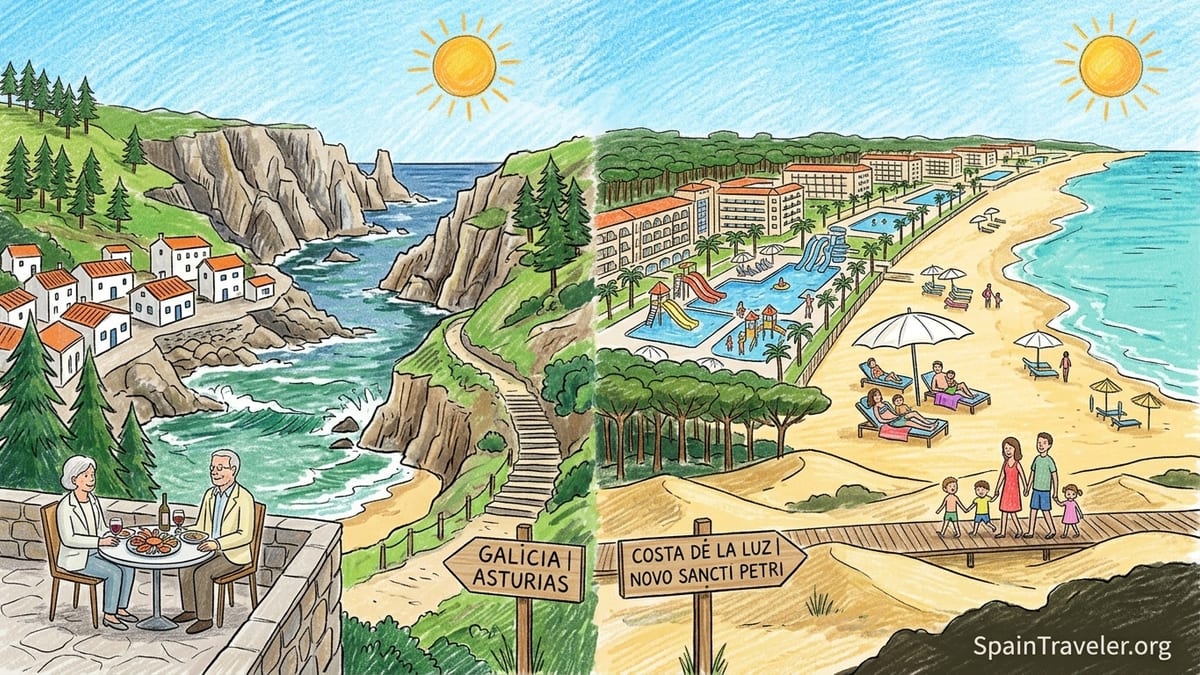
Northern Atlantic vs Costa de la Luz: Two Very Different Beach Holidays
The northern Atlantic coastline of Spain, running through Galicia, Asturias, Cantabria and the Basque Country, is defined by dramatic cliffs, fishing villages and relatively small properties. Even top‑rated places such as Noa Boutique Hotel near A Coruña or sea‑view boltholes around Fisterra and the Rías Baixas tend to have under 40 or 50 rooms, often with just a single small pool or no pool at all, relying instead on direct sea views and nearby coves. Nightlife is low‑key, with dinners built around local seafood and an after‑dinner stroll along the paseo marítimo rather than late‑night entertainment.
On the Costa de la Luz in Andalusia, particularly in resort zones like Novo Sancti Petri, Costa Ballena, Islantilla or Isla Canela, the scale changes completely. Along La Barrosa beach at Novo Sancti Petri, for example, there are roughly twenty 4 and 5 star hotels in one continuous resort strip, many with several outdoor pools, kids’ clubs, spa circuits and direct dune access from the garden. It feels closer to the Caribbean model of a beach resort than to the boutique world of northern Spain. This is also where Booking currently lists close to 2,000 beach hotels and similar properties, reflecting how much of Spain’s Atlantic resort inventory is concentrated here.
Weather is another dividing line. In the north, even in July and August you can hit cloudy days and cool water, and in June or September you may be more focused on coastal walks and gastronomy than long swims. In contrast, La Barrosa, Conil and Zahara de los Atunes typically enjoy a long summer season from late May into early October, with locals recommending June and September for warm water and fewer crowds. When you choose between regions, you are deciding not only between hotel styles but also between an Atlantic that feels almost Celtic and one that feels distinctly Andalusian.
Prices reflect those realities. A stylish room with balcony and ocean view in a northern boutique like Noa Boutique or a fully renovated hotel in San Vicente de la Barquera might run 180 to 260 euros in high season, but without all‑day animation or massive pool complexes. A mid‑range resort in Novo Sancti Petri or Costa Ballena often starts closer to 220 to 280 euros per night in August for a family room, but includes multiple pools, organised activities and extensive buffet spreads that can make the overall cost per day more predictable for families.
Sea‑View Beach Hotels in Galicia
Galicia is the greenest and most rugged of Spain’s Atlantic coasts, and its best beach hotels lean into that feeling of edge‑of‑the‑world seclusion. Around A Coruña and the Rías Altas, properties like Noa Boutique Hotel in Santa Cruz de Oleiros sit directly on small bays, with almost every room facing the water. Further along the Costa da Morte, places around Muxía and Fisterra often offer clifftop terraces where you watch waves crash below rather than step straight onto a wide sandy beach. Many of these hotels offer direct sea views but require a short walk, sometimes via stone steps, down to the actual sand.
In the southern Rías Baixas, especially around Sanxenxo and O Grove, beach hotels are more likely to sit immediately behind family‑friendly sands. Here you will find modern aparthotels and four‑star properties with simple outdoor pools and children’s areas. A typical mid‑range hotel might have one outdoor pool, a small spa with a couple of treatment cabins and a compact gym rather than a full wellness complex. Parking is usually available but often in tight underground garages with a nightly fee, which is worth factoring into your budget if you are driving the coast.
Family facilities in Galicia tend to be soft rather than highly structured. Many hotels advertise family rooms, baby cots and playgrounds, and seaside towns run their own summer kids’ activities on the promenade or beach. However, there are relatively few kids’ clubs with fixed timetables, and evening entertainment is more likely to be a bar terrace with local wine and live guitar than a full animation team. Families who like self‑directed days exploring beaches, boat trips to the Cíes or Ons Islands and long seafood lunches will be happiest here.
Restaurant options are a major plus. Even smaller hotels typically have a good in‑house restaurant that leans hard into Galician products, from percebes and razor clams to local beef and Albariño. In towns like Sanxenxo or Baiona you can walk from your hotel to a dozen tapas bars and marisquerías within 10 minutes, and it is common to book room only or bed and breakfast, leaving most meals for nearby eateries. Compared with resort buffets further south, this gives you far more variety, though at the cost of predictability and, sometimes, needing reservations in peak weeks.
Asturias, Cantabria and the Basque Coast: Boutique by the Bay
Neighbouring Asturias and Cantabria have a similar boutique tone but with some of Spain’s prettiest small bays and town beaches. Around Ribadesella, Llanes or Gijón in Asturias, you find character hotels and small beachfront properties where many rooms overlook the Cantabrian Sea but the building itself sits one street back from the sand. In places like Hotel Villa Rosario in Ribadesella, a historic mansion converted into a hotel, you stay directly on the seafront promenade, with a grassy lawn and just a few steps separating your room from Playa de Santa Marina. Pools are less common here, as many hotels rely on the beach itself and a more temperate climate.
In Cantabria, classic seaside towns such as Santander, Noja and San Vicente de la Barquera concentrate much of the beach hotel stock. Hotels fronting El Sardinero in Santander or the long bay of Noja tend to be medium‑sized, with some parking and perhaps a small indoor pool or spa area, but they rarely offer the waterpark‑style complexes of Andalusian resorts. Guests come for brisk dips, surfing and sailing schools, and long walks at low tide along golden sand that feels far removed from the high‑rise feel of the Mediterranean.
Continuing east into the Basque Country, the hotel scene around San Sebastián and Zarautz is even more urban and compact. Here you might choose a smart hotel like Lasala Plaza or a design‑forward property near La Concha, where sea‑view rooms look directly onto an elegant city beach framed by Belle Epoque architecture. Direct beach access generally means crossing the promenade rather than stepping directly from hotel gardens onto sand, and pools are rare in the historic centres. For many visitors, the trade‑off is worthwhile because you have world‑class restaurants within walking distance, from pintxos bars to Michelin‑starred tables, which makes the beach just one part of the experience.
Across these northern regions, parking must be considered carefully. Historic town centres and seafront promenades often rely on public or hotel garages with tight spaces and nightly charges that can add 15 to 25 euros to your bill. If you plan to explore multiple beaches by car, look for properties advertising on‑site outdoor parking or slightly set‑back locations where you can leave the car and walk 5 to 10 minutes to the sand. The upside is that you are rarely trapped in a single resort complex: moving between different coves, surf spots and fishing villages is part of the pleasure of a northern Atlantic trip.
Resort‑Style Costa de la Luz: Novo Sancti Petri and Conil
On the Costa de la Luz, the most resort‑like stretch is the area around Novo Sancti Petri on La Barrosa beach, in the province of Cádiz. Here the coastline behind the dunes is almost entirely given over to purpose‑built 4 and 5 star hotels, including large complexes from Spanish chains that hug the waterline. Properties like Hipotels Barrosa Garden, Iberostar Royal Andalus or Riu Chiclana typically offer several outdoor pools, separate splash zones for children, and multiple restaurants from buffet dining to a la carte grills. From the garden you step straight onto boardwalks leading over dunes to several kilometres of wide, soft sand, with beach bars and sunbed concessions dotted along the way.
Conil de la Frontera, a whitewashed town a short drive down the coast, blends a more traditional Andalusian village feel with modern resort hotels on its edges. Up on the cliffs at Fuente del Gallo and Roche you find hotels and aparthotels with sea‑view pools looking directly over unspoilt coves, while on the main town beach larger properties sit a little back from the promenade. Compared with Novo Sancti Petri, Conil’s hotels are more intermixed with residential streets and independent chiringuitos, which makes it easier to eat somewhere different every night without leaving town, even if your own hotel offers half board or all inclusive.
Direct beach access and pools are effectively guaranteed in these areas. Almost every major property offers at least one large outdoor pool, often complemented by indoor heated pools and complete spa circuits with saunas and hydrotherapy. Families will find kids’ clubs, playgrounds, mini‑discos and organised activities from aqua gym to beach volleyball. Parking is typically on‑site, either in open lots or underground garages, and while many hotels charge a nightly fee, they also cater explicitly to self‑drive guests with clear access roads and easy luggage drop‑off. This is a very different experience from circling narrow streets in a northern fishing village.
When it comes to food, resort hotels along La Barrosa and around Conil offer extensive buffets, themed nights and poolside snack bars so that guests never need to leave the complex. However, one of the pleasures of the Costa de la Luz is that even within resort zones you are rarely far from independent beach bars and fish restaurants. In Chiclana and Conil you can combine a comfortable resort base with evening walks to local tapas bars, or short taxi rides to restaurants in Vejer de la Frontera or Cádiz city, which keeps things from feeling too enclosed.
Southern Atlantic for Families: Costa Ballena, Zahara, Islantilla and Isla Canela
Further along the Costa de la Luz, other resort clusters offer a slightly quieter, family‑oriented version of the Novo Sancti Petri model. At Costa Ballena, near Rota and Chipiona, purpose‑built resorts like Elba Costa Ballena Beach & Thalasso Resort sit behind wide, shallow beaches, with golf courses and cycle paths weaving between hotels and the sea. Pools tend to be large and lagoon‑style, with separate paddling areas and plenty of shade structures, while the presence of on‑site parking and bike rental makes it easy for families to move around without using the car daily.
Zahara de los Atunes, by contrast, feels more like a village that happens to have a long line of low‑rise hotels and apartments along a spectacular beach. Here you can find medium‑sized hotels with direct beach access and pools, but the atmosphere is less all‑inclusive and more focused on evenings spent in town squares lined with bars and seafood restaurants. Travellers who want a beach holiday with a real sense of place, but who still value having a pool and secure parking, often choose Zahara as a compromise between northern intimacy and big‑resort convenience.
Closer to the Portuguese border, Islantilla and Isla Canela in the province of Huelva offer yet another variant. Large hotels and aparthotels stretch along extremely shallow, family‑friendly beaches backed by pinewoods and marshes. Properties such as Puerto Antilla Grand Hotel in Islantilla or Barceló Isla Canela are typical examples: multiple outdoor pools, extensive gardens, easy boardwalk access to the sand and a strong focus on family entertainment. This is a good area for those who want calm sea for small children, resort facilities and the option of day trips into Portugal’s Algarve.
Across these southern resorts, spa facilities are generally more extensive than in the north. Many four‑star hotels have full thalassotherapy centres or wellness areas, and even mid‑range properties at Costa Ballena or Isla Canela may offer basic spa circuits. Restaurant options mix large hotel buffets with beachfront chiringuitos that specialise in fried fish, grilled tuna and local wines. Compared with Galicia or the Basque Country, you are more likely to stay on half board or full board, and less likely to spend every evening actively hunting for a new restaurant, which can be a plus for families travelling with children.
Comparing Key Features: Access, Pools, Spa, Parking, Family and Food
Direct beach access is perhaps the clearest dividing line between the northern sea‑view hotels and the southern resorts. In Galicia, Asturias, Cantabria and the Basque Country, a true beachfront hotel is rare, and many excellent properties sit on a promenade or clifftop with wonderful views but require a short walk or descent to reach the sand. If you want to walk straight from your sunbed to the water without crossing a street, you will have more options on the Costa de la Luz, especially in Novo Sancti Petri, Costa Ballena, Islantilla and Isla Canela, where resorts are designed around dune‑side gardens and boardwalks.
Pools and spa facilities follow a similar pattern. Northern boutique hotels might have one modest outdoor pool or a small indoor relaxation area, but generally lack water slides, lazy rivers or elaborate spa circuits. On the Costa de la Luz, it is normal for a single resort to have several pools of different depths, adult‑only quiet areas and family splash zones, as well as full wellness centres offering massages and hydrotherapy. If pool time is as important as the beach itself, southern Andalusia is the better fit.
Parking and family facilities are where practical considerations come into play. In the north, you may pay nightly for tight garage parking and rely on public playgrounds and surf schools for children’s entertainment. In the south, larger complexes offer on‑site parking designed for high volumes of self‑drive guests, plus kids’ clubs, sports courts and organised activities from morning to night. For a couple or solo traveller who values atmosphere, food and landscape more than structured entertainment, northern coasts are ideal. For families who want children happily occupied on‑site, the Costa de la Luz resorts are simply more convenient.
Restaurant options represent a genuine trade‑off. Northern towns excel in independent bars and restaurants, where you can eat in a different place every night and focus on regional cuisines such as Galician seafood, Asturian cider house menus or Basque pintxos. You pay each bill separately and may need reservations in peak periods. Southern resorts are built around large buffet restaurants, snack bars and themed venues within the hotel. This suits travellers who like predictable costs and all‑inclusive plans, but can feel repetitive. Choosing between these models is less about which is “better” and more about how you actually want your days and evenings to flow.
The Takeaway
Choosing between the northern Atlantic coasts of Galicia, Asturias, Cantabria and the Basque Country and the southern resorts of the Costa de la Luz is really about choosing a style of beach holiday. In the north you wake to cool sea air and clifftop views, stroll down to small coves or town beaches, and spend evenings discovering local restaurants. Hotels are often small, characterful and close to the water rather than directly on it, with limited pools and spa facilities but abundant charm.
On the Costa de la Luz, by contrast, you move inside a purpose‑built holiday environment of wide dunes, giant pools and resort strips backed by pinewoods and golf courses. Novo Sancti Petri, Conil, Zahara, Costa Ballena, Islantilla and Isla Canela all deliver some combination of direct beach access, extensive pool complexes, kids’ clubs, on‑site parking and all‑inclusive dining. This suits travellers who want a classic, sunny beach escape with everything at their fingertips and less day‑to‑day decision‑making.
With Booking currently listing around 1,996 beach hotels along the Costa de la Luz alone and a substantial number of sea‑view properties scattered across Galicia, Asturias and Cantabria, there is no shortage of choice. The key is to be honest about what matters most to you. If your ideal day revolves around surfing, coastal walks and leisurely lunches in fishing villages, the northern coasts will be more rewarding. If you picture a lounger by a big pool, warm evening walks on a long beach and children busy in the kids’ club, focus your search on Andalusia’s Atlantic.
Wherever you decide, book with a clear view of the differences between these regions rather than assuming that every Spanish “beach hotel” means the same thing. Matching the coast to your travel style is the best way to turn a simple sea‑view room or resort package into the beach holiday you were actually dreaming of.
FAQ
Q1. Which Spanish Atlantic coast is best for families with young children?
Families with young children usually find the Costa de la Luz more convenient, especially resort areas like Novo Sancti Petri, Costa Ballena, Islantilla and Isla Canela, where beaches are wide and shallow and hotels offer multiple pools, kids’ clubs and easy on‑site parking.
Q2. Are there true beachfront hotels in Galicia, Asturias and Cantabria?
There are some hotels right on the sand or promenade in the north, but many highly rated properties sit on cliffs or one street back from the beach, offering sea views and short walks down to the shore rather than direct garden to sand access.
Q3. How does the weather compare between the northern coasts and Costa de la Luz?
The northern Atlantic coasts are cooler and more changeable, even in summer, with fresher water and more cloudy days. The Costa de la Luz tends to be sunnier and warmer from late May to early October, which suits classic sun‑and‑swim holidays.
Q4. Are pools and spa facilities better in the north or on the Costa de la Luz?
Resorts on the Costa de la Luz almost always win on pools and spa facilities, with multiple outdoor pools and full wellness areas. Northern boutique hotels may offer a single pool or small spa but focus more on views and atmosphere.
Q5. Is it easier to park at northern beach hotels or in Andalusian resorts?
Andalusian resorts are generally easier for drivers, with large on‑site car parks or garages designed for high volumes. In the north, many seafront properties rely on smaller garages or public parking, which can be tight and often carries a nightly fee.
Q6. Where will I find better restaurant variety within walking distance?
Northern towns such as Sanxenxo, Llanes, Santander or San Sebastián typically offer more independent bars and restaurants within a short walk, while Costa de la Luz resorts lean on their own buffets and a smaller number of nearby chiringuitos and village eateries.
Q7. What is a realistic nightly budget for a good sea‑view room on these coasts?
In peak summer, a stylish northern sea‑view room often runs around 180 to 260 euros per night, while a family‑oriented resort in Novo Sancti Petri or Costa Ballena might start closer to 220 to 280 euros, reflecting the added facilities and all‑inclusive options.
Q8. Which area is better for surfing and active sports?
The northern coasts of Galicia, Asturias and Cantabria provide excellent conditions for surfing and bodyboarding, along with coastal hiking. Costa de la Luz also offers surf spots and kitesurfing, especially near Tarifa, but big resorts are more focused on pool and beach relaxation.
Q9. Do I need a car to enjoy these beach areas?
A car is very useful on both coasts, but in the north it allows you to move between coves and villages easily, while on the Costa de la Luz it makes it simpler to reach off‑site towns and attractions from resort areas that may be set a little apart from urban centres.
Q10. How far in advance should I book beach hotels on the Spanish Atlantic?
For peak summer dates in July and August, it is sensible to book several months ahead, especially for small northern boutique hotels with limited sea‑view rooms and for popular family resorts on the Costa de la Luz that can fill up early with repeat guests.