


On Spain’s Atlantic seaboard, the true all-inclusive action is not in the lush "Green Spain" of Galicia or Asturias, but hundreds of miles south on the sunlit Costa de la Luz. Stretching along the Gulf of Cádiz through the provinces of Cádiz and Huelva, this coast has quietly developed a dedicated all-inclusive market, with clusters of large beachfront resorts around Novo Sancti Petri and La Barrosa in Chiclana de la Frontera, and further west around Islantilla. For travelers who want Caribbean-style ease with Andalusian character and Atlantic beaches, this is where to look in 2026.
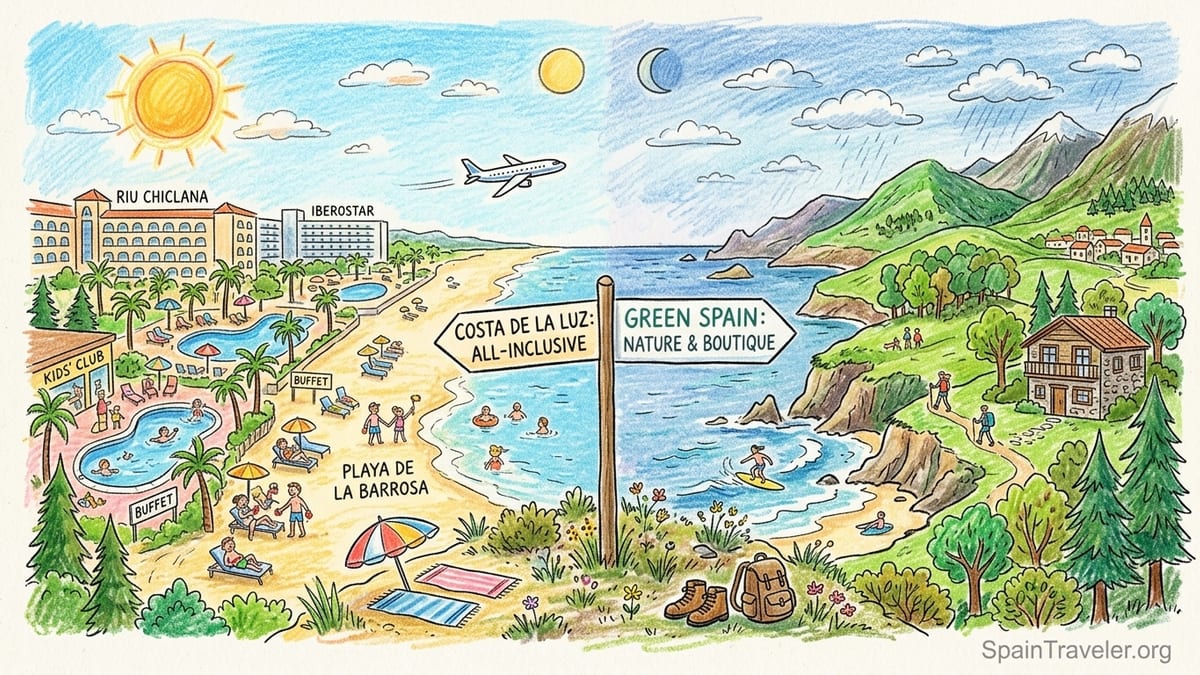
Costa de la Luz vs Green Spain: Where All-Inclusive Really Lives
Start with an important reality check for anyone planning an Atlantic Spain getaway: if you are looking for a dense choice of modern all-inclusive resorts, you need the Costa de la Luz, not the greener and cooler northern shores of Galicia, Asturias or Cantabria. The northern "Green Spain" coast has spectacular scenery and good boutique hotels, but it has never embraced the large, purpose-built all-inclusive format in the same way. By contrast, the Atlantic-facing Costa de la Luz, especially around Chiclana de la Frontera and Huelva’s western beaches, was designed with resort tourism in mind, with long sandy strands, golf courses and hotel zones developed specifically for package travelers.
Within this southern strip, Novo Sancti Petri and La Barrosa in Chiclana stand out as the most concentrated all-inclusive hub, with big names such as Iberostar Waves Royal Andalus, Hipotels Barrosa Garden and Hotel Riu Chiclana offering full-board and all-inclusive options on or very close to Playa de la Barrosa. West of Cádiz city, the coast around Islantilla, on the border of the towns of Isla Cristina and Lepe, forms the second key node, with a smaller but growing set of resorts strung along its dune-backed beach and golf complex. Together, these Atlantic enclaves give travelers a practical alternative to the Mediterranean’s Costa del Sol or the Balearic Islands while keeping a familiar Spanish resort feel.
This concentration matters in practice. A family arriving on a Saturday in August can choose between several comparable 4 and 5 star setups within a ten minute taxi ride of each other around La Barrosa alone, adjusting their priorities for kids’ club facilities, spa access, or proximity to golf. Meanwhile, couples heading to Islantilla might base their decision on whether they want a quieter boardwalk setting or easier access to nearby towns like Lepe and Ayamonte. In short, the Costa de la Luz is where the Atlantic all-inclusive choice is deepest and most flexible right now.
Novo Sancti Petri & La Barrosa: Flagship All-Inclusives
Chiclana de la Frontera’s Novo Sancti Petri complex was one of Andalusia’s earliest purpose-built resort zones, and today it has the largest number of hotel beds on the Costa de la Luz. At its heart lies Playa de la Barrosa, an 8 kilometer beach backed by dunes and low-rise hotels, with direct access from several properties. Iberostar Waves Royal Andalus, for instance, occupies one of the prime beachfront plots with an all-inclusive option, multiple pools and direct dune access, making it a strong candidate for travelers who want to step from breakfast buffet straight onto the sand without crossing a road.
Hotel Riu Chiclana, slightly set back but still just about 200 meters from La Barrosa, epitomizes the full-scale resort model in this area. It is a 24 hour all-inclusive property with more than 800 rooms arranged in several buildings, five outdoor pools, two children’s pools, and a line-up of themed restaurants and bars. A guest here might easily spend three or four days without leaving the grounds: mornings at the main pool with organized activities, afternoons at the on-site splash area or kids’ club, and evenings at a different specialty restaurant followed by a family-friendly show.
Hipotels Barrosa Garden, another Novo Sancti Petri mainstay, leans into its family-friendly positioning with a dedicated children’s splash park, outdoor pools, an entertainment program and a garden setting close to La Barrosa’s sands. Where Riu Chiclana feels more like a self-contained village, Barrosa Garden is slightly more compact and easier to navigate with small children, while still offering a classic buffet plus snack bar format that will feel familiar to anyone who has stayed in Mediterranean all-inclusive resorts.
Price-wise, during high summer a standard double on an all-inclusive basis at these La Barrosa properties can often land in the mid-range bracket for Spain’s resort market, depending on booking window and room type. Travelers might see nightly rates for two adults in July or August that roughly match a 4 star half-board stay on the Costa del Sol, but with more expansive pool complexes and all drinks included. In shoulder seasons such as late May or September, the same rooms can drop significantly, making a long weekend all-inclusive stay a realistic option even for shorter breaks from elsewhere in Europe.
Islantilla and Huelva’s Western Beaches: Quieter Atlantic All-Inclusive
Further west, near the Portuguese border, Islantilla has evolved into Huelva province’s main resort strip and forms part of the Costa de la Luz as well. Here the feel is subtly different from Novo Sancti Petri. The beach is still broad and sandy, but the backdrop is more low-rise apartments, boardwalk cafes and a smaller clutch of resort hotels rather than a continuous hotel front. Several of these properties offer all-inclusive or at least full-board options targeted at families, taking advantage of the area’s flat terrain and easy walks between hotel, beach and small commercial centers.
In Islantilla, the pool areas are often slightly more compact than the mega-complexes of Chiclana, and the evening entertainment tends to be lower key, with mini-discos for children followed by live music or quiz nights rather than large-scale stage productions. For many travelers this is an advantage. It feels easier to pair an all-inclusive package with leisurely strolls along the promenade, a coffee at a local chiringuito, or a side trip to Isla Cristina’s fishing harbor or the marshes of Isla Cristina and Ayamonte.
Food options around Islantilla also push more strongly toward local seafood and regional dishes when you step outside the hotels. While the resort buffets lean international, guests frequently wander out for plates of grilled sardines, marinated dogfish or arroz marinero at independent restaurants along the seafront. Because the concentration of all-inclusive hotels is smaller than in Novo Sancti Petri, it can be easier here to balance hotel-based convenience with independent dining and bar-hopping, especially in the cooler evenings of late spring and early autumn.
If you are the kind of traveler who enjoys having most meals prepaid but still wants the option of unhurried discovery in nearby towns, Islantilla and neighboring beaches such as La Antilla and Isla Cristina can be a smart base. Taxi rides to Lepe or Ayamonte are usually short and reasonably priced, and rental cars are easy to park compared with more urbanized Mediterranean coasts, making day trips to places like the Rio Tinto mines or even across the border into Portugal a realistic complement to an otherwise relaxed resort stay.
Food and Drinks: Buffets, Tapas and What All-Inclusive Really Buys You
Food and drink quality is often the deciding factor when choosing an all-inclusive. On the Costa de la Luz, the big resort brands tend to follow the familiar pattern: large buffet restaurants with show-cooking stations for breakfast, lunch and dinner, plus one or more specialty or à la carte venues that require reservations. Iberostar Waves Royal Andalus, for example, features the main Al-Andalus buffet with live cooking along with additional à la carte options, while Hotel Riu Chiclana offers a mix of buffet service and themed restaurants, with cuisines that can include Italian, Andalusian or broader international menus.
In practice, this means that a typical day in high season might start with a substantial breakfast buffet including hot dishes, fresh fruit, pastries and cold cuts, followed by a casual lunch delivered via the same main restaurant or a poolside snack bar. Many guests then choose a later, more relaxed dinner at a specialty restaurant, especially on longer stays where variety becomes more important. Drinks at these resorts usually include local draft beer, house wines, simple cocktails and soft drinks, all served without additional charge under the all-inclusive plan, although some premium spirits and branded wines may incur a supplement.
Travelers frequently ask whether the buffets in Andalusian all-inclusives reflect local cuisine. The answer is that they generally do, but in a diluted way. You will likely see gazpacho, salmorejo, local cheeses and grilled fish appear alongside standard international options such as pizza, pasta and burgers, designed to satisfy fussy eaters and children. At properties with a more explicit regional focus, there may be themed Andalusian nights that highlight dishes like oxtail stew, fried fish from the Bay of Cádiz, or Iberian pork from the nearby Sierra, but these rotate among a wider set of global offerings.
If you are a serious food traveler, Costa de la Luz’s all-inclusive buffets are probably not the main reason to visit. Their strength lies in predictability and value rather than culinary adventure. That said, for families budgeting carefully, having three solid meals and drinks included can make the cost of a week-long holiday much easier to plan, especially when compared with paying restaurant prices for every drink and snack along the beach. Guests who want a little more culinary interest can select properties with good à la carte reputations, opt for half-board, and deliberately schedule some evenings at independent tapas bars in Chiclana town, Cádiz city or small fishing villages nearby.
Kids’ Clubs, Entertainment and Pools: How Family-Friendly Are These Resorts?
For many visitors, especially those flying in with school-age children, the success of an all-inclusive holiday hinges on kids’ facilities and entertainment more than anything else. Here, Costa de la Luz resorts hold their own. Hotel Riu Chiclana runs its RIU Land program, with age-segmented children’s clubs, supervised activities, and separate children’s pool areas. A typical day might see younger guests doing craft workshops in the morning, joining a treasure hunt or pool game in the afternoon, and finishing with a mini-disco before the evening show. Parents report that this kind of structure makes it easy to carve out a quiet hour by the adults’ pool or at the spa.
Hipotels Barrosa Garden markets itself explicitly as a family hotel, and the design reflects that. Pools are clustered so adults can watch multiple children in different zones, and there is usually a splash area with slides for younger kids. Organized activities and evening entertainment tend to be lighter and more family-focused than in adult-oriented resorts, with game nights, family quizzes and live music on outdoor terraces. Iberostar Waves Royal Andalus also caters well to families, combining child-friendly pools with beach access and kids’ programming that dovetails with the brand’s emphasis on sustainability and ocean awareness.
Compared with some Mediterranean coasts, one advantage on the Costa de la Luz is space. Because the resorts are often surrounded by dunes or golf courses rather than dense urban streets, pool decks and garden areas feel more open. This makes it easier to find quiet corners away from the main activity pool when you need a break. On the downside, the Atlantic breeze can make shoulder season pool days feel cooler than equivalent dates on the Mediterranean. Heated indoor pools at some properties help extend the practical swimming season into early spring and late autumn, but families visiting in April or late October should still bring light layers for evenings.
Entertainment also extends to sports and wellness. Many of the Novo Sancti Petri resorts are adjacent to or integrated with golf courses, giving golfers easy access to tee times without long transfers. Others provide tennis courts, paddle courts, or beach volleyball areas that are included or available at a modest extra cost. A family might easily spend a morning cycling along the coastal paths between Sancti Petri and La Barrosa, rent stand-up paddleboards on calmer days, or join a guided excursion into the nearby natural parks that protect dunes and marshlands along this coast.
Beachfront Access and Local Exploration: When Half-Board Makes Sense
Direct beach access is one of the biggest selling points for Costa de la Luz’s all-inclusive cluster. Iberostar Waves Royal Andalus is often highlighted for its location at one of the best access points to La Barrosa, essentially opening onto the sand with minimal transition. Other properties like Riu Chiclana require a short walk or descent via paths and stairs, but still get guests to the water in a matter of minutes. In Islantilla, most resorts are set just back from the boardwalk and dunes, so it is typically a flat stroll across a wooden walkway to reach the shoreline.
Given how good these beaches are, many visitors spend most of their daytime hours either by the pools or on the sand and only really think about leaving the resort in the evenings. This is where the choice between full all-inclusive and half-board or full-board becomes strategic. If you plan to rent a car and explore regularly, including dinners in places like Vejer de la Frontera, Cádiz, Sanlúcar de Barrameda or Ayamonte, you may find that paying for unlimited hotel drinks and lunches you rarely use is not the best value. A half-board plan that includes breakfast and dinner can give cost certainty while still letting you sample tapas at lunchtime in whichever town you are visiting.
A concrete example: a couple staying at La Barrosa might book half-board at a 4 star property in late September, then spend one evening eating in the hotel buffet, another trying the à la carte restaurant on a supplement basis, and two others exploring Chiclana town’s tapas scene or Cádiz’s historic center, all without feeling they are wasting prepaid lunches or poolside cocktails. Another family might opt for the full all-inclusive package during a peak August week, calculating that the children will consume a near-continuous stream of ice creams, soft drinks and snacks, and they themselves will enjoy poolside drinks without thinking about the bill.
Local restaurant pricing supports both strategies. In many of the smaller towns along the Costa de la Luz, it is still possible to find a generous tapa and a drink for a modest sum, and even dinner at a mid-range seafood restaurant will typically cost less than in Spain’s major cities. That makes a hybrid approach attractive: book all-inclusive for a shorter break where relaxation is the only priority, then choose half-board on a longer stay where you are more likely to feel restless and eager to explore. The crucial point is to be honest about your habits. If you are committed to discovering local bars every night, a strict all-inclusive plan may box you in.
Choosing Between Chiclana, Islantilla and Other Southern Resort Areas
When deciding where along the Costa de la Luz to base yourself, it helps to think in terms of atmosphere, connectivity and how self-contained you want your holiday to feel. Novo Sancti Petri and La Barrosa in Chiclana are best suited to travelers who want a classic resort corridor experience: multiple big hotels, wide beaches, an internal rhythm of pool, buffet, kids’ club and show, with the option of occasional side trips to Cádiz or Jerez. The infrastructure here is polished, with good road access, organized taxi ranks and a clear separation between quiet residential zones and hotel areas.
Islantilla, in contrast, feels more like a single resort community embedded into a quieter stretch of coast. It appeals to those who value a boardwalk ambiance and easier mixing between hotel life and local promenading. You are more likely to see Spanish and Portuguese families on weekend breaks, and the town-to-town distances are shorter, making spur-of-the-moment trips to neighboring beaches intuitive. The flip side is that if you crave a very wide choice of all-inclusive brands and waterpark-sized pool complexes, you will find more variety around La Barrosa than in Huelva’s beach towns.
Other established southern resort areas, such as the Cadiz city beaches, Rota, El Puerto de Santa María or Mazagón, offer a different model again. Here you will encounter more traditional hotels, pensions and apartments aimed at domestic tourism, often with breakfast only, full-board or simple meal plans instead of full international all-inclusive. These can be excellent bases if your focus is local culture, seafood and nightlife rather than a closed resort ecosystem. For families prioritizing predictable costs, however, the draw of the all-inclusive clusters in Chiclana and Islantilla is hard to beat.
Transportation also influences the decision. Chiclana’s La Barrosa zone is convenient to Jerez and Seville airports by road, and organized transfers are common in package deals from many European cities. Islantilla connects relatively easily with Faro in Portugal as well as Seville, which can be useful if you find better flight options into the Algarve. Once on site, most resorts work well without a car for guests happy to stay mainly within the complex. Those wanting deeper exploration of the region’s sherry bodegas, white villages or natural parks will find renting a car for at least part of their stay worthwhile.
The Takeaway
In 2026, the Spanish Atlantic all-inclusive scene is clearly concentrated on the Costa de la Luz, especially around Novo Sancti Petri and La Barrosa in Chiclana de la Frontera, and around Islantilla on the Huelva coast. Green Spain may be verdant and dramatic, but for purpose-built resorts with buffets, wristbands, kids’ clubs and unlimited poolside drinks, it is this southern shore that sets the pace. Properties such as Iberostar Waves Royal Andalus, Hipotels Barrosa Garden and Hotel Riu Chiclana exemplify the model: large, family-friendly complexes within easy reach of excellent beaches and reachable from major Iberian airports.
Choosing the right resort comes down to how you travel. If you are happiest in a self-contained environment where every meal and drink is prepaid, the all-inclusive formulas around La Barrosa and Islantilla deliver exactly that, with enough pools, restaurants and entertainment to keep both adults and children occupied for a full week. If you prefer a blend of comfort and discovery, half-board or flexible meal plans in the same areas can free you to chase tapas in Cádiz, seafood in Isla Cristina or sunset views in Vejer without worrying about missing out on prepaid perks. Either way, Costa de la Luz offers a compelling alternative to the Mediterranean that combines Atlantic beaches with Andalusian character.
FAQ
Q1. Is Costa de la Luz better than Green Spain for all-inclusive resorts?
Costa de la Luz has a far higher concentration of modern all-inclusive properties, especially around Chiclana and Islantilla, while Green Spain is stronger for small hotels and rural stays.
Q2. Which area is best for families: Novo Sancti Petri or Islantilla?
Novo Sancti Petri around La Barrosa offers more large-scale resorts with extensive pools and kids’ clubs, while Islantilla is quieter and better for mixing hotel time with relaxed seaside walks.
Q3. Are the beaches on Costa de la Luz suitable for young children?
Yes, the main resort beaches like La Barrosa and Islantilla are wide and sandy with gentle slopes, though Atlantic waves and breezes can be stronger than on the Mediterranean.
Q4. Is the food at all-inclusive resorts in Chiclana and Islantilla mostly Spanish?
Buffets mix international staples with Andalusian dishes. You will find local items like gazpacho and grilled fish, but menus are designed to appeal to a broad audience.
Q5. Should I choose all-inclusive or half-board if I want to explore local restaurants?
If you plan to dine out several evenings or take day trips, half-board often offers better value and flexibility than full all-inclusive, especially for longer stays.
Q6. Do Costa de la Luz resorts have good kids’ clubs and entertainment?
Yes, major properties such as Riu Chiclana, Hipotels Barrosa Garden and Iberostar Waves Royal Andalus offer structured kids’ clubs, children’s pools and nightly family entertainment.
Q7. How close are the main resorts to the beach?
Many hotels in Novo Sancti Petri and Islantilla are directly on or just behind the dunes, usually a few minutes’ walk to the sand via paths or boardwalks.
Q8. Is it easy to explore nearby towns from an all-inclusive base?
Yes. Taxis and rental cars are readily available, and towns such as Cádiz, Chiclana, Lepe and Ayamonte are within straightforward driving distance from the main resort clusters.
Q9. When is the best time of year to visit Costa de la Luz all-inclusive resorts?
Late May, June and September often balance warm weather, open facilities and fewer crowds, while July and August are hottest and busiest with peak family demand.
Q10. Are Costa de la Luz all-inclusive resorts good value compared with the Mediterranean?
They are generally competitive, often offering similar or better facilities for comparable prices, especially in shoulder seasons, with the added appeal of Atlantic beaches and a slightly less crowded feel.