


On Spain’s Atlantic coast, the Cíes Islands sit like a sandbar between the Ría de Vigo and the open ocean, protected as part of the Atlantic Islands of Galicia National Park. Daily visitor caps, mandatory permits and a patchwork of ferry routes mean that getting there is not as simple as turning up at the pier. This guide walks you through the 2026 ferry and excursion options from Vigo, Cangas, Baiona, Sanxenxo and Portonovo, with real crossing times, live-market prices and concrete advice on how to secure your ticket before the day sells out.
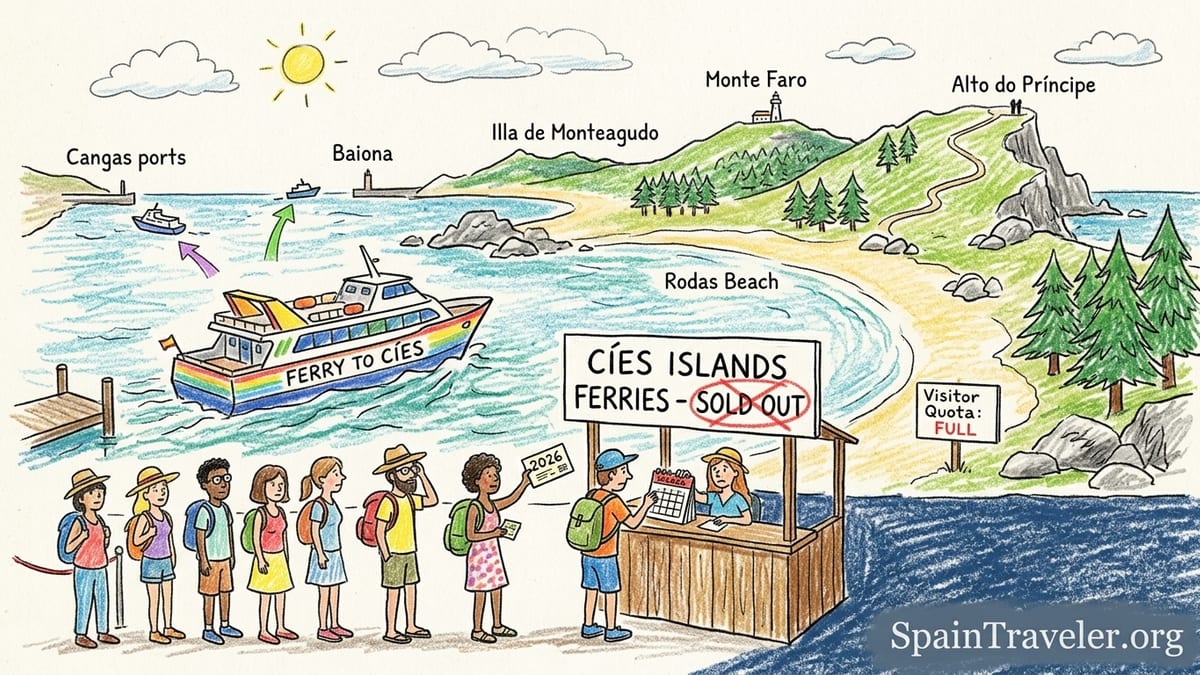
Why Cíes Islands ferries sell out fast in 2026
The Cíes archipelago is one of the most tightly managed protected areas on Spain’s Atlantic coast. In peak season the National Park limits day visitors to roughly a couple of thousand people per day, with additional caps for campers and private boats. On busy summer weekends those quotas are reached days in advance, which is why travellers arriving in Vigo without a reservation increasingly find that there is no legal way onto the islands that day.
Since May 2026, the main season for Cíes has effectively stretched from mid May through mid September, with Semana Santa, some spring weekends and early autumn dates also seeing ferry operations. Within this period, maritime companies concentrate most departures in the core summer weeks of July and August, when the weather is settled and the water is warm enough for swimming. Outside those months, sailings are fewer and more weather dependent, but demand can still spike on sunny weekends.
The upshot is that Cíes has shifted from a spontaneous day trip to a pre-planned experience. It is increasingly common for August dates to show “cupos completos” in the official system and “no availability” on ferry booking engines, even though there are still hotel beds in Vigo and Sanxenxo. For travellers this means choosing departure port, schedule and ticket type early, then locking in a booking before organising the rest of their Rías Baixas itinerary around it.
At the same time, competition between operators and ports has created more choice. Vigo remains the primary gateway with the most crossings and the sharpest pricing, but Cangas and Baiona are close behind, and seasonal departures from Sanxenxo and Portonovo are aimed squarely at beach-resort visitors who want a one-day adventure offshore.
Vigo departures: fastest crossings and best value
Vigo is by far the main launch point for the Cíes Islands. In 2026, standard ferries from Vigo take around 40 minutes to reach the Rodas beach jetty on Illa do Faro, with live-market return fares typically starting around 24 euros in the lower seasons and around 27.50 euros in July and August. These reference prices match what you see when you check a real booking engine for early September or mid summer dates, and they include the handling of the mandatory visitor authorization.
From June through August, the Vigo timetable feels almost like a commuter service on busy days. Morning sailings often start shortly after 9:00 and run in dense waves through late morning, with another burst of departures in mid afternoon for those who prefer to arrive after lunch. In a typical August week you might find options such as 09:00, 10:15, 10:45, 11:00, 12:15 and 15:30, plus later returns around 17:00, 18:00, 19:00 or even 20:00, always subject to weather and quotas.
In shoulder months like May, June and September, Vigo still tends to run several daily departures on weekends and at least one or two on weekdays, though there may be entire November days with no service. Travellers landing in Vigo by train from Madrid or Santiago often choose the mid morning boat, arriving on the islands before lunchtime and returning on the 18:00 or 19:15 service to enjoy the golden-hour light over Rodas beach.
For most visitors, Vigo is also the easiest port to reach. The ferry terminal sits on the central waterfront, a short walk from many hotels and about a 20 minute taxi ride from Vigo airport. For a typical couple staying in Vigo for a city break, the most economical and flexible option is to book a simple Vigo–Cíes ferry ticket with morning departure and evening return, rather than an organized excursion, since the standard ticket already includes basic information and park authorization.
Cangas and Baiona: alternative gateways on the Ría
Cangas, on the north side of the Ría de Vigo, is the second most important departure point for Cíes. Crossing times are slightly longer than from Vigo, usually around 45 to 50 minutes depending on the vessel and sea conditions. Schedules mirror Vigo’s pattern: several morning departures in July and August, thinning to a handful on spring and autumn weekends. Pricing is broadly similar to Vigo, with low-season return fares in the mid 20 euro range and high-season fares only a couple of euros higher.
From a traveller’s point of view, Cangas makes most sense if you are already staying on the Morrazo Peninsula or using it as a base for exploring local beaches such as Playa de Liméns or Praia de Nerga. For example, a family staying in a coastal apartment in Moaña might drive 15 minutes to Cangas, park near the marina and board a mid morning sailing, avoiding the heavier traffic and parking challenges on Vigo’s city waterfront.
Baiona offers a different ambience. The town is a historic seaside resort with a medieval old quarter, a parador housed in a fortress and a long promenade facing the ocean. Ferries from Baiona to Cíes are more seasonal, concentrated heavily in July and August and on key shoulder-season dates like Easter and early September. In practice, you might see a pattern of morning sailings around 09:45 or 11:00, with returns in mid afternoon and early evening, sufficient for an unhurried beach day on Rodas or a hike up to the Monte Faro lighthouse.
Because Baiona is farther from the islands, crossing times are slightly longer than from Vigo, typically in the 45 to 60 minute range. Prices are usually a little higher than Vigo’s base fares, reflecting both the longer route and the resort market, but in 2026 they still sit within the high 20 euro to low 30 euro band for a standard adult day trip. For travellers sleeping in Baiona itself, this small price difference is often worth it to avoid the extra logistics of buses or taxis to Vigo.
Sanxenxo and Portonovo: seasonal departures from the beach coast
Further north on the Pontevedra coast, Sanxenxo and Portonovo tap into the huge summer population of the Rías Baixas beach resorts. Here, departures to Cíes are strictly seasonal and usually framed as excursions rather than year round ferry lines. Companies schedule boats mainly between late June and early September, aligning with school holidays and the peak hotel season along the Silgar and Canelas beaches.
In practice, a family staying a week in Sanxenxo might find a handful of dates where an operator runs a direct Sanxenxo–Cíes sailing, often as part of a combined experience that includes a short cruise through the Ría de Pontevedra or a commentary on mussel farms and local villages. Crossing times are longer than from Vigo, commonly approaching an hour each way, because the boat must leave the Ría de Pontevedra, round the headland and then enter the Ría de Vigo.
Portonovo, just a few minutes along the coast from Sanxenxo, sometimes acts as an alternate boarding point on the same excursion route. The port has a more traditional fishing-town feel and can be more convenient if you are staying in nearby coves like Montalvo or A Lanzada. However, departure calendars here are even thinner, with some summers only offering a few fixed excursion days per week and no service at all if demand is low or sea conditions unstable.
Because of the longer navigation and excursion-style format, prices from Sanxenxo and Portonovo often sit slightly above the Vigo benchmark. It is common to see adult fares clustering in the high 20s or low 30s in euros, sometimes with children’s tickets discounted and infants travelling free. These departures are ideal if you do not wish to drive to Vigo or Cangas, but you should be prepared for fewer time slots and a more structured outing with commentary and fixed return times.
Ferry ticket vs organized boat excursion
When searching for “Cíes Islands boat” in 2026 you will find two broad product types. The first is the conventional ferry ticket: a straightforward return crossing from a specific port, with fixed outbound and inbound times that you choose when booking. The second is the organized boat excursion: a more packaged experience that might include on board narration, extra stops in the rías, drinks or snacks, and a group guide for part of the day.
A standard Vigo–Cíes ferry ticket is generally the cheapest and most flexible choice for independent travellers. You book a morning departure and an evening return, receive an email including your park authorization, show up at the terminal 30 to 40 minutes before sailing and then explore the islands on your own. You are free to spend the morning on Rodas beach, hike to Alto do Príncipe in the afternoon and catch whatever return boat you have chosen, provided you respect the fixed time.
Organized boat excursions, by contrast, tend to appeal to visitors who want more structure or commentary. A common format from Sanxenxo or Portonovo, for example, is a full day coastal cruise that includes a narrated passage past mussel platforms, an hour stop in a fishing village on the way out or back, and several hours of free time on Cíes itself. Some Vigo-based operators also sell “sunset at Cíes” or “Cíes plus Ría de Vigo” excursions that weave together multiple viewpoints in a single outing.
Price differences vary. In many cases a straightforward ferry ticket from Vigo might cost around the mid to high 20 euros, while a full excursion with commentary and extras from Sanxenxo or Baiona might cost somewhat more for the added content. Travellers should read inclusions carefully, especially regarding food and drink, guide services and flexibility of return times. If your main goal is simply to lie on Rodas beach and swim, the basic ferry is often the smarter buy. If you have only one day for the Galician rías and enjoy guided explanations, an excursion can deliver more varied value.
Authorizations, capacity limits and when to book
All visits to the Cíes Islands fall under the rules of the Atlantic Islands of Galicia National Park. In practice this means that every traveller must hold a valid visitor authorization for a specific date, linked to a ferry ticket or camping reservation. In peak season there is also a separate system for private boats, which need both a navigation permit and a daily anchoring slot, with strict quotas for each anchorage area.
The process for day visitors is simpler than it used to be. In 2026, most ferry companies bundle the authorization into the ticket: when you buy a return from Vigo or Cangas online, the operator uses your passport or ID details to generate an official authorization code and sends it with your confirmation. You no longer have to navigate the regional government’s booking platform yourself unless you prefer to, though you should still check that names and ID numbers are correct, since park staff can perform identity checks on arrival.
Capacity limits are what drive sellouts. In peak summer the day visitor quota for Cíes sits in the low thousands, with an additional cap for guided group visits in the off season. On sunny August days, especially around Spanish holidays or major festivals in Vigo, those quotas can be fully used, leading to headlines in local media about travellers turned away at the port. Some companies respond by adding larger vessels or extra sailings, but they cannot exceed the island’s daily cap.
As a practical rule, travellers planning a July or August visit should book as soon as they have fixed dates for their Rías Baixas trip, ideally several weeks in advance for weekends and Spanish public holidays. For late May, June and September, booking one to two weeks ahead is usually enough, except if your dates coincide with popular events on the Vigo waterfront. Outside these windows, you may find availability only a few days ahead, but weather-related cancellations become more likely and some weeks have no service at all.
Choosing your departure port: how to decide
For first time visitors flying into or staying in Vigo itself, the default choice should be Vigo departures. They combine the shortest crossing time, the widest selection of sailing hours and the most competitive base fares. The central ferry terminal is easy to reach on foot from most downtown hotels, and if conditions are rough, Vigo is often the last port from which sailings are kept on schedule.
Cangas makes sense if you prefer staying on the quieter northern shore of the ría or are combining Cíes with a driving tour of the Morrazo Peninsula’s beaches. The slightly longer crossing is usually offset by calmer pre and post trip logistics, such as easier parking and less city traffic. Travellers with campervans often prefer campsites around Cangas or Moaña, using a morning Cangas–Cíes sailing and returning in time for a seafood dinner along the waterfront.
Baiona is the natural gateway if you are basing yourself in this historic resort town or along the coast towards A Guarda. It allows you to fold the Cíes day trip seamlessly into a slower, more contemplative seaside holiday without needing to drive inland to Vigo. The extra 5 to 10 minutes at sea compared with Vigo is largely unnoticeable, and some travellers actually prefer the feeling of sailing straight out past Baiona’s fortress walls towards the open Atlantic.
Sanxenxo and Portonovo are the strategic choice when your entire holiday is centered on the Ría de Pontevedra resorts and you would rather not spend an hour on the road to Vigo. Here, the key trade off is between convenience and frequency: you gain a local boarding point but accept fewer dates, fewer time slots and a more excursion-style format. If Cíes is a central reason for visiting Galicia, many travellers still opt to drive or bus to Vigo for the flexibility, reserving Sanxenxo and Portonovo departures for those who value simplicity over choice.
The Takeaway
Reaching the Cíes Islands in 2026 is as much about timing and planning as it is about geography. Vigo, with its roughly 40 minute crossing and fares starting around 24 euros in low season and 27.50 euros in summer, remains the reference port for most travellers. Cangas and Baiona provide excellent alternatives if you are already staying on their respective shores, while Sanxenxo and Portonovo offer seasonal departures tailored to beach-resort visitors who prefer all-in-one excursions.
Daily capacity limits and mandatory visitor authorizations mean that last minute decisions carry a growing risk of disappointment, particularly in July and August. The smartest strategy is to decide early which port fits your itinerary, check crossing times and real prices for your dates, and secure tickets several weeks in advance for peak periods. Whether you choose a simple ferry ticket or a more elaborate boat excursion, the reward is the same: a protected Atlantic landscape of dunes, pine forest and clear water that still feels surprisingly wild, despite its fame.
FAQ
Q1. Do I really need a permit to visit the Cíes Islands?
Yes. Every visitor must have a valid authorization issued by the Atlantic Islands of Galicia National Park for a specific date, usually handled automatically when you buy a ferry ticket from an authorized company.
Q2. How far in advance should I book my Cíes ferry in summer?
For July and August, plan on booking at least two to three weeks in advance for weekends and Spanish holidays, and at least a week ahead for midweek dates, as daily quotas and popular time slots often sell out.
Q3. Which port is best: Vigo, Cangas, Baiona, Sanxenxo or Portonovo?
Vigo is best for most first time visitors because it has the shortest crossing, the most departures and the sharpest pricing. Choose Cangas, Baiona, Sanxenxo or Portonovo mainly if you are already staying nearby and want to avoid extra transfers.
Q4. How much does the ferry from Vigo to Cíes cost in 2026?
In the live 2026 booking market, standard return fares from Vigo usually start around 24 euros in lower season and around 27.50 euros in high summer, with small variations between operators and dates.
Q5. How long does the boat take from each port?
From Vigo the crossing is around 40 minutes. From Cangas and Baiona it is typically about 45 to 60 minutes, and from Sanxenxo or Portonovo it is often close to an hour, depending on sea conditions and route.
Q6. What is the difference between a ferry ticket and an organized excursion?
A conventional ferry ticket is a simple return crossing with fixed outbound and inbound times. An organized excursion usually adds commentary, possible extra stops in the rías and a more structured group format, sometimes at a slightly higher price.
Q7. Can I visit Cíes outside the main summer season?
Yes, but sailings are much less frequent and often limited to Easter, some spring and autumn weekends, and specific holidays. In the quietest months some days have no service at all, and visits may be restricted to guided groups.
Q8. Is it better to stay overnight on Cíes or do a day trip?
Most visitors choose a day trip, but spending a night at the official campsite allows you to enjoy sunset and early morning light when the day boats have left. Reservations for camping also require advance planning due to quotas.
Q9. What happens if bad weather cancels my ferry?
If conditions are unsafe, companies may cancel or reschedule departures. In that case you are normally offered a change of date or a refund, but specifics depend on the operator’s policy, so check the terms when booking.
Q10. Are children and older travellers comfortable on the crossing?
Yes in most cases. The boats are modern, with indoor seating and toilets, and the 40 to 60 minute crossing is manageable for most ages, though those prone to seasickness may prefer morning sailings in calmer conditions.