


Driving the Atlantic edge of Spain and Portugal is one of Europe’s great coastal journeys, but the car rental picture is surprisingly fragmented. Bilbao, Santander, Asturias, Santiago, Vigo, Seville, Jerez and Faro all work very differently as pickup points, and choosing the right one has a bigger impact on budget and stress levels than many visitors expect. This guide focuses on the rental decisions that matter: where to start and end, one-way drop fees, automatic availability, insurance traps and what parking really looks like in these cities and beach towns.
Do You Really Need a Car Along the Spanish Atlantic Coast?
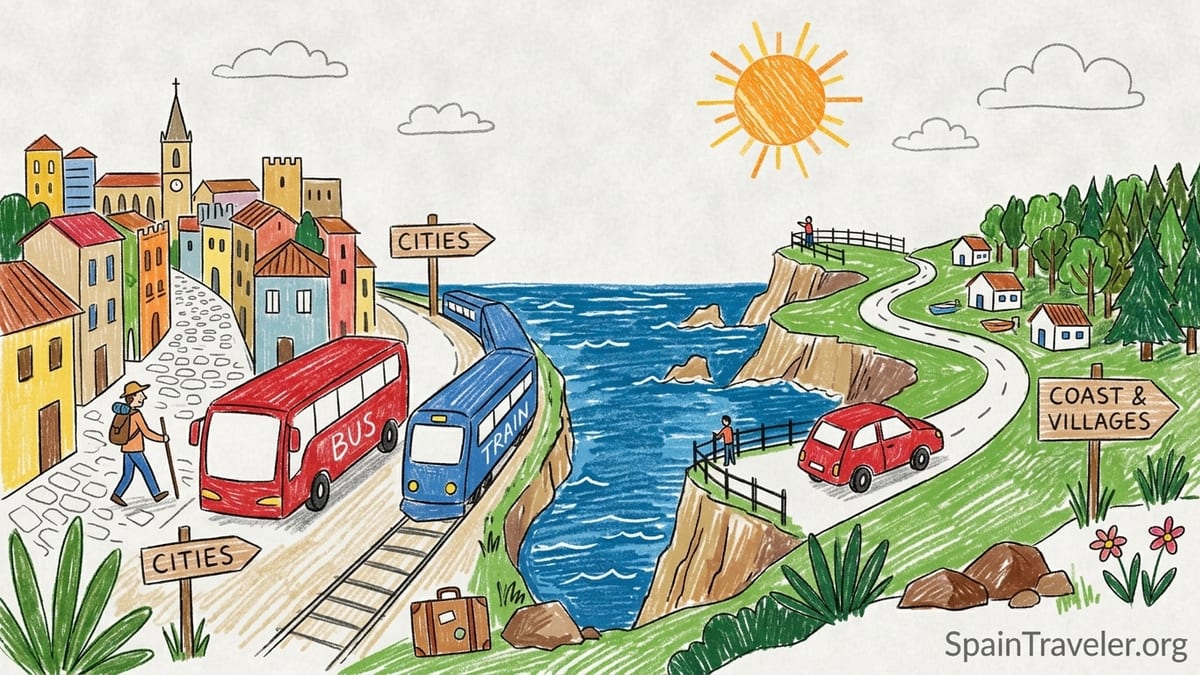
The first decision is whether you need a car at all. Along much of the Spanish Atlantic and northern coast, trains and buses connect the main cities efficiently, while compact historic centers make walking the easiest way to explore. San Sebastián, Santander, Cádiz and Bilbao itself are classic examples: you can land at the airport, take public transport or a taxi into town, and comfortably see the old quarter, waterfront and museums on foot with maybe a single rideshare or taxi each day.
Where a car becomes valuable is once you move into the rural edges of Galicia, Asturias and Cantabria, and down in the Costa de la Luz in Andalusia. Think of places like the Rías Baixas fishing villages west of Vigo, the clifftop miradores on the Costa da Morte, the tiny coves between Llanes and Ribadesella in Asturias, or the broad Atlantic beaches between Conil de la Frontera, Zahara de los Atunes and Tarifa. Public transport exists but runs infrequently, and some of the best spots are simply not reachable without your own wheels.
For a typical ten-day itinerary, this often means combining city time without a car and coastal time with one. For example, you might spend three nights car-free in San Sebastián, then pick up a car in Bilbao airport for a loop through Cantabria and Asturias, or stay in Seville without a car and then collect one on departure day for a circuit of the Costa de la Luz, dropping in Jerez or back in Seville. Planning your rental around these high-value driving segments is far more efficient than carrying a car into every old town where parking is a hassle.
Budget also plays a role. In shoulder seasons you might see compact manual cars advertised for around 20 to 40 euros a day at major airports such as Bilbao or Santiago, but once you factor in one-way drop fees, extra insurance and parking charges, keeping a car idle for city days can quickly add several hundred euros to the final bill. Matching the rental period to when you truly need a car is the single biggest way to keep costs under control.
Choosing Your Pickup Hub: Bilbao vs Santander vs Asturias vs Galicia
Most travelers tackling northern Spain by car start in either Bilbao, Santander, Asturias Airport or one of the Galician airports at Santiago de Compostela or Vigo. Bilbao Airport is by far the largest car rental hub in the region, with major brands like Enterprise, Hertz, Avis, Sixt, Europcar and several low-cost operators offering large fleets year-round. Offices sit in or next to the terminal car rental hall and, in normal periods, you will find everything from small manuals to SUVs and automatics. This depth of supply usually makes Bilbao the most forgiving place for last-minute bookings or for securing an automatic transmission.
Santander and Asturias airports have fewer flights and smaller rental fleets, but they can be very convenient if your route is focused on Cantabria or Asturias rather than the Basque Country. In practice, the smaller fleets mean less competition and occasionally higher prices for one-way rentals in peak summer, and automatic cars often sell out first. Travelers flying into Santander specifically to drive the coast should book well ahead for July and August, and be prepared to pick up or return at Bilbao if they need more flexibility.
In Galicia, Santiago de Compostela Airport acts as the main gateway, with a runway of rental desks lining the arrivals hall and brands ranging from international names to regional brokers. Despite being a relatively small city, the volume of pilgrims and tourists means car hire is well developed, and you can usually find automatics if you reserve in advance. Vigo Airport is smaller but practical if you are concentrating on the Rías Baixas, Cíes Islands access point in Vigo, and nearby coast. With fewer flights and rental counters, however, selection can be limited, so Vigo is best for those who already hold a confirmed booking rather than relying on walk-up availability.
Asturias, Cantabria and Galicia might look close on the map, but driving times between airports are non-trivial. For example, Bilbao to Santiago by motorway takes around five hours of driving. Changing pickup hubs mid-trip rarely makes sense unless you are ending a non-driving city stay and beginning a dedicated rural segment. In most cases, it is better to choose one of these airports as your main hub, do a one-way drop at another major airport if necessary, and accept the associated fee.
Andalusia and the Algarve: Seville, Jerez and Faro Compared
At the southern end of this coastal arc, Seville, Jerez and Faro serve different needs. Seville Airport is the largest Andalusian gateway for many international flights, with a broad range of car rental companies and substantial fleets. It is ideal if your plan includes both the city of Seville and onward driving to the Costa de la Luz beaches around Cádiz, Conil, Vejer or Tarifa. Jerez Airport is much smaller and more seasonal, but if you find a good connection there, it can be the perfect low-stress pickup for a beach-focused trip anchored around Cádiz and the sherry country.
Faro Airport, just across the border in Portugal, is the main entry to the Algarve and also a significant base for people combining southern Portugal with western Andalusia. Its car rental market is very competitive, with multiple major brands and many local companies clustered in or around the terminal. That competition can translate into attractive base rates, particularly outside peak August holidays, but travelers must scrutinize fuel policies, deposit requirements and extra insurance charges, which can vary sharply between providers.
From a pure driving perspective, Seville or Jerez are better starting points if your focus is Spanish Costa de la Luz towns like El Puerto de Santa María, Zahara de los Atunes and Tarifa, as you avoid cross-border paperwork and international one-way constraints. Faro works well if your trip is truly bi-national, for example Faro to Lagos, Sagres, then across to Huelva and back to Seville by bus or train. Where many travelers run into problems is trying to use Faro as a cheap pickup and then dropping the car in Spain, which leads directly into high international one-way fees.
As with the northern airports, Seville tends to offer the best combination of availability and pricing for automatics, particularly for US and Canadian drivers who are less comfortable with manuals. Jerez’s smaller fleet can mean that automatic compact SUVs, which are popular with families headed for the coast, sell out quickly in August and during major events like the Jerez MotoGP weekend. Booking several months ahead is wise if you intend to pick up in Jerez during those periods.
One-Way Drop Fees and the Cost of Crossing Borders
One-way rentals are one of the biggest decision points on this route. Within mainland Spain, most major companies allow one-way rentals between airports such as Bilbao, Santander, Asturias, Santiago and Vigo, usually with a fixed surcharge. For example, some Spanish agencies publish domestic one-way fees on internal grids that show routes like Bilbao to Santiago or Asturias to Santander as permitted, with a supplement that might run to a rough range of several dozen euros on shorter hops and higher for longer cross-country returns. Exact amounts vary by company and season, but it is common to see a line item that adds a noticeable percentage to the rental total.
For many travelers, the convenience is worth it. A typical itinerary might start in Bilbao, wind along the coast through Cantabria and Asturias, dip into western Galicia, then finish in Santiago de Compostela with a car drop at the airport before taking a flight or train onward. On a ten-day rental, the extra domestic one-way fee often feels manageable when compared to the value of avoiding a full day’s backtracking drive. The key is to check that the surcharge is clearly itemized in the quote rather than appearing as a surprise at the counter.
International one-way rentals between Spain and Portugal are a different story. While a few larger brands technically permit picking up in Seville and dropping in Faro or Lisbon, or the reverse, the surcharges can be substantial, sometimes rivaling or exceeding the base rental price on shorter bookings. Travelers frequently report that cross-border drops are “unheard of” with many companies or only available under premium conditions with steep fees. A more practical approach is usually to drop the car in one country near the border and continue by bus, train or taxi to pick up a new rental in the other.
Driving a Spanish rental into Portugal or vice versa for a round trip is generally easier, provided the company authorizes it and you pay a smaller cross-border permission fee. Many Spanish airport branches specify that their vehicles may be driven into Portugal as long as they remain registered on the contract, and some Portuguese firms explicitly allow travel into Spain for an added daily charge or a one-off fee. This can work well if you plan a loop that starts and ends in the same country, such as Seville to the Costa de la Luz, across to the Algarve, and back to Seville, returning the car where you started.
Automatic Availability: Where to Find the Easiest Options
Automatic transmission cars are no longer rare in Spain and Portugal, but they are still a minority of the fleet in many regional airports, and they sell out quickly in peak season. Bilbao, Seville and Faro usually offer the widest selection by virtue of their size. At these hubs you will find everything from compact hatchbacks to mid-size SUVs and even people carriers with automatic gearboxes, particularly with large international brands. Prices for an automatic can run noticeably higher than for a manual, with daily differentials that add up over a week, but the availability is usually there if you book early.
In smaller airports like Santander, Asturias, Vigo and Jerez, automatic options are more limited. At Santiago de Compostela, a relatively busy regional hub, there are multiple brands that list automatic categories, but in practice some of those bookings are “on request” and can be reallocated if demand is strong. Travelers who must have an automatic should avoid last-minute reservations at these smaller outlets and should be prepared to choose an alternative pickup location, such as Bilbao instead of Santander or Seville instead of Jerez, if the search results show only a handful of automatic cars left.
Seasonality matters as well. Outside of July and August, particularly in May, June, September and October, it is far easier to secure an automatic at a moderate price. During high summer and during specific events like Semana Santa in Seville or local festivals in Bilbao and Santiago, the same automatic category may jump sharply in price or disappear entirely from search results. If your itinerary is fixed around those peak dates, locking in the car at the same time you book flights and accommodation is sensible.
Finally, be realistic about car size. Rural roads in Galicia, Asturias and Cantabria are often narrow, with stone walls and tight village corners. A compact or compact SUV is usually a better choice than a large SUV or people carrier, even for families, both for driving comfort and for squeezing into village parking spots. An automatic compact SUV balances ease of driving with manageable dimensions and is usually easier to find than a full-size automatic in smaller airports.
Insurance, Deposits and Real-World Costs
Insurance structure is another key factor that differs between countries, companies and pickup points. Standard Spanish and Portuguese rentals typically include a basic collision damage waiver with a deductible that can run into the four figures in euros, meaning you are still on the hook for a substantial excess in the event of damage. At the counter you will be offered various extra coverages to reduce or eliminate that excess. Buying the company’s top-tier coverage can easily add a significant daily surcharge, sometimes approaching the base rate itself for short rentals.
Many travelers choose to rely on a credit card’s rental coverage or an independent policy instead of the most expensive in-house options. If you take this route, you will usually still need a substantial deposit held on your card at pickup, and you must be comfortable fronting repair costs and claiming reimbursement later in the event of damage. Terms vary by provider and country, so confirm in advance that your card’s coverage applies in both Spain and Portugal if your route crosses the border, and print or save proof for the counter staff.
Smaller regional and low-cost rental companies, particularly around Faro and some Spanish airports, may advertise very low daily rates but make up the difference through mandatory insurance packages, fuel policies that require you to pay for a full tank at a marked-up rate, and high fees for late returns or small dings. Reviews frequently mention long inspection processes and aggressive up-selling. Larger international brands are not immune from these practices, but their rules tend to be more standardized and easier to understand before you book.
One underappreciated cost is add-ons like cross-border authorization, additional drivers and child seats. For a couple planning to share driving between Bilbao and Santiago, adding a second driver at the time of booking can be far cheaper than at the counter. For a family collecting a car in Seville and touring the Costa de la Luz, the cost of two child seats over ten days can rival an extra day’s rental. In all these airports, reading through the detailed tariff or conditions, rather than just the headline daily rate, is the best way to avoid surprise charges.
Parking Realities: Cities vs Villages and Beach Towns
The parking experience varies dramatically between the big cities, mid-size coastal towns and rural villages along this route. In compact historic centers such as San Sebastián, Bilbao, Santiago de Compostela and Cádiz, parking in the old town is either heavily restricted or effectively impossible. Visitors usually rely on underground garages at the edge of the center, with day rates that can be a noticeable line item in the travel budget. For example, staying three nights in central San Sebastián or Bilbao with daily garage fees can easily add the equivalent of one extra day of car rental to the total cost.
By contrast, mid-size coastal cities such as Santander, Gijón, A Coruña or Vigo often have a mixed picture. Central streets use paid curbside parking during the day, but you can usually find cheaper municipal or private garages a short walk from the waterfront. Overnight parking on the street may be free or cheaper in residential areas slightly outside the tourist core. In practice, this encourages a pattern where travelers park the car once on arrival, explore the city on foot, and only touch the vehicle again when leaving, which makes it wasteful to keep a rental for multiple purely urban days.
In rural Galician and Asturian villages, parking is often informal but physically tight. Many fishing ports and ría-side hamlets have small public lots near the harbor or church, which fill quickly at lunchtime and on weekends. Locals may also park in ways that feel creative to visitors, squeezing into narrow spaces or partially onto verges. In popular beach villages in Cantabria and Asturias, summer weekends can see long queues for the main beach car park, with attendants turning cars away once full. Arriving early in the day and choosing smaller, more maneuverable cars pays dividends here.
Along the Costa de la Luz, parking near major beaches such as La Barrosa, Bolonia or Valdevaqueros is a mix of official paid lots, roadside pull-offs and informal fields that operate as seasonal car parks. On busy August afternoons, attendants may manage queues and charge flat rates for the day, but on shoulder-season weekdays it can be more relaxed and sometimes free. Here again, having a car is a major advantage compared with relying on infrequent buses, but the overall experience is smoother if you plan to arrive outside the peak midday window when lots are fullest.
Where a Car Adds the Most Value vs When to Go Car-Free
For Galicia, Asturias and Cantabria, the most rewarding use of a rental car is to stitch together small places that would otherwise be awkward or impossible to reach in a single day. A driver based near Llanes in Asturias can wake up and decide between an inland drive to the Picos de Europa, a string of beaches along the coast, or a circuit through cider country, changing plans based on weather. In Galicia, a car makes it easy to combine hilltop viewpoints above the rías with small seafood villages and hidden coves in a single loop, something that public transport timetables rarely permit.
In the Costa de la Luz, a car is equally transformative. Staying in a whitewashed hillside town like Vejer de la Frontera or in a beachfront place such as Zahara de los Atunes, you will quickly discover that buses are sparse, taxis are limited and distances between beaches, villages and hiking trailheads are not trivial. With your own car, you can time beach visits around wind conditions, follow the sun along different stretches of sand, and see more than one town without worrying about the last bus back.
On the other hand, there are several places along this route where a car is more burden than asset. San Sebastián’s compact bayfront and old town, Bilbao’s Guggenheim area and Casco Viejo, Santander’s central beaches and Magdalena Peninsula, as well as Cádiz’s walled old city, are all best explored on foot and by public transport. In these cities, driving is mostly a matter of threading one-way systems and hunting for parking, which adds stress without much benefit once you are settled in your hotel.
The most efficient strategy for many travelers is a hybrid approach. For example, you could fly into Bilbao, spend two nights car-free in the city, then pick up a rental at the airport on the morning you depart for Cantabria and Asturias, returning it in Santiago or back in Bilbao once you shift into a purely urban phase. Similarly, you might stay in Seville for several days without a car, then collect one on departure to explore the Costa de la Luz and drop it in Jerez or Seville Airport the morning you fly home.
The Takeaway
Planning a rental car along the Spanish Atlantic coast and the adjacent Algarve is less about finding the absolute cheapest deal and more about aligning your pickup point, route, and city stays. Bilbao, Seville and Faro are the heavyweight hubs with the deepest fleets and best odds of securing an automatic, while Santander, Asturias, Santiago, Vigo and Jerez work well for more focused regional trips with advance planning. Domestic one-way drops within Spain are usually manageable if factored in from the start, but cross-border one-way rentals between Spain and Portugal often carry punishing surcharges that make them poor value.
A car is most valuable where public transport thins out: the green coasts of Galicia, Asturias and Cantabria, and the long beaches of the Costa de la Luz. In contrast, walkable cities like San Sebastián, Bilbao, Santander and Cádiz reward a car-free approach. By keeping the car only for the days when it opens up countryside and coast, choosing realistic car sizes, and understanding insurance and parking realities, you can turn this fragmented coastline into a coherent, low-stress road trip rather than an expensive logistics puzzle.
FAQ
Q1. Is it better to start a northern Spain road trip in Bilbao or Santander?
Bilbao is usually the better starting point because it has more flights, more car rental companies and a larger fleet, especially for automatic cars, which makes availability and pricing more forgiving than in Santander. Santander can work if your flights line up and you book early, but Bilbao is generally more flexible.
Q2. Can I pick up a car in Bilbao and drop it in Santiago de Compostela?
Yes, most major rental companies allow one-way rentals between Bilbao and Santiago airports, but they usually charge a domestic one-way fee. This surcharge is often worthwhile if it allows you to drive the coast in one direction without backtracking, but you should confirm the amount in your quote before booking.
Q3. How hard is it to find an automatic rental car in northern Spain?
At larger airports like Bilbao and Santiago de Compostela, automatics are widely available if you book in advance, though they cost more than manuals. At smaller airports such as Santander, Asturias and Vigo, the selection is smaller and automatics can sell out for peak summer dates, so early reservation and flexibility with pickup location are important.
Q4. Should I rent a car in San Sebastián or just use public transport?
For most visitors, it is better to explore San Sebastián without a car and only rent one when you are ready to leave the city. The old town and bayfront are compact and walkable, parking is expensive and limited, and buses or taxis cover the occasional longer hop, whereas a car mainly adds parking hassles.
Q5. Is it worth renting a car in Galicia, or can I rely on trains and buses?
Trains and buses connect the main Galician cities, but a car is extremely valuable for exploring the Rías Baixas, Costa da Morte and small inland villages. Many of the best viewpoints, beaches and fishing ports have infrequent public transport, so a car lets you combine them in a single day and adjust plans to weather and tides.
Q6. Can I pick up a car in Seville and drop it in Faro or Lisbon?
Some companies allow cross-border one-way rentals between Spain and Portugal, but the fees can be very high, sometimes close to or greater than the base rental cost for short trips. A more practical approach is usually to return the car in Spain, travel across the border by bus or train, and start a new rental in Portugal.
Q7. Do I need a car to visit Cádiz and the Costa de la Luz?
You do not need a car to enjoy Cádiz city itself, which is compact and pedestrian friendly, but a car is very useful for the wider Costa de la Luz. Towns such as Conil de la Frontera, Zahara de los Atunes and Tarifa are spread out along the coast, public transport is limited, and driving makes it much easier to reach beaches and viewpoints.
Q8. How expensive is parking in cities like Bilbao, Santander and Santiago?
In the central areas of these cities, you should expect to pay for underground garages or regulated on-street parking, with full days often adding a noticeable amount to your budget. While exact prices vary, keeping a car parked for several consecutive city days can add up to the equivalent of an extra rental day or more, which is why many travelers return or delay collecting a car for urban stays.
Q9. Is it safe and practical to drive rural roads in Asturias and Cantabria?
Yes, it is generally safe and very rewarding, but you should be prepared for narrow, winding roads, occasional livestock, and tight village streets. Choosing a smaller car, driving cautiously, and avoiding night driving on unfamiliar rural routes will make the experience far more comfortable.
Q10. When should I book my rental car for a summer trip along this coast?
For July and August travels, especially if you need an automatic or plan to pick up at smaller airports like Santander, Asturias, Vigo or Jerez, it is wise to book several months in advance. This gives you better choice of cars, more predictable pricing and time to compare domestic one-way and insurance costs across different pickup and drop-off combinations.