


The Spanish Atlantic coast has quietly become one of Europe’s most interesting surf playgrounds, from wild Galician headlands to mellow Cádiz beach breaks. Spain’s official tourism board now highlights Mundaka, Zarautz, Ferrolterra, Rodiles, Salinas, Somo and El Palmar as key surf hubs, and around them a dense network of surf camps has grown up. In 2026 you can choose anything from simple room-only packages to full-board weeks with daily coaching, yoga and airport transfers. This guide looks at some of the most established destinations and camps in Galicia (Pantín and Valdoviño), Asturias, Somo and San Vicente de la Barquera in Cantabria, Zarautz in the Basque Country, and El Palmar and Tarifa in Cádiz, focusing on beginner suitability, seasonality and what you actually get for your money.
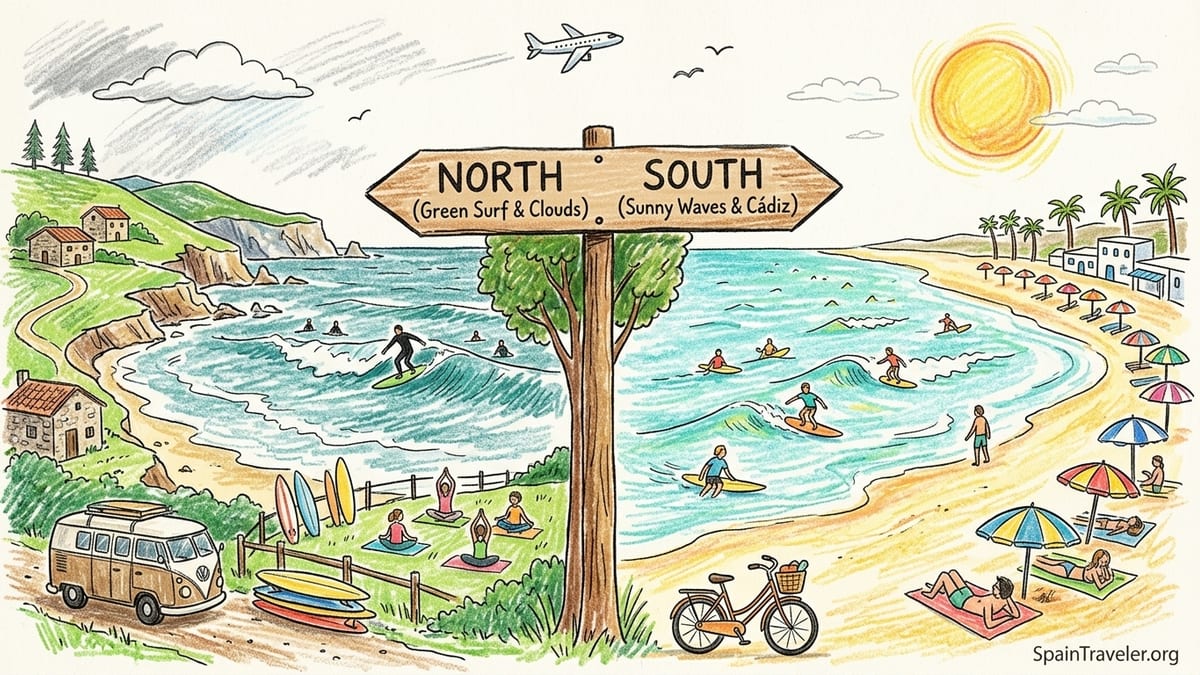
Choosing Between the North and the South Atlantic Coasts
For a first surf trip to Spain, the main decision is often whether to head to the green, wave-rich north or the sun-drenched beaches of Andalusia. Galicia, Asturias, Cantabria and the Basque Country all face the open North Atlantic and collect solid swells from autumn to spring. Summers are milder, with more beginner-friendly days and cooler air and water. Cádiz province, centred on El Palmar and Tarifa, looks toward the Atlantic but sits much further south, which means warmer water, more sun and a slightly shorter, but often gentler, surf season for first-timers.
In practice, that means a July week in Somo or Zarautz will often involve waist- to chest-high waves, 3/2 mm wetsuits and cool evenings, while the same week in El Palmar can be t-shirt weather on land with small, playful peaks and early-morning glass. By contrast, an October trip to Galicia’s Pantín or Valdoviño might deliver powerful overhead surf suited to confident intermediates joining guided camps, whereas El Palmar’s main season for reliable waves tends to cluster between November and March, when winter swells wrap into the long beach break but air temperatures remain relatively mild.
From a budget perspective, northern spots like Somo, Rodiles and Salinas still offer a wide spread of prices, from basic tented surf camps that start around the mid-hundreds of euros for a week including group lessons, through to boutique surf houses close to or right on the beach. In Cádiz and Tarifa, prices have risen in step with their broader tourism appeal, but you can still find week-long surf and yoga packages in El Palmar that remain competitive with Cantabrian or Basque equivalents, especially in shoulder seasons like March, April or November.
What unites all of these destinations in 2026 is that surf-camp packages are flexible. Along the Spanish Atlantic you will see everything from accommodation-only rooms where you bolt on a handful of lessons, to fully catered one or two-week experiences with twice-daily coaching, yoga, equipment hire and airport transfers bundled into a single price. The detail varies by region, so it pays to understand the feel of each coast before you book.
Galicia’s Ferrolterra: Pantín and Valdoviño
Ferrolterra, on the wild northern coast of Galicia, is now firmly on the international surf map. Pantín hosts Spain’s stop on the World Surf League, drawing pros to its sand-bottomed bay, while nearby Valdoviño offers long, open beaches that catch almost any swell. Camps here make the most of that consistency. A typical example is a women-focused camp in Pantín running in summer 2026, where packages for a week combine shared accommodation, breakfast and dinner, daily coaching tailored for adult beginners and improvers, plus yoga or stretching sessions to offset the paddle fatigue.
For beginners, Pantín and Valdoviño are best in late spring through early autumn, roughly May to September, when swell sizes are more manageable and water temperatures creep into the high teens or low twenties Celsius. In winter, these beaches can be heavy, with strong rips that suit experienced guided surfers rather than absolute first-timers. Camps tend to adapt by reducing lesson intensity or shifting sessions to the most sheltered banks. Some providers use minivans to shuttle guests to more protected coves if Pantín’s main peaks become too powerful for the group.
Accommodation in Galicia’s surf camps often leans rural and low-key. Converted stone houses or farmsteads close to the coast are common, sometimes with dorm-style rooms, sometimes with a mix of doubles and family rooms. A week-long package might include half-board meals focused on local Galician produce, four to six surf lessons with equipment included, and optional extras like video analysis. Airport transfers are usually offered from A Coruña or occasionally Santiago de Compostela, either included in premium packages or available for an additional fee that is commonly priced to be shared among arriving guests on the same day.
Yoga is increasingly part of the mix in Ferrolterra, though not yet as ubiquitous as in some Portuguese or Indonesian surf retreats. Many 2026 packages advertise at least a couple of guided mobility or yoga classes during a week-long stay, aimed at loosening shoulders and backs after consecutive paddling days. That can be a deciding factor if you are choosing between a simple accommodation-and-lessons setup and a slightly higher-priced camp that integrates more structured recovery and wellbeing sessions.
Asturias: Rodiles, Salinas and Quiet Beach Town Camps
Continuing east, Asturias offers a quieter alternative to the Basque and Cantabrian hotspots, with a mix of estuary river-mouths and open beaches. Rodiles, singled out by Spain’s tourism board, is famous for its long, peeling left on the right sandbank, while Salinas, near Avilés, is a long, urban-backed beach that hosts surf festivals and contests. For complete beginners, camps often base themselves either near mellow sections of these beaches or in smaller nearby towns where sandbars are more forgiving.
The main surf season for camps in Asturias runs from May through October, mirroring Galicia but with a slightly more sheltered feel thanks to local headlands. In early summer, wind patterns often favour clean, shoulder-high days that are ideal for learners. Many Asturian surf houses structure their offers around half-board accommodation in converted casonas or simple hostels with communal kitchens, pairing that with a daily lesson and full-day board hire so you can practice outside lesson time if conditions are gentle.
Prices in 2026 for a one-week surf camp in Asturias typically sit in the mid-range of Spain’s Atlantic coast: higher than the most basic tent camps in Somo or Galicia but usually below the more premium houses in Zarautz or central El Palmar. Meals are often standout features, with home-cooked Asturian dishes and a focus on local cider culture. Yoga is less central here than in some other regions, but many camps now partner with nearby studios or freelance instructors to offer evening sessions on demand, especially in high season.
Airport transfers in Asturias are comparatively straightforward, since Asturias Airport near Avilés is small and close to many surf towns. Some camps build transfers into their package price, especially family or teen camps, while adult-focused houses more often offer them as an add-on or simply provide clear public transport guidance for budget-conscious travelers happy to combine train and taxi.
Cantabria: Somo and San Vicente de la Barquera
Cantabria is one of Spain’s most developed surf-camp regions and a clear choice for first-time visitors. Somo, recognised officially as a major surf area and designated Spain’s first natural surf reserve, is a classic sandy bay facing the open sea. It has multiple peaks spread along a wide sandbar, which means there is usually room for different levels. Several long-running surf schools operate here, alongside tented surf camps that open from early June through mid-September and hostel-style lodgings that remain open for much longer.
In 2026, a representative Somo package for one week might include six nights in a shared tent or simple surf hostel, five days of group lessons of around two hours each, surfboard and wetsuit hire for the full stay, and breakfast or half-board meals. Indicative prices for these all-in weeks often sit in the mid-hundreds of euros, with upgrades for private rooms or glamping-style tents. There are also more comfortable houses and apartments that partner with surf schools, allowing guests to book accommodation-only then add a set of four to six lessons spread across the week.
Somo is particularly good for beginners from June to September, when water temperatures rise and summer sandbars slope gently, though experienced surfers might prefer spring and autumn when swells are more powerful. The village itself has grown a vibrant surf-camp culture. You will find children’s day camps that run Monday to Friday with lunch included, classic backpacker-style camps with communal barbecues, and adult-only or women-only surf and yoga weeks where a handful of small-group yoga sessions are scheduled on-site or at a nearby studio.
About ninety minutes further west along the coast, San Vicente de la Barquera combines an attractive old town with quick access to several beach breaks, including Oyambre. Surf camps here lean slightly more rural, with small hostels and campgrounds forming a base. Packages can resemble Cantabrian norms: five or six nights of accommodation paired with five surf lessons, equipment, and sometimes breakfast. For travelers landing in Santander, both Somo and San Vicente are accessible via public transport plus a short taxi ride, but many camps advertise paid pick-ups from Santander or, less commonly, Bilbao airports to simplify arrival.
Zarautz and the Basque Country: Long Beach, Strong Identity
Zarautz in the Basque Country is one of the best-known surf towns in Spain and officially highlighted as a major surf zone. The town stretches along a curved bay backed by a promenade and a line of surf schools and rental shops. Camps here usually take the form of surf houses in the hills above the town or shared accommodation near the beach, pairing housing with lesson packages and often a social programme of communal dinners, evening gatherings and occasional excursions to nearby San Sebastián.
In 2026, a typical week-long Zarautz camp offers seven nights of accommodation and a bundle of surf sessions that might combine five group lessons with gear plus free-use periods when you can take boards out under your own steam. Some houses advertise weekend surf camps with two nights, two or three lessons and at least one yoga or dry-land training session. Surf and yoga is a common combination here, with classes often held on terraces overlooking the bay or in small indoor studios when the weather is unsettled.
For beginners, summer and early autumn are generally the most forgiving periods in Zarautz. As with Somo, July and August bring crowds but also plenty of small, approachable waves. The beach can still handle more size in shoulder seasons, so improvers who want punchier conditions often visit in September or October. Prices tend to be slightly higher than in most of Cantabria or Asturias, reflecting a strong Basque tourism market and Zarautz’s popularity with city break visitors from nearby San Sebastián and the French Basque coast.
Meals in Basque surf houses often showcase local gastronomy, from simple pintxos-style snacks at communal dinners to occasional organised evenings in traditional cider houses or nearby restaurants. Some camp packages build breakfast and most dinners into the rate, while others keep it flexible, offering only breakfast so guests are free to explore the town’s restaurants. Airport transfers are commonly organised from Bilbao or Biarritz for an extra fee, though train connections are also popular for independent travelers.
Cádiz: El Palmar and Tarifa on the Atlantic Edge
Far to the south, Cádiz province offers an Atlantic coast with a very different personality. El Palmar, near Vejer de la Frontera, has been explicitly identified as a major Spanish surf area and is widely regarded as one of the best beach breaks in Andalusia. Its sandy bottom, multiple peaks and reliable winter swells make it a strong option for both beginners and more advanced surfers looking for a warm-water European winter. The town is small and seasonal, with chiringuitos, surf schools and rental shops lining the beachfront during the busier months.
El Palmar’s main learner-friendly window typically runs from late autumn to early spring, roughly November through March, when the Atlantic sends consistent groundswells that translate into waist- to head-high waves along the beach. Summer can be flatter or dominated by wind, while winter mornings often produce glassy walls before the breeze picks up. Surf camps here range from compact surf houses offering room-only or bed-and-breakfast stays plus lesson packs, to structured full-board youth camps in summer that include accommodation, three meals daily and daily surf instruction.
South and east of El Palmar, Tarifa is better known as a kitesurf capital, driven by its famously strong Levante and Poniente winds. However, many broader “surf camps” based in or around Tarifa give guests the option of both wave-surfing days in nearby El Palmar or other beaches and kite-focused days closer to Tarifa’s own shoreline. Teen language and activity camps in Tarifa, for example, may include optional surf or stand-up paddle excursions alongside Spanish classes and general beach time, which suits families wanting a mix rather than a pure surf-intensive week.
Accommodation standards in Cádiz surf camps vary widely. In El Palmar you can find simple shared houses with bunk rooms and communal kitchens, renovated farmhouses set back from the dunes with gardens for yoga, and small family-run guesthouses that partner with a specific surf school. Food is usually a highlight, featuring Andalusian seafood, seasonal vegetables and relaxed outdoor dining. Airport transfers are most often arranged from Jerez or occasionally Seville or Málaga, sometimes included in high-season youth packages but more commonly priced separately for adults and charged per journey or per person.
Comparing Beginner Conditions, Seasons and Inclusions
For a first surf trip, wave shape, water temperature and group sizes matter as much as price. Somo and Zarautz are among the most forgiving options, thanks to their long, sandy beaches with multiple peaks that spread crowds and allow instructors to split groups by level. In high summer they can feel busy, but that also means plenty of infrastructure: rental shops, cafés, medical services and alternative activities on flat days. El Palmar offers similarly approachable beach breaks in winter, but winds and sandbanks change more frequently, so beginners benefit from camps that adjust session times and chosen peaks each day.
In contrast, Pantín and Valdoviño in Galicia and some Asturian spots like Rodiles can be more powerful, especially outside summer. They are fantastic for intermediates and advanced surfers joining guided camps that emphasise reading conditions, paddling out through stronger currents and handling larger sets. If you are a true beginner keen on these wilder coasts, look for camps that explicitly mention working with first-timers, small group ratios and the option of moving to more sheltered beaches when the main breaks get too heavy.
In 2026, surf-camp seasons are broadly similar across the north: most open fully from around June and wind down by late September or early October, with a few houses staying open later for storm-season surfers. Somo, San Vicente and Zarautz showcase a classic nine- to twelve-week summer peak when tent camps operate at full capacity and daily group lessons are guaranteed. In Cádiz, especially El Palmar, the focus shifts to winter and early spring. Many camps promote week-long surf and yoga retreats running from late autumn into March, when Atlantic swells are most reliable and there are fewer general beach tourists.
Inclusions vary, but there are some patterns. Northern tent camps typically bundle shared accommodation, breakfast and sometimes dinner, plus a five-day lesson package and unlimited use of soft-top boards and wetsuits, while more upmarket surf houses offer private rooms, higher-quality meals and smaller class sizes. Yoga is almost standard in Basque, Cantabrian and Cádiz retreat-style camps, whereas in more straightforward school-style setups yoga might be an optional add-on. Airport transfers are rarely universal; many camps offer them for a fee and encourage car rental or public transport for those seeking flexibility.
How to Choose Between Accommodation-Only and Full-Board Camps
Spain’s Atlantic surf camps span a wide spectrum from bare-bones to all-inclusive. Accommodation-only options are most common in places with dense surf infrastructure like Somo, Zarautz and El Palmar, where numerous independent schools line the beach promenade. Booking a room in a surf house and then assembling your own package of board hire and two-hour group lessons day by day can be a cost-effective and flexible approach, particularly if you are unsure how many days you will want to surf or if you plan to explore multiple beaches.
Full-board weeks, on the other hand, suit travelers who want to switch off and be taken care of. In Pantín, Somo or San Vicente you will find camps that include breakfast, packed lunches and evening meals, plus daily coaching and equipment. That structure is especially attractive for solo travelers, teens, and first-time surf trippers, since it builds in a community and removes the guesswork around where to eat or when to surf. In Cádiz and the Basque Country, many surf and yoga retreats follow this model, sometimes adding extras like guided meditation, breathwork or cultural excursions.
Price differences between accommodation-only and full-board can appear large at first glance, but when you factor in the cost of restaurant meals, separate lessons, transport and board rental, the gap often narrows. A full-board camp with inclusive lessons might deliver better overall value if you plan to surf every day and enjoy social evenings. Conversely, if you intend to combine surfing with day trips, city visits or hiking, a breakfast-only surf house in Zarautz or a simple apartment in Asturias with pay-as-you-go lessons could keep your costs and schedule more flexible.
When comparing offers, pay attention to details such as maximum group sizes in the water, whether equipment hire outside lesson times is included, and how many yoga or cross-training sessions are part of the base price. Ask specifically about airport or station transfers, as a seemingly cheaper camp located far from public transport can quickly become more expensive if every arrival and departure requires a private taxi from a regional airport.
FAQ
Q1. Which Spanish Atlantic surf camp is best for complete beginners?
For complete beginners, Somo in Cantabria and Zarautz in the Basque Country are strong choices thanks to their long, sandy beaches, numerous surf schools and well-established beginner-focused camps, especially in summer.
Q2. When is the best time of year to surf in Galicia’s Pantín and Valdoviño?
The most beginner-friendly period in Pantín and Valdoviño is usually from May to September, when swells are smaller and water temperatures are milder, though conditions can still be powerful on big Atlantic swells.
Q3. Is El Palmar in Cádiz suitable for a first-ever surf trip?
El Palmar can work very well for beginners, particularly from late autumn to early spring when consistent Atlantic swells create user-friendly beach breaks, provided you book with a camp that adapts session times and locations to daily wind and sandbank changes.
Q4. How do surf-camp prices in Spain compare between the north and Cádiz?
Broadly, northern destinations like Somo and Asturias offer slightly more budget tent camps and simple hostels, while El Palmar and Tarifa often price closer to mid-range retreat levels, though shoulder-season deals in Cádiz can match northern prices.
Q5. Do Spanish surf camps usually include airport transfers?
Some camps include transfers, particularly youth or teen-focused programmes, but many adult surf houses treat airport pick-ups from hubs like Santander, Bilbao, A Coruña, Jerez or Málaga as optional paid extras.
Q6. Can I find surf camps that include yoga on the Spanish Atlantic coast?
Yes, surf and yoga combinations are now common in Zarautz, Somo, San Vicente and El Palmar, with many week-long packages including several yoga or mobility sessions alongside daily surf lessons.
Q7. Are there women-only or adult-only surf camps in these regions?
Across Galicia, Cantabria and Cádiz you will increasingly see women-only weeks and adult-only dates, for example women’s surf trips in Pantín and adult surf camps in Somo that focus on small-group coaching and a social but relaxed atmosphere.
Q8. What kind of accommodation do Spanish surf camps typically offer?
Accommodation ranges from simple shared tents and bunk rooms in classic surf camps, through hostel-style surf houses and renovated rural homes, to more boutique lodgings with private rooms and gardens for yoga or barbecues.
Q9. Do I need a car if I stay in a Spanish surf camp?
In towns like Somo, Zarautz and El Palmar you can manage without a car because surf schools, restaurants and beaches are walkable, while more rural Galicia or Asturias camps may recommend a car for exploring alternative spots and nearby villages.
Q10. How far in advance should I book a surf camp on the Spanish Atlantic coast?
For peak summer weeks in Somo, Zarautz or San Vicente, and for popular winter retreats in El Palmar, it is wise to book several months ahead, while shoulder-season dates often remain available closer to arrival.