


Spain’s Green Coast has two headline luxury trains, both run by Renfe: the Costa Verde Express and the Transcantábrico Gran Lujo. They follow broadly similar Atlantic routes through the Basque Country, Cantabria, Asturias and Galicia, but they deliver very different experiences and sit at very different price points. If you are trying to decide where to spend several thousand euros and a precious week of vacation, the details matter. This guide breaks down cabins, routes, excursions, food, dates and overall value to help you choose the right train for your style and budget.
Understanding Renfe’s Two Northern Luxury Trains
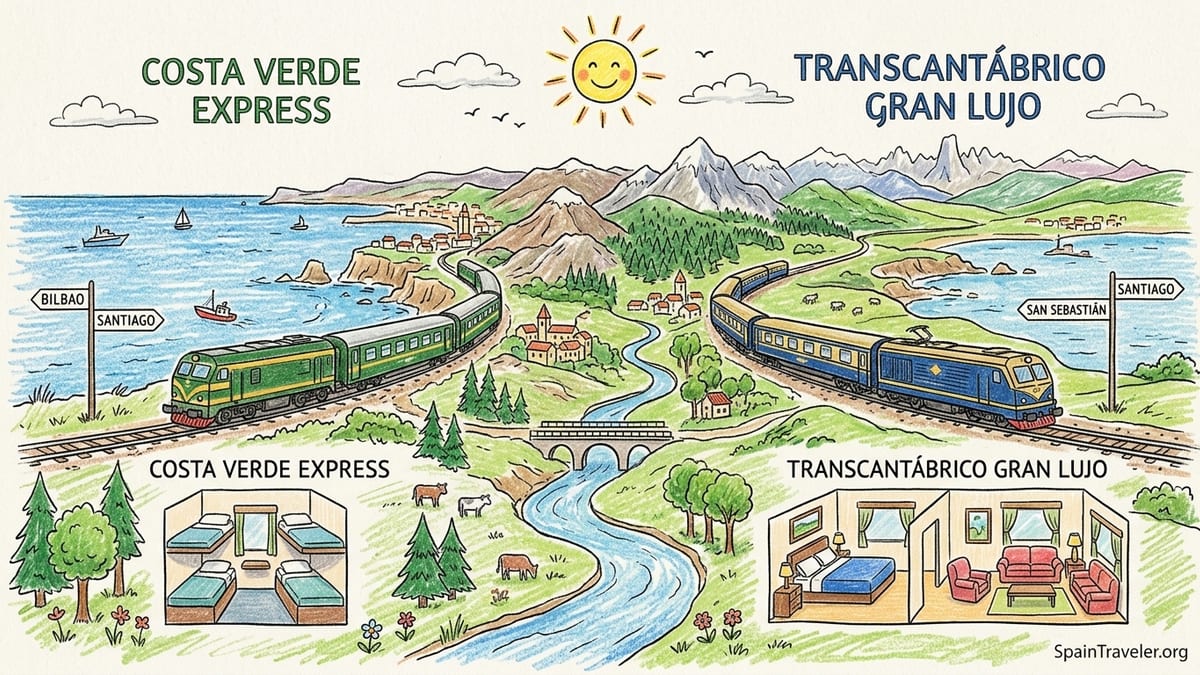
Both the Costa Verde Express and the Transcantábrico Gran Lujo are part of Renfe’s portfolio of “Trenes Turísticos de Lujo,” multi-day rail journeys that function more like moving boutique hotels than point-to-point transportation. They share heritage: the Costa Verde Express is the rebranded successor to the former Transcantábrico Clásico, while the Transcantábrico Gran Lujo is the upgraded flagship that Renfe created after a major refurbishment of historic coaches. The Gran Lujo is now the single top-tier Transcantábrico product, with the Costa Verde Express positioned just below it in space and price but following a parallel coastal concept.
In practice, this means that on both trains you sleep on board, dine on regional cuisine, travel during the day at leisurely speeds along the narrow-gauge Cantabrian line, and step off for guided excursions by luxury coach. Both itineraries are fully escorted, all meals are included along with many wines, and each day combines some rail time with visits to coastal towns, fishing villages and historic inland sites. What distinguishes them is mostly the level of space and refinement on board, the length of the trip, and how intensive the included sightseeing program is.
It also matters that both trains are officially operated by Renfe Viajeros and marketed through Renfe’s tourist-train platform and specialist agencies, which keeps standards fairly consistent. You can expect Spanish and international guests, with English-speaking guides typically on board, though the primary language on both trains is Spanish. Departures are limited and seasonal, usually from spring to autumn, so planning around exact dates is part of the decision.
Route & Itinerary: Similar Coastline, Different Pace
The Costa Verde Express generally operates a 6 day / 5 night route between Bilbao and Santiago de Compostela (and in reverse), tracing the Bay of Biscay coastline. Typical stops include Santander, Santillana del Mar and the Altamira area in Cantabria, Llanes and Oviedo in Asturias, plus Ribadeo, Viveiro and Ferrol in Galicia before guests are transferred by coach into Santiago’s old town. The mood is coastal, with a strong emphasis on medieval stone towns, pretty harbors and manageable daily touring rather than marathon days.
The Transcantábrico Gran Lujo follows essentially the same Green Spain arc but stretches it across 8 days / 7 nights between San Sebastián and Santiago de Compostela. The longer route gives time for extra experiences. A classic eastbound itinerary begins with a night in San Sebastián, includes a guided visit to Bilbao with entry to the Guggenheim Museum, continues to Santander, then heads inland through the Hermida Gorge to Potes and the Picos de Europa area before returning to the coast. On the Asturian leg you are more likely to visit places such as Covadonga Sanctuary and lakes in the Picos, while still calling at coastal towns like Llanes and Gijón or Oviedo, then on to Ribadeo, Viveiro and Ferrol before reaching Santiago.
Practically, both trains show you a representative slice of Green Spain: Basque chic in San Sebastián or Bilbao, the belle époque promenades of Santander, the rugged Asturian shore and the Galician rías. The extra two nights on the Gran Lujo allow more time in star locations and more inland forays to mountain landscapes. If your dream is simply to trace the northern coast and you have limited time, the Costa Verde Express delivers that in six days. If your priority is depth, especially in places like the Picos de Europa, the Gran Lujo’s extra days make a real difference.
Cabin Space & Onboard Comfort: How Much Suite Do You Need?
Cabin size is the single clearest differentiator between these two trains. The Transcantábrico Gran Lujo offers only “Grand Luxury” suites, with a maximum of around 14 double suites and a capacity of roughly 28 to 30 passengers. Each suite is effectively a small apartment on rails, with a separate bedroom area, a living area with sofa and large window, and a private bathroom with full shower. Beds are typically fixed double beds rather than convertible sofas, and there is enough space to move around even when the bed is made. For couples used to small ship suites or compact city hotel rooms, Gran Lujo cabins feel genuinely spacious by train standards.
On the Costa Verde Express, you also have all-suite accommodation with private bathrooms, but the footprint is noticeably smaller and closer to classic European sleeper cabins. By day, most cabins have a seating or lounge configuration that converts to beds at night, and storage is more compact. You still get en suite facilities, air conditioning and large picture windows, but you do not have the separate sitting room feel you do on the Gran Lujo. For many travelers who are used to standard train sleepers, this still feels very comfortable, but if you dislike tight quarters, you will notice the difference.
In daily life on board, this plays out in how much time you want to spend in your cabin. On the Gran Lujo, it is natural to retreat after excursions, open a bottle of wine and watch the countryside roll by from your sofa while getting ready for dinner. On the Costa Verde Express, guests tend to spend more social time in the lounge and bar cars, returning to cabins primarily for sleep or short rests. If you are celebrating a honeymoon, significant anniversary or you simply prize private space, the Gran Lujo’s generous suites are a key reason to justify its higher price.
Excursions & Daily Rhythm: Touring Intensity Compared
Both trains operate with an accompanying luxury coach and local guides, which handle most sightseeing while the train stays on the most scenic stretches of the Cantabrian line. Breakfast is usually on board while the train is in motion; you then disembark for morning visits, lunch either in a local restaurant or back on the train, and further short touring in the afternoon, with the train typically moving again toward the evening. Museums, churches and coastal walks are common elements on both itineraries.
The Costa Verde Express schedule is busy but not overwhelming. A typical day might see you visit Santillana del Mar’s historic center and a replica of the Altamira cave in the morning, followed by free time for coffee on the plaza before rejoining the coach. Another day could include a walking tour of Gijón or Oviedo’s old quarter with time afterwards to explore on your own. You will usually fit one or two structured visits and still get some independent time, which suits travelers who like guided interpretation but do not want every hour scripted.
On the Transcantábrico Gran Lujo, the excursions program is denser and leans more heavily into marquee experiences. In Cantabria, the day trip from Santander through the Hermida Gorge to the mountain village of Potes often includes a thermal circuit at a local spa before returning to the train in the late afternoon. In Asturias, a full-day outing into the Picos de Europa might combine the Covadonga lakes, the sanctuary and a lunch of local specialties in a countryside restaurant. Add to this a guided visit of Bilbao that includes Guggenheim entry and more sit-down lunches in notable restaurants, and you can expect fuller days and less unstructured time than on the Costa Verde Express.
Travelers who thrive on curated experiences, want to see as much as possible and appreciate not having to plan anything will likely appreciate the Gran Lujo’s intensive itinerary. Those who prefer time to wander, linger over a coffee or simply stay on board and read while the train is in a siding may find the Costa Verde Express a better fit. In either case, both programs are all-inclusive in the sense that there is no pressure to book extra tours; the excursions that define each train are built into the fare.
Dining & Onboard Atmosphere: Shared Strengths, Subtle Differences
Renfe’s northern luxury trains are built around gastronomy as much as scenery. On both the Costa Verde Express and the Transcantábrico Gran Lujo you can expect multi-course dinners with regional wines, substantial buffet and a la carte breakfasts, and lunches that rotate between on-board service and carefully chosen restaurants on the route. Typical dishes might include grilled Cantabrian fish, Asturian fabada bean stew, Galician octopus, and Basque-style cod, often presented at white-tablecloth settings with attentive yet relaxed Spanish-style service.
The Gran Lujo edges ahead in refinement. With fewer passengers and higher fares, the menus often showcase slightly more elaborate presentations and occasional tasting-menu style dinners. There is more frequent use of well-known local restaurants along the route and more premium wine pairings included as standard. Even in the lounge and bar cars, the choice of snacks, cava and spirits feels closer to a small luxury cruise ship than a standard train. Evening entertainment, such as live music in the pub car, is common and contributes to a clubby, once-in-a-lifetime feel.
The Costa Verde Express offers very good food, typically well above what most travelers expect from any train. However, the atmosphere leans a little more informal and sociable. With slightly more cabins and a lower price point, you are likely to have a more mixed crowd of rail fans, multi-generational families and couples celebrating big trips. The bar car becomes a social hub before and after dinner, and wine flows generously but not ostentatiously. Both trains enforce dress codes that are smart casual rather than black-tie, but Gran Lujo guests are somewhat more inclined to dress up for dinner.
Dates, Seasonality & Price: What You Actually Pay
Both trains operate a limited season, typically from spring through late October. For the Transcantábrico Gran Lujo, Renfe and its partner agencies release specific Saturday departure dates from San Sebastián and Santiago de Compostela, commonly in March, April, May, June, July, August, September and October. For the 8 day / 7 night Grand Luxury Suite, recent pricing for the main season has hovered around or just under five figures per person in a double suite, with single supplements significantly higher and triple occupancy available in some suites. Specialist agencies currently quote prices in the region of 9,000 to 10,000 euros per person for 2025 and 2026 sailings, depending on date and direction.
The Costa Verde Express, on its 6 day / 5 night itinerary between Bilbao and Santiago, is priced notably lower. While exact tariffs vary by year and season, it typically undercuts the Gran Lujo by several thousand euros per person. For example, where a peak-season Gran Lujo departure might price around the high four to low five figures per person, the Costa Verde Express often comes in closer to the mid four figures for the whole six-day package in a double cabin. That differential adds up quickly for couples or small groups, especially once you factor in flights to Spain and pre- or post-tour hotels.
In both cases, the fare is genuinely all-inclusive in a way that justifies part of the sticker shock: all breakfasts, most lunches and all dinners, a wide range of wines and drinks, coach transfers, guided excursions, museum entrances and gratuities for onboard staff. Once you step onto either train, your out-of-pocket costs are largely limited to shopping, bar extras beyond the included list and any add-on private arrangements you choose to make at either end. The main budget variables you can control are the time of year you travel, your cabin occupancy (double versus single or triple) and, crucially, your choice of train.
Which Train Offers Better Overall Value?
Value on these routes is less about finding a bargain and more about aligning what you pay with the experience you truly want. If you divide the approximate fare by the number of nights on board, the Transcantábrico Gran Lujo still comes out significantly more expensive on a per-night basis than the Costa Verde Express. What you are paying for on the Gran Lujo is more than two extra days of touring: it is the much larger suites, the very small guest count, elevated gastronomy and a more intensive, curated program of excursions that includes marquee experiences like Bilbao’s Guggenheim Museum and more time in the Picos de Europa.
From a pure euros-per-kilometer or euros-per-day standpoint, the Costa Verde Express is hard to beat if your priority is to experience Green Spain from a classic luxury train without pushing into flagship pricing. You still sleep in an en suite cabin, dine very well, and see many of the same towns as Gran Lujo guests. Travelers who know they will spend most of their time off the train or in public areas, or who are more excited by the destinations than by having a suite-like cabin, often find that the Costa Verde Express delivers 80 to 90 percent of the overall experience for a noticeably lower cost.
On the other hand, if this is a once-in-a-lifetime journey and you value space, privacy and the feeling of being on a very exclusive train, the Gran Lujo more clearly justifies its premium. For a couple used to staying in junior suites and booking business class flights, the per-night cost fits within that broader luxury travel pattern, and the step up from a standard cabin to a Grand Luxury suite will be immediately tangible. In that sense, both trains offer good value to different markets: one as a high-end but relatively accessible splurge, the other as an ultra-premium rail cruise.
How to Choose: Matching Train to Traveler
If you are a first-time visitor to Spain or Europe and want a comfortable, curated way to see the north without worrying about logistics, the Costa Verde Express is usually the safer starting point. Its six-day format fits more easily into a broader Iberian itinerary that might also include time in Madrid, Barcelona or Porto, and the lower fare leaves budget room for those extra stops. It is particularly attractive for travelers celebrating major birthdays, retirees who are more price-conscious but still want a special trip, or rail enthusiasts who value the historic rolling stock and coastal scenery over ultra-large cabins.
Choose the Transcantábrico Gran Lujo if you are already convinced by the concept of luxury train cruising and know that you will use the extra space and upgraded amenities. It excels as a honeymoon or milestone-anniversary trip, or as a centerpiece for travelers who have already seen much of Spain and now want to dive deeply into its northern Atlantic culture with minimal compromise on comfort. If you read the sample itineraries and are most excited by deeper inland excursions, thermal spa sessions, and extended time in places like San Sebastián, Potes or Covadonga, the Gran Lujo is likely worth stretching for.
In either case, checking current-season departure calendars before fixing flights is essential, because these trains do not run daily. Many departures sell out months in advance, especially in late June through September, and agency allotments can disappear even faster. Early booking can sometimes secure promotional rates or at least give you maximum choice of dates and direction of travel. Finally, remember that both trains can be combined with high-speed AVE or Avlo services to connect to Madrid, Barcelona or other hubs before and after your coastal journey.
The Takeaway
Both the Costa Verde Express and the Transcantábrico Gran Lujo traverse the same lush strip of northern Spain, stringing together the Basque Country, Cantabria, Asturias and Galicia into a single rail cruise along the Atlantic. The real choice is not about route but about style and scale. The Costa Verde Express is the more accessible luxury option: slightly shorter, more sociable, with compact but comfortable cabins and a price that, while high, is within reach for a broader range of travelers planning a one-off splurge.
The Transcantábrico Gran Lujo is the northern flagship, defined by its spacious suites, very limited passenger count and particularly immersive excursion program. For those who measure value in comfort, space and exclusivity rather than in price per day, it is hard to beat and can feel comparable to the better European river cruises or small-ship sailings. Both will show you dramatic cliffs, fishing villages and green valleys, and both wrap that scenery in Spanish hospitality and rich regional cuisine.
Ultimately, the better train is the one whose price, cabin style and pace of travel align with how you actually like to spend your days. If you dream of stretching out in a private suite and savoring every moment on board, aim for the Gran Lujo. If you are more focused on the landscapes and towns outside your window and happy with a well-designed, comfortable cabin, the Costa Verde Express offers a compelling and often better-value way to ride Spain’s Atlantic rails.
FAQ
Q1. Which train is more luxurious, the Costa Verde Express or the Transcantábrico Gran Lujo?
The Transcantábrico Gran Lujo is more luxurious, with significantly larger suites, a smaller guest capacity and a more elaborate gastronomy and excursion program.
Q2. How long are the journeys on each train?
The Costa Verde Express typically runs 6 days and 5 nights between Bilbao and Santiago de Compostela, while the Transcantábrico Gran Lujo runs 8 days and 7 nights between San Sebastián and Santiago.
Q3. How big are the cabins on the Transcantábrico Gran Lujo compared with the Costa Verde Express?
Gran Lujo cabins are true suites with separate living and sleeping areas and full private bathrooms, whereas Costa Verde Express cabins are smaller all-in-one en suite compartments comparable to classic European sleepers.
Q4. Do both trains include excursions and guided tours in the price?
Yes. Both trains include a full program of guided excursions by luxury coach, with museum entries, local guides and many lunches in regional restaurants built into the fare.
Q5. Is food and drink included on both trains?
Yes. On both trains breakfasts, most lunches, all dinners and a selection of wines and drinks are included. The Transcantábrico Gran Lujo typically offers slightly more elaborate menus and wine pairings.
Q6. How much more expensive is the Transcantábrico Gran Lujo?
The Gran Lujo generally costs several thousand euros more per person than the Costa Verde Express for a full itinerary, and it is also more expensive on a per-night basis because of its larger suites and higher service level.
Q7. Which route is better if I mainly care about coastal scenery?
Both follow the same Green Spain coastline and visit many of the same towns, so for pure coastal scenery the Costa Verde Express often offers better value, while the Gran Lujo adds more inland mountain excursions.
Q8. Are these trains suitable for English-speaking travelers?
Yes. Although Spanish is the primary language on board, both trains usually have English-speaking staff and guides, and agencies commonly provide itineraries and information in English.
Q9. How far in advance should I book?
It is wise to book several months ahead, especially for departures between late June and September, as both trains have limited cabins and many peak-season journeys sell out early.
Q10. Which train should I pick for a honeymoon or milestone celebration?
For a once-in-a-lifetime celebration and if budget allows, the Transcantábrico Gran Lujo is usually the better choice thanks to its spacious suites, highly personalized feel and extra days on board.