


Spain’s Atlantic coast stretches from the French border in the Basque Country down to the wind-whipped beaches of Tarifa, where the Atlantic meets the Mediterranean. It is cooler, greener and far less overbuilt than much of the Mediterranean coast, with small fishing towns, surf beaches, maritime cities and some of Europe’s most scenic coastal drives. This guide focuses on a selective set of bases and stopovers that work well together on a multi-week itinerary: San Sebastián, Getaria and Zarautz, Santander and Comillas, the Asturian coast around Llanes, Ribadesella and Ribadeo, Galicia’s Costa da Morte and Rías Baixas around Vigo, then Cádiz, Conil, Zahara de los Atunes and Tarifa in the far south.
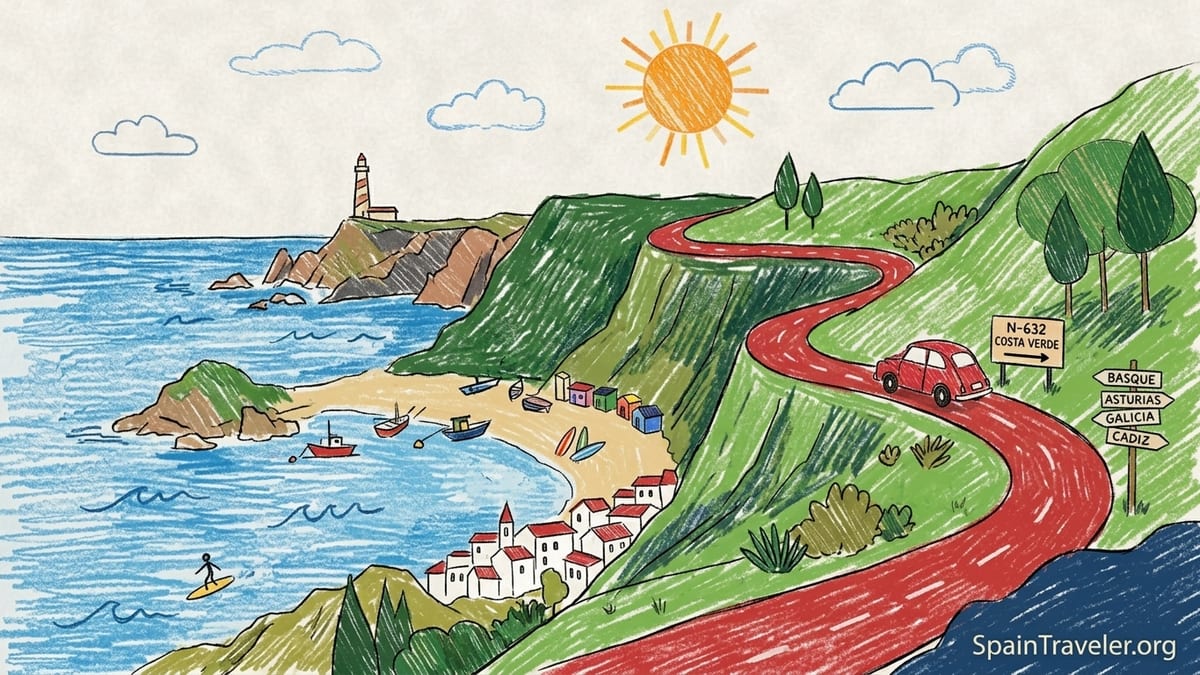
How to Think About Spain’s Atlantic Coast
The Atlantic coast of Spain is really three personalities in one trip. In the north, between San Sebastián and Ribadeo, the Basque and Asturian shoreline is a continuous run of green cliffs, surf beaches and compact towns connected by the A-8 motorway and older coastal roads such as the N-632 in Asturias, which closely follows the sea between Ribadesella and Canero and is promoted locally as a classic scenic drive. Expect frequent miradores, short detours down to coves and villages where you can eat a menú del día of grilled fish and cider for roughly 15 to 20 euros.
West of Ribadeo, Galicia’s Costa da Morte and Rías Baixas turn wilder and more fragmented. The Costa da Morte in particular is marketed by regional tourism boards as a rugged route of lighthouses, cliffs and long beaches like Carnota and Laxe, with driving itineraries that link fishing ports, viewpoints and walking paths along the Atlantic swells. Here the focus is less on a single base and more on daisy-chaining short stays or day trips from a town like Muxía or Fisterra.
Far to the south, Cádiz province and Tarifa share the same ocean but a different mood. Long, pale-sand beaches face steady Atlantic swells and powerful winds that have turned Tarifa into one of Europe’s most famous wind sports hubs, with kites and sails filling the sky on Playa de Los Lances and Valdevaqueros. Inland, the whitewashed towns of Cádiz province offer history and tapas, while the coast is a string of beach villages that still feel more local than resort-driven, especially outside August.
When planning, it helps to decide which places will be your city bases with walkable culture and nightlife, which are relaxed surf and beach hubs, and which are scenic road-trip stops where a night or two is enough. The destinations below are grouped to make that choice clear, so you can combine a Basque city break with a few surf days, then a slow road trip along Asturias and Galicia before flying south or taking a long train ride to Cádiz and Tarifa.
San Sebastián: City Break With a Surf Beach
San Sebastián, or Donostia, is the most obvious urban base on Spain’s Atlantic coast. The city curves around three main beaches and a sheltered bay backed by Belle Époque architecture, pintxos bars and a compact old town. Unlike many coastal cities, you can walk from your hotel to a proper surf break in ten minutes: Zurriola Beach, overlooked by the modern Kursaal Congress Centre in the Gros district, is the city’s main surf beach and hosts regular competitions. Local tourism listings note several surf schools and a year-round surf scene concentrated along this stretch of sand.
For most travelers, San Sebastián works as a three or four night base. In practice, people spend mornings on the sand or in the water, afternoons walking the promenade between La Concha and Ondarreta or climbing Mount Urgull for bay views, then evenings hopping between pintxos bars in the old town and Gros. A typical pintxo with a glass of txakoli or beer usually runs 3 to 5 euros, so a self-guided “pintxos crawl” can double as dinner without any one stop feeling expensive.
San Sebastián also anchors the Basque segment of an Atlantic road trip. The A-8 motorway and coastal secondary roads make it easy to do day trips west to Zarautz and Getaria or east toward the French border. Rental car rates fluctuate, but in low season you can often find manual compact cars from around 35 to 45 euros per day when booked in advance, which pays off if you plan several coastal side trips.
Accommodation ranges from family-run pensiones in historic buildings to design hotels along the bay. Prices spike in late July and August, especially during festival weeks, so if your dates are fixed and you want a central balcony overlooking La Concha, it is worth booking months ahead. Outside peak season, you can often get a mid-range room within walking distance of the old town for under 150 euros per night.
Getaria and Zarautz: Easygoing Basque Surf Strip
Fifteen to twenty minutes west of San Sebastián, the neighbouring towns of Getaria and Zarautz form a more relaxed coastal strip that is ideal for surf-focused stays or as a two or three night break in between city time. Zarautz in particular is known within Spain as a classic surf destination, with a long beach that hosts national competitions and several schools lining the seafront. Boards and wetsuits can typically be rented by the hour, and a two-hour beginner lesson might cost around 40 to 60 euros depending on the season and group size.
Getaria, just along the coast, is smaller and more intimate, clinging to a headland with a working harbour. It is famous for grilled fish restaurants that line the main street near the port and for txakoli vineyards in the hills above town. In practice, travelers often stay in Getaria for the atmosphere and food, then drive or take the train ten minutes to Zarautz when they want a full surf day. Even in summer, the short drive between the two takes you past vineyards and small miradores that are easy to pull into for a photo stop.
As a base, Zarautz suits travelers who want to wake up directly on the sand, surf in the morning, then eat and drink in a lively but small-town setting at night. Getaria leans more toward slow-food weekends: long seafood lunches, walks up to the lighthouse, and quiet evenings with a glass of white wine overlooking the harbour. Both towns connect easily to the A-8, so they slot neatly into a scenic drive from San Sebastián toward Bilbao or vice versa.
If you are traveling without a car, regional trains and buses link San Sebastián, Zarautz and Getaria, but schedules thin out late in the evening. Many visitors therefore use San Sebastián as their main base for nightlife and take day trips out to these coastal towns, returning before midnight when buses and local trains tend to stop running frequently.
Santander and Comillas: Cantabrian City and Coastal Detour
Heading west from the Basque Country, Santander is a logical overnight stop and gentle introduction to Cantabria. It is a mid-size port city with several urban beaches, a redeveloped waterfront and the Magdalena Peninsula, where locals walk, jog and swim before or after work. For travelers, Santander is essentially a city base with a maritime feel: you stay here for museums, restaurant choice and easy access to both the coast and nearby valleys, rather than as a pure beach resort.
Hotel prices in Santander are generally a little lower than San Sebastián, especially outside the Spanish school holidays. It is realistic to find mid-range rooms for under 120 euros per night in shoulder seasons. From the city you can reach beaches like El Sardinero on foot or by local bus, and there are regular ferries and boat trips across the bay that provide an easy half-day excursion without needing a car.
About an hour west by car, Comillas is the highlight small town on this stretch of coast. It is known for its eclectic architecture, including a summer palace and a whimsical building designed by Antoni Gaudí long before his Barcelona fame, as well as a broad sandy beach backed by green hills. Comillas works best as a scenic road-trip stop: spend one or two nights, visit the Gaudí building, walk the beach, then continue west toward Asturias. The town is small enough to cross on foot in ten minutes, and out of high summer parking is usually manageable around the centre or near the sea.
Between Santander and Comillas, there are numerous smaller beaches and coves accessible from the A-8 and old N-634. Many travelers simply detour when they see a brown tourist sign for a playa or mirador, stopping for an hour or two and a coffee at a chiringuito, before pressing on. This flexibility, more than any single sight, is what makes this section of the Atlantic coast feel like a genuine road trip rather than a checklist.
Llanes, Ribadesella and Ribadeo: Classic Asturian Coastal Drive
Crossing into Asturias, the coastline becomes even more indented and distinctly green. The official tourism board promotes a multi-day driving route between Ribadesella, Llanes and Colombres along a mix of the N-632 and parallel local roads, noting viewpoints over cliffs, historic Indianos mansions built with fortunes made in Latin America, and detours to long beaches such as Vega or smaller coves. In practice, this is one of the most rewarding sections of Spain’s Atlantic coast to tackle by car, with distances short enough that you can stop often without feeling rushed.
Llanes is the main base town for many visitors. Its old quarter gathers around a small port, with colourfully painted breakwater cubes by artist Agustín Ibarrola and easy access to several beaches within a ten-minute drive. The vibe in summer is busy but not overwhelming, with plenty of sidrerías where staff still pour cider from a height in the traditional Asturian style. A typical ración of grilled squid or fried hake might cost 12 to 18 euros, while a bottle of local cider often stays under 5 euros in a casual bar.
Ribadesella, further west, offers a different feel: a long urban beach on one side of the river, a small old town on the other, and caves with Paleolithic art nearby, visitable on guided tours that must usually be reserved in advance during peak months. For many travelers, Ribadesella is a pleasant one or two night stop, enough time to walk the seafront promenade, explore the cliff-top views east toward the Bufones de Pría blowholes, and perhaps take a short section of the Camino del Norte which passes through town.
Ribadeo, on the border between Asturias and Galicia, is valuable mainly as a gateway to the famous As Catedrais beach, where natural stone arches and cliffs frame the sand. Because of erosion concerns and popularity, access to the beach at low tide often requires advance registration in summer and around Easter, which is managed by regional authorities and is free but capacity controlled. Given these logistics, many travelers either base themselves one night in Ribadeo to match their visit to the right tide time, or visit on a day trip while passing through. The town itself has enough cafés, bakeries and simple hotels to make a short stay comfortable.
Costa da Morte and Vigo / Rías Baixas: Wild Galicia and Ría Harbours
West of Ribadeo, Galicia’s Costa da Morte is one of Spain’s officially promoted scenic coastal zones. Regional brochures describe routes weaving between fishing ports like Muxía and Fisterra, lighthouses such as Cabo Vilán and Punta Nariga, and long beaches including Carnota, often cited as one of the most impressive in the region. Driving here is slower than on the northern highway: secondary roads curl around rías and headlands, and distances that look short on the map can take an hour or more as you rise and fall with the terrain.
The Costa da Morte is best approached as a road-trip segment rather than a single base. Many travelers choose two or three nights in a small hotel or rural guesthouse near one of the main towns, then spend days exploring by car, stopping at viewpoints and short walking trails. Expect simple seafood restaurants serving dishes like pulpo a feira, grilled fish and empanadas at prices that are often lower than in the more touristed Rías Baixas further south. English may be less commonly spoken in the smallest villages, so having a few Spanish phrases and offline maps makes the experience smoother.
Further south, the Rías Baixas and the city of Vigo shift the mood again. Vigo itself is a working port and largest city in Galicia, used by many as a practical base with good transport connections, larger hotels and an urban restaurant scene. From here, travelers fan out along the Rías Baixas to beaches on the Cíes Islands, to small resort towns such as Sanxenxo, or to wine country around the Ría de Arousa known for Albariño whites. In summer, ferries to the Cíes Islands are quota-controlled, and round-trip tickets can sell out on sunny weekends, so advance booking becomes essential for day trippers.
As a base, Vigo or a nearby ría town works well for three or four nights if you want a mix of beach days, boat trips and seafood dining without moving hotels every night. Prices in mid-range hotels can be competitive compared with northern Basque cities, especially outside the August peak. Having a car opens more options for small coves and countryside vineyards, but you can still enjoy a lot of what the Rías Baixas offer by pairing Vigo with a couple of organized boat or wine tours that include transport.
Cádiz, Conil and Zahara de los Atunes: Cádiz Province Atlantic Beaches
At the opposite end of the country, Cádiz province sits on the Atlantic and faces directly toward the ocean swells. Cádiz city itself is an excellent base for travelers who like history and urban life as much as beaches. The old town occupies a peninsula almost entirely surrounded by water, with long urban beaches such as La Victoria stretching south along newer neighbourhoods. As a base, Cádiz works best for three nights or more, allowing time both to wander its tight lanes and squares and to take day trips out to the surrounding coast.
Conil de la Frontera, about 45 minutes by car from Cádiz, is a whitewashed town on low cliffs above wide sandy beaches. In summer it fills with Spanish holidaymakers, giving it a lived-in rather than resort-built feel. Conil is a classic beach holiday base: you choose a small hotel or apartment close to the old town, walk down to the beach in ten or fifteen minutes, and return in the evening for tapas in pedestrian streets. Beach bars set up in high season with simple food and cocktails; prices for a plate of tuna or prawns are generally lower than in the city, though they still rise during August when demand peaks.
Zahara de los Atunes, further along the coast, is smaller and even more laid back. It fronts a long, straight beach with fine sand and often steady Atlantic breezes that keep summer temperatures tolerable. Many visitors rent apartments or small houses for a week or more, settling into a rhythm of late breakfasts, long beach sessions and late dinners. While the town has become more fashionable in recent years, it retains a relatively low-rise profile compared with crowded Mediterranean resorts. It suits travelers who prefer simplicity and long walks on open sand over built-up promenades and nightlife.
These Cádiz province coast towns also pair naturally with inland visits to Vejer de la Frontera or the sherry bodegas around Jerez, both of which can be reached in under an hour by car from Conil or Zahara. Car rental is extremely useful here because public transport between smaller coastal villages is limited, especially outside peak months. A realistic pattern is to base in Cádiz city without a car for a couple of nights, then rent one to explore Conil, Zahara and Tarifa over another four or five days.
Tarifa: Europe’s Wind Capital at the Edge of Two Seas
Tarifa occupies mainland Europe’s southernmost point, where the Strait of Gibraltar narrows to roughly 14 kilometres between Spain and Morocco and mountains rise on both shores. This geography concentrates winds known locally as Levante from the east and Poniente from the west, which alternate over Tarifa’s beaches and have made it one of Europe’s kite and windsurf capitals. Playa de Los Lances and Valdevaqueros are particularly well known among riders for their conditions, with local guides emphasising how frequently kites are in the air here compared with many other European spots.
Tarifa is a specialist base where the main draw is wind sports rather than conventional beach lounging. The old town itself is compact and atmospheric, with narrow streets, low white buildings and a busy bar and restaurant scene that caters to an international mix of kitesurfers, climbers and backpackers. Accommodation ranges from simple guesthouses in historic buildings to boutique hotels and countryside cortijos a short drive from the beach. Prices fluctuate with wind forecasts and main holiday periods, but it is common for riders to book one or two weeks at a time, hoping to catch several good Levante or Poniente days within that window.
For beginners, Tarifa can be intense. Local and international kitesurfing schools often warn that strong Levante days are better left to experienced riders, steering less confident students toward lighter wind periods or more protected spots. Typical beginner packages run to 3-day or 9-hour courses priced in the region of 250 to 400 euros including equipment, safety gear and boat support where needed. Non-kiters can still enjoy Tarifa by walking the seafront out to the Isla de las Palomas causeway, watching the mass of kites over Valdevaqueros from a chiringuito terrace, or taking whale-watching boat trips into the strait in season.
As part of an Atlantic itinerary, Tarifa makes most sense at the end of a Cádiz province loop. You might spend three nights in Cádiz city, three in Conil or Zahara, then two or three in Tarifa before looping back to Seville or Málaga for flights. Because winds and sea conditions can be demanding, it is wise to build a buffer day into your plan for when Levante is too strong for comfortable beach time, using it instead for a day trip to nearby white villages or to the Roman ruins at Baelo Claudia near Bolonia beach, about a half-hour drive from town.
The Takeaway
Spain’s Atlantic coast is not a single destination but a chain of distinct regions that reward a selective approach. San Sebastián and Santander provide city bases with culture and urban beaches. Getaria, Zarautz, Llanes and Ribadesella are classic surf and seaside towns, best enjoyed over lazy days and evenings in small bars. The Costa da Morte and Rías Baixas around Vigo turn the trip into a genuine road adventure along officially promoted scenic routes, with lighthouses, ría harbours and remote beaches. Far south, Cádiz, Conil, Zahara de los Atunes and Tarifa deliver big skies, Atlantic swells and some of the best wind and kitesurf conditions in Europe.
When planning, think in segments: a Basque city-and-surf block, an Asturian and Galician road trip, then a Cádiz and Tarifa finale. Within each, pick one or two bases rather than changing beds every night, and allow time for slow drives along older coastal roads like the N-632 in Asturias or signed lighthouse routes in Costa da Morte. Costs on the Atlantic coast are often lower than on Spain’s most famous Mediterranean strips once you leave the biggest cities, especially if you embrace simple seafood menus and small family-run lodgings.
Above all, treat the Atlantic coast as a place for weather-watching and spontaneity. Swell forecasts, wind charts and tide tables will shape your days as much as museum hours or restaurant bookings. With a flexible outline, a car for at least part of the journey, and a willingness to stop whenever a brown sign points to a playa or mirador, this side of Spain becomes one of Europe’s most rewarding slow-travel corridors.
FAQ
Q1. How many days do I need to explore the Spanish Atlantic coast properly?
For a relaxed trip linking the Basque Country, Asturias, Galicia and Cádiz province, plan at least 14 to 18 days. With 10 to 12 days you can still combine San Sebastián, an Asturian coastal segment and a shorter Cádiz and Tarifa loop by skipping some smaller stops.
Q2. Which towns work best as main bases rather than brief stopovers?
San Sebastián, Santander, Vigo, Cádiz and Tarifa all function well as multi-night bases, with enough restaurants and activities for several days. Places like Getaria, Zarautz, Comillas, Llanes, Ribadesella, Ribadeo, Conil and Zahara de los Atunes are better for shorter stays of one to three nights or as day-trip targets.
Q3. Do I need a car for this itinerary or can I rely on public transport?
You can move between major cities such as San Sebastián, Santander, Vigo and Cádiz by train or long-distance bus, but a car is strongly recommended for Asturias, Costa da Morte, Zahara de los Atunes and many smaller beaches. Having your own vehicle lets you use scenic roads like the N-632 in Asturias and access viewpoints and coves that are hard to reach on public transport.
Q4. When is the best time of year to visit the Atlantic coast of Spain?
Late May to early July and September are ideal for most travelers, with milder temperatures, fewer crowds and generally reliable weather. August is busy almost everywhere with Spanish holidaymakers, while winter can be stormy and cool in the north, though Cádiz and Tarifa often stay pleasantly mild.
Q5. Is the Atlantic coast of Spain suitable for a pure beach holiday?
Yes, especially around Zarautz, Conil and Zahara de los Atunes, which all have long sandy beaches and plenty of accommodation close to the sea. However, the Atlantic can be cooler and rougher than the Mediterranean, so many travelers mix beach days with sightseeing, coastal walks and village visits.
Q6. I am a beginner surfer or kitesurfer. Which areas are best for me?
For surfing, Zarautz, San Sebastián’s Zurriola Beach and some Asturian beaches near Llanes and Ribadesella have established surf schools and manageable beach breaks. For kitesurfing, Cádiz province has several beginner-friendly spots, but Tarifa’s strong Levante winds can be challenging, so it is important to book lessons with reputable schools that provide safety support and adapt to conditions.
Q7. How expensive is the Spanish Atlantic coast compared with Barcelona or the Costa del Sol?
San Sebastián and Cádiz city can approach big-city prices for central hotels and high-end dining, but many smaller Atlantic towns are noticeably cheaper than major Mediterranean resorts. Expect casual restaurant meals from about 15 to 25 euros per person and mid-range double rooms in smaller towns from roughly 70 to 120 euros outside peak August.
Q8. Can I swim comfortably in the Atlantic, or is the water too cold?
In summer, sea temperatures in northern Spain are cooler than the Mediterranean but still comfortable for most swimmers, especially in July, August and early September. Further south around Cádiz and Tarifa the Atlantic is warmer, though wind and waves can make conditions feel cooler, so many people still prefer short wetsuits for long sessions in the water.
Q9. Are the coastal driving routes in Asturias and Costa da Morte difficult or dangerous?
The main coastal roads like the A-8 and N-632 are generally well maintained and straightforward, though they can be winding in places with frequent curves and occasional fog or rain. In Costa da Morte, some secondary roads are narrow and slow but not technically difficult; driving cautiously, avoiding night-time rural driving when possible and allowing extra time for each leg makes the experience enjoyable rather than stressful.
Q10. How far in advance should I book accommodation on the Spanish Atlantic coast?
For July, August and major local festivals, it is wise to book popular spots like San Sebastián, Zarautz, Llanes, Vigo, Cádiz, Conil, Zahara de los Atunes and Tarifa several months ahead, especially if you want sea views or parking. In shoulder seasons such as June and September, you can often book one or two weeks in advance, though very small properties in tiny villages may still fill quickly on sunny weekends.