


Spain’s Atlantic coastline has quietly become one of Europe’s most appealing villa destinations, especially for travelers who prefer relaxed coastal towns to crowded resort strips. From the golden, wind-brushed beaches of the Costa de la Luz in Cádiz and Huelva to the lush, cool inlets of Galicia’s Rías Baixas, villa stays here feel more like living locally than checking into a resort. The trick is knowing which areas suit private pools and big family homes, where you can walk to the beach, and when a surf-style shared house makes more sense than a secluded rural retreat.
Why Villas Work So Well on the Atlantic Coast
On Spain’s Atlantic side, villas and self-catering houses often fit the landscape better than large hotels. The Costa de la Luz stretches from the Cádiz area through Conil, El Palmar, Zahora, Tarifa, Sanlúcar and into Huelva, with a long-established market of holiday homes, bungalows and rural fincas. Many are purpose-built for families and small groups who want space, private outdoor areas and easy access to sweeping beaches rather than a dense hotel strip. In practical terms, this means you will find everything from simple one-level houses with shared pools to high-end villas with gated parking and saltwater pools within walking distance of the sand.
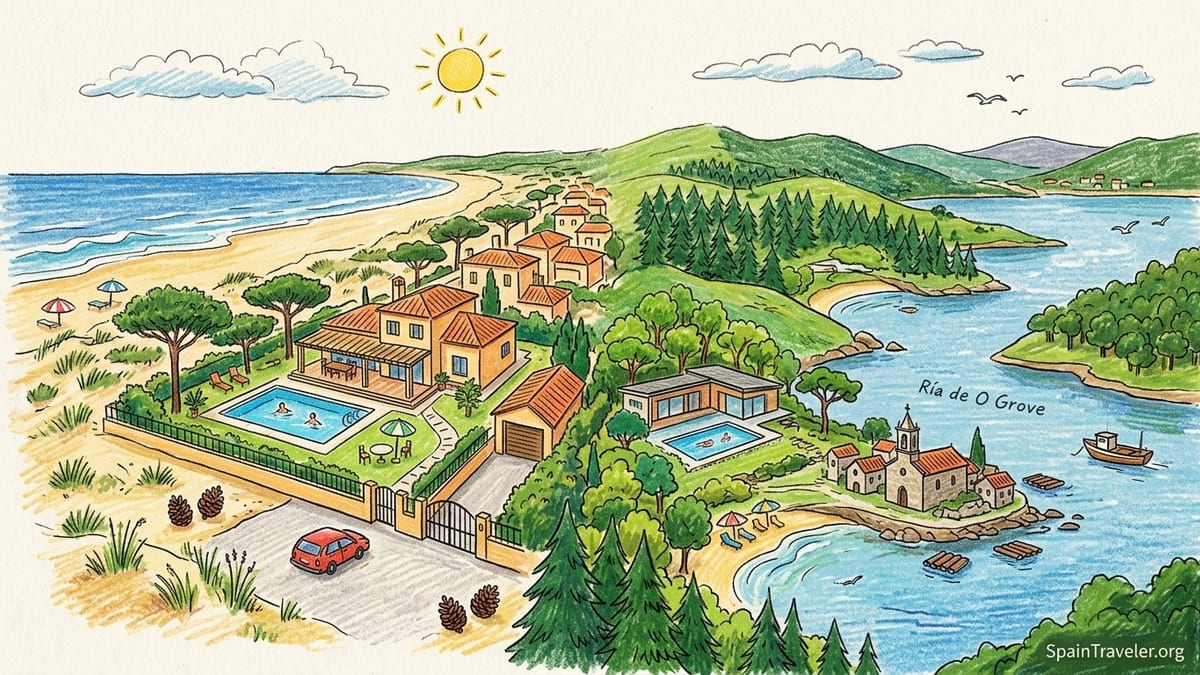
Further north in Galicia, especially around the Rías Baixas, villas tend to cluster along peninsulas like O Grove and around coastal hubs such as Sanxenxo, Combarro and A Lanzada. Here, the setting is greener and often cooler in summer, with sheltered coves and estuaries instead of open Atlantic surf. A modern villa in O Grove with a heated private pool, for instance, can sit around 500 metres from beaches such as Raeiros and within a short drive of A Lanzada, offering the comfort of a pool even when the Atlantic water feels brisk. This combination of coastal scenery and home-style comfort is a major reason visitors return to villas year after year.
Across both regions, the villa market is varied and highly seasonal. In July and August, demand peaks for houses with pools and air conditioning, particularly near Cádiz and Chiclana on the Costa de la Luz and around Sanxenxo and O Grove in Galicia. Outside these months, rates soften and availability widens, but pool heating, insulation and proper heating for cooler nights become a bigger factor. Understanding these regional differences will help you choose a stay that fits not only your budget but also your travel style and timing.
Costa de la Luz: Classic Beach Villas and Family Retreats
The Costa de la Luz is one of Spain’s strongest self-catering markets, with a dense mix of villas, townhouses and small developments spread across Cádiz province. Around Conil de la Frontera and nearby El Palmar, low-rise houses with gardens and pools sit a short walk or drive inland from the long sandy beach. In Zahora and Los Caños de Meca, rustic villas like Casa Trafalgar in Zahora pair big private gardens and saltwater pools with proximity of roughly 700 metres to the beach, often reached on quiet rural lanes. These properties usually include secure gated parking, which is important in small coastal villages where on-street parking can be tight in August.
Farther along the coast, Chiclana’s La Barrosa area and Novo Sancti Petri offer some of the most consistently family-friendly villa neighborhoods. Here you find three and four-bedroom homes with private pools within a short drive, rather than a walk, of La Barrosa’s long urban beach. Many of these houses are purpose-built for summer use, with tiled floors, shaded terraces and air conditioning in living areas and bedrooms. Property information sheets for this zone commonly outline details such as check-in deposits, pool usage rules and air conditioning instructions, which is a sign that owners are used to receiving international guests.
Near Tarifa and Zahara de los Atunes, the feel shifts to a mix of upscale villas in hillside urbanisations overlooking the Strait of Gibraltar and more modest townhouses within small complexes. Some duplexes and apartments advertise community pools, garage parking and air conditioning, with around a ten-minute walk to the beach and historic centre. These can be a smart compromise if you want walkability to cafés and kite-surfing schools but do not need a completely private pool or garden.
Galicia & the Rías Baixas: Green Hills, Cool Seas and Heated Pools
In Galicia, villa stays are concentrated around the Rías Baixas, where drowned river valleys create a network of sheltered bays and islands. The peninsula of O Grove is a good example: a small town surrounded by beaches like A Lanzada and Raeiros, connected to the mainland by a slim isthmus. The area is more compact and walkable than much of the Costa de la Luz, with visitors often choosing to stay in or just outside towns like O Grove or Sanxenxo to have shops and seafood restaurants close at hand while still accessing multiple beaches by car.
Because the Atlantic is cooler here, private pools, especially heated ones, carry a different value than in the south. A modern villa in San Vicente, near O Grove, might advertise a private heated pool and a distance of around 500 metres to Raeiros beach. This gives families the option of swimming at home if a morning on the beach leaves them tired or if younger children struggle with the cooler sea. Many Rías Baixas villas sit on their own plots of land with lawn areas, stone terraces and views over the ría rather than immediate beach frontage, so you may trade a short drive to the sand for more space and privacy.
Sanxenxo, widely known for beaches like Silgar, Areas and Montalvo, has seen a rise in modern villas and small developments just behind the shore. New-build projects often highlight energy-efficient construction, private parking and easy access to beaches while remaining set back from the busiest waterfront streets. This suits travelers seeking a blend of coastal life and quiet nights. Unlike in Andalusia, air conditioning is not universal; many houses rely on natural ventilation and thick walls, but they may feature underfloor heating or radiators for the longer, damp Galician winters, important if you travel in shoulder seasons such as May, June or September.
Private Pools vs Walk-to-Beach: Choosing Your Priority
Private pools are a defining feature for many Atlantic-coast villas, yet they are not always essential. On the Costa de la Luz, where water temperatures rise significantly in summer and beaches are wide and sandy, some travelers prioritize being within a few minutes’ walk of the sea over having a pool. For example, bungalow complexes near El Palmar beach often sit roughly 800 to 900 metres from the sand, with compact private or shared pools that act more as a cooling dip than an all-day attraction. In this region, families with small children often appreciate being able to return from the beach for naps and still have water play in a safe, enclosed space.
In Galicia, the calculation changes. A heated pool can extend the comfortable swimming season from late spring to early autumn, while the Atlantic itself remains brisk. Villas near O Grove or Combarro with heated pools often charge more, and some owners apply a daily surcharge for pool heating, particularly outside peak summer. If you visit in June or September, clarify in writing whether pool heating is included or available at extra cost, and what temperature you can realistically expect. For some guests, especially those spending most of their time exploring beaches and towns, a shared pool in a small development may be enough, keeping overall costs lower.
Walk-to-beach properties, meanwhile, are highly sought after in both regions and often command premium pricing in July and August. On the Costa de la Luz, “walking distance” can stil mean 10 to 15 minutes along unpaved rural tracks; check satellite images or street descriptions if mobility is a concern. In Rías Baixas hotspots like Sanxenxo, walkable beach houses are usually townhouses or apartments instead of detached villas with large gardens. Deciding whether your priority is doorstep sand access or private space will narrow your search considerably.
Large Family Villas, Rural Coastal Houses and Surf Group Stays
For extended families or two families traveling together, large villas on the Costa de la Luz are relatively easy to find. A property like Casa Trafalgar in Zahora, sleeping around 12 guests across a main house and annexe, illustrates the typical setup: a central pool, generous terraces and a barbecue area, with a few minutes’ walk to the beach and chiringuitos. These homes often come with multiple bathrooms, outdoor showers to rinse off sand and secure on-plot parking for two or more cars. In peak season, prices reflect the capacity, but per-person costs can be attractive once fully occupied.
Rural coastal houses are also common in the countryside between Chiclana, Conil and Vejer de la Frontera. Many are set a short drive inland, surrounded by fields or pine forest, and offer more privacy than village properties. The trade-off is that you will drive everywhere, including to the bakery and supermarket. These houses may have simpler finishes, ceiling fans instead of full air conditioning and rustic gardens, but they suit travelers who value space, peace and night skies free from street lighting.
For surf-focused trips, shared surf houses and camps are a defining feature of the Costa de la Luz around El Palmar. Several surf academies and surfhouses cluster near the beachfront, offering packages that combine accommodation in surf houses or bungalows with surf lessons, board hire and sometimes yoga or bike use. A typical surf house here might offer four shared rooms, communal kitchens and gardens within a short walk of the break. These are ideal for solo travelers, small groups and those who prefer a social, hostel-like environment in a beach village widely known as a surf hub.
In Galicia’s Rías Baixas, surf-specific group accommodation is less concentrated than in El Palmar, though surf schools operate on beaches such as A Lanzada and in the broader Pontevedra estuary area. Villa rentals in this region tend to cater more to families and groups interested in a mix of beaches, seafood and day trips rather than pure surf camps. That said, groups of surfers can still base themselves in a rural house near A Lanzada or Patos beach and use local schools for guiding and equipment while enjoying the comfort of a full villa in the evenings.
Parking, Car Hire and Getting Around
On both the Costa de la Luz and in Galicia, a rental car is strongly recommended for villa stays, unless you deliberately pick a townhouse or apartment right in a resort town. In Cádiz province, many of the best villas sit in dispersed residential areas that are not well served by public transport. Even when a house is technically within walking distance of the beach, the walk may lack pavements or street lighting, and carrying groceries from the nearest supermarket can be impractical. Villas marketed through agencies frequently highlight “private parking” or “gated driveway,” a sign that car access is considered standard. In high summer, this also saves you from circling for street spaces in busy beach villages.
Parking conditions vary between towns. In Tarifa and Conil, historic centres have narrow streets and limited on-street spaces, so properties with on-site garages or allocated parking in a shared underground facility can be a real advantage. Duplex rentals in Tarifa sometimes include secure garage spots with direct stair access to the apartment, plus community pools and shared gardens. In more rural spots such as Zahora or inland around Chiclana, villas typically offer open-air spaces inside gated plots, which are practical but may not offer shade for the car.
In the Rías Baixas, distances are shorter but a car remains very useful. Towns like O Grove and Sanxenxo are walkable once you are there, but many villas are set on surrounding hills or rural roads with views over the ría. Here, private parking is almost always included, often in the form of a gravel driveway or a small carport. Coastal roads can be busy on summer weekends, so factor in extra time when driving to popular beaches like A Lanzada or urban sands such as Silgar. If you prefer to minimize driving, consider basing yourself in a property within the town limits of Sanxenxo, O Grove or Combarro and using the car primarily for day trips.
Climate, Air Conditioning, Heating and Pool Season
Climate is one of the biggest differences between the southern Costa de la Luz and the far north-west of Galicia, and it should heavily influence your villa choice. In Cádiz and Huelva, summers are hot and dry with strong sun and, in many areas, reliable Atlantic breezes. This means air conditioning is highly desirable from roughly late June to early September, especially in bedrooms. Many modern villas and townhouses in Chiclana, Novo Sancti Petri and Conil include split-unit air conditioning, while older rural houses may offer only ceiling fans and shutters. If you are sensitive to heat, confirm that there is air conditioning in all bedrooms, not just in the living room.
Pool season on the Costa de la Luz typically runs from late May through late September for unheated pools, though brave swimmers may start earlier. Some villas state that pools are only maintained and opened during fixed summer dates, which is worth checking if you are visiting in April, May or October. Heated pools are less common here than in the north, and when available they may carry extra charges. It is also common to have basic rules such as no glass by the pool and showering before entry, designed to keep the water clear and maintenance costs manageable.
In Galicia, summers are milder, with more variable weather and cooler evenings. Air conditioning is less common, but reliable heating becomes essential outside high summer. Stone-built or new energy-efficient villas may rely on underfloor heating, radiators or pellet stoves rather than reversible air-conditioning units. For trips between October and April, ask owners how the house is heated and whether any fuel surcharges apply. Pool season here is shorter; unheated pools are most comfortable from roughly late June to early September, and using pool heating outside those months may involve a clearly stated daily fee. For some travelers, especially those who expect to spend most days exploring beaches, islands and towns, the pool is a nice extra rather than a central part of the trip.
Deposits, Cleaning Fees and Booking Practicalities
Villa rentals on Spain’s Atlantic coast follow broadly similar patterns for deposits and fees, but there are regional nuances. On the Costa de la Luz, many local agencies and owners request a damage deposit payable on arrival, either in cash or via card pre-authorization, often returned after a quick inspection at check-out. Cleaning is frequently included in the rental price, especially for week-long bookings, though some properties levy an end-of-stay cleaning fee or expect guests to leave kitchens and barbecues reasonably clean. In written property information, you may see specific check-out tasks listed, such as emptying rubbish and placing used linens in baskets.
In Galicia’s Rías Baixas, especially for modern villas and higher-end properties, deposits are often handled in advance through booking platforms or agencies and refunded a few days after departure once cleaners have reported back. Cleaning fees can be folded into the total price or listed as a separate line, which can make shorter stays appear proportionally more expensive. Some houses impose additional fees for optional services such as mid-stay cleaning, fresh bed linen or use of fireplaces outside certain dates.
One important practical detail is pool heating and other add-ons. Hosts sometimes advertise “heated pool” as a feature but specify in the small print that heating carries a daily surcharge, particularly outside peak dates when ambient temperatures are lower. If a heated pool matters to you, ask explicitly whether any extra charges apply and request confirmation in writing. Similarly, clarify whether air conditioning, if available, is unlimited or subject to fair-use policies that could lead to additional charges for excessive consumption, something more common in very hot summers.
Finally, be aware that minimum stays and changeover days can be strict in July and August, especially on the Costa de la Luz where Saturday-to-Saturday bookings remain common. In shoulder seasons, owners and agencies are often more flexible, which can suit travelers combining multiple stops along the Atlantic coast or those looking for long weekend surf trips.
The Takeaway
Choosing the best villa on Spain’s Atlantic coast begins with deciding between the sun-baked, surf-friendly Costa de la Luz and the green, estuary-filled landscapes of Galicia’s Rías Baixas. If you want consistent summer heat, long beaches and a strong surf and family-villa infrastructure, the stretch from Cádiz and Chiclana through Conil, El Palmar and Tarifa delivers a huge range of houses with pools, gardens and easy car access. For cooler nights, seafood-driven dining and a more intimate feel, Galicia’s coastal peninsulas around O Grove, Sanxenxo and Combarro offer modern villas and rural homes that blend local character with contemporary comforts.
Across both regions, villas make particular sense when you care about space, privacy and flexibility. Large family villas and rural coastal houses suit multi-generational trips and longer stays, while walk-to-beach properties and surf houses cater to more active or social vacations. Parking, air conditioning or heating, pool season and extra fees are not afterthoughts but core elements that can shape your experience, so take the time to study descriptions, ask questions and think realistically about how you will use the house day to day.
With expectations set correctly, a villa on Spain’s Atlantic coast can feel less like a rental and more like a temporary home. Whether you are rinsing off salt and sand in a garden shower in Zahora, watching the sun drop behind A Lanzada from a terrace in O Grove or sharing a big kitchen with new friends at a surf house in El Palmar, the right property will anchor your trip, giving you space to slow down, explore and enjoy the rhythm of the sea.
FAQ
Q1. Is a rental car essential for villa stays on the Costa de la Luz and in Galicia?
For most villa stays, a rental car is very helpful and often essential, especially on the Costa de la Luz where many houses sit in dispersed residential areas with limited public transport. In Galicia’s Rías Baixas, you can sometimes get by without a car if you stay in town apartments in places like Sanxenxo or O Grove, but a car still makes beach-hopping and supermarket runs much easier.
Q2. When is the best time of year to rent a villa on the Costa de la Luz?
The main season runs from June to early September, with July and August busiest and most expensive. Late May and September can be excellent for warm weather with fewer crowds and slightly lower prices, though some pools may not yet be in full operation at the very start or end of this shoulder period.
Q3. Do I really need a heated pool in Galicia’s Rías Baixas?
A heated pool is not strictly necessary, but it extends comfortable swimming time, especially in June and September when the air is mild but the Atlantic remains cool. Families with young children and guests who enjoy evening swims often appreciate the extra warmth, while budget-conscious travelers who plan to spend most of their time on the beach may be happy with an unheated pool or no pool at all.
Q4. How close to the beach are typical villas in these regions?
Distances vary widely. On the Costa de la Luz, many villas sit between 700 metres and a few kilometres from the beach, reached via rural roads. In Galicia, villas may be set on hills a short drive from coves and town beaches, while townhouses and apartments can be only a few minutes’ walk from the sand in places like Sanxenxo. Always check the exact distance and walking conditions rather than relying solely on “near the beach” wording.
Q5. Are air conditioning and heating usually included in villa rentals?
In Andalusia, especially around Chiclana, Conil and Tarifa, air conditioning is common in modern villas and generally included, though some owners may apply fair-use rules. In Galicia, air conditioning is less common, but proper heating is important outside mid-summer and is usually included in the rental price. It is wise to confirm how both cooling and heating work and whether any surcharges apply.
Q6. What should I know about deposits and potential extra fees?
Most villas require a damage deposit, either as a cash payment on arrival or a card pre-authorization processed in advance. Extra fees may apply for final cleaning, mid-stay cleaning, pool heating or additional linen changes. To avoid surprises, ask owners or agencies to spell out all possible charges before you confirm your booking.
Q7. How long is the typical villa pool season on the Atlantic coast?
On the Costa de la Luz, unheated pools are usually open and comfortable from late May through late September, depending on the year. In Galicia, unheated pool season is shorter, mostly from late June to early September. Heated pools can be usable slightly outside these windows, but using heating in cooler months may incur an extra charge.
Q8. Are surf camps and surf houses suitable for families?
Surf camps and surf houses around El Palmar generally cater to adults and older teens, with shared rooms and communal spaces. Some offer private rooms or bungalows that can work for families with responsible teenagers, but they are not usually set up for very young children. Families seeking more privacy and quieter evenings may be better served by a private villa combined with lessons at local surf schools.
Q9. How far in advance should I book a villa in peak season?
For stays in late July and August, particularly in popular areas like La Barrosa, Conil, El Palmar, Sanxenxo or O Grove, it is sensible to book several months in advance. Larger villas with private pools and walkable beach access are often reserved early by repeat visitors, while shoulder-season stays in May, June or September usually offer more flexibility.
Q10. Are villas on the Spanish Atlantic coast a good value compared to hotels?
For couples, a small hotel or guesthouse can sometimes be cheaper, especially outside peak season. For families and groups, villas often provide better value once you factor in shared bedrooms, kitchens for self-catering and private outdoor space. The key is to compare the total villa cost, including any fees, with the combined price of multiple hotel rooms in the same area for the same dates.