


Sun-bleached Atlantic beaches, Andalusian white towns and a growing network of package flights have turned Spain’s Costa de la Luz into one of southern Europe’s quiet success stories. For 2026 and 2027, major tour operators such as TUI and Jet2 are running separate package inventories for the eastern Costa de la Luz via Jerez Airport and the western stretch via Faro, creating two distinct gateways into the same luminous coast. Understanding the difference between these hubs, and between all-inclusive, family, luxury and half-board options, can save you serious money and frustration once you land.
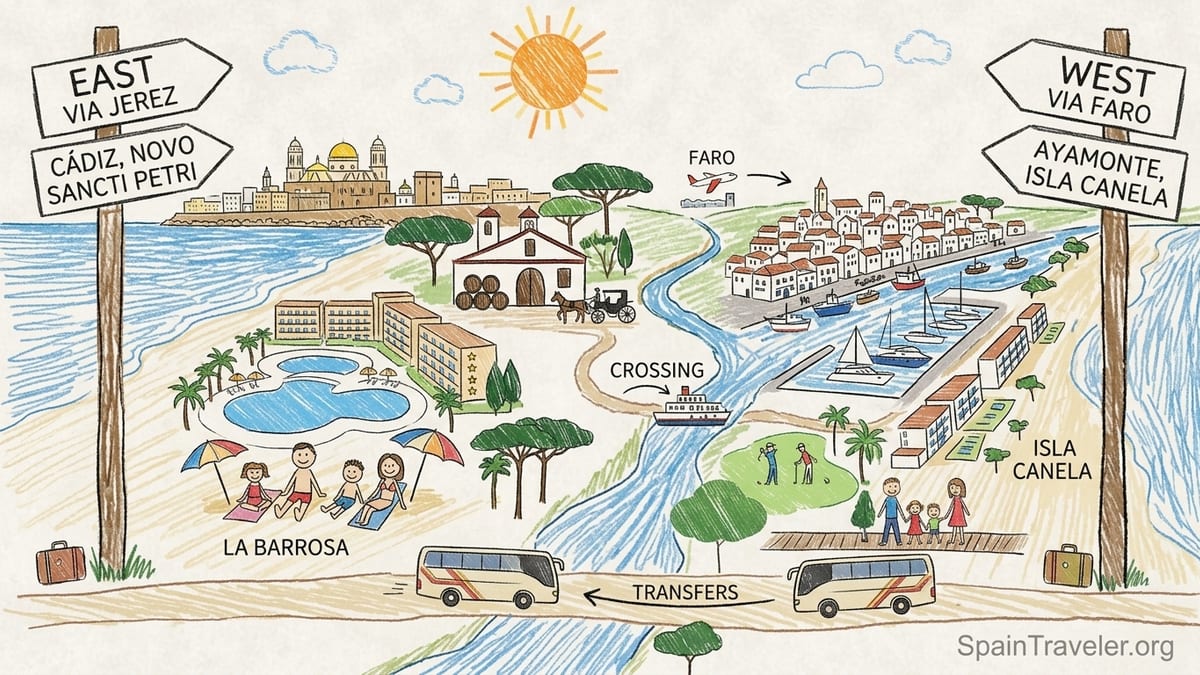
Understanding the Costa de la Luz Package Map
Costa de la Luz runs along Spain’s Atlantic shore from the Portuguese border in Huelva province to Tarifa in Cádiz. The core package market, however, clusters around a few specific resort zones. In the east, beach developments such as Novo Sancti Petri and La Barrosa sit within easy transfer distance of Jerez Airport, backed by Cádiz city and Jerez de la Frontera’s historic centre. In the west, Isla Canela, Isla Cristina and the Ayamonte area lean towards Faro in Portugal, even though you are technically staying over the border in Spain.
TUI and Jet2 currently treat these as separate destinations: Costa de la Luz East is sold through Jerez, while Costa de la Luz West is sold through Faro with transfers across the Guadiana River into Spain. That split affects not just flight times and departure airports, but also which kinds of resorts dominate each side. East tends to mix big four and five star hotels in purpose-built zones with access to historic towns, while west has more low-rise beachfront hotels and apartment complexes aimed at families and golfers who are comfortable being car-free for a week.
For most holidaymakers, the practical decision is less about geography and more about style of stay. If you want a conventional all-inclusive beach week with plenty of kids’ facilities and do-not-leave-the-resort simplicity, both sides work. If you prefer tapas-hopping in old towns, sherry bodegas and day trips to Cádiz, the Jerez side generally offers richer options. The way operators bundle flights, baggage and transfers for 2026 and 2027 means you need to look carefully at the small print, especially when comparing headline prices between Costa de la Luz East and West.
Seasonality matters as well. This Atlantic coast is breezier and a touch cooler than the Costa del Sol, with peak package demand concentrated from late May to September and a smaller “winter sun light” market based around golfers and walkers. That influences which boards, room types and child offers appear in the brochures for each season.
Costa de la Luz East via Jerez: Cádiz, Jerez and Novo Sancti Petri
Flying into Jerez Airport positions you close to some of Andalucía’s most appealing coastal and historic sights. Jet2’s packages to Jerez are marketed as a gateway not only to the beaches but also to Jerez de la Frontera, Cádiz and the wider sherry triangle. TUI, meanwhile, has built Jerez into a branded gateway for its Costa de la Luz East programme, with a dedicated summer schedule and promotional focus on the region’s flamenco culture, horses and bodegas.
On the coast, Novo Sancti Petri and the 6 kilometre La Barrosa beach near Chiclana de la Frontera form the main hotel strip. This is a modern resort district where large four and five star properties dominate, often with extensive pools, spas and on-site golf. You are technically within the municipality of Chiclana, but most big hotels sit in an urbanised zone several kilometres from the traditional town centre. Expect manicured gardens and promenades rather than village life directly outside the gate. Typical transfer times from Jerez Airport are around 45 to 60 minutes, depending on traffic and how many hotel drops your shuttle makes.
Package deals here tend to position themselves as an alternative to the Costa del Sol for travellers who want more Spanish ambience and fewer high-rise blocks. A realistic example for 2026 might be a seven-night half-board stay in a four star hotel at La Barrosa for two adults and one child in early June, with Jet2 or TUI flights from a regional UK airport, checked luggage and transfers, often starting in the low to mid four figures in pounds or euros depending on departure point and school holiday overlays. Prices shift significantly in late July and August when Spanish families arrive, so flexibility by a week or two can save a large percentage.
For culture, the Jerez side wins comfortably. Many Jerez-based packages allow you to add sherry bodega tours, flamenco evenings or day trips into Cádiz at booking stage. If you prefer to organise your own exploring, public buses and reasonably priced taxis connect Novo Sancti Petri and La Barrosa to Chiclana town, San Fernando, Cádiz and Jerez, although frequencies can thin out outside high season. This is a key difference from some isolated western resorts that effectively require a hire car if you want to explore beyond the seafront.
Costa de la Luz West via Faro: Ayamonte, Isla Canela and the Portuguese Connection
On the western side, Jet2 and other operators use Faro Airport to serve a run of Spanish resorts just over the Portuguese border. From Faro, coaches head east through the Algarve before crossing into Spain near Ayamonte. Here, low-rise beachfront areas like Isla Cristina and Isla Canela have slowly developed a package scene that still feels smaller and quieter than more famous Spanish coasts. TUI and Jet2 list Costa de la Luz West separately from the Algarve, even though you fly into the same airport.
Transfer times from Faro to the Costa de la Luz West hotels are typically 60 to 90 minutes, influenced by border traffic and the number of intermediate drops at Algarve resorts on shared shuttles. When you price packages, check whether the transfer is a direct coach to your Spanish hotel or a shared shuttle that calls at Portuguese stops first. A slightly higher fare for a private or semi-private transfer can save you an hour or more at the start and end of your holiday, which matters on shorter stays.
The resort layout in this western stretch is more linear and low-key than the big hotel clusters east of Cádiz. Isla Canela, for example, mixes apartment complexes and a handful of four star hotels set behind broad Atlantic sands, with a marina area that offers restaurants and low-key nightlife. Ayamonte itself, a short taxi ride away, is a genuine working town with a pretty centre and riverfront tapas bars. Package descriptions often highlight these towns, but you should verify on a map whether your hotel is actually within walking distance of Ayamonte’s old streets or out in a newer, quieter zone along the beach or golf course.
This cross-border set-up has a practical advantage. Many operators allow you to combine a largely Spanish beach stay with optional Algarve excursions, such as day trips to Tavira or boat trips from Portuguese marinas, which adds variety without changing hotels. It also broadens flight options from the UK and other European countries, since Faro is a major low-cost hub with dense summer schedules.
Flights, Baggage and Transfers: Reading the Small Print
On paper, packages to both sides of the Costa de la Luz give you the usual flight plus hotel plus transfer model that UK and northern European travellers know well. In practice, inclusions and extras vary by operator and can significantly change the real cost. Jet2holidays, for example, typically includes at least one checked bag per person, resort transfers and accommodation in the core price, with options to upgrade seat selection or baggage weight. Many TUI packages follow a similar model, but some lower headline fares on promotional pages strip back cabin bag size or checked baggage as part of dynamic packaging.
For 2026 and 2027, expect more tiered product lines. You might see standard packages with 22 kg checked luggage included, “Lite” fares where only a small under-seat bag is included, and premium lines bundled with extra legroom seats and priority boarding. When comparing a Costa de la Luz East week from Jerez with a similarly priced West package via Faro, check whether you are looking at like-for-like baggage and transfer terms. A deal that appears 100 or 200 units of local currency cheaper can quickly even out once you add a suitcase and shared coach both ways.
Transfers also differ subtly. On the Jerez side, many coastal hotels fall within a fairly compact arc south of the airport, so a shared shuttle normally feels tolerable even with multiple stops. In the west, when shuttles zigzag across Algarve resorts before crossing into Spain, journey times can expand. If you are travelling with young children, or landing late in the evening, investigating a private transfer or a hire car for the Faro-based resorts can improve the start of your holiday, even if your operator already includes a basic shared shuttle.
Finally, look at flight times. Early-morning departures from northern Europe can have you on the beach by lunchtime, but may be less appealing with toddlers. Some 2027 programmes are already loading additional flight days on routes such as UK to Jerez and UK to Faro to cope with peak season demand, spreading capacity over the week and opening up shorter 4 or 5 night durations alongside classic 7 or 14 night stays.
All-Inclusive, Half-Board, Family and Luxury: Choosing the Right Board
The Costa de la Luz package scene has evolved from a loosely half-board market into a mix of all-inclusive, family-focused and higher-end stays. In Novo Sancti Petri and Isla Canela you will now find all-inclusive beachfront properties offering buffets, snacks, soft drinks and local alcoholic drinks from late morning to late evening, often marketed to families who want to control spend in advance. On TUI’s Costa de la Luz East pages you can already filter specifically for all-inclusive hotels, while Jet2’s Costa de la Luz East and West listings flag all-inclusive and half-board options clearly in the hotel summary.
All-inclusive makes the most sense in relatively self-contained resort zones where dining options outside the complex are limited or relatively expensive. A typical example is a four star hotel in Novo Sancti Petri, fronting La Barrosa beach, offering three main meals, snacks and local drinks, plus a kids’ club and evening shows. If your priority is to keep children fed and entertained without constantly reaching for your wallet, this model works, though it can subtly discourage you from venturing into nearby towns like Chiclana or Cádiz for dinner.
Half-board leans towards travellers who want structure at breakfast and dinner but value the freedom to explore at midday or in the evenings. This is particularly attractive around Cádiz city, Jerez and Ayamonte, where local tapas bars and seafood restaurants add as much to the holiday as the beach itself. A half-board stay in a four star hotel near Cádiz or in a beachfront property within a taxi ride of Ayamonte allows you to enjoy hotel facilities but still budget for a few nights eating out. In some cases, the price difference between half-board and all-inclusive is small enough that families who drink mostly soft drinks and water will not see much gain from stepping up to all-inclusive.
Luxury packages on this coast usually mean five star hotels in Novo Sancti Petri or along La Barrosa, sometimes with adult-only zones, full-service spas and golf packages. These may come as bed and breakfast or half-board as standard, with optional all-inclusive upgrades. Here the value of a package lies less in food and drink and more in reliable transfers, ATOL-style financial protection and flight-hotel coordination. If you are building a higher-end trip, it is worth comparing a package rate with booking flights and hotel separately to see whether the bundled extras, like airport-hotel transfers and flexible payment terms, justify any price premium.
Walkable Towns vs Isolated Resort Strips
One of the crucial, often overlooked questions for Costa de la Luz packages is whether your chosen hotel sits in a walkable town or in a relatively isolated resort strip. Marketing language can blur this distinction, with phrases like “Cádiz area” or “near Ayamonte” appearing in brochures when the hotel is actually several kilometres away from the old town, connected only by an occasional bus or a taxi rank.
In the Jerez gateway zone, Cádiz city hotels, central Jerez properties and accommodation in towns like El Puerto de Santa María are genuinely walkable and well connected by public transport. You step out into lived-in streets, local markets and tapas bars, with the beach a short ride away. By contrast, much of Novo Sancti Petri resembles a green, well-planned hotel suburb. You can walk between hotels, the golf course and the beach promenade, but you will not stumble into an old town square without a taxi ride. For some travellers that is ideal. For others, the lack of an authentic centre on the doorstep can feel sterile after a few days.
On the western side, Ayamonte town and Isla Cristina offer more of a lived-in feel, while parts of Isla Canela and purpose-built golf resorts are quieter and more spread out. When browsing packages via Faro, scan the hotel description for phrases that hint at isolation, such as “set in extensive grounds,” “direct beach access” or “shuttle bus to town.” These can be positives if your goal is poolside downtime, but they mean you should not count on evening strolls through busy local streets unless you are happy to use taxis.
If walkability matters to you, consider prioritising smaller city hotels in Cádiz or Jerez with bed and breakfast, then adding local buses or day trips to reach the beaches. Packages that include these urban stays exist, although they may not feature the same volume of family-focused amenities as the big beach hotels. Alternatively, in the west, choose accommodations that sit within Ayamonte itself or at least within a short walk of a marina or harbourfront, even if that means compromising slightly on hotel star rating or pool size.
Family, Couples and Activity-Focused Holidays
The Costa de la Luz is fundamentally family-friendly. Wide sandy beaches, generally moderate Atlantic waves outside winter storms and long daylight hours in summer create easy days for children. Package hotels in both east and west increasingly lean into this, with family rooms, kids’ clubs and shallow pools. Jet2 and TUI both highlight properties with children’s splash zones and kids’ entertainment, sometimes offering free child places or reduced child prices during shoulder seasons in May, early June and late September.
For families, the difference between east and west is often about how much independent exploring you plan to do. If your children are happy spending most of the week at the hotel, a large all-inclusive complex in Novo Sancti Petri or Isla Canela will deliver. If you picture early evening walks through narrow streets, stopping for ice cream and watching local families on the paseo, basing yourselves near Cádiz, Jerez or Ayamonte town gives more of that atmosphere. In either case, check how early the kids’ clubs operate in shoulder season. Some programme elements only run July and August, leaving off-peak travellers with a more low-key schedule.
Couples and groups of friends may prefer half-board or bed and breakfast in smaller properties that feel more boutique than resort. Jerez in particular appeals to food and wine lovers, with sherry bodegas, flamenco peñas and day trips to white villages like Arcos de la Frontera. A long weekend in Jerez with a day trip to Cádiz and one beach day at La Barrosa works well within a package format via Jerez Airport. On the Faro side, golfers often choose Isla Canela or nearby courses, bundling green fees into their packages or booking them separately once flights and hotel are arranged.
Activity-wise, the Atlantic setting opens up kitesurfing, windsurfing and sailing, especially closer to Tarifa at the far eastern end of the coast. While most mainstream packages do not include these sports in the base price, local operators along the beaches can arrange lessons and equipment hire. If water sports are a priority, look for hotels that either sit near established surf schools or advertise partnerships with them in the activity section of the description.
The Takeaway
Choosing a Costa de la Luz package for 2026 or 2027 means balancing two main decisions. First, decide whether the eastern Jerez gateway or the western Faro gateway fits your travel style. Jerez offers tighter links to Cádiz, sherry country and the large resort zone of Novo Sancti Petri, while Faro opens up the quieter Spanish resorts around Ayamonte and Isla Canela, with the Algarve in easy reach. Second, decide which board and hotel style aligns with how you prefer to holiday: all-inclusive or half-board, family mega-resort or smaller town-based property.
Whichever side you choose, put practicalities ahead of brochure gloss. Compare baggage rules, flight times and transfer types, and check on a real map where your hotel sits in relation to the nearest genuine town. A few minutes of research at booking stage, backed by the broader route networks and dedicated Costa de la Luz inventories that TUI and Jet2 are now running for 2026 and 2027, can turn a decent package into a holiday that matches exactly how you like to experience Spain’s luminous Atlantic coast.
FAQ
Q1. Is it better to fly into Jerez or Faro for a Costa de la Luz holiday?
Jerez suits travellers who want quick access to Cádiz, Jerez de la Frontera and Novo Sancti Petri, with relatively short transfers. Faro works well if you prefer quieter western resorts like Isla Canela and Ayamonte and do not mind a longer cross-border transfer.
Q2. Are all-inclusive packages common on the Costa de la Luz?
Yes, especially in purpose-built areas such as Novo Sancti Petri and Isla Canela. Many four and five star hotels now offer all-inclusive, though half-board remains popular where local dining scenes are strong.
Q3. Do Jet2 and TUI include luggage and transfers in Costa de la Luz packages?
Often they do, but not always in the same way. Standard packages usually include at least one checked bag and shared transfers, while some budget or “lite” fares reduce baggage allowances. Always check the inclusions section for your chosen holiday.
Q4. Are the advertised “Cádiz area” hotels actually in Cádiz city?
Not necessarily. Some beach hotels are 30 to 45 minutes from Cádiz in resort zones like Novo Sancti Petri. If you want a city base, look for hotels clearly described as being in Cádiz or Jerez centres.
Q5. How long are airport transfers from Jerez and Faro to the main resorts?
From Jerez, most coastal resorts are around 45 to 60 minutes away by shared coach. From Faro to Ayamonte or Isla Canela, typical transfer times are 60 to 90 minutes, sometimes longer on shared shuttles with multiple Algarve stops.
Q6. Is the Costa de la Luz suitable for families with young children?
Yes. Wide sandy beaches, family pools and kids’ clubs make it very child-friendly. Look for hotels with children’s facilities that operate throughout your travel dates, not just in peak August.
Q7. What is the difference between half-board and all-inclusive here?
Half-board usually includes breakfast and dinner, with guests free to explore local bars and restaurants at lunchtime or in the evening. All-inclusive adds lunch, snacks and most drinks, which is convenient in isolated resort zones but may discourage you from dining out.
Q8. Do I need a car to enjoy the Costa de la Luz?
You do not need one in city bases like Cádiz or Jerez, or in self-contained resorts if you plan to stay on-site. If you want to explore multiple towns from an isolated beach hotel, hiring a car for at least part of your stay is very helpful, especially on the Faro side.
Q9. When is the best time to visit the Costa de la Luz on a package deal?
Late May, June and late September often balance warm weather with softer prices and fewer crowds. July and August bring higher prices and more local holidaymakers, while shoulder months can be attractive for golfers and walkers.
Q10. Are there many luxury options on the Costa de la Luz?
Yes. The main concentration of luxury hotels is around La Barrosa and Novo Sancti Petri, with several five star properties offering golf, spas and higher-end dining, largely accessed via Jerez Airport.