


Few countries reward a road trip like Spain. From the white villages of Andalusia to the green hills of the north and the sun‑drenched Mediterranean, the country is built for slow, scenic driving. This guide brings together practical advice on renting a car, understanding tolls and fuel, and choosing routes, plus sample one‑ and two‑week itineraries that link Spain’s most memorable roads.
Essential driving basics for a Spain road trip
To drive legally in Spain you need a valid driving licence, passport, and proof of insurance. Visitors from the EU, UK, US, Canada, Australia and most developed countries can drive on their home licence for short stays. Many rental companies require drivers to be at least 21, and often 23 or 25 for larger vehicles. If your licence is not in Roman script, plan to carry an International Driving Permit in addition to your national licence.
Spain drives on the right with speed limits typically 120 km/h on motorways, 90 or 100 km/h on rural roads, and 30 or 50 km/h in towns unless signed otherwise. The traffic authority (DGT) regularly enforces limits with fixed and mobile cameras, and fines are commonly mailed to rental companies, who then charge your card. It is worth using the cruise control on long motorway stretches such as the A‑7 along the Costa del Sol or the A‑66 between Seville and Oviedo to avoid creeping over the limit.
Seatbelts are mandatory for all occupants and mobile phones must be used hands‑free only. Blood alcohol limits are lower than in many countries and police run frequent roadside checks, especially on weekend nights and holiday periods. In practice, this means planning to walk or take a taxi if you are enjoying wine in Rioja or sherry in Jerez rather than trying to drive after dinner.
Foreign drivers also need to understand Spain’s recent move to a connected emergency light known as the V‑16, which is gradually replacing warning triangles as the standard way to mark a stopped vehicle. The rule currently applies to vehicles registered in Spain; visitors can continue to use triangles if their own country requires them. For a rental, staff will explain which equipment is on board, but if you are bringing your own car it is worth checking up‑to‑date guidance from the DGT before departure because rules around emergency signaling are evolving.
Car rental, insurance and costs on the road
Spain has a competitive rental market, especially at major airports like Malaga, Barcelona and Madrid. You will see global brands alongside local companies at Malaga‑Costa del Sol Airport, where it is common to find compact cars in low season from roughly 25 to 35 euros per day, rising to around 60 to 80 euros in peak summer for the same vehicle class. Smaller regional airports such as Jerez or Santander may be slightly pricier due to lower fleet sizes.
Most rental offers include basic collision damage and theft cover with a high excess, often between 900 and 1,500 euros for an economy car. You can either buy the rental company’s excess waiver, which might add 12 to 25 euros per day, or use an independent policy from a specialist insurer at home. If you rely on a credit card’s rental coverage, read the terms carefully, as some exclude campervans, luxury cars or one‑way rentals. Checking the car for existing damage and photographing it at pick‑up and return is standard good practice, especially in busy locations like Barcelona‑El Prat or Madrid‑Barajas where turnover is high.
Fuel is one of the key ongoing costs. As of mid‑2026, petrol and diesel prices in Spain sit in the mid‑range for western Europe, often noticeably cheaper than in France or Italy. You will typically pay a bit less at large supermarket stations on the outskirts of towns such as Mercadona or Carrefour fuel points, and a little more on motorway service areas along the AP‑68 or A‑8. Many modern rental cars are diesel or small‑engine petrol models that return efficient consumption, which helps on long drives such as Seville to Bilbao or Barcelona to Granada.
When budgeting, factor in parking and potential city surcharges. Some historic centers, including Granada’s Albaicín and Seville’s Santa Cruz, restrict access to residents’ vehicles and hotel guests who have registered plates. In these places you may need to leave your car in a public underground car park on the edge of the center, which might cost around 18 to 25 euros per day. Coastal resorts along the Costa del Sol or Costa Brava often have free or inexpensive street parking in low season, but in August you may find paid blue‑zone spaces near beaches in places such as Nerja, Sitges or Cadaqués filling early in the day.
Tolls, fuel, parking and practical on‑the‑road tips
Spain’s main high‑capacity roads are divided into toll motorways, marked as AP, and non‑toll motorways and dual carriageways, marked as A. Over the past few years, several former toll routes such as the AP‑2 between Zaragoza and the Mediterranean and parts of the AP‑7 along the eastern coast have had their tolls removed, but some stretches remain paid, for example parts of the AP‑68 in the Ebro valley or the tunnel sections in the Basque Country and Catalonia. Rental cars often come equipped with an electronic toll device; if not, booths usually accept credit cards. Where a toll‑free A road runs parallel, such as the A‑7 along the Mediterranean, it is usually good quality and only slightly slower.
Fuel stations are widespread along major routes like the A‑4 from Madrid to Andalusia or the A‑8 through northern Spain, but in rural areas of Extremadura, inland Andalusia or the Pyrenees they can be 50 kilometers or more apart. It is wise to top up when you reach half a tank if you are heading into sparsely populated areas like the Sierra de Cazorla or the Picos de Europa. Larger service areas often include simple restaurants, children’s play areas and sometimes showers, which can be useful on multi‑day drives.
Parking habits and rules vary regionally. Blue‑painted zones in cities indicate paid short‑stay parking, where you buy a ticket from a nearby machine and display it on the dashboard. Green zones are usually resident‑focused, though non‑residents can sometimes park for limited periods at a higher tariff. Underground garages are common under main squares; for example, Plaza Mayor in Salamanca, Paseo de la Bomba in Granada, or near San Mamés stadium in Bilbao all have central car parks that allow you to step straight into the old town on foot.
Inside cities and larger towns, public transport and walking are usually more convenient than driving. In Barcelona or Madrid, it is often better to park at a hotel or a park‑and‑ride on the metro network and rely on trains, trams and walking to explore central districts. In coastal destinations such as Valencia or Malaga, keeping the car for day trips to smaller towns Albufera wetlands or the white villages of Frigiliana and Mijas works well while leaving it parked for beach or museum days.
Scenic Andalusia: white villages, sierras and the Costa del Sol
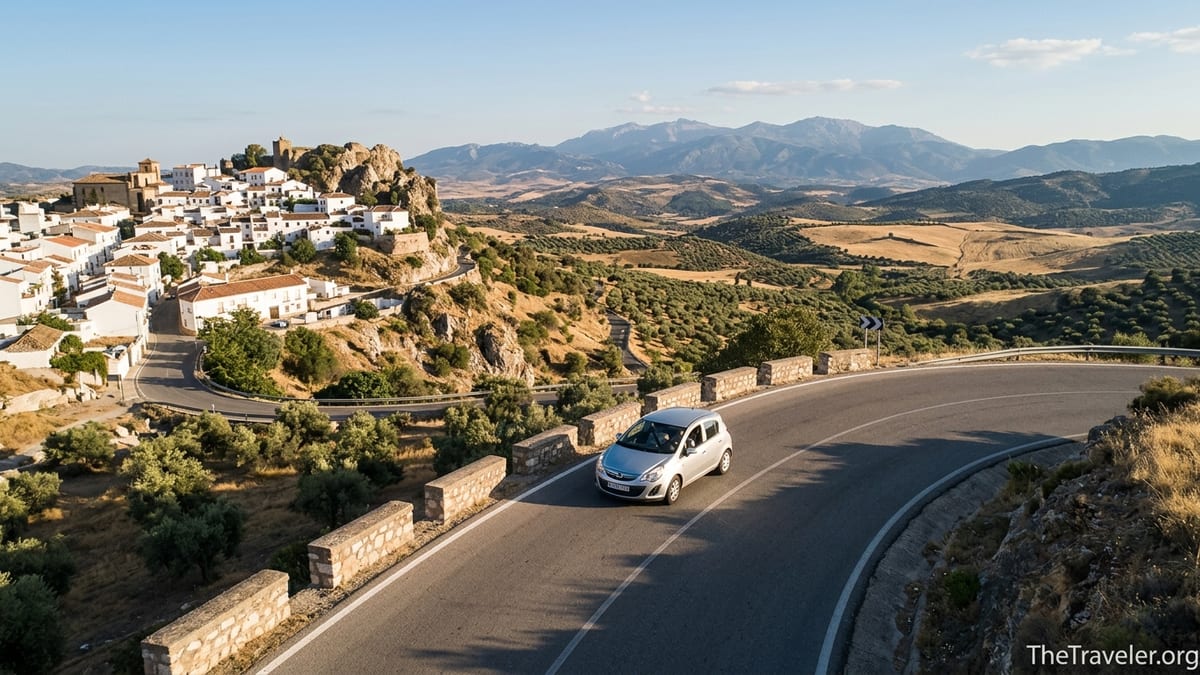
Andalusia is Spain’s classic road trip region, combining mountain roads, Moorish cities and coastal drives. A popular week‑long loop begins and ends in Malaga, which has a major airport and extensive car rental options. From Malaga, drivers often head inland to Ronda along the A‑397, a winding mountain road that climbs from sea level through pine forests to a plateau town dramatically perched above a deep gorge. Continuing north on smaller roads to Zahara de la Sierra and Grazalema takes you through the white villages of the Sierra de Grazalema Natural Park, with frequent viewpoints and roadside ventas serving grilled meats and local cheeses.
From the sierras, many itineraries continue to Seville via the A‑384 and AP‑4 or A‑4, trading mountain curves for rolling farmland and olive groves. Seville’s historic center is not car‑friendly, so visitors often book hotels with parking on the ring roads or across the river in Triana, leaving the car while they explore the cathedral, Alcázar and tapas bars on foot. From Seville, a scenic route south leads through Jerez de la Frontera and the sherry triangle to the Atlantic beaches of Cádiz and Zahara de los Atunes, where free street parking is still common outside peak August weekends.
Another celebrated drive is the road between Granada and the Alpujarras, where the A‑348 and connecting mountain roads wind along the southern flank of the Sierra Nevada. The villages of Pampaneira, Bubión and Capileira are reached through a series of hairpins but reward the effort with stone houses, chestnut forests and hiking trails. In winter, the A‑395 from Granada up to the Sierra Nevada ski station offers a completely different mountain landscape, though snow and ice are possible, so winter tyres or chains may be required in cold snaps.
For coastal scenery, the N‑340 and A‑7 east of Malaga deliver stretches of cliff‑hugging highway around Nerja and Almuñécar before reaching the quieter Costa Tropical. Small coves like La Herradura or Playa de Cantarriján may have steep access roads and limited parking; arriving early in the morning is key in summer. Driving further east toward Cabo de Gata‑Níjar Natural Park near Almería rewards with semi‑desert landscapes, volcanic headlands and small fishing villages such as San José, where streets narrow quickly and parking on the edge of town is usually the least stressful option.
Northern Spain: green coasts, mountains and historic cities
Northern Spain offers a striking contrast to Andalusia, with lush hills, Atlantic weather and quieter roads. A classic route traces the Bay of Biscay between Bilbao and A Coruña along the A‑8 and N‑634, detouring into fishing villages and surf beaches. Starting in Bilbao, you can pick up a rental car near the city’s airport and drive west toward Castro Urdiales, Llanes and Ribadesella, where the motorway runs slightly inland and older coastal roads offer more dramatic sea views and access to coves like Playa de Torimbia or Playa del Silencio.
Between Cantabria and Asturias, the Picos de Europa are one of Spain’s most rewarding mountain driving areas. The N‑621 and N‑625 snake through limestone gorges such as Desfiladero de la Hermida and Desfiladero de los Beyos, with trailheads for hikes to lakes and viewpoints. In high season, access to popular spots like the Covadonga Lakes near Cangas de Onís is partly controlled by shuttle buses, so you may need to park in designated lots lower down and continue on public transport. Overnight parking in small mountain villages is often free or inexpensive, making it feasible to base yourself in places like Potes or Arenas de Cabrales and explore the passes by day.
Further west, Galicia combines rugged coastlines with historic towns. The drive from Santiago de Compostela to the Rías Baixas weaves along fjord‑like inlets, vineyards and shellfish farms. Roads such as the PO‑308 along the O Grove peninsula provide constant sea views and frequent miradors. Inland, the route from Ourense to the Ribeira Sacra follows river canyons and terraced vineyards, with narrow side roads descending to viewpoints over the Sil gorge. Galicia’s changeable weather means mist and rain are common, so extra caution on wet, shaded bends is essential.
Across northern Spain, parking and traffic are typically lighter than in the south, but coastal towns fill quickly in July and August. Cities like San Sebastián and Santander operate regulated parking zones and underground garages near beaches such as La Concha or El Sardinero. In many cases, locals use suburban trains or buses to reach the seafront, and visitors can mirror this by leaving cars at accommodation slightly inland and traveling into the center by public transport.
Mediterranean Spain: coastal highways and inland detours
The Mediterranean corridor from Barcelona to Valencia and on toward Alicante and Murcia offers an appealing mix of fast coastal motorways and pretty side roads. The A‑7 and AP‑7 together form the main corridor; in some stretches you can choose between the free A‑7 a little inland and the AP‑7 closer to the sea, where any remaining tolls are clearly signed at ramps. Many drivers plan a leisurely route, stopping in seaside towns like Tossa de Mar on the Costa Brava, Peñíscola with its hilltop castle, or Altea near Alicante, where old towns rise above marinas and promenades.
In Catalonia, the drive from Barcelona north along the C‑31 and GI‑682 through coastal towns like Sant Pol de Mar, Tossa de Mar and Sant Feliu de Guíxols offers some of the most twisting sea‑view driving in the region. Inland detours lead to Girona’s medieval core or the volcanic landscapes of La Garrotxa. South of Barcelona, the C‑32 and N‑340 pass through Sitges and Tarragona, whose Roman remains and sandy beaches make good overnight stops. Many city‑center hotels here offer paid parking, allowing you to park the car and explore on foot.
Between Valencia and Alicante, the N‑332 acts as a slower, more scenic alternative to the inland motorway, connecting resort towns like Gandia, Dénia and Calpe. It passes orange groves, coastal wetlands and viewpoints over rocky headlands such as the Peñón de Ifach. Inland, the CV‑70 and other secondary roads climb into the mountains around Guadalest, a village perched above a reservoir. These smaller roads are often narrow with sheer drops and few guardrails, so drivers who are not comfortable with heights may wish to stick to main routes and visit only select viewpoints.
Further south, the combined coastal corridor of the A‑7 and AP‑7 links Murcia with Almería and on toward the Costa del Sol. Sections between Cartagena and Águilas, and between Motril and Almería, offer changing views of rugged coastline, greenhouse agriculture and distant sierras. Here, services can be more widely spaced than on the Barcelona‑Valencia section, so maintaining a healthy fuel reserve and carrying water is sensible, especially in the summer heat.
Sample one‑ and two‑week itineraries
For travelers with one week, a focused regional loop usually works better than trying to cross the whole country. A classic 7‑day Andalusia circuit might start in Malaga with two nights, giving time to explore the city and nearby Nerja, then head inland to Ronda for a night via the mountain A‑397. From Ronda, you could drive through Grazalema and Zahara de la Sierra to Seville for two nights, using hotel parking outside the old town. The final stretch returns to Malaga via Córdoba or directly through Jerez and the Costa de la Luz, depending on whether you prioritise historic cities or beaches.
Another one‑week option focuses on northern Spain. Flying into Bilbao, you could spend a night in the city before driving along the coast to Llanes or Ribadesella for two nights, using these towns as bases for day trips into the Picos de Europa. From there, continue west to Oviedo or Gijón, then on to Santiago de Compostela via the coastal A‑8 or the more rural N‑634, with a final night exploring Santiago’s old town before returning to Bilbao or flying out of Santiago’s airport.
With two weeks, it becomes realistic to link regions. One ambitious but rewarding 14‑day itinerary might begin in Barcelona, with three nights for the city and a Costa Brava day trip, then continue south along the Mediterranean through Valencia and Alicante, spending nights in smaller towns such as Peñíscola or Dénia to avoid big‑city driving. From Murcia or Almería you then cross into Andalusia, visiting Granada and the Alhambra, detouring into the Alpujarras if mountain roads appeal, then on to Malaga, Ronda and Seville. A final leg could take you north through Extremadura to Cáceres and Salamanca, finishing in Madrid for a flight home.
Alternatively, a two‑week northern and inland route could start in Madrid, with a rental car collected from the airport and a first night in the city. From there, drive north to Burgos and the wine regions of La Rioja or Ribera del Duero, where many bodegas sit along quiet country roads and offer parking for visitors. Continue on to Bilbao and along the coast through San Sebastián, then cut inland via Pamplona and the Pyrenees before looping back to Zaragoza and Madrid. This style of itinerary mixes high‑speed motorways with scenic secondary roads and gives a good sense of Spain’s varied landscapes without over‑long daily drives.
When designing your own route, consider limiting driving days to 3 or 4 hours behind the wheel, leaving time for unplanned stops at viewpoints, villages and markets. Spain’s network of roadside restaurants and simple hotels makes it easy to adjust plans on the fly if you discover an area you want to explore more deeply.
The Takeaway
Spain’s combination of reliable infrastructure, diverse landscapes and compact distances makes it one of Europe’s most rewarding countries for a road trip. With a little preparation on the practical side, from understanding tolls and fuel prices to navigating parking rules in historic centers, you can focus on the real highlights: winding up to a whitewashed village at sunset, cresting a mountain pass in the Picos de Europa or tracing the Mediterranean coast with the windows down.
Choosing a realistic itinerary is key. A one‑week loop in Andalusia, northern Spain or along the Mediterranean lets you dig into a region’s character, while a two‑week route can link several without constant rushing. Whichever route you choose, building in time for detours along minor roads, seaside miradors and village plazas will turn a simple drive into a memorable journey.
FAQ
Q1. Do I need an International Driving Permit to drive in Spain?
In most cases visitors from the EU, UK, US, Canada, Australia and several other countries can use their home licence for short stays, but if your licence is not in Roman script or you plan a long trip, it is safer to carry an International Driving Permit alongside your national licence.
Q2. Is it better to rent a car or use trains and buses for this kind of trip?
For regional and coastal exploration, especially in Andalusia and northern Spain, a rental car gives far more flexibility than public transport, although for big cities like Madrid and Barcelona many travelers combine trains between cities with short car rentals for countryside sections.
Q3. How expensive are tolls on Spanish motorways?
Toll costs vary widely depending on route and distance, and several major sections have become toll‑free in recent years, so many drivers now combine free A‑roads with selected tolled AP sections when they want to save time around busy cities or in mountain tunnels.
Q4. What is the typical fuel price and how much will I spend on petrol or diesel?
Fuel prices in Spain usually sit in the middle of the western European range and are often lower than in neighboring France, so for a compact rental car on a two‑week itinerary you should expect fuel to be a noticeable but manageable part of the overall budget.
Q5. Is parking difficult in Spanish cities and resort towns?
Parking is straightforward in many smaller towns and outside high summer, but in historic centers and busy coastal resorts it is common to rely on underground garages or hotel parking and to leave the car while you explore on foot or by public transport.
Q6. Are Spain’s mountain and rural roads safe for inexperienced drivers?
Main mountain highways are generally well engineered, but rural and high‑pass roads can be narrow and winding with steep drops, so inexperienced drivers should avoid night driving, take their time, and choose routes that match their comfort level.
Q7. Can I do a meaningful Spain road trip in just one week?
Yes, as long as you focus on a single region such as Andalusia, northern Spain or the Mediterranean coast and limit daily driving distances so that you still have time to stop and explore.
Q8. Do I need to book hotels and paradores in advance when driving in Spain?
In peak months like July and August it is wise to book popular coastal resorts and historic paradores ahead, while in shoulder seasons you can often combine a few key reservations with some nights left flexible for spontaneous stops.
Q9. What equipment should I check is included with my rental car?
At minimum you should confirm that the car carries a reflective vest, warning triangle or local equivalent emergency device, a spare wheel or repair kit, and the insurance and registration documents required if you are stopped by police.
Q10. Is it realistic to visit both Andalusia and northern Spain in a single trip?
It is possible on a two‑week itinerary if you use motorways for the long north‑south transfers and keep city stays short, but many travelers prefer to focus on one half of the country and save the other for a future journey.