


Spain is one of Europe’s easiest countries to cross by train, with fast links between Madrid, Barcelona, Seville, Valencia, Málaga and dozens of smaller cities. At the same time, some of Spain’s most beautiful corners are awkward by rail and far better with a car. This guide walks you through how to plan a rail-focused trip in Spain, how to choose between high-speed and regional trains, what to expect at stations, how tickets and luggage actually work in practice, and when it is worth adding a rental car to the mix.
How Spain’s Rail Network Works Today
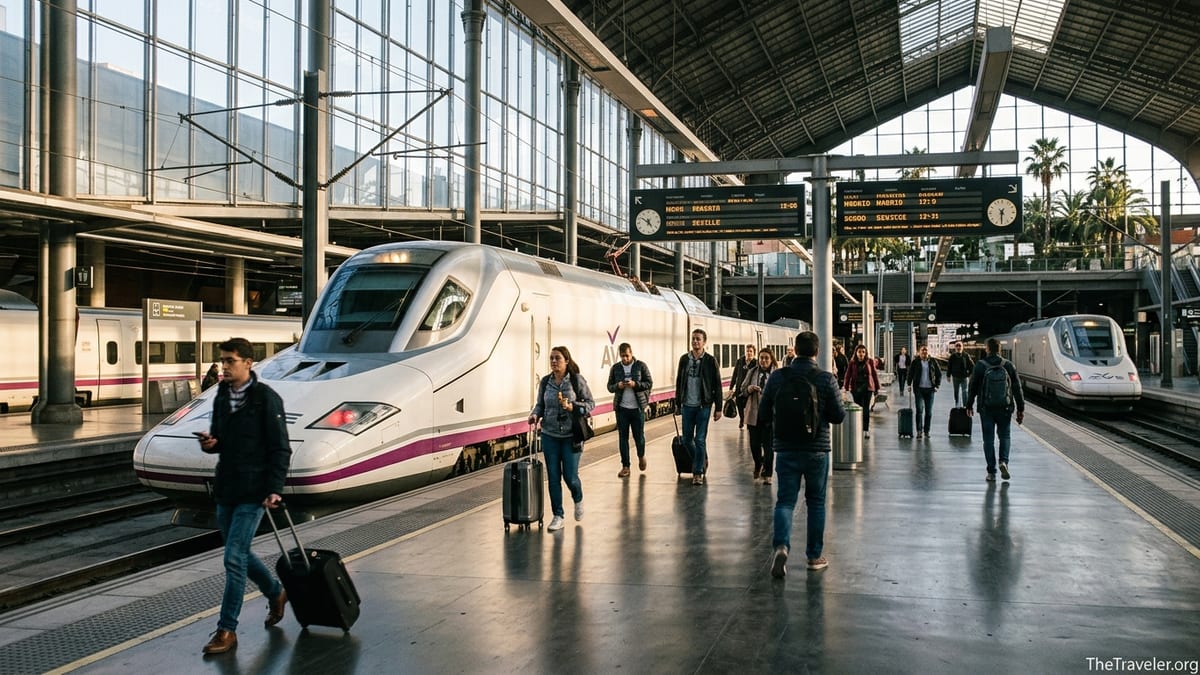
Spain’s rail map is built around high-speed lines that fan out from Madrid toward Barcelona, Valencia, Seville, Málaga, Alicante and the north. On the flagship Madrid to Barcelona route, the fastest trains usually take around 2.5 hours, while Madrid to Seville is roughly 2.5 hours and Madrid to Málaga about 2 hours and 40 minutes, depending on the departure you choose. Multiple operators now compete on key high-speed routes, so you will see Renfe’s AVE and Avlo services alongside Ouigo and Iryo on routes such as Madrid to Barcelona or Madrid to Valencia. This competition has pushed prices down compared with a few years ago, especially if you are flexible on time.
High-speed services sit on top of a dense web of conventional lines. Media Distancia regional trains link major cities with smaller ones, such as Seville to Cádiz or Valencia to Alicante, typically at lower speeds but with more intermediate stops. Around major urban areas you will also find Cercanías commuter networks, for example around Madrid and Barcelona, which can be useful for reaching outlying sights or suburban hotels. When you plan a trip, it helps to think in layers: use high-speed trains for the long jumps between hubs, then regional or commuter services for nearby day trips.
Most visitors will interact primarily with the main intercity stations. In Madrid, high-speed trains use Puerta de Atocha or Chamartín depending on the route, while Barcelona’s main station is Sants. In Andalusia, Santa Justa in Seville, Málaga María Zambrano, Córdoba Central and Granada’s station form a high-speed spine through the region. Valencia Joaquín Sorolla is the high-speed terminal a short walk or shuttle ride from the older Estación del Norte. Understanding which station your train uses is essential when you book accommodation or time airport transfers.
Ownership of the tracks and stations is separate from operation of the trains, which is why you may see different brands sharing platforms. Tickets for Renfe services are sold through Renfe’s own channels and at stations, while Ouigo and Iryo sell through their own sites and apps. There is no single all-operator ticket office at Spanish stations, so if you arrive intending to buy on the day, you may find that only certain trains can be sold at a particular counter or machine.
Choosing Routes: Madrid, Barcelona, Seville, Valencia, Málaga and Beyond
For a classic first trip, a popular rail loop is Madrid to Seville to Córdoba to Granada to Valencia to Barcelona over 10 to 14 days. For example, you might start in Madrid, take a morning AVE to Seville in roughly 2.5 hours, then use an Avant or Media Distancia train to Córdoba in about 45 minutes for a day trip or overnight. From Seville or Córdoba, high-speed or fast regional trains connect to Málaga in around 1 hour and 50 minutes from Seville or under 1 hour from Córdoba, which makes it easy to add the Costa del Sol without a car.
From Andalusia you can cut across to Valencia or head back to Madrid. A Madrid to Valencia high-speed train usually runs about 1 hour and 50 minutes. That means you can breakfast near Madrid’s Plaza Mayor and have a late-morning coffee in Valencia’s Ruzafa neighborhood the same day. From Valencia, fast Euromed or AVE-type services continue along the Mediterranean coast to Barcelona, often in about 3 hours. Many travelers choose to break this leg with a night in smaller coastal cities like Tarragona or Castellón, using regional trains that accept walk-up tickets and allow easier hopping on and off.
High-speed lines also open up longer one-way itineraries. A two-week north-south route might start in Barcelona, continue to Zaragoza, then Madrid, down to Córdoba and Seville, and finish in Málaga. On this kind of itinerary, you can often rely completely on trains between cities and only think about a car for specific rural side trips. For example, if you want to see the white villages around Ronda, you might catch a train from Málaga to Ronda, then rent a small car there for two days to drive the winding roads, instead of keeping a car the entire time.
Secondary routes remain useful even if they are not fully high speed. A good example is Madrid to Toledo. Media Distancia or Avant-style trains reach Toledo in roughly 30 minutes, often running at commuter-friendly times that make a day trip very simple. Another is Barcelona to Girona and Figueres, which gives you easy access to Costa Brava bus connections and the Dalí Theatre-Museum. Here, you may find a mix of high-speed and regional trains; the high-speed options cost a little more but can cut the journey nearly in half compared with the slowest services.
High-Speed vs Regional Trains: Comfort, Cost and When Each Makes Sense
On Spain’s high-speed lines, you will see several product names. AVE is Renfe’s flagship, usually with assigned seating, quiet, air-conditioned coaches and a mix of standard and comfort classes. Avlo is Renfe’s low-cost brand with a denser seating layout and a stricter luggage policy. Foreign visitors often compare AVE to a full-service airline and Avlo to a budget carrier. Meanwhile, private operators such as Ouigo and Iryo run their own high-speed trains with varying seat layouts and onboard services, so it is worth comparing not just times and prices but also the total cost once luggage and seat selection are added.
Regional Media Distancia and Avant services are slower but can feel more relaxed. Seats tend to be spacious, luggage rules are simpler and there is often less of an airport-style boarding process. For example, an Avant train between Seville and Córdoba still covers the distance quickly but usually has a more commuter-focused feel, with regulars boarding at the last minute and using multi-trip passes. Fares on these services are often fixed or only mildly variable, which means buying on the day may not be dramatically more expensive than booking months in advance, unlike popular AVE departures.
In practice, the choice between high-speed and regional depends on distance, budget and scenery. For a 2.5 hour Madrid to Barcelona run, the time savings of high speed are dramatic compared with older routes, and the tracks do not pass especially scenic landscapes, so the extra cost is almost always justified. By contrast, on shorter segments like Seville to Cádiz, the regional route along the Guadalquivir marshes and coastal plains can be part of the experience, and saving 20 or 30 minutes with a faster service rarely matters as much.
Comfort is generally good across the board, but there are differences. High-speed trains usually offer power sockets, at-seat tables and decent onboard Wi-Fi on at least some operators. Regional trains may have limited power outlets and more basic toilets, and older rolling stock can appear on quieter lines. If you plan to work on board, drafting an article between Madrid and Valencia or joining a video call between Barcelona and Zaragoza, paying for a high-speed option with reliable power and quieter coaches is often worthwhile.
Tickets, Reservations and How Far Ahead to Book
High-speed tickets in Spain are yield-managed, similar to airline fares. On core routes such as Madrid to Barcelona or Madrid to Valencia, booking 2 or 3 months ahead often reveals base fares that can be half or less of last-minute prices. Promotional campaigns such as Renfe’s recurring “Superprecios” sales periodically advertise lead-in fares from around 7 to 9 euros on Avlo and from around 15 euros on AVE for select dates and times, mostly outside peak hours or holidays. These eye-catching prices are limited, but they give an idea of how cheap Spanish high-speed travel can be if you are flexible.
For December or other busy periods, tickets on high-speed routes typically appear around 60 to 90 days before departure, though the exact window fluctuates. Many travelers trying to book Christmas Madrid to Barcelona trains in July will find nothing available simply because the schedule has not opened yet rather than because trains are sold out. A practical strategy is to set a calendar reminder 10 to 12 weeks before the date you want to travel, then check all operators once schedules open. On routes where multiple companies compete, such as Madrid to Barcelona, you will often find that one operator releases times earlier than another, so doing a one-time comparison when you are ready to book is essential.
On regional Media Distancia and Avant services, reservations may or may not be compulsory, depending on the line. Even when seats are assigned, prices are often more stable, so buying the day before or even day of travel is usually fine outside major holidays. For instance, a day trip from Madrid to Segovia or Toledo rarely needs to be booked months ahead in ordinary weeks. You might still want to buy a morning departure the previous evening just to secure your preferred time, especially in peak summer when many local residents also travel.
Spain no longer revolves around traditional rail passes in the way some other European countries still do, but some multi-trip products matter if you stay longer. Avant and Media Distancia passes targeted at regular commuters offer significant per-trip discounts but typically require Spanish residency or at least an ID number to purchase and use. For most visitors, buying individual advance tickets from Madrid to Barcelona or Seville ends up cheaper than continental passes once reservations and supplements are factored in. Apps from each operator are now the easiest way to manage tickets, as QR codes on your phone are widely accepted at boarding gates and ticket checks.
Luggage, Security and Station Experience
On regular Renfe high-speed services such as AVE, most passengers are allowed up to three pieces of hand luggage with a combined weight up to roughly 25 kilograms, as long as the total dimensions stay within stated limits. In practice, this often translates to one medium checked-style suitcase plus a cabin bag and a small backpack. Oversize luggage on some services, especially low-cost brands like Avlo, can attract an extra fee that is cheaper if purchased at the time of ticket booking and more expensive if added later at the station. Online discussions from recent travelers suggest that while weight is rarely checked, staff may enforce size and piece limits when platforms are busy.
Luggage storage on Spanish trains varies by model. On many AVE sets you will find large racks at the end of each coach, overhead shelves suitable for cabin-size suitcases and limited space between seat backs. Regional trains may have fewer dedicated racks, which can leave large bags protruding slightly into the aisle if you board late. A good tactic on popular routes like Madrid to Barcelona is to arrive at the platform a few minutes early and walk a little down from the escalators, where carriages are often less crowded and the luggage racks less full.
High-speed departures in Spain involve some light security. At stations such as Madrid Puerta de Atocha and Barcelona Sants, you usually pass your bags through an X-ray scanner before entering the high-speed waiting area. The process is more like a quick museum check than an airport: you keep your shoes on, liquids remain in your bag and queues often move quickly. For regional and commuter trains there is usually no formal screening; you simply walk to the platform when the train is announced.
Stations themselves are part of the journey. Madrid’s Atocha has a tropical garden and is integrated into the city’s metro and bus network, while Barcelona Sants is more functional but has plenty of eateries and a large taxi rank just outside. In Seville, Santa Justa lies slightly outside the historic center but is connected by bus and taxi; many travelers arriving from Madrid will drop bags at a hotel near the cathedral within 20 to 30 minutes of stepping off the train. Understanding transfers ahead of time, such as which metro line connects your Madrid station to your neighborhood, saves time and reduces stress when you arrive with luggage.
When a Rental Car Makes More Sense
Despite the reach of Spanish rail, there are clear moments when a rental car beats the train. Rural areas such as the Pueblos Blancos between Ronda and Arcos de la Frontera, the volcanic landscapes of La Garrotxa north of Girona or remote corners of Extremadura and Castilla-La Mancha are poorly served by public transport, especially on weekends. To explore multiple hill towns in a single day, pull over for photos at miradors or detour to a vineyard, a car offers the flexibility that even the best regional rail cannot match.
Car rentals are widely available in all major Spanish cities and at many mid-sized ones. Prices fluctuate seasonally; in peak summer it is common to see compact cars advertised from around 35 to 50 euros per day from large brands, sometimes slightly more when demand is high and stock is tight. One-way rentals, for instance picking up a car in Seville and dropping it in Málaga or Valencia, frequently carry a drop-off fee that can add anything from a modest daily supplement to a substantial flat charge. The precise fee varies by company and route, so it is worth checking a couple of providers and reading the small print about one-way conditions before committing.
A practical pattern is to keep your itinerary rail-based between large cities and only rent a car in specific segments where trains are clearly inconvenient. For example, you might travel from Madrid to Granada by high-speed train, spend two nights in the city without a car, then rent a vehicle for three days to explore the Alpujarras villages and the Costa Tropical before dropping the car at Málaga airport. Similarly, on the northern coast, you could take a train to Oviedo or Santander, then use a car for the winding coastal roads and inland valleys that are difficult and slow by bus.
Driving in historic centers can be stressful. Many Spanish cities operate low-emission zones or restrict non-resident access to narrow old-town streets, enforced by cameras that issue fines if you enter without authorisation. Hotels within these zones may register your plate on arrival, but this is not universal, and signage can be confusing if you are unfamiliar with local rules. Parking in medieval cores like Toledo, Córdoba or Girona is often expensive and tight, which is another argument for picking up cars on the edge of a city or at a train station when you are ready to leave rather than driving into the historic quarters.
Combining Trains and Cars: Real-World Itineraries
Consider a 12-day Andalusia and Mediterranean trip. You could arrive in Madrid, spend two nights, then take a morning AVE to Seville in about 2.5 hours. After three nights in Seville with a day trip to Córdoba by train, you might pick up a rental car at Seville’s Santa Justa station and spend three days driving the white villages via Arcos, Grazalema and Ronda, staying in rural guesthouses. From Ronda you would drive to Málaga, drop the car at the station or airport, and ride a fast train along the coast and inland to Valencia and then Barcelona. In this scenario, you use trains for long distances and dense urban legs, while the car is reserved for the rural middle.
Another example is a northern Spain loop focused on food and landscapes. Start in Barcelona, take a high-speed train to Zaragoza for a night, then continue to Pamplona or Logroño using Media Distancia services. After enjoying Rioja vineyards, rent a car to explore small villages and bodegas that are almost impossible to reach by rail. Later, drive to San Sebastián or Bilbao, drop the car and continue by train to León and Madrid. This balances the ease of rail for big hops with the freedom of a car in wine country and mountains.
Families often appreciate splitting the trip like this. Children can move around more easily on trains than in rental cars, and you avoid long motorway days by concentrating driving into shorter, scenic stretches. For example, parents might book a 2nd class AVE compartment from Madrid to Valencia, letting children watch the landscape pass by on tablets, then switch to a car for a three-day circuit through the orange groves and hilltop castles of inland Valencia and Castellón. After returning the car, a fast train to Barcelona brings you back to a car-free urban environment.
Budget travelers can also make smart combinations. If you spot a very low promotional fare on a specific Madrid to Barcelona Avlo departure, you might anchor your itinerary around that date, then fill the days before and after with slower, cheaper regional journeys and local buses. The money saved on that one big hop can offset the cost of a short car rental later on, such as a one-day hire from Granada to visit rural villages that are otherwise awkward and time-consuming on public transport.
The Takeaway
Spain is one of the few countries where you can breakfast in Madrid, have lunch in Valencia and arrive in Barcelona for dinner without ever seeing an airport. High-speed trains stitch together the country’s major cities quickly and, with competition between operators, often at attractive prices if you book a few weeks ahead. Regional services fill in the gaps, linking hubs such as Seville, Córdoba, Málaga and Valencia to smaller centers and day-trip destinations.
At the same time, trains cannot reach every white village, vineyard or mountain valley. Adding a short, well-planned car rental to a rail itinerary unlocks rural areas that buses and regional trains only skim. The trick is to let Spain’s rail network handle the long distances and busy corridors, then rent a car only where it clearly improves your experience. With a little planning around stations, ticket release dates, luggage rules and urban driving restrictions, you can enjoy the best of both worlds: effortless city-to-city hops by train and slow, scenic detours by road where it counts most.
FAQ
Q1. Do I need to reserve seats on Spanish high-speed trains?
Seat reservations are compulsory on high-speed services such as AVE, Avlo, Ouigo and Iryo, and your specific seat number is printed on the ticket or app.
Q2. How far in advance should I book Madrid to Barcelona trains?
On busy routes like Madrid to Barcelona, it is wise to start checking fares 2 to 3 months before travel and to book once a good schedule and price appear.
Q3. Can I just show up and buy tickets on the day?
For many regional and short-distance routes you can buy on the day, but for popular high-speed departures there is a real risk of higher prices or limited availability.
Q4. What luggage can I bring on Spanish trains?
Most high-speed tickets allow several pieces of hand luggage up to a total around 25 kilograms, but low-cost brands may charge extra for larger suitcases, so check your fare details.
Q5. Are Spanish trains safe and is there security screening?
Spanish trains are generally safe, with light airport-style X-ray checks for high-speed departures in big stations and normal platform boarding for most regional services.
Q6. When is renting a car better than taking the train?
A car is better for rural regions and scattered villages, such as the white towns around Ronda or remote wine areas, where public transport is infrequent or slow.
Q7. Is it difficult to drive and park in Spanish cities?
Driving into historic centers can be stressful due to restricted zones and narrow streets, and parking is often costly, so many visitors avoid using cars inside old towns.
Q8. Do I need an international driving permit to rent a car in Spain?
Many rental companies accept a standard license from countries like the United States or Canada, but some recommend or require an international permit, so confirm before booking.
Q9. Are there discounts for young people or frequent travelers on trains?
There are often seasonal discounts and special schemes for young residents and frequent commuters, but most short-term visitors will rely on advance-purchase promotional fares.
Q10. Can I combine different train operators on one trip?
You can mix operators on your itinerary, for example using Iryo for Madrid to Barcelona and Renfe for Seville to Málaga, but each ticket is booked and managed separately.