


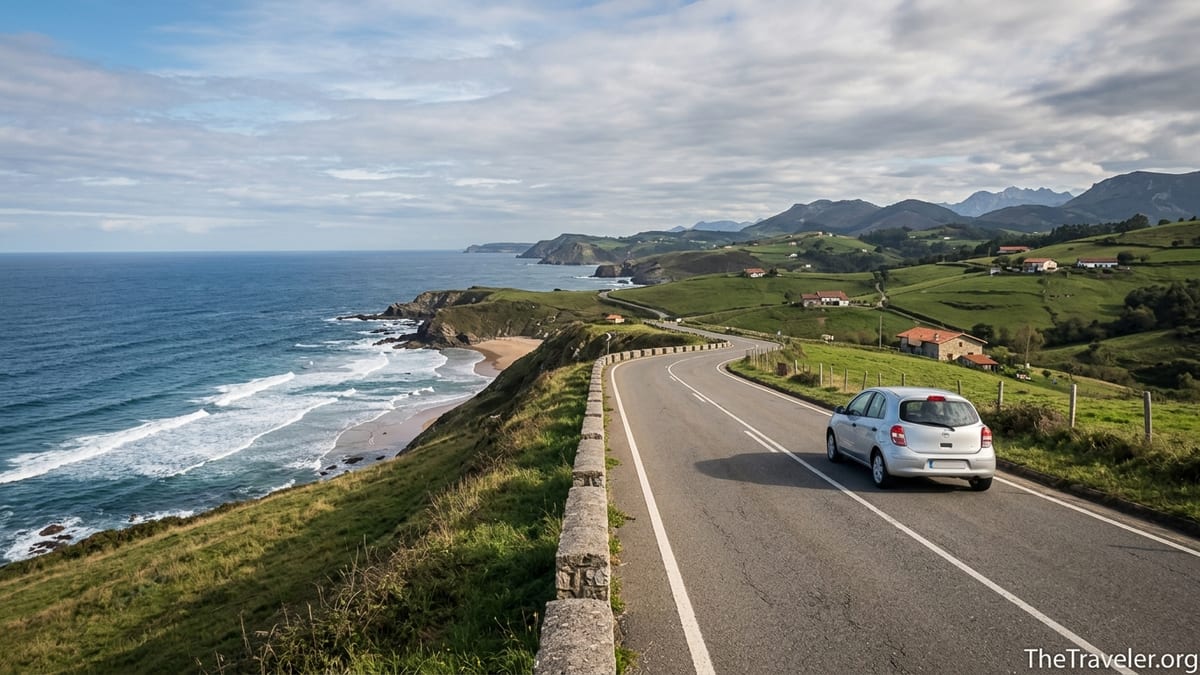
Driving the green northern coast of Spain from the Basque Country to Galicia is one of Europe’s great coastal journeys. Atlantic light, rugged cliffs, fishing ports and compact cities all link together along the N-634 and A-8 to create a road trip that is as practical as it is spectacular. This guide focuses on real-world logistics: how to rent a car, which roads to follow, where to park easily, and how to shape 7, 10 or 14 days into a satisfying loop or one-way itinerary.
Why Drive Northern Spain’s Green Coast
The coastal arc from the Basque Country through Cantabria and Asturias to Galicia is a continuous band of green hills, cliffs and small beach towns that feels far removed from the dry interior of Spain. Distances are manageable by European standards, yet the character of each stretch changes quickly, from the elegant bay of San Sebastián to the wild headlands of western Galicia. You can fly into Bilbao or San Sebastián, pick up a rental car, and within an hour be on quieter coastal roads watching the Bay of Biscay crash below.
Unlike some legendary coastal routes that demand difficult driving, northern Spain is largely straightforward for confident drivers. The tolled AP-8 motorway and free A-8 autovía run like a fast backbone, while the older N-634 threads through fishing villages such as Castro Urdiales, Laredo, Llanes and Ribadeo. Many travelers use the A-8 to cover ground on transfer days, then drop down to the N-634 or local roads for relaxed sightseeing sections with frequent photo stops.
Green Spain is also practical if you prefer moderate temperatures. Summer highs often stay in the low to mid 20s Celsius rather than the extreme heat of Andalusia. That makes road tripping, city walks and short hikes around spots like Gaztelugatxe in the Basque Country or the cliffs near Cudillero in Asturias much more comfortable in July and August, although rain and Atlantic mist are always possible so flexible plans and a rain jacket help.
With good infrastructure and a culture used to visitors, you can mix upscale city hotels with family-run guesthouses and rural casas near beaches or farm country. It is realistic to plan a trip that moves every night if you enjoy momentum, but many drivers now build in two- and three-night stays in bases such as Santander, Llanes or A Coruña to cut packing and unpacking and enjoy slower coastal days.
Rental Cars, One-Way Fees and Driving Basics
The most common starting points are Bilbao Airport and San Sebastián’s smaller airport, with Santiago de Compostela and A Coruña in Galicia useful as end points. Major rental agencies such as Avis, Europcar, Enterprise, Hertz and Spanish brands like Record Go and Centauro operate at these airports. For a typical one-week rental in late spring, many travelers currently report paying roughly 35 to 55 euros per day for a compact manual car with basic insurance, booked a few months ahead, with automatic cars often 25 to 40 percent more and in shorter supply.
One-way rentals between regions are widely available but can carry noticeable surcharges. Dropping a car in Santiago de Compostela after picking up in Bilbao, for example, often adds a fixed one-way fee that might range from about 80 to 200 euros depending on demand and season. If you want to avoid that cost, consider starting and ending in Bilbao, making a loop that pushes west to Galicia then returns inland via León or Burgos, using faster autovías for the final leg back.
For most visitors, a compact or intermediate-sized hatchback is the best match for narrow old-town streets and tight hotel garages. Large SUVs and vans can be awkward in smaller coastal villages such as Getaria or Lastres, where streets can be steep and parking bays short. Manual transmission still dominates the rental fleets; if you must have an automatic, reserve early, especially for July and August. International visitors should bring their home-country license and, if it is not in Roman script, an International Driving Permit. Basic mandatory equipment such as reflective vests and warning triangles is supplied with the car, and tolls are straightforward, primarily on the AP-8 near the French border.
Northern Spain’s main highways are modern and well signposted. Speed limits are typically 120 km/h on autovías, 90 or 100 on secondary roads, and less through towns. Fixed speed cameras are present, especially on the A-8 and N-634; using cruise control where possible helps avoid surprises. Fuel stations are frequent on major roads and near cities, with prices often a little higher at motorway service areas than at supermarkets or independent stations on the outskirts of towns like Santander, Gijón or Vigo.
Choosing Your Coastal Route: A-8 vs N-634
You will spend much of this journey deciding when to use the fast A-8 dual carriageway and when to drop onto the older N-634. The A-8 lets you cover distance efficiently between hubs such as Bilbao and Santander or Gijón and Ribadeo, with service areas, clear signage and relatively gentle curves. It runs inland in places, so while views can still be pretty, you are often above or away from the actual shoreline.
The N-634, by contrast, is the scenic spine of Green Spain, at times running right above the sea or passing through villages that feel barely changed in decades. Sections between Castro Urdiales and Laredo in Cantabria, around Llanes in Asturias, and approaching Ribadeo on the Galician border are especially picturesque, with glimpses of wide beaches and craggy headlands. This road is mostly single carriageway and slower, with farm traffic, local buses and regular roundabouts, so you should allow much more time than the distance might suggest.
A realistic compromise many drivers use is to stay on the A-8 until a specific coastal target, then exit and follow smaller roads for an hour or two of slower scenic driving. For example, on a transfer day from Bilbao to Santander you could drive the A-8 to Castro Urdiales, then take the coastal road via Islares and Oriñón before joining the A-8 again near Laredo. Similarly, between Llanes and Ribadesella you might choose the AS-263 coastal route through tiny coves and viewpoints rather than remaining on the motorway.
Weather and season affect route choice. On clear summer days, coastal roads reward you with sweeping ocean views and photogenic light late in the afternoon. In winter or in heavy Atlantic squalls, the A-8 is usually safer and more predictable than exposed cliff roads. Some high-mountain detours into the Picos de Europa, such as the road up to the lakes of Covadonga, can be closed to private cars at busy times or in adverse weather, with shuttle buses replacing them, so checking local information before committing to detours is wise.
Parking and Overnight Stops from Basque Country to Galicia
City centers in northern Spain were not designed for cars, so parking strategy can make or break a road trip. In larger cities like Bilbao, San Sebastián, Santander, Gijón, Oviedo or A Coruña it is usually easier to book a hotel with garage access and absorb the 15 to 25 euros per night fee than to hunt for free street parking. Many travelers instead choose accommodations just outside the central historic zones, for example near San Sebastián’s Amara district or A Coruña’s Riazor beach, where on-street spaces or cheaper private lots are easier to find while still being a short walk or bus ride from the main sights.
In resort towns and fishing villages, the pattern changes. Places such as Getaria, Zumaia, Comillas, Llanes, Ribadesella or Cudillero typically have municipal car parks near the port or beach and free or cheap parking slightly uphill above the old quarter. In summer, it is worth arriving early in the day, before local day trippers fill the lots. For instance, the clifftop views above Cudillero are easiest to enjoy if you park at the upper car park before mid-morning and walk down through the lanes to the harbor rather than trying to squeeze into the small spaces near the water.
Throughout Cantabria and Asturias, rural guesthouses and agriturismo-style stays often offer on-site parking included in the rate. Staying just outside major hubs can save money and simplify parking, especially if you do not mind a 10 to 20 minute drive into town for dinner. Around Santander this might mean basing yourself in village areas like Somo or Pedreña and taking a passenger ferry into the city once or twice, leaving your car at the hotel.
When planning nightly stops on a full coast-to-coast journey, consider a rhythm of bigger hubs and quieter interludes. A common pattern is to sleep in Bilbao or San Sebastián for museums and food, then shift to smaller coastal places like Laredo or Santillana del Mar in Cantabria, Llanes or Cangas de Onís in Asturias for nature and hiking access, and finally A Coruña or Santiago de Compostela in Galicia for culture and flights out. This alternation keeps driving sections varied and gives you a mix of urban energy and ocean calm.
Suggested 7-Day, 10-Day and 14-Day Circuits
In seven days, you will only scratch the surface but can still complete a satisfying snapshot. A realistic one-way 7-day route might start in Bilbao, with a first night in the city to visit the Guggenheim and riverside areas, then move to San Sebastián for a night focused on pintxos and La Concha bay. From there, you could drive via the Cantabrian coast to Santander or nearby Santillana del Mar for a night, continue to Llanes or Cangas de Onís in Asturias for access to Picos de Europa, then finish with two nights in either Oviedo or Gijón before returning the car or taking a train onward. This keeps driving legs mostly within two to three hours per day.
With 10 days, many travelers extend the route all the way into Galicia. A workable pattern is Bilbao to San Sebastián, then Santander or Comillas, then Llanes for a base to visit the Picos de Europa and the lakes of Covadonga, followed by a night near Cudillero or Luarca on the Asturian coast. From there, cross into Galicia via Ribadeo, detouring to Praia das Catedrais if tides and access rules allow, and spend one or two nights in A Coruña or Lugo. Finish with at least two nights in Santiago de Compostela, returning the car and exploring the old town on foot before flying out.
A 14-day circuit rewards those who want a slower rhythm and more rural nights. You could arrive in Bilbao and spend two nights there, then two nights in San Sebastián with a day trip to coastal villages like Getaria or Zumaia. Continue with two nights in Cantabria, perhaps one in Santillana del Mar and one near the coast around San Vicente de la Barquera, then three nights in Asturias, splitting time between a seaside base like Llanes or Ribadesella and a mountain village closer to Picos de Europa. Finally, allocate three to four nights in Galicia, dividing them between the northern coast around Viveiro or Ortigueira, the city of A Coruña, and Santiago de Compostela. On this timeframe you can afford non-driving days for hikes, boat trips or simply lingering on beaches.
Travelers who prefer to avoid one-way rental surcharges can adapt the 10- and 14-day itineraries into loops. For example, you could drive west along the coast from Bilbao to somewhere in western Asturias, then turn inland via the AS-64 and A-63 towards Oviedo and León, before rejoining the A-8 or AP-1 eastbound back toward Bilbao. Another option is to loop from Galicia back to the Basque Country via the interior N-120 and A-1 through cities such as Ourense and Burgos, trading sea views for vineyards and high plateaus during the return leg.
Seasonal Considerations, Budget and Practical Tips
Weather is the defining variable on this route. From late May to early October, conditions are generally mild, with long evenings and frequent clear spells between showers. July and August bring warmer seas and most festivals but also the heaviest domestic tourism, especially around San Sebastián, Santander and the Asturian coast. In high summer, booking coastal accommodation weeks or months ahead is normal, and daily parking around popular beaches like La Concha, San Lorenzo in Gijón or Playa de Oyambre near Comillas can feel competitive by mid-morning.
Spring and autumn can be excellent for driving, with less traffic and lower prices. April and early May often bring green hillsides and wildflowers, while late September and early October can still feel summery on calmer days. In these shoulder seasons, you might find double rooms in simple coastal hotels for broadly 80 to 120 euros per night, with city-center options in Bilbao or Santiago generally higher and rural guesthouses somewhat lower. Winter road trips are entirely possible if you accept more rain, shorter daylight and the chance of low cloud obscuring some classic viewpoints; in return, you gain quieter roads and more availability.
Food budgets can be controlled without sacrificing quality by embracing set menus and bar food. Fixed-price weekday lunches, or menú del día, in local restaurants between the Basque Country and Galicia often sit in the 12 to 20 euro range including bread and a drink, while evenings can be as affordable or expensive as you choose. You might graze on individual pintxos in San Sebastián or Bilbao for a few euros each, or splurge on a seafood feast in a Galician port, sharing a platter of grilled fish and shellfish caught that morning.
Other practical tips include carrying some coins or a contactless card for smaller municipal parking machines, keeping a light jacket and umbrella in the car regardless of season, and downloading offline maps covering both the A-8 and the smaller coastal and mountain roads. Mobile coverage is broadly good but can drop in narrow valleys in the Picos de Europa or along remote stretches of the Cantabrian coast, so preloading directions to trailheads or rural stays avoids last-minute stress.
FAQ
Q1. Do I need a car to travel from the Basque Country to Galicia, or can I rely on trains and buses?
Trains and buses link the main cities, but they are slower along the coast and often miss smaller fishing villages and viewpoints. A car gives far more flexibility to stop at beaches, viewpoints and rural guesthouses that are not on main public transport routes, which is why most travelers planning a full coastal road trip choose to drive.
Q2. Is it better to start my road trip in Bilbao or San Sebastián?
Bilbao usually offers more flight options, larger rental car fleets and slightly cheaper car hire, making it a practical starting point. San Sebastián is more intimate and focused on food and beach life, so some visitors spend a couple of nights there without a car first, then pick up a vehicle in Bilbao before heading west along the coast.
Q3. How difficult is the driving on coastal and mountain roads in northern Spain?
Most main highways such as the A-8 and AP-8 are modern and easy to drive, with clear signage and good surfaces. Coastal and mountain roads like parts of the N-634 or access routes into Picos de Europa can be narrow and winding, but they are usually well maintained; taking your time, avoiding aggressive schedules and choosing a reasonably small car makes them manageable for confident drivers.
Q4. What is a realistic daily driving distance on this route?
On days focused on sightseeing, many travelers find that 100 to 150 kilometers along a mix of A-8 and local roads is enough, which often equates to two to three hours of actual driving plus stops. On transfer days when you mainly use the A-8, covering 250 to 300 kilometers is realistic, but doing this every day will leave little time to explore towns and beaches.
Q5. How much should I budget for fuel and tolls on a one-way trip to Galicia?
Fuel costs depend on your car and driving style, but for a compact petrol or diesel car driving from the Basque Country to Galicia with detours, many visitors report spending a low to mid three-figure sum in euros on fuel over one to two weeks. Tolls are modest compared with some European countries because much of the A-8 is toll-free; the main tolled segment is usually around the Basque border area, so many drivers find toll costs to be a relatively small part of their overall budget.
Q6. Is it easy to find parking in popular cities like San Sebastián, Santander and A Coruña?
Parking in central districts can be tight, especially in summer, but underground public car parks and hotel garages are common. Expect to pay a daily fee similar to other Western European cities, and consider staying slightly outside the historic cores where on-street parking or smaller private lots are easier to secure, then walking or taking local transport into the center.
Q7. Can I safely drive this route in winter?
Yes, the main roads remain open in winter except during occasional severe weather events, which are more likely in high mountain areas than along the coast. You should expect more rain, changeable visibility and shorter daylight hours, so planning shorter legs, checking local forecasts daily and being flexible about scenic detours into the Picos de Europa is sensible.
Q8. Do I need to book accommodation in advance in summer?
In July and August, advance booking is strongly recommended for coastal locations and major cities, especially on weekends and around local festivals. Outside peak season, it is easier to book a few days ahead as you go, but if you have your heart set on specific villages such as Llanes, Santillana del Mar or Cudillero, securing rooms in advance still provides peace of mind.
Q9. Is it worth detouring inland to Picos de Europa on a short road trip?
Even on a tight itinerary, many travelers consider a night or two near Picos de Europa highly worthwhile because the contrast between Atlantic coast and limestone peaks is dramatic. Bases such as Cangas de Onís or Arenas de Cabrales allow you to sample mountain roads, short hikes and viewpoints like Covadonga while still being a reasonable drive from the coastal towns.
Q10. Should I drop the car before exploring Santiago de Compostela or keep it until departure?
Santiago’s historic center is compact and largely pedestrianized, so a car is more of a liability than an asset once you arrive. Many visitors return their rental car on the edge of the city or at the airport and explore on foot for a day or two before flying out, simplifying parking and reducing rental costs at the end of the trip.