


Northern Spain’s “green coast” is one of Europe’s most rewarding road trips, threading together elegant cities, surf beaches, quiet fishing villages and wild Atlantic headlands. This itinerary follows the Cantabrian and Galician coast from San Sebastián to A Coruña and along Galicia’s shore, with realistic driving times, suggested hotels and concrete stops that turn a scenic drive into a memorable journey.
How long you need and when to drive Northern Spain’s coast
For a dedicated coastal itinerary from San Sebastián to A Coruña and along Galicia’s coast, most travelers do best with 8 to 12 days. That allows at least one night each in San Sebastián, Bilbao, Santander, Llanes or another Asturian village, Cudillero, Ribadeo and A Coruña, plus one or two nights on Galicia’s wilder Costa da Morte or Rías Baixas. With only a week you can still cover the route, but you will need to limit long detours and pick just one Galician base.
The driving itself is straightforward. The modern A-8 and AP-8 motorways track the coast with frequent exits for beaches and villages, while older N-roads like the N-634 and N-642 give more scenic sea views. Distances are modest but bends and viewpoints slow you down. As a rule of thumb, plan 1 hour 15 minutes for San Sebastián to Bilbao, around 1 hour for Bilbao to Santander, 1 hour 15 minutes to Llanes, about 1 hour 10 minutes from Llanes to Cudillero, 1 hour 20 minutes from Cudillero to Ribadeo, and roughly 2 hours 15 minutes from Ribadeo to A Coruña. Add extra time in summer or on weekends.
Weather shapes the experience. The Basque, Cantabrian and Galician coasts have a milder Atlantic climate than much of Spain, with frequent showers and changeable skies even in July and August. That is part of the appeal: green hills, dramatic clouds and uncrowded beaches compared with the Mediterranean. The best window for a road trip is late May to early October, when most beach services are open and sea temperatures are at their warmest, but spring and autumn bring quieter roads and cheaper hotel rates.
Car hire is widely available in San Sebastián, Bilbao and Santander, and many travelers choose to drop the car in A Coruña or Santiago de Compostela to continue by train or plane. Look for mid-size models with enough space for luggage and easy handling on narrow village streets. Automatic cars are less common and more expensive, so book ahead if you need one.
San Sebastián: elegant bay, surf beach and first viewpoints
San Sebastián, or Donostia, makes an ideal starting point. Its three main urban beaches sit within minutes of the old town. La Concha, curving in front of Belle Époque facades, is the classic city beach with calm waters suited to swimming rather than surf. At the western end, Ondarreta is a family-friendly stretch with space for beach games and a view across to Santa Clara Island. On the opposite side of the river Urumea, Zurriola is the liveliest and most exposed beach, drawing a younger crowd and a steady lineup of surfers.
If you are staying one or two nights, choose accommodation that lets you walk to the shoreline. In practice this means hotels and guesthouses in the Centro, Old Town or Gros districts. A typical mid-range double in high season might cost the equivalent of a few hundred US dollars per night close to La Concha, while smaller pensions a few streets back can be significantly cheaper. Early reservations are essential in July and August when festivals and domestic holidays drive demand.
Before you start the road trip west, take in at least one viewpoint. The funicular up Monte Igueldo gives a classic panorama of La Concha Bay, including both La Concha and Ondarreta beaches and the surrounding hills. For a more rugged feel, the walk around Monte Urgull on the opposite side of the bay offers cliffside paths, sea views and historic fortifications within steps of the old town pintxo bars.
Leaving San Sebastián by car, follow the AP-8 towards Bilbao. If you have time to spare, short detours off the motorway lead to smaller Basque coastal villages like Getaria and Zumaia, with their own beaches and seafood restaurants, though that adds several hours and is best saved for a longer regional trip.
Bilbao and the Basque coast: city culture and clifftop drives
The drive from San Sebastián to Bilbao takes around 1 hour 15 minutes via the tolled AP-8, or a little longer on the older N-634. Bilbao itself sits slightly inland on the Nervión estuary but is closely tied to the sea. The city has transformed from an industrial port into a cultural hub, with the Guggenheim Museum Bilbao as its architectural emblem and a lively riverside promenade lined with cafes and pedestrian bridges.
For a road trip, however, the appeal lies in combining Bilbao’s urban buzz with quick side trips to the Basque coast. The beaches of Getxo, such as Ereaga and Arrigunaga, are within a 20 to 30 minute drive and offer wide sands backed by villas and cliffs. Farther along, the dramatic headland of San Juan de Gaztelugatxe, with its chapel-topped islet linked by a stone causeway, has become a famous viewpoint. Reaching the steps requires advance planning and a timed reservation in peak months, and parking fills quickly, so many drivers park in nearby villages and walk in along signposted paths.
In Bilbao, hotel prices cover a wide range. Central business hotels near the river are convenient if you plan a single night. Boutique properties in the old town (Casco Viejo) provide easier access to pintxo bars and the covered market. Parking garages are common in the center and usually charge a daily rate that is similar to large European cities, so factor this into your budget.
When you leave Bilbao for Santander, the coastal motorway again gives the fastest link. Those with extra time can exit towards Castro Urdiales, a Cantabrian seaside town with a Gothic church, harborfront promenade and small city beach, making a good coffee or lunch stop about 30 to 40 minutes out of Bilbao.
Santander to Llanes: Cantabrian beaches and clifftop promenades
Santander, capital of Cantabria, spreads along a south-facing natural bay with a string of beaches just east of the city center. Playa del Sardinero, actually two linked beaches, is the best known, backed by grand early 20th century buildings and a long promenade. Nearby, the Magdalena Peninsula offers walking paths, views of the bay and small coves sheltered from Atlantic swell.
Staying one night in Santander allows time to stroll the waterfront and sample local specialties like rabas, battered squid rings often served with a drink in traditional bars. Mid-range hotels line the Sardinero promenade, many with sea views and paid parking. As with the rest of the route, simpler guesthouses and apartments in residential areas can be significantly cheaper, though you may trade views for a short drive to the beach.
From Santander to Llanes you cross into Asturias, a region renowned for its green hills and dramatic coastline. The drive takes about 1 hour 15 minutes on the A-8, plus time for detours. Several beaches are worth a stop if conditions cooperate. Playa de Oyambre, west of San Vicente de la Barquera, lies within a natural park and offers a long arc of sand with mountain views. Closer to Llanes, playas such as Barro or Torimbia (reached by a short walk from clifftop parking) showcase the mix of turquoise water, rocks and pastures typical of the Asturian coast.
Llanes itself is a compact fishing town with a small harbor, medieval streets and a series of nearby beaches. The seafront Paseo de San Pedro is a grassy clifftop promenade above the town, ideal for an evening walk as waves crash below. Accommodation includes small hotels in the historic center, modern properties on the outskirts and rural guesthouses in neighboring villages. In the summer peak, rooms in central Llanes are often booked out weeks in advance, so consider nearby villages such as Poo or Andrín if you are planning late.
Asturias highlights: from Llanes to Cudillero
Continuing west, the stretch from Llanes to Cudillero is one of the most scenic drives on the Cantabrian coast. Without stops it takes around 1 hour 10 minutes, but it is worth allowing half a day. Weather permitting, you can pause at viewpoints or lesser-known beaches signposted from the A-8 or along older coastal roads. In clear conditions, the Picos de Europa mountains form a dramatic inland backdrop.
Between Ribadesella and Gijón, detours lead to blowholes and sinkhole beaches such as Playa de Gulpiyuri, a small sandy inlet inland from the sea, reached by footpath across fields. These attractions are sensitive to overcrowding and parking is limited; visiting early or outside peak season helps reduce impact and stress. The city of Gijón itself, with its own urban beaches and a working port, can serve as an overnight stop if you want more urban life before heading into quieter fishing villages.
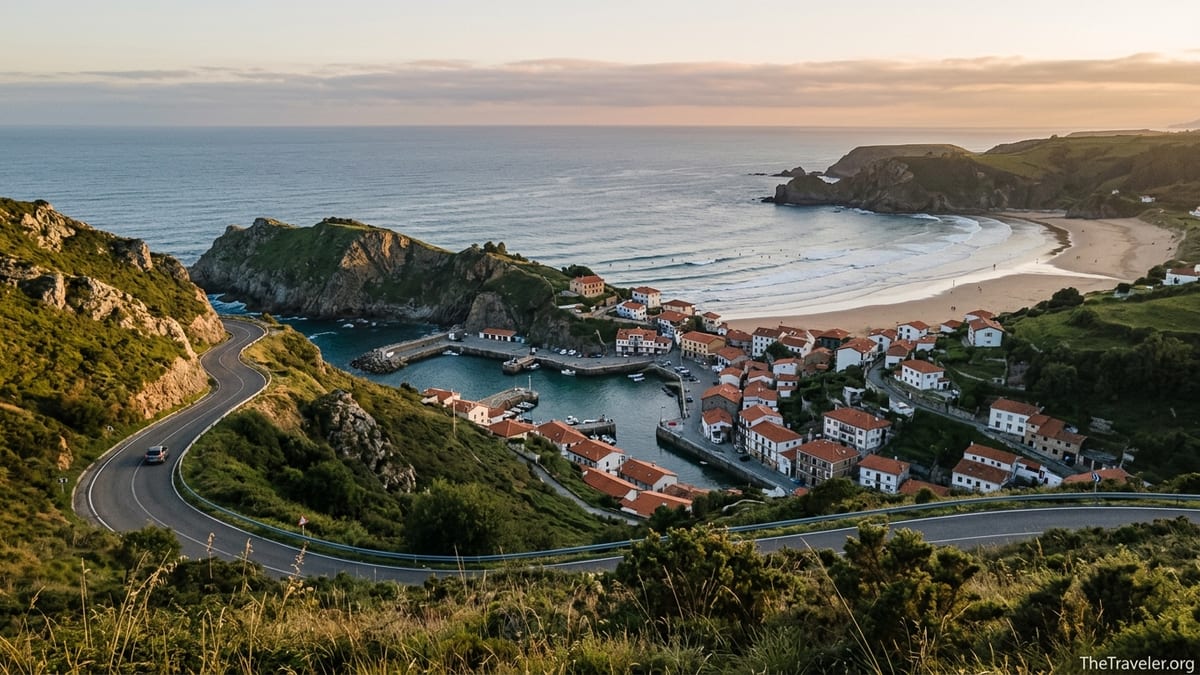
Cudillero, however, offers a different atmosphere. This small Asturian fishing village is wedged into an amphitheater-shaped hillside, with houses climbing steeply above a compact harbor. Colored facades, stepped alleyways and terraces with sea views give Cudillero a postcard feel. Parking is generally on the outskirts, with walking access into the old village. Many visitors stay in family-run guesthouses on the slopes above or in small hotels a short drive away on the plateau, where there is more room for cars.
Nearby beaches include Playa del Silencio, a crescent of shingle and cliffs accessed by a steep path, and the long sandy stretch of Playa de Aguilar. Both require short drives from the village and some walking, so comfortable footwear is useful. In high summer, it is wise to arrive early in the day to secure parking and enjoy the scenery before the crowds grow.
Ribadeo and the Lugo coast: dramatic rocks and tidal beaches
From Cudillero to Ribadeo, where Asturias gives way to Galicia, the direct drive along the A-8 takes around 1 hour 20 minutes. Ribadeo sits on an estuary with a compact historic center and serves as the main base for visiting Praia das Catedrais, one of the most photographed beaches in northern Spain. At low tide this beach reveals a series of rock arches and caves that resemble a natural cathedral, which has made it extremely popular in recent years.
Access to Praia das Catedrais is strictly controlled in summer and on busy holiday weekends. Visitors must secure a free reservation from the regional authorities for a specific date and time window, and parking is limited to designated areas near the clifftop. Because the spectacle depends on low tide, planning is essential: match your booking to the tide charts and allow extra time for walking paths and steps down to the sand. Many travelers choose to stay one night in Ribadeo or in nearby villages so they can visit the beach early or late in the day when light is best and crowds smaller.
Beyond Praia das Catedrais, the Lugo coast offers other viewpoints and quieter sands. Small fishing and farming villages dot the N-642, and pull-offs lead to lesser-known beaches framed by cliffs and grassy headlands. Simple rural guesthouses and small hotels provide overnight options, often at lower prices than the more famous resorts farther east. Dining is typically focused on local fish and shellfish, along with Galician staples like empanadas and hearty soups.
From Ribadeo to A Coruña, the fastest route stays on the A-8 and AP-9 for a drive of around 2 hours 15 minutes. For a more scenic but slower option, you can weave through the higher Rías Altas, visiting capes and viewpoints on smaller roads, which can easily turn the journey into a full day.
A Coruña and Galicia’s Costa da Morte: lighthouses, headlands and fishing ports
A Coruña, on a peninsula surrounded by ocean, combines urban beaches, a long seaside promenade and the working feel of a Galician port. The city’s signature landmark is the Tower of Hercules, a Roman lighthouse that still functions and stands on a grassy headland with walking paths and Atlantic views. Within the city, urban beaches like Riazor and Orzán sit just below apartment blocks and cafes, making it easy to mix swimming and sightseeing.
Many travelers use A Coruña as a base for one or two nights before exploring the Costa da Morte, the “Coast of Death” stretching southwest towards Fisterra. The name reflects the many shipwrecks that occurred along this rugged, rock-strewn shoreline. Today it is a sparsely populated region of lighthouses, small fishing ports and long, often empty beaches. Driving from A Coruña to the heart of the Costa da Morte, around towns such as Malpica, Laxe or Muxía, typically takes 1 hour 30 minutes to 2 hours depending on stops and chosen roads.
On this stretch, concrete scenic stops include clifftop viewpoints with signed miradores, small harbors where fishing boats land shellfish and white fish, and long beaches that may have only a handful of visitors outside peak summer weekends. Local tourism boards and small visitor centers provide up-to-date information on walking routes, surf spots and conditions. Rural hotels, converted farmhouses and simple seaside pensions are common, often offering sea views, on-site parking and home-style cooking at prices lower than those in the Basque cities.
If your road trip continues south towards the Rías Baixas and eventually Portugal, expect another several hours of driving along a mix of coastal and inland roads, with options to stop in towns like Muros, Noia or Cambados. Those ending the journey in Galicia often drop the car in A Coruña or Santiago de Compostela and continue by rail or air to Madrid, Barcelona or back home.
Practical tips: driving, parking, tides and hotels
Although much of this route follows motorways, the most memorable moments come from short detours: a fifteen-minute side road to a headland, a signed track to a beach car park, or a steep descent into a harbor village. To make these feel manageable, plan conservative daily distances. As a guideline, combining more than three separate stops and two hours of driving in one day can feel rushed, especially in midsummer traffic.
Parking varies by destination. In major cities like San Sebastián, Bilbao, Santander and A Coruña, expect to use underground garages or marked surface lots, paying hourly or daily rates similar to other Western European urban centers. In small fishing villages, parking is often free but limited; spaces near harbors and beaches fill up quickly on sunny days, and local police may close access roads when lots are full. Arriving early in the morning or late in the afternoon often makes the experience far smoother.
Tides are particularly important on parts of the Galician and Asturian coast. Attractions like Praia das Catedrais only reveal their full rock formations at low tide, and some small coves become inaccessible or dangerous in big swell. Tourist offices and regional websites publish tide tables, and many beachfront bars post daily times on chalkboards in season. Checking these each morning can help you decide where to swim, walk or photograph safely.
When booking hotels and guesthouses, consider not just price but ease of access with luggage and a car. In older centers like Cudillero or Llanes, some properties are reachable only via stepped alleys. If carrying heavy bags is a concern, look for accommodations that specify on-site or adjacent parking and elevator access. Many rural hotels in Asturias and Galicia include breakfast in the room rate, which can provide good value compared with eating out for every meal.
FAQ
Q1. How many days do I need for a coastal road trip from San Sebastián to A Coruña?
Most travelers are comfortable with 8 to 12 days, which allows one night in each major stop plus extra time for Galicia’s coast without rushing.
Q2. What is the best time of year to drive the northern Spain coast?
The most reliable weather is from late May to early October, with July and August warmest but busiest. Spring and early autumn are quieter and often better value.
Q3. Do I need a four-wheel-drive vehicle for this itinerary?
No. All main roads and typical detours to beaches and viewpoints are paved. A standard car is sufficient, though a compact size is easier in tight village streets.
Q4. Is it easy to find fuel and services along the route?
Yes. Service stations are frequent on the A-8, AP-8 and AP-9 motorways and near major towns. Many include cafes, basic shops and restrooms open daily.
Q5. Can I swim at the beaches along the Cantabrian and Galician coasts?
Swimming is common in summer, but conditions vary. Always observe local flags, heed lifeguard advice and be cautious of strong currents, especially on exposed Atlantic beaches.
Q6. Do I need advance reservations for Praia das Catedrais near Ribadeo?
In peak season and on many weekends you do. Access is controlled with free time-slot reservations, and planning around low tide is essential to see the rock arches.
Q7. Are there tolls on the roads between San Sebastián and Galicia?
Yes. Sections of the AP-8 and AP-9 are tolled. You can reduce costs by using parallel national roads, though journeys will take longer.
Q8. Is parking difficult in small fishing villages like Cudillero and Llanes?
Parking is limited near historic centers and harbors. Expect to use edge-of-village lots and walk in, especially during summer weekends and holidays.
Q9. Can I do this road trip using public transport instead of a car?
Trains and buses link the main cities and larger towns, but many viewpoints, smaller beaches and rural stretches are hard to reach without a car.
Q10. Is it safe to drive and park overnight along the northern Spain coast?
For most visitors it feels safe. Use common sense: park in well-lit areas, avoid leaving valuables in view and follow local advice on where to leave the car.