


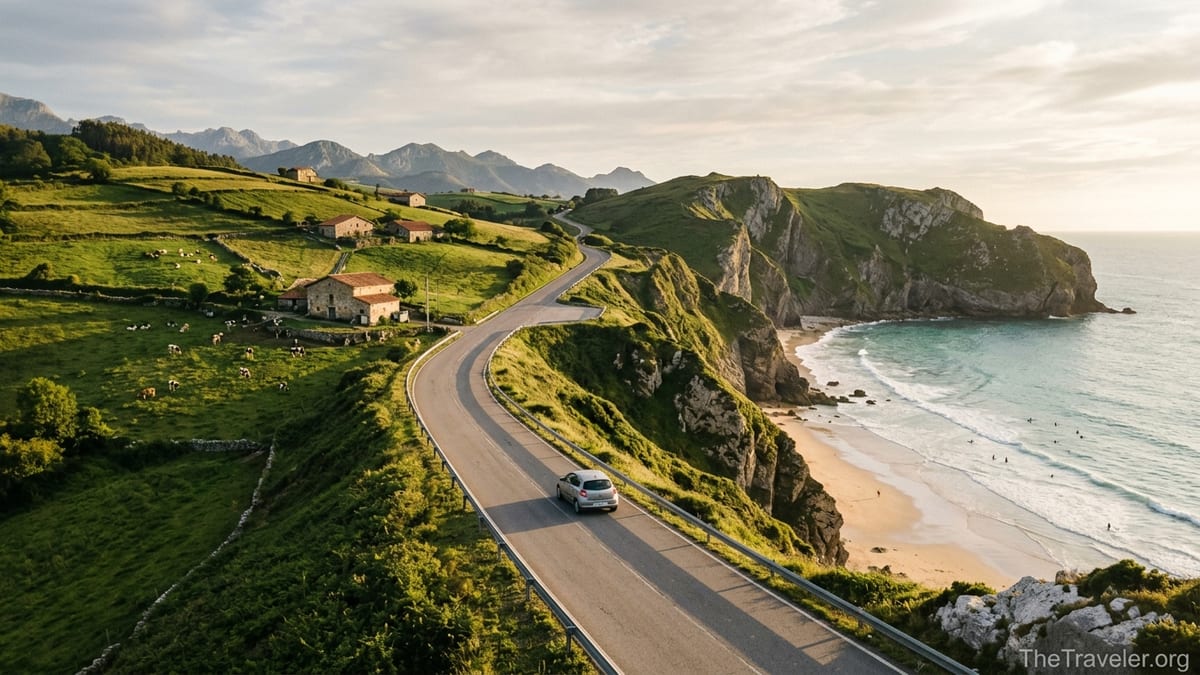
Northern Spain’s Atlantic coast stretches in a long green arc from the French border to the wild rías of Galicia. Linking the Basque Country, Cantabria, Asturias and Galicia in a single trip means weaving together food-obsessed cities, fishing villages, surf beaches and mountain landscapes. This guide outlines realistic 5, 7, 10 and 14-day itineraries with suggested overnight bases, typical driving times and shorter alternatives for travelers who cannot cover the entire coast.
How to structure a Northern Spain trip
Most travelers connect the four Atlantic regions in a westbound arc from the Basque Country to Galicia, often starting in Bilbao or San Sebastián and finishing in Santiago de Compostela or A Coruña. Driving the full coastal route between San Sebastián and Santiago is roughly 800 kilometers, usually broken into hops of 1 to 3 hours. For context, Bilbao to Santander on the A-8 motorway is about 100 kilometers and usually takes around 1 hour, while Oviedo to A Coruña via the A-8 and A-6 is closer to 3.5 hours in normal traffic.
A rental car is the most flexible way to cover the coast, particularly for reaching smaller villages such as Cudillero in Asturias or Comillas in Cantabria, and trailheads in Picos de Europa. Many visitors pick up a compact car at Bilbao Airport (BIO) or Santander Airport (SDR). Daily rental rates fluctuate, but in peak summer it is common to see small cars starting around the equivalent of 50 to 70 euros per day when booked a few weeks ahead, plus tolls on some expressways in the Basque Country.
Public transport works if you are not in a hurry. The narrow-gauge coastal trains inherited from the old FEVE network connect Bilbao with Santander, Santander with Oviedo and Oviedo with Ferrol in Galicia, stopping at coastal towns along the way. This is scenic and relatively inexpensive but slower than the motorway and best suited to travelers with more time. Regional buses also fill gaps, for example between Oviedo and Cangas de Onís for Picos de Europa or between Lugo and coastal towns in Galicia.
Weather is a major reason to choose the north. In July and August, average daytime temperatures in San Sebastián and Santiago de Compostela sit in the low to mid 20s Celsius rather than the high 30s more typical of inland Spain. Short rain showers are common, so a light rain jacket and quick-drying shoes are usually more useful than formal clothes. Even in high season, beaches such as Playa Torimbia near Llanes or Playa de Doniños near Ferrol can feel relaxed compared with Mediterranean resorts.
Five days: Basque focus with a taste of Cantabria
With only five days, it is unrealistic to cross all the way into Asturias and Galicia without spending much of the trip in the car. A more satisfying approach is to combine the Basque Country with a short foray into eastern Cantabria. One common pattern is to arrive in Bilbao, spend two nights there, then move to San Sebastián or Hondarribia for two nights, with a final night in or near Santander for a quick look at Cantabria’s coast.
Bilbao makes an easy first base. Two full days allow for the Guggenheim Museum, pincho bars in Casco Viejo and perhaps a half-day drive to the Txakoli vineyards near Getaria or to the coastal town of Bermeo and the viewpoint of Gaztelugatxe. Driving times are short: Bilbao to Bermeo is around 40 minutes, Bilbao to San Sebastián via the AP-8 a little over an hour if traffic is light. Many visitors choose a central hotel near the river to be able to walk between the Guggenheim and the old town in 20 minutes.
For days three and four, San Sebastián offers an immediate change of pace with its horseshoe-shaped La Concha Bay, Belle Époque promenade and dense clusters of bars in the Parte Vieja. With a single full day, you can spend the morning walking up Monte Urgull for panoramic views, then take the funicular to Monte Igueldo in the afternoon. If you prefer a smaller town, Hondarribia near the French border keeps you close to the coast while reducing city logistics, and you can still hop by bus into San Sebastián for an evening of pintxos.
To include a glimpse of Cantabria, finish with a night in Santander or a village like Somo across the bay. The drive from San Sebastián to Santander is about 2.5 hours along the A-8, with easy stops in Castro Urdiales or Laredo. Santander offers an elegant waterfront, the Magdalena Peninsula and Playa del Sardinero for an afternoon swim before a last seafood dinner. This five-day plan keeps daily drives manageable and avoids rushing into Asturias, which is better saved for a longer trip.
Seven days: Basque Country and Cantabria with a short Asturias add‑on
A week allows you to add a first taste of Asturias while still giving Basque Country and Cantabria decent time. A realistic structure is two nights in Bilbao, two nights in San Sebastián or Hondarribia, two nights in western Cantabria around Santillana del Mar or Comillas, and one night at the gateway to Asturias in Llanes or Ribadesella.
After two or three nights split between Bilbao and San Sebastián, point west along the A-8 to Cantabria. A popular base is Santillana del Mar, a medieval stone village inland from the coast, known as a staging point for visiting the replica of the Altamira cave. Alternatively, Comillas on the coast offers a sandy beach, a compact old center and one of Antoni Gaudí’s early works, El Capricho. Distances remain comfortable: San Sebastián to Comillas is about 2.5 to 3 hours by motorway, Comillas to Santander around 50 minutes.
Use your Cantabrian base for short loops. For instance, from Santillana you can drive in roughly an hour to the dramatic headlands of San Vicente de la Barquera, combining a seafood lunch with beach time at Merón. Another day might focus on Santander itself, strolling the regenerated Centro Botín waterfront and the Sardinero beaches before returning to your quieter base. Local guesthouses in these towns often include parking and basic breakfast in nightly rates that, outside peak August, can be comparable to midrange hotels in larger cities.
With one or two nights left, cross the border into eastern Asturias. Towns like Llanes and Ribadesella work well as compact bases, with a string of small coves and viewpoints nearby. The drive from Comillas to Llanes is around 1.5 hours, and Comillas to Ribadesella about 2 hours, so you can still stop at viewpoints such as the cliff-top Hermitage of San Emeterio near the border. In Asturias, aim for at least one walk along the coastline, for example from Llanes toward Playa de Toró or Torimbia, before returning west or catching a flight from Santander or Asturias Airport.
Ten days: classic San Sebastián to Santiago coastal route
Ten days is long enough to follow the full coastal arc from the Basque Country to Santiago de Compostela at a relaxed but still focused pace. A common pattern is two nights in San Sebastián or Bilbao, one night in or near Santander, two nights in western Cantabria or eastern Asturias, two nights on the central Asturian coast and three nights split between the Rías Altas and Santiago in Galicia. This results in driving days of 2 to 4 hours rather than marathon hauls.
Begin with two nights in San Sebastián for food and city life, or split one night Bilbao and one night San Sebastián if you want both. On day three, drive west along the A-8 and spend the night near Santander or Santillana del Mar. From Bilbao, reaching Santander is roughly 1 hour, and Bilbao to Santillana del Mar about 1.5 hours. Spend the afternoon on Santander’s Magdalena Peninsula or wandering Santillana’s cobbled lanes before dinner in a traditional mesón.
Day four and five can cover western Cantabria and eastern Asturias. Use a base in Comillas, San Vicente de la Barquera, Llanes or Ribadesella. This gives you easy access to Capricho de Gaudí in Comillas, the estuary and beaches of San Vicente, and, if the weather cooperates, a side trip inland to Picos de Europa. For example, San Vicente to the mountain town of Potes takes around 1.5 hours via the N-621, following the Deva River into the gorge. If you stay in Llanes, picturesque coves such as Cuevas del Mar lie within a 20 or 30 minute drive.
On days six and seven, consider shifting your base to central Asturias, perhaps between Cudillero and Gijón. The stretch of coast west of Gijón is often cited by road trippers as one of the prettiest sections, with small fishing harbors and broad sandy beaches framed by cliffs. Cudillero’s amphitheater of colorful houses stacked above the port draws many visitors; staying overnight rather than day tripping means you experience the town after tour buses leave. From here, day trip options include the Cabo Vidio cliffs or the quieter Playa de San Pedro de la Ribera, both often reachable in under 40 minutes by car.
Reserve days eight to ten for Galicia. Cross into the region near Ribadeo, optionally timing your visit to Playa de las Catedrales, whose access is often regulated in high season and depends on low tide. It is realistic to spend one night in or around Ribadeo or Viveiro to enjoy the Rías Altas coastline, then continue to either A Coruña or directly to Santiago de Compostela. Driving from Ribadeo to A Coruña usually takes around 2.5 hours on the A-8 and AP-9, and A Coruña to Santiago roughly 50 minutes. Finish with at least two nights in Santiago to explore the cathedral quarter and, if you have energy, a day trip out to the Ría de Muros e Noia or the nearby Albariño wine country.
Fourteen days: slow traverse with mountains and inland detours
With two full weeks, you can slow the pace, add back roads and include the mountains that often tempt travelers away from the highway. This length of trip suits travelers willing to shift bases every two or three nights and perhaps include an inland loop to Picos de Europa or to wine regions such as La Rioja or Ribeiro in inland Galicia. It can also work as a one-way route, for example flying into Bilbao and out of Santiago or A Coruña, which avoids backtracking.
A sample pattern might be three nights in the Basque Country, three in Cantabria, four in Asturias and four in Galicia. Start with a mix of Bilbao and San Sebastián, using local buses and metro in Bilbao and walking in San Sebastián to limit driving days at the beginning. From there, move west to Santander or Santillana del Mar for two nights, then inland to Picos de Europa for a night in Potes or Fuente Dé. This gives you time to ride the cable car at Fuente Dé, hike a short section of the Ruta del Cares if conditions are safe and enjoy mountain views without rushing.
Continue into Asturias with a base in Cangas de Onís or Arriondas if you want more Picos time, including Covadonga Lakes when roads and weather allow. From Cangas de Onís, it is only about 25 minutes by car to Ribadesella on the coast, making it realistic to pair a morning hike with an afternoon on the beach. After two or three nights inland, shift to the coast at Gijón, Oviedo or Cudillero for urban culture and seafood. Oviedo, though inland, is well connected by rail and road, and its compact old town, pre-Romanesque churches on Monte Naranco and cider bars make it a comfortable base for a few days.
Give Galicia at least four nights. One approach is to spend two nights in the Rías Altas, perhaps basing in Viveiro or near Ortigueira for wild headlands such as Estaca de Bares, then drive down to the Rías Baixas for two nights near O Grove or Cambados. From Viveiro to Santiago de Compostela by road can take around 3 hours, while Santiago to the southern Rías Baixas can be under 1.5 hours. Longer stays make it easier to time coastal walks with tides and weather, and to fit in winery visits, boat trips to shellfish farms or simple afternoons on family-friendly beaches.
If you prefer fewer hotel changes, a 14-day trip can also be structured around four main hubs: Bilbao or San Sebastián, Santander or Santillana, Gijón or Oviedo, and Santiago. From each hub you can make day trips in a 60 to 90 minute radius. For example, from Santiago you can reach the Costa da Morte villages like Muxía in about 1.5 to 2 hours, or head inland to medieval towns such as Lugo in roughly 1.5 hours. This hub-and-spoke pattern particularly suits families or travelers who value unpacking less often over seeing every small village.
Shorter alternatives and one‑region trips
Not every traveler needs or wants to cross four regions in a single holiday. If you have limited time, focusing on a smaller stretch can yield a more relaxed experience and reduce logistical stress. For example, a five-day Asturias-only trip flying in and out of Asturias Airport near Oviedo could pair two nights in Oviedo with three nights on the coast near Llanes or Cudillero, allowing for mountain day trips without long highway days.
Similarly, a one-week Basque and Rioja combination might appeal to food and wine lovers. You could spend three nights in San Sebastián, enjoying pintxos and perhaps a day trip to Saint-Jean-de-Luz in French Basque Country, then pick up a rental car for four nights in La Rioja around Logroño or Haro. Driving from San Sebastián to Logroño typically takes around 2 hours, and in Rioja many wineries are within a 20 or 30 minute drive of town centers, making it easy to structure tastings and vineyard visits.
For travelers relying on public transport, linear city-to-city routes can be more practical than trying to reach every rural village. An example would be Bilbao to Santander by coastal train, onward by bus or train to Oviedo or Gijón, then a longer rail segment to A Coruña or Santiago. Overnight stops in those cities still provide access to beaches by short local bus rides and allow you to experience regional cuisine in settings where car-free logistics are straightforward.
Another compromise is to pair a short self-drive segment with longer train travel. You might take a fast train from Madrid to León or Burgos, rent a car there for four or five days to loop through Asturias and Cantabria, then drop the car in Bilbao and continue by train or plane. This kind of hybrid approach reduces car rental days and toll costs while preserving flexibility in rural and mountain areas.
Practical tips on driving, seasons and budgeting
Road conditions along the main A-8 motorway are generally good, but the motorway can be busy in July and August, especially near major cities and coastal junctions. Expect slower progress on scenic secondary roads, where frequent curves and village speed limits keep average speeds down. Many rural roads have viewpoints or small parking areas that appear without much warning, so planning photo stops in advance is sensible. If you are not used to manual transmissions, it is worth paying extra for an automatic, as steep hills and narrow streets are common in old quarters.
Parking is an important consideration when choosing overnight bases. City centers like San Sebastián, Bilbao and Santiago often rely on underground garages that charge per hour or per day, while smaller towns may offer free street parking a short walk from the center. When comparing accommodation, check whether parking is included, available nearby at a fixed nightly rate, or requires using public garages. In some historic villages, hotels may be inside car-restricted zones, so arriving first at a public car park and walking in can avoid unnecessary stress.
In terms of timing, late May, June, September and early October often balance milder weather, fewer crowds and lower prices compared with peak summer. Coastal temperatures remain comfortable for hiking and beach walks, and the risk of very hot days is lower than in the interior. Winter brings quieter towns and lower accommodation rates but also shorter daylight hours, more rain and, in the mountains, the possibility of snow and road closures, which can complicate Picos de Europa excursions.
Daily budgets vary widely depending on lodging and dining choices, but many travelers find that staying in smaller guesthouses and rural inns keeps costs down while providing local character. A simple lunch menu in a non-touristy bar, such as a menú del día in Oviedo or Lugo, is often reasonably priced and includes two courses, bread and a drink. Splurge meals at destination restaurants in the Basque Country or Cantabria require advance bookings and can add significantly to trip costs, so it is wise to decide in advance whether such experiences are a priority and plan the itinerary and budget accordingly.
FAQ
Q1. Is it realistic to drive from San Sebastián to Santiago de Compostela in one week?
It is possible but feels rushed. A week allows you to follow the coast with daily drives of 2 to 4 hours, but you will need to limit stops. Many travelers prefer to end in Asturias or western Cantabria instead and save Galicia for another trip.
Q2. Do I need a car to enjoy Northern Spain’s Green Coast?
No, but a car makes reaching small villages and viewpoints much easier. Without a car you can still link major cities like Bilbao, Santander, Oviedo and A Coruña by train and bus, then use local buses or taxis for nearby beaches.
Q3. What are good overnight bases if I want to change hotels as little as possible?
For a simple structure, consider Bilbao or San Sebastián in the Basque Country, Santander or Santillana del Mar in Cantabria, Oviedo or Gijón in Asturias, and Santiago de Compostela or A Coruña in Galicia. From each, you can reach many sights on day trips.
Q4. When is the best time of year to road trip Northern Spain?
Late spring and early autumn often provide a balance of pleasant temperatures, fewer crowds and lower prices. July and August have the most reliable beach weather but also the heaviest traffic and highest accommodation rates, especially in smaller coastal towns.
Q5. How many regions can I realistically see in five days?
With five days it is sensible to focus on one region and a slice of the next. For example, combine Basque Country with a short visit to eastern Cantabria, or base yourself only in Asturias, pairing Oviedo with a coastal town like Llanes or Cudillero.
Q6. Are the roads in Picos de Europa difficult to drive?
Some mountain roads are narrow and winding with steep drop-offs, which can be challenging if you are not used to such conditions. Driving slowly, avoiding night driving in the mountains and checking weather forecasts helps most cautious drivers feel comfortable.
Q7. Can I do this route by campervan instead of car and hotels?
Yes, many travelers use campervans along the A-8 and in coastal areas, but you should plan for official campsites or designated motorhome areas, respect local parking rules and be prepared for narrower village streets where large vehicles are not ideal.
Q8. Is Northern Spain suitable for families with children?
Yes. The combination of beaches, short hikes, compact historic centers and generally milder summer temperatures works well for families. Choosing a few multi-night bases with apartment-style accommodation can make the trip easier with younger children.
Q9. How far in advance should I book accommodation in July and August?
For popular coastal towns and small villages, booking several months ahead is prudent, especially for weekends and local festivals. In shoulder seasons, you often have more flexibility and can book closer to arrival, particularly in larger cities.
Q10. Is it safe to drive and park in the bigger cities on this route?
Driving standards are generally good and city centers are well signposted, but traffic can be dense at peak times. Many visitors prefer to park once in a central garage and then move around Bilbao, San Sebastián, Oviedo or Santiago primarily on foot or by public transport.