


Most travelers treat Madrid as a city break, tick off the Prado and Plaza Mayor, then fly home without ever seeing the rest of the region. On a recent October trip, I did the opposite. I used Madrid as a base but deliberately pushed out into the Community of Madrid: royal towns, mountain monasteries, vineyards and small stone villages that rarely make it into guidebooks. What follows is what I actually spent, line by line, with concrete examples from trips taken in 2024 and 2025, then checked again in late 2026 against current official prices. Instead of one abstract “daily budget,” this is a realistic look at how much it costs to explore beyond the capital, and which decisions really move the needle on your final bill.
Madrid As a Base: Core Transport Costs Before Day Trips
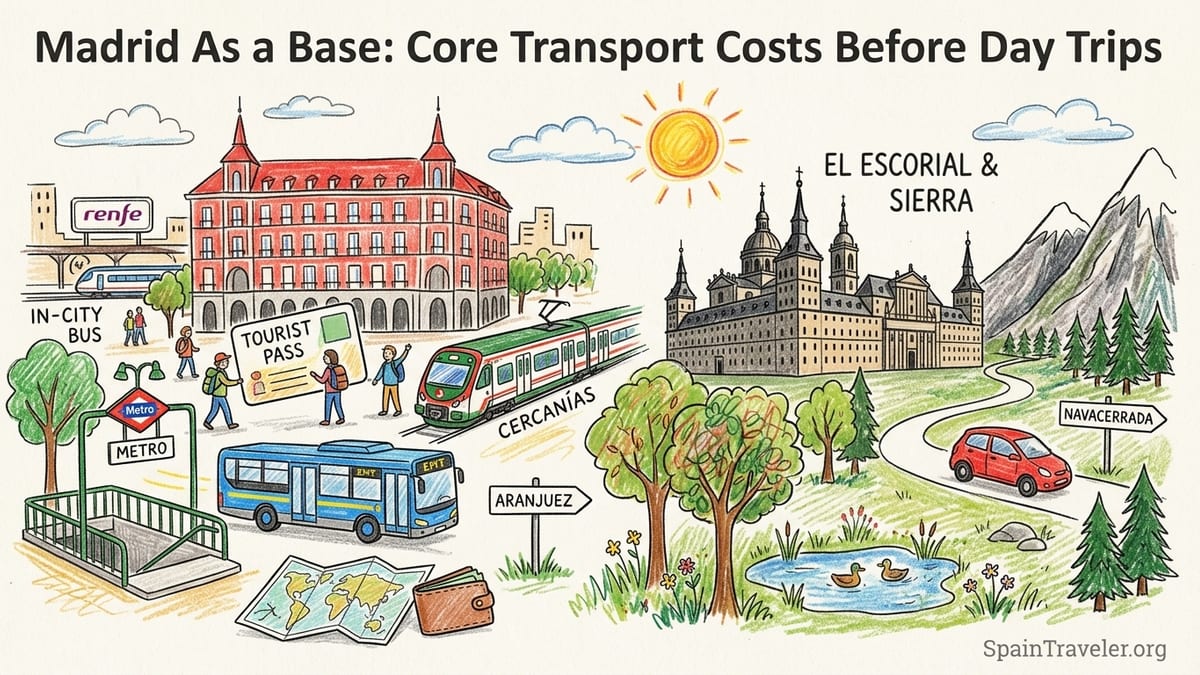
Before you can judge the price of day trips around the Community of Madrid, you need a sense of what the “baseline” in the capital looks like. In October 2024, I based myself near Puerta del Sol for five nights and relied almost entirely on public transport. I bought a 3 day tourist ticket covering zone A and nearby municipalities, which allowed unlimited travel on metro, city buses and Cercanías suburban trains within its zones. The passes are sold by the Madrid Regional Transport Consortium and, with state-backed discounts that remained in place through at least the first half of 2025 and were later extended, they worked out to roughly 22 to 25 euros for 3 days per adult for central zones when I cross-checked prices in late 2026. This pass covered all my in-city movement and some suburban hops at a predictable cost.
On two additional days when I did not have a tourist pass active, I bought single tickets and used a topped-up transport card. Metro and EMT bus singles in central Madrid hovered between about 1.5 and 2 euros per ride depending on distance, with airport surcharges on the metro costing several extra euros per trip. Short suburban Cercanías rides within a couple of zones, such as Madrid Sol to Aranjuez or El Escorial, were priced around 3 to 4 euros one way in 2024 and 2025 when bought as standard single tickets, according to current Renfe fare tables I checked again in 2026. That meant a typical in-city day without day trips cost me around 8 to 10 euros in public transport, while days on an unlimited tourist pass averaged closer to 7 euros because of the intensive usage.
Accommodation in Madrid city sets the stage for the rest of your budget. On my 2024 trip, I paid an average of 130 euros per night for a midrange hotel just off Gran Vía in early October. In April 2025, when I checked again for comparison, similar centrally located three-star hotels were quoting between 120 and 150 euros per night for flexible rates in shoulder season. Those numbers climb easily above 180 euros in May and September. Since every euro spent on a central hotel is a euro you are not using on rural stays or heritage experiences, your starting point in the capital heavily shapes what is left for exploring the region.
Meals in the city were reasonable compared with other Western European capitals. A menú del día near Atocha station in October 2024 cost 13.90 euros for three courses with wine. In the La Latina district, I paid 2.50 to 3 euros for individual tapas in classic tabernas and about 18 to 22 euros per person for a full dinner with shared raciones and drinks. These benchmarks matter because when you venture out into the rest of the Community of Madrid, food often becomes cheaper but transport and entry tickets begin to bite into your budget.
Aranjuez: Cheap Train, Expensive Experiences
Aranjuez is the archetypal “easy” Madrid day trip. In practice, its cost depends heavily on whether you choose the ordinary Cercanías train or opt for heritage packages like the Tren de la Fresa. On a clear Tuesday in late April 2024, I took an early Cercanías C-3 train from Sol to Aranjuez. I bought a standard suburban ticket at the station machines and paid just under 4 euros one way, matching current Renfe price bands for a multi-zone Cercanías ride as of 2025. The journey took about 45 minutes, and once in Aranjuez I walked to the Royal Palace and the gardens in less than 15 minutes. Local urban buses around Aranjuez were priced similarly to other Madrid-region city buses, roughly 1.50 euros for a single in recent fare tables.
Entry to the Royal Palace of Aranjuez and the nearby Royal Barges Museum added the real cost. In 2024 I paid 9 euros for general palace admission on a weekday, which aligned closely with official ticket prices still displayed in 2026, and about 4 euros extra for the barges museum. I joined an optional guided visit in Spanish that cost 5 euros on top of the base ticket. Lunch in a traditional restaurant a block off Calle de la Reina cost 17 euros for a menú del día with a local red wine and coffee. Counting train, tickets and food, my simple self-organised Aranjuez day came to roughly 45 to 50 euros per person from Madrid.
The equation changed dramatically when I returned in May 2025 to try the Tren de la Fresa, the historic “Strawberry Train” that runs on selected spring and autumn dates between the Madrid railway museum and Aranjuez. According to the official 2025 price table issued by the train’s operator, the most popular “Fresas de la Huerta” itinerary, which includes round-trip travel in vintage wooden coaches, a local bus transfer, palace and garden visits and tastings, cost 58 euros for adults that season. I purchased this package in late May 2025 and paid that advertised amount. On top of that, I spent around 12 euros on extra drinks and pastries in Aranjuez. My total for essentially the same day trip soared from about 50 euros on the commuter train to over 70 euros with the heritage package.
Was it worth it? For rail enthusiasts and families, the Tren de la Fresa delivers a layered experience, with staff in period dress, strawberries served on board and guided elements folded into the day. For travelers primarily interested in the palace and gardens at a reasonable price, the regular Cercanías train keeps Aranjuez one of the cheapest classic day trips from Madrid. The underlying lesson is that in Aranjuez, the basic transport is inexpensive but curated packages, palace add-ons and food choices can quietly triple your spend without you ever leaving the region.
El Escorial and the Sierra: When Cheap Trains Meet Mountain Costs
San Lorenzo de El Escorial and the nearby Sierra de Guadarrama are where my budget started to wobble. In October 2024, I took a Cercanías C-3a train from Madrid Chamartín to El Escorial. The single ticket, crossing several fare zones, cost just under 4 euros based on the multi-zone fares valid at the time, and current Renfe documentation in 2026 still lists a comparable price band of around 3.40 to 4 euros for five-zone journeys. From El Escorial station I grabbed a local bus up the hill to San Lorenzo, paying about 1.60 euros for the short ride as set by the regional transport consortium.
Entry to the Monastery and Royal Site of San Lorenzo de El Escorial is where the region’s heritage pricing becomes obvious. In 2024 I paid 12 euros for a standard adult ticket, which matched the official fee in place through 2025. I added a guided visit in English, booked on site, for an additional 4 euros. Lunch in a simple restaurant under the arcades facing the monastery cost about 19 euros for a menu that included a hearty cocido madrileño and a glass of wine. Counting train, bus, monastery entry, guided visit and lunch, my day trip total came to about 45 euros.
The figures escalated on a later winter weekend when I paired El Escorial with a foray into the Sierra de Guadarrama. In January 2025, I rented a compact car from a major agency near Atocha for a Saturday to Sunday overnight. The base rental cost was 52 euros for 24 hours with limited mileage, plus roughly 19 euros in insurance add-ons. Fuel for a loop that included El Escorial, the mountain pass of Navacerrada and back to Madrid came to about 24 euros at pump prices around 1.60 euros per litre at the time. Parking near the monastery cost 6 euros for several hours, and in Navacerrada village I paid 4 euros for two hours of street parking using the local pay-and-display system.
On this mountain loop I did not pay for ski lifts, but I did pay a premium for food. A late lunch in Navacerrada, at a popular restaurant packed with day-trippers from Madrid, ran to 28 euros per person including a shared ración of grilled meats, dessert and wine. When I added up rental car, fuel, parking, monastery ticket and two substantial meals out of the city, the overnight mountain excursion cost me around 120 euros per person, assuming two people split the car. This was more than double the price of my simple El Escorial day on public transport. The cheap suburban train is an excellent value, but once you add car rental to reach viewpoints and smaller villages, the Sierra becomes one of the more expensive corners of the Community of Madrid.
Alcalá de Henares and Rural Stays: Is Sleeping Outside Madrid Worth It?
Alcalá de Henares shows how a combination of suburban rail and an overnight stay outside the capital can either balance or blow your budget depending on timing. In March 2024, I visited Alcalá as a day trip using Cercanías line C-2 from Madrid Atocha. The ticket price was in the same suburban band as Aranjuez, around 3 to 4 euros one way for the multi-zone ride. I walked the flat route from the station into the historic center, which took about 15 minutes and cost nothing beyond the time.
Admission to the major sights was modest compared with the royal monasteries. The University of Alcalá courtyard visit and Cervantes Birthplace Museum were both under 10 euros in total on that trip, as standard adult tickets. Lunch on the main Calle Mayor, surrounded by arcaded houses and student life, cost 15 euros for a menú del día featuring migas, grilled pork and a glass of house wine. Coffee and pastries in the afternoon added another 4 euros. This no-frills day trip came to just over 40 euros including round-trip train, admissions and food, making Alcalá one of the best low-cost cultural excursions from Madrid.
My cost structure changed when I decided to stay overnight in the region in June 2025. I booked a rural-style hotel in Chinchón, another historic town in the southeast of the Community of Madrid that is famous for its circular main plaza and anisette liqueur. Lacking direct Cercanías, I rented a small car from Madrid city for two days. The rental cost 96 euros for 48 hours, including basic insurance, and fuel for the short round-trip and some detours into the Tajuña valley came to about 20 euros. I parked just outside the main square in Chinchón in a free municipal lot, avoiding the paid spaces closer in.
The hotel itself, a converted townhouse with rustic timber ceilings, cost 140 euros for a double room for one night in June 2025, booked with breakfast included. When I compared this with the Parador de Chinchón, the region’s historic state-run property in a former convent, midweek rates for similar dates and conditions were typically in the 190 to 230 euro range per night for two people according to official Paradores price calendars I checked. I opted for the cheaper rural hotel but visited the Parador courtyard and restaurant instead of staying there. Dinner on the plaza in Chinchón, including local lamb and a bottle of wine, cost 32 euros per person. In the morning, breakfast at the hotel was included but would ordinarily have cost around 9 to 12 euros per person.
Was the overnight worth the extra cost? Compared with paying roughly 130 to 160 euros for another night in central Madrid plus a day-trip car rental, shifting one night to a rural hotel in Chinchón added about 20 to 30 euros to the overall accommodation budget but transformed the experience. Watching the plaza empty of day-trippers at dusk, hearing church bells instead of Gran Vía traffic and being able to wander quiet alleys after dinner were tangible benefits. If I had booked the Parador at over 200 euros, however, the premium would have been harder to justify unless I treated the property itself as a destination, enjoying the cloisters, pool and slow meals on site rather than merely using it as a place to sleep.
Wine, Food and Guided Tours: Hidden Multipliers on Regional Costs
Transport is only one side of the Community of Madrid equation. Wine tastings, special menus and guided tours often turn an otherwise affordable outing into a higher-end experience. In September 2024, I joined a half-day wine excursion to a bodega near Navalcarnero, southwest of Madrid. The tour company charged 69 euros per person, which included round-trip minibus transport from central Madrid, a guided visit in English and tastings of three regional wines with cheese and cured meats. When I priced the same winery for an independent visit, public transport connections involved a combination of interurban bus and taxis, and the cellar door tasting alone cost about 18 euros per person. In practice, booking a guided tour more than tripled the cost of the wine experience but simplified logistics and eliminated the need to drive after drinking.
Similarly, in Aranjuez I tested an add-on wine package tied to a heritage train itinerary in May 2025. The “Fresas con vino” program, advertised through official channels, combined the vintage train ride with a guided visit to the historic Real Cortijo de Carlos III cellar and a tasting. The full package cost about 70 euros per adult that season. If I had cobbled the day together myself, the commuter rail ticket to Aranjuez and a separate winery visit would likely have come in closer to 40 to 45 euros per person, but I would have had to juggle bus schedules or pay for local taxis between town and vineyard.
Guided walking tours inside the region’s cities also stacked up over time. In Alcalá de Henares in 2024, I booked a small-group evening tour focused on Cervantes and local history for 18 euros per person, which I arranged at the official tourism office. In San Lorenzo de El Escorial, the English-language guided tour inside the monastery added just 4 euros to the 12 euro base ticket but gave far more context to the paintings and royal tombs. For most travelers, picking one or two targeted guided experiences per trip, especially at complex royal sites or wineries, feels like money well spent, while turning every stop into a fully guided and catered excursion can easily add hundreds of euros to a week in the region.
Food choices amplify these patterns. In rural areas, basic menus of the day rarely exceeded 15 to 18 euros on my 2024 and 2025 visits, and simple cafés in villages along the Sierra routes served coffee for under 2 euros and pastries for around 2.50. By contrast, fine dining in Madrid’s Salamanca district or tasting menus in destination restaurants around the region regularly pushed past 60 euros per person without wine when I checked current sample menus in late 2026. Travelers who limit splurges to one or two special meals and focus on local taverns elsewhere will see far lower average daily food costs than those who treat every lunch or dinner as an occasion.
Putting It Together: Sample Regional Itineraries and What They Cost
To make these numbers more tangible, it helps to map them onto specific days I actually traveled. In October 2024, one of my cheapest outings was a combined Cercanías and walking day in Alcalá de Henares. I paid roughly 8 euros for round-trip suburban train tickets, under 10 euros for cumulative museum entries, 15 euros for lunch and 4 euros for café stops and bottled water, for a total of about 37 euros. Because I skipped guided tours, taxis and wine tastings, almost every euro went directly into simple food and entry fees.
By contrast, my May 2025 Tren de la Fresa day to Aranjuez was among the more expensive one-day regional forays despite using trains in both directions. The 58 euro heritage train and palace package set the base, and I added 12 euros in extra snacks and drinks plus a 5 euro supplement for an audio guide inside the palace. My total approached 75 euros, nearly double my low-cost Alcalá day. The key difference was not distance or basic transport but the choice of a heritage rail experience with included guided elements.
The overnight mountain trip with car rental in January 2025 sat at the top of my Community of Madrid spending. Splitting the costs between two people, each of us effectively paid about 48 euros for our share of the car and insurance, 12 euros each for fuel, around 5 euros each for parking, 16 euros for the monastery ticket and guided visit and roughly 45 euros per person for two generous restaurant meals. The per-person total landed near 126 euros for a single very full day and overnight outing, not counting the Madrid hotel night we forfeited by being out of the city. If we had instead used the suburban train to visit only El Escorial and skipped the mountain detours, we would have spent closer to 45 to 50 euros per person.
My Chinchón overnight in June 2025 came somewhere in the middle. Compared with staying in Madrid, I effectively spent an extra 20 to 30 euros on accommodation for the night and about 25 euros per person on car rental and fuel, then around 32 euros on a leisurely dinner and a few euros on snacks. The total for that experience sat around 90 euros per person for the travel, lodging supplement and food beyond what I would have paid simply spending another day in the capital. For me, the feeling of being embedded in a small town’s rhythm justified that bump, but budget travelers might prefer to visit Chinchón on a day trip by bus and keep their overnight base in Madrid where cheaper hostels and apartments are easier to find.
Taxis in the region were an occasional but noticeable cost. A short hop from a train station to a rural hotel outside a village cost me 12 euros in one case in late 2024, because there was no bus running at that hour. In another, a 10 minute ride from a winery to the nearest Cercanías station in 2025 came to 15 euros ordered by phone. On days when I stuck to rail, walking and buses, my transport averaged under 15 euros. On days when one or two taxi segments crept in because of timing or luggage, the total climbed into the 25 to 30 euro range without any extra sightseeing built in.
The Takeaway
After two years of trips that took me far beyond Madrid’s center, a few patterns have become clear about what really drives the cost of exploring the wider Community of Madrid. Distance itself, measured in kilometers from Puerta del Sol, matters less than how you move, how many places you try to string together and how often you layer on premium experiences. Simple day trips by Cercanías to single destinations like Alcalá de Henares or Aranjuez, built around self-guided walks, museum entry and a menú del día, routinely came in under 50 euros per person in 2024 and 2025, even after I accounted for the latest fare and ticket information in 2026.
The moment I added rental cars, heritage trains or bundled wine excursions, my per-day spending often doubled. The Tren de la Fresa, wine tours in Navalcarnero and mountain loops around Navacerrada were unquestionably memorable, but they also transformed 40 euro outing days into 80 to 130 euro experiences. Likewise, the decision to sleep outside Madrid, in rural hotels or parador-style properties, usually added 20 to 80 euros per night compared with simply extending my city stay, although in places like Chinchón the added atmosphere made that seem like reasonable value.
Season plays a quieter but important role. Hotel rates in both Madrid and regional towns spike around spring festivals, summer holidays and the autumn shoulder season, while midwinter and midweek stays in March or November tend to be more affordable. Public transport fares are relatively stable thanks to regional subsidies, but the availability of heritage trains, vineyard events and mountain activities is highly seasonal. Visiting when the Tren de la Fresa is running or when Sierra lifts and refuges are fully open means you will find more ways to spend money, but also more structured experiences to justify those costs.
Perhaps the most decisive factor is how many distinct places you attempt to see in a short period. Trying to cram Aranjuez, El Escorial and a Sierra village into a single weekend almost required car rental or expensive taxi transfers, while slowing down and dedicating an entire day to each town allowed me to rely on suburban trains and buses. In the Community of Madrid, a “cheaper” trip is rarely about cutting every corner. It is about choosing a handful of meaningful destinations, using the integrated public transport network whenever possible, being deliberate about when to splurge on heritage or wine experiences and accepting that the region will reward you most when you give it time rather than taxis.
FAQ
Q1. How much should I budget for a simple day trip from Madrid to Aranjuez by regular train?
For a do-it-yourself day, expect to spend around 40 to 50 euros per person. That includes roughly 8 euros for round-trip Cercanías tickets from central Madrid, around 9 to 13 euros for palace and museum entry depending on which sites you visit, and 15 to 20 euros for a menú del día lunch and coffee.
Q2. Is the historic Tren de la Fresa worth the higher price compared with Cercanías?
The Tren de la Fresa packages I checked for the 2025 season cost about 58 to 70 euros per adult, several times more than a standard commuter ticket. It is worth it if you value the vintage coaches, guided components and included transfers and entry tickets. If your priority is simply seeing the palace and gardens as cheaply as possible, the regular Cercanías remains the better value.
Q3. How expensive is it to rent a car for exploring the Sierra de Guadarrama?
On my January 2025 weekend, a compact car rental from central Madrid cost about 50 to 55 euros per day including basic insurance. Fuel for a full day of mountain driving added around 20 to 25 euros, and parking near major sights ranged from free village lots to about 6 euros for several hours. Split between two people, car-based mountain trips ran to 60 or more euros per person once meals and monastery tickets were included.
Q4. Are overnight stays in rural hotels or paradores much more expensive than staying in Madrid?
In many cases they are moderately more expensive rather than dramatically pricier. My rural hotel in Chinchón cost 140 euros for a double room with breakfast, while similar central Madrid hotels in June 2025 were quoting around 120 to 150 euros for flexible rates. Parador properties, such as the one in Chinchón, often start near 190 to 230 euros per night for two people, which is a clear step up but also includes the experience of staying in a historic monument.
Q5. How much do guided winery visits and tastings in the Community of Madrid cost?
For winery visits reachable from Madrid, I paid about 18 euros per person for cellar-door tastings that included a short tour and several wines. Organized half-day excursions that bundled transport, guiding and tastings started around 60 to 70 euros per person. Packages that tie into heritage trains or special events can cost more, but they remove the need to rent a car or manage bus and taxi combinations.
Q6. What does a typical day of food spending look like outside Madrid city?
On my trips, a filling menú del día in towns like Alcalá de Henares or San Lorenzo de El Escorial usually cost between 13 and 18 euros, including a drink. Coffee in a café ran about 1.50 to 2 euros, pastries around 2 to 3 euros and an evening drink in a bar 3 to 4 euros. A normal food budget of 25 to 35 euros per person per day was sufficient outside the capital if I avoided high-end restaurants.
Q7. Are regional buses cheaper than trains for day trips from Madrid?
Interurban buses set by the Madrid transport consortium often cost slightly less than comparable multi-zone Cercanías rides, especially for shorter distances. Urban buses within towns are usually around 1.50 euros per single ticket. However, suburban trains are faster and more frequent on key corridors like Aranjuez, Alcalá and El Escorial, so the overall value depends on your route and schedule flexibility.
Q8. How does season affect trip costs in the Community of Madrid?
Transport fares tend to remain stable through the year because of regional subsidies, but accommodation and experience availability change. Hotel rates rise during spring and autumn peaks, and some heritage trains, outdoor activities and vineyard events run only on selected dates between roughly April and October. Traveling in quieter months like January or November can lower room prices but may limit special experiences.
Q9. Do I need to factor in many taxi rides when exploring beyond Madrid?
If you plan carefully around train and bus schedules, you may only need occasional taxis, such as late-night returns to rural hotels or links between wineries and stations. On my trips, short taxi segments typically cost between 10 and 15 euros per ride. A couple of these in a day can quickly add 20 to 30 euros to your transport bill, which is why I tried to cluster sights around walkable centers whenever possible.
Q10. Is it cheaper overall to visit several regional towns in one packed day or to spread them out?
From a cost perspective, it is usually cheaper to spread visits out. Trying to see multiple towns in a single day often pushes you toward car rental or taxis to make connections, which raises transport costs sharply. Dedicating one day per town lets you use slower but cheaper suburban trains and buses, and it tends to result in lower, more predictable spending and a more relaxed experience.